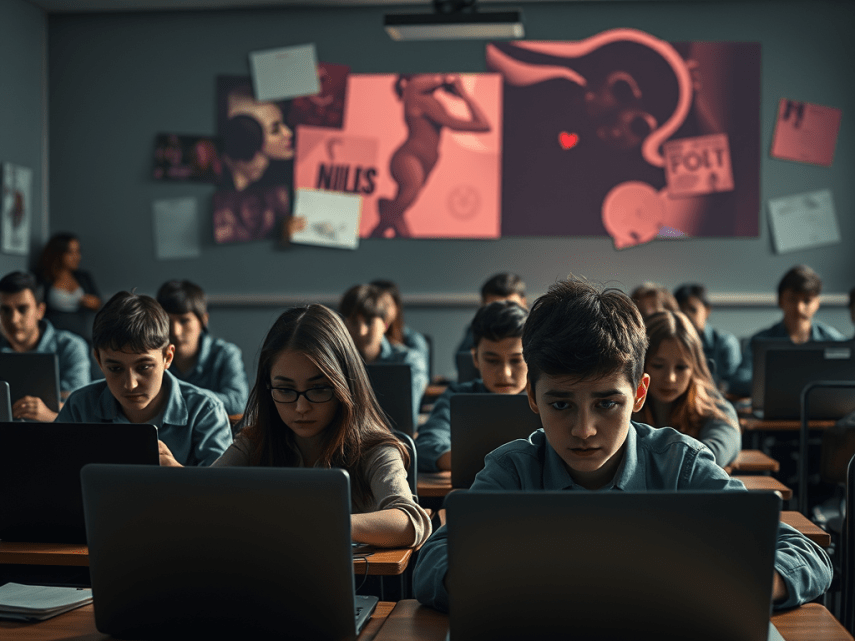
School-issued laptops have created a pornography crisis for America’s public school students
Norman public schools recently sent out a survey to parents to gauge their opinion of the district’s in-school smartphone policy, anticipating the passage of legislation that would severely restrict the use of phones by students during school hours. From “strongly disagree” to “strongly agree”, parents are asked whether phones should be put away all day, used only during passing periods, used only for emergencies, et cetera. I opted for the strictest policy options given, but even then, I don’t believe it’s enough.
“Phone” is an insidious euphemism for these pocket-sized, high-powered computers that can be used to access the most explicit content imaginable. For the first time in human history, the most degenerate content in existence is instantly within our children’s reach, and, being children, they search it out. We as a society have consciously turned a blind eye to this hideous tech revolution, telling ourselves that kids aren’t accessing this garbage, and only using their phones for their intended purpose. We’re lying to ourselves, and instead of confronting this crisis directly, we’re allowing it to unfold without a whimper of protest, with catastrophic consequences for our kids’ developing minds.
The phones, though, aren’t even the worst part of this grotesque tech intrusion.
School-issued laptops have become the primary gateway for adolescents to access pornography, explicit music, and other degenerate content, and nothing at all is being done about it. At NPS, all middle school and high school children are issued laptops to be used for classwork. The problem is that these laptops also access the internet, and despite assurances from the school district that internet “filters” are in place, kids are able to access explicit content, corrupting them and setting them up for debilitating digital addictions for the rest of their lives.
Students also take these laptops home with them, using them on internet connections without any filters in place at all. If all NPS laptops were audited to find out how students have been using them, what would we discover?
This question was researched in 2023, and researchers found that 41% of students accessed explicit material during the school day.
A quick Google search of in-school laptops being used to access explicit content turns up endless news stories that read like every parent’s nightmare.
A story from January details how parents learned that their 4th grader was able to access “hardcore porn” on his school-issued laptop.
In a post published at HoweverItHappened, a parent described finding pornography on their 9 year old son’s laptop. The parent locked down all devices, and discovered that their son had searched for this content while at school.
In 2020, parents were horrified to discover that their middle schoolers were accessing pornography on school laptops. Parents of an 11-year old boy were devastated at what they found in their son’s browsing history. From the article:
““We feel almost robbed of our son’s innocence,” said the boy’s mom, who asked to remain anonymous. “It’s been really hard, I’ll be honest, on me for the past week.” Another parent, who also asked to remain anonymous to protect his family’s privacy, said his 9-year-old third-grader had also accessed extremely graphic content, mostly through Twitter.”
In 2017, auditors found that students at a Mississippi public school were using their school laptops to access explicit content.
Another article explains how kids can bypass existing school filters to access degenerate material through the use of a wifi hotspot, VPNs, proxy websites, or smart DNSs.
Explicit content isn’t the only problem. Many parents are infuriated to discover that their kids have been mindlessly browsing the web while at school, resulting in plummeting grades. Memphis parents found that their daughter had been watching YouTube all day long while in class, and apparently the teachers were either unable or unwilling to put a stop to it.
While the Children’s Internet Protection Act requires schools to monitor student’s usage of district-provided devices, it is clear that no amount of “monitoring” will solve this issue.
The current conversation surrounding internet-connected devices in our schools is fundamentally flawed. The question shouldn’t be “when or where”, but whether students should have access to this technology at all while on campus. They clearly should not. School should be a sanctuary away from our tech-saturated society. Students need to learn to live without their devices for at least 8 hours a day. If many can’t, then we need to confront the fact that these devices have become highly-addictive drugs, and begin treating them as such.
The surest way to remove laptops from our schools is to force the district to perform an audit. We would be so horrified at what was discovered that I believe our kids would return to pencil-and-paper learning within a week. The only problem now is how to force the NPS to perform the audit.
Through unrestricted access to explicit content, these devices destroy our children’s innocence before they’ve even begun puberty. And these devices are everywhere. The fact that our schools are giving them to students means that schools themselves are facilitating the destruction of the innocence of America’s school children. This is a national crisis that has been ignored long enough.
The solution isn’t “more filters” or “enhance monitoring” of student’s devices. It is the total removal of this technology from our schools, root and branch. We’ve allowed a Big Tech takeover of our schools without a single objection, and the result is horrific: children developing a life-long addiction to these devices and the content that they find. This may be Big Tech’s real goal: the creation of life-time customers. We must face this reality now, for our the sake of our children’s mental and emotional wellbeing, and their future.
________________________________________
Addendum: ROPE Report dealt with this in our interview with Kansas parent, Denise Roberts.