First, why do you suppose it’s important to use the word “Workforce” to describe people who are – or will be employed? Answer: so that people become accustomed to being widgets – not individuals. Who is the Constitution made for? Individuals. Who votes in elections in our Democratic Republic? Individuals.
What about the phrase “community”? Answer: it’s a group of individuals. Groups are much more easily led and studies show this to be true. This is where we get the tongue-in-cheek term, “Sheeple”. So why move to this use of the word “community” to describe multiple groups of individuals? Because
What about the phrase “data-driven”? Answer: Data is science. Science has become the God of many today (COVID anyone?) Therefore, science knows better about people than people can know about people. There’s no argument about a child’s trajectory in life, then, if the “data” lines out that trajectory. No muss, no fuss, no messy, “but mom and dad, I’d like to be a firefighter when I grow up”. If the data says “aerospace engineer” (because the state is giving the industry millions in tax credits), then Johnny gets to be an aerospace engineer.
In 2008, Barack Obama became our 49th president. Let us never forget that under the one-word campaign slogan – CHANGE – Obama set about creating a socialist paradise in this country which dismantled nearly every LOCALIZED state institution – including education – almost thoroughly.
In the place of localized educational standards, Obama worked with the National Governor’s Association (of which Governor (King) Stitt just become Chair – please review his Igniting The Dream initiative below) and of which Mary Fallin was Chair during her term, 2013-14) and the Counsel of Chief State School Officers (all state superintendents) to create top down (national) educational standards to make sure every student in America was learning like every other student in America, which they called the Common Core State Standards. Unbelievably, (wink, wink) The CCSS have been found to be a failure in every state that adopted them (please internet search the term “Common Core failure” for more studies describing this boondoggle).
He also ramped up the State Longitudinal Database System. Working with the The National Center for Education Statistics, the Common Education Data Standards Initiative was created where thousands of data points were developed so that every school around the country could collect information on every student enrolled in public school in the United States to help them ‘learn’ better. (To find more information on Common Core and the SLDS, see our former blogspot.) This initiative has not failed, and in fact, has gained more steam the more tyrannical governments at every level realize how easy it is to control a populace on which they have millions of datapoints of information.
Besides an initiative to grade teachers (which has created part of the mess we now see in public education) – the Teacher Effectiveness system – the last of Obama’s four pillars was to create a TURNAROUND MODEL for ‘turning around failing schools, funded by School Improvement Grants. This roundly debunked initiative has been an absolute failure, yet it cost US taxpayers BILLIONS of dollars.
And so, this last week, Governor (King) Stitt, took full advantage of ELECTED Ryan Walters’ decision to quit his job instead of upholding his compact with his VOTERS to finish his term and made SWEEPING changes to Oklahoma’s upper education infrastructure – which he called Oklahoma’s “turnaround”. Hopefully, you’ll understand from the brief synopsis above, why I’m not in the least inspired by this turn of events.
Now, let’s review all that has happened since Ryan Walters quit:
Governor King-Stitt tells the public he’s going to ask the legislature to make the State Superintendent position appointed because there isn’t enough alignment between the Governor’s office and the state superintendent if the position is not appointed. (NO. JUST NO. This is at minimum a CHECK AND BALANCE. Number 2, I’ve had enough of Governor Stitt’s failed appointments and number 3, we are a Representative Government, not an oligarchy or a private business – things Governor King-Stitt forgets on a regular basis.)
Governor King-Stitt moves around his office staff – hiring what can only be called “swamp creatures” to help him finish out his term. This included trying to move long-time associate Donelle Harder into the Secretary of State position (don’t worry, after telling him to exit, I’m sure Stitt will find a cozy new deal for perennial government satellite Josh Cochroft) when she wasn’t eligible. How did no one in Stitt’s office seem to know the actual rules? If you’re King, or CEO, what do rules really matter?
Governor King Stitt appoints a new Secretary of Education, Daniel Hamlin, whose background includes University of Oklahoma professor, and who was educated both in Asia (MA Sejong University, Seoul, Asian Studies) and Canada where he received a Ph.D. from Ontario Institute for Studies in Education (OISE) Educational Leadership and Policy. So, advanced degrees from socialist countries. That’s comforting. Though he’s worked at OU the last 7 years, before that, he was at Oxford for 8 and University of Toronto for 4. Very Oklahoman! He is also Jeb Bush adjacent and seems to have an itch to control HOMESCHOOLING!
Governor King Stitt appoints his Obama-styled “turnaround team” at the Department of Education that includes (among others):
Megan Oftedal (Ph.D.) was the head of the Oklahoma Education Quality and Accountability office (OEQA). She was educated at Loyola University, UCLA, RAND Pardee Graduate School and Harvard – the last two universities where she received her Ph.D., and did post-grad work in data. She somehow got to Oklahoma, where she was employed by American Fidelity (the bank associated with the the complaint of election conspiracy in the Joy Hoffmeister campaign) and then on to a stint at META before coming back to Oklahoma to work at OEQA. The OEQA website tells us, “Dr. Megan Oftedal is a results-driven data leader with over a decade of experience in both the public and private sectors. She is excited to serve OEQA and transform it into a P20 data and analytics hub to inform policy and improve educational outcomes.” P20 is the State Longitudinal Database that collects data points on children from birth (day care) to 20 years old (workforce). Now that she’ll be ensconced at the Department of Education who knows what she can do?
Current Okemah Chamber of Commerce President Connie Reilly, will now take over for Oftedal as the head of OEQA. She was a decades-long educator in Okemah schools, who was appointed to the Board of Regents of the Regional University System of Oklahoma by Brad Henry in 2007 – a post she has kept through 2 successive Republican governors now. Why a retired teacher would want to suddenly become president of the local chamber flummoxes me. And yet she will now be in a position where she can work with the Chamber and Dr. Oftedal, to hook all the databases in the state together so we can follow all children from birth to grave. Yay.
Governor King-Stitt then replaced two of his friends he had earlier appointed to the Oklahoma State Board of Education, but who haven’t been showing up much lately – Zach Archer and Sarah Lepak (who was Assistant General Counsel at Gateway Mortgage Group, from Apr 2012 – Mar 2017) – with Brian Bobek and Wes Nofire. Stitt has already appointed Bobek to the state board, where he served from 2019 to 2023. Bobek left BP Oil after 23 years to come to work for Governor Stitt, where, so far, he’s been his Deputy Chief of Staff, Chief Operating Officer (of something, I guess Governor Stitt?) and his Director of Faith Based Initiatives (another made up job not found in the Oklahoma Job Catalog so we have no idea what taxpayers pay for his salary). Nofire – like all the others – has been appointed by Stitt to something before: he’s a Commissioner on the Board of the State Athletic Commission and he’s also the Native American Liaison to the Office of the Governor since 2024.
Interestingly – neither our new, nice, State Superintendent, nor King-Stitt, notified our friend – and former Oklahoma State School Board member Kendra Wesson, that she had been fired as the Chair of the Oklahoma State Textbook Committee. She only found out when I read it in a ‘news’ media article and shared the information with her. Just another way we know that King-Stitt’s agenda is NOT about We The People.
I think it’s worth noting that in SEVERAL articles I read, the local “news” media have managed to quote Oklahoma Edvocates (a group for leftist teachers, not for parents or students), President, Jami Jackson Cole on King-Stitt’s Obama-like Turnaround, which she appears to be all for.
So, in closing, let all that sink in. Governor King-Stitt has now put into place all the “yes” men he’s previously appointed/worked with in some capacity as stewards of our Oklahoma Education funds and students. It is clear to me that this “turnaround” is one in which parents will be left behind. It has to be that way for the Jeb Bush/Chamber of Commerce-focused agenda of driving students into jobs so the elites can save money on job training can play out in real time.
Gone will be the effort to remove predators from schools and smutty, developmentally-inappropriate books from the library. Incoming will be the giant cookie cutter of big government, stamping children into widgets through collection of reams of unnecessary and invasive data for the benefit of private businesses. Watch.
__________________________________________
Governor Stitt’s Reigniting The Dream initiative as Chair of the National Governor’s Association, 2025:
Unlocking Economic Opportunity: Advancing the American Dream through entrepreneurship, creating a good jobs economy and economic mobility
Empowering Every Learner: Reimagining education and creating real on-the-jobs experiences for youth
Energizing the Future: Powering America’s next chapter by powering our AI future
Throughout the year, Governor Stitt will lead a series of convenings bringing together governors, private-sector leaders, and changemakers to explore policy and practice to forge a more hopeful, prosperous future for every American.
NGA also announced leadership for NGA’s three Governor-led task forces. The task forces foster a collaborative environment for Governors to focus on NGA’s top federal priorities. The task force co-chairs are:
Education, Workforce and Community Investment: Wisconsin Governor Tony Evers, Wyoming Governor Mark Gordon
Economic Development and Revitalization: Kentucky Governor Andy Beshear, North Dakota Governor Kelly Armstrong
Public Health and Emergency Management: Missouri Governor Mike Kehoe, North Carolina Governor Josh Stein
But small is the gate and narrow the road that leads to life, and only a few find it.
Because we were recently deplatformed from YouTube for some unknown reason (and then reinstated in an hour after I complained), I began a SubStack for me and ROPE.
I will be using it to try and cross post from the blog for platforming reasons, but, since Charlie Kirk’s death, I’ve been writing more personal and less political pieces the last couple of days (since I’m down for a bit with a full knee reconstruction).
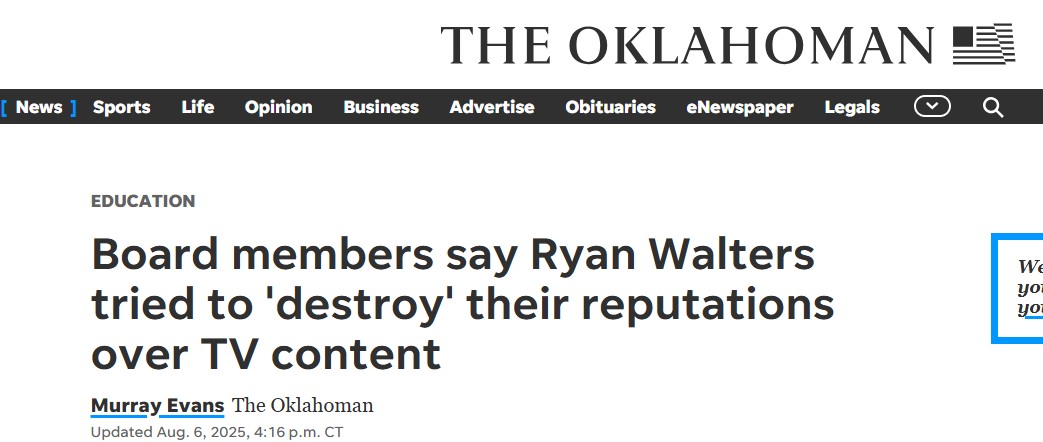
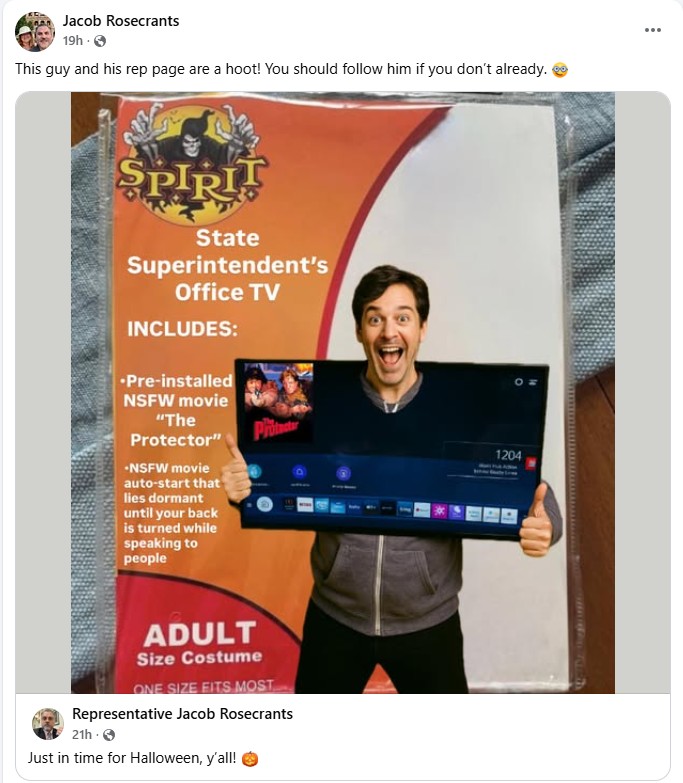
From the Daily Oklahoman (8.7.25), “What we saw on TV is content that would get the certificate of any teacher in this state revoked had it showed up on a classroom TV,” they said. “Now we have to ask the question: Why did Superintendent Walters lie about the TV being connected to the internet and what he saw on the TV that day? He repeatedly called the board members liars and attempted to destroy our reputation.”
This comment was apparently released by Governor Kevin Stitt-appointed, Oklahoma State of Education Board members, Becky Carson and Ryan Deatherage, though I couldn’t find an associated press release, just the comment in the DO article linked above. Not that it would matter. I find the statement so absolutely ridiculous, unserious and “pot calling the kettle black“, that it matters not where it was actually published.
Since “Nudigate” – as Katy Smith (V1SUT) and I named it in a live special last week – became primetime MSM fodder, it has gone from the ridiculous to the more ridiculous, from shrieking and pearl clutching to shrieking and character assassination.
While the MSM have focused on allegations meant to steer the public into considering that our State Superintendent of Public Instruction watches porn in his office leading to the conclusion that he should therefore be removed from his office – you know, the one to which OKLAHOMA VOTERS ELECTED HIM – the Oklahoma Independent Media have been busy trying to find other reasons for board member allegations that there were naked women on the TV in Walters’ office.
Tuesday, August 5th, the Speaker of the House of Representatives, Kyle Hilbert, came forward with a conclusion to his investigation – “When initially powered on, the television displayed Samsung TV Plus Channel 1204 (Movie Hub Action).” On Samsung Plus at the time was a Jackie Chan movie from the 1980’s that had significant frontal nudity in the American release.
So, amazingly, this explanation not only vindicates Superintendent Walters, but the OSBE members as well. This is an odd situation, but probably the only plausible one. Yes, the members saw naked women, but no, Walters had no hand in the debacle.
Now, let’s go on to this one question that remains – WHY ON EARTH WASN’T ANY OF THIS HANDLED BEHIND CLOSED DOORS? Why did Becky Carson IMMEDIATELY run to the media in hysterics? Why would Ryan Deatheridge join in the fun?
Obviously only those Board members would know, obviously, but we can certainly generate some thoughts and ideas based on recent history:
Governor Stitt fires three OSDE Board members over a political perspective – the Board members had listened to a presentation from the Oklahoma City Public Schools Superintendent who said that they were struggling because it was becoming extremely difficult to educate non-English speaking students. Though the state is required to collect data on illegal students, when the three members of the Board broached the idea of collecting data on these students, Governor Stitt fired them. (By the way, has anyone ever wondered why Zach Archer and Sarah LePak are never there during controversial happens with the Board? Who are these people to Kevin Stitt? It might be worth reading to find out.)
This action generates a rift in the formerly finish-each-other’s-sentences-bromance of Stitt and Walters. Now, suddenly, Stitt seems to actually have it out for Walters – a situation so noticeable, News9 did a complete timeline of the fallout.
Becky Carson is appointed with little fanfare – more on her here – yet, suddenly, she is all over the MSM 24/7.
Now. Let’s posit some more;
If you were a board member on good terms with your Chair, would you run screaming to the media bout something odd and concerning that happened before an Executive meeting being held in the office of the Chair, or would you go to the Board and to the Chair to discuss it and possibly have it investigated?
What does it buy a Board member to run screaming to the media about something odd and concerning that happened before an Executive meeting being held in the office of the Chair instead of discussing it and possibly having it investigated?
Yes, Walters did call the Board members liars. Hmmm…this is just me, but, if I was accused of doing something societally gross (even today we frown on public servants watching porn at work) that I didn’t do and I had a family with children who can be exposed to the media – which was spewing it all over every channel night and day – and a spouse I loved who I didn’t want embarrassed by an untrue allegation, YEAH I MIGHT GET A BIT HACKED OFF and even accuse people of lying when I know the allegations being made against me weren’t true. Especially if I’d been under fire from the Left from the beginning of my term.
What have the Left in Oklahoma done to Walters since HIS ELECTION BY THE PEOPLE? Hint: check out the screenshots below and anything by local hater of everything conservative, Sean Cummings.
So now, let’s recap: several members of the Oklahoma State Board of Education appointed by Governor Kevin Stitt – in the middle of a public feud with the State Super – see something on a television that was inappropriate and – instead of reporting the incident to the rest of the Board and/or others privately – go screaming to the MSM. The Board members ACCUSE the state Superintendent of watching porn in his office supported by tax payers. The Governor stays silent on the matter. The Super gets justifiably angry about the accusations and accuse the Board members of lying. NO ONE WINS, but the Left goes nuts with the entire story and uses it as justification for a rally to try and impeach a seated official who has been shown to have done nothing wrong, but was the victim of a bizarre electronic mistake.
Look, I’m not a Walters sycophant. I’ve been on his case – especially about vouchers for private schools – more than anyone who brands themselves Republican. If I thought – for one minute – that Walters was doing something he shouldn’t have been doing, do you think that wouldn’t have been a big blow up on this blog and on the podcast? It sure as shootin’ would’ve.
This is all political theater of the highest heights. It’s political nonsense that’s actually hurt a family for no reason other than politics and that hacks me off. I don’t care if you don’t like conservative politics, that dislike is not a reason to hurt someone else with impunity and then have the unmitigated GALL to turn around and say you’ve been hurt.
Becky Carson and Ryan Deatheridge are the absolute worst of the worst of appointed officials in Oklahoma right now and they should be released from the Oklahoma State School Board ASAP, with VanDenhende and Tinney not be far behind – if for no other reason than their OBVIOUS conflicts of interest not reported by any other media than ROPE Report and other Oklahoma IMs. I’m sick to my stomach about the political drama created by Governor Stitt through his appointments to this Board and the fact that absolutely NONE OF THIS HELPS OKLAHOMA KIDS in any way – which, by the way, Superintendent Walters and the previous board were actually doing by removing sexual predators from our public schools system.
So then, could this be what all of this is about in the first place? Could Governor Stitt and the rest of this Board object to removing sexual predators from our kids? Anyone with a brain has to wonder.
A large study has just been published on the effects of screentime in children and the results are extremely concerning.
Sixteen authors contributed to Electronic Screen Use and Children’s Socioemotional Problems, published by the American Psychological Association this month. The study model is very interesting. It collected research papers that had studied screen use in children in any way, pulled the results of 117 of those studies and then used something called Multivariate analysis to predict the outcome of screen use in children under 18.
The studied data included research from all over the world between 1972 and 2024. American-derived studies comprised the bulk of the study (41), with Canada (13), Australia (11), Germany (7) and the Netherlands (7) coming in behind. A total of 331,391 children were represented through the researched studies – 48.1% were boys and 48.5% were girls, with the mean age reported as 10.4 years.
This study is hugely significant for two reasons:
The number of children included in the study. The larger a study size, the much more likely statistical analyses are to produce accurate results. Small study sizes are harder to produce statistically significant results than larger ones. With over 300 hundred thousand children included through all the research analyzed, the statistical significance of any reported conclusions are very high.
The number of years of research collected is – again – very high. It may mean one thing that a report done in 1972 finds that screen time correlates with emotional troubles in children, but to find that same result in a study from 2024 is huge. As in the numbers of children represented in the study, the number of years represented in the study also creates a very high statistical significance that the results are accurately reported.
Therefore, the conclusions from this research are NOT to be ignored. They are, by all accounts, statistically significant thanks to the robust number of children studied over a long period of time.
Please click on the link for the paper’s title to look at the study for yourself. It was very interesting research – a really ingenious way of coming to a conclusion about screens and the behavior of children.
Now, here’s the bottom line.
CHILDREN – PARTICULARLY THOSE FROM AGES 6-10 – WHO USE SCREENS MORE THAN 30 MINUTES A DAY ARE PRONE TO SOCIOEMOTIONAL PROBLEMS such as attention deficit/hyperactivity disorder (ADHD) symptoms (48), followed by aggressive behavior (39), emotional problems (37), conduct problems (including oppositional defiant behavior; 30), mental health problems (20), peer relationship problems (19), antisocial behavior (17), and low self-esteem (11).
From the research:
These data suggest that small amounts of screen use are not problematic— there appear to be few differences between outcomes for children watching 10 and 30 min per day. For children exceeding the guidelines, there was a substantial association between their screen use and socioemotional problems. At these levels, more is worse, likely because screens increasingly displace other essential protective behaviors (Roberts et al., 1993; World Health Organization, 2019). As noted earlier, meta-analyses have shown that screen usage is associated with lower levels of physical activity (Kontostoli et al., 2021), poor sleep duration or quality (Carter et al., 2016; Hale & Guan, 2015; Zhang et al., 2022), and reduced in-person social interactions (Twenge et al., 2018). Small increases in screen use are unlikely to displace these behaviors, but once exceeding guidelines, an extra hour of screen use likely means less sleep, social time, or physical activity.
And this goes both ways. From the study:
…children on screens may be at greater risk of developing socioemotional problems, just as children with preexisting socioemotional problems may turn to screens in general as a way to cope with their emotional and social distress.
So, in closing, PLEASE, PLEASE, PLEASE, aggressively limit the amount of time your child/children spend on screens. Do NOT allow them to have ANY screens in their bedrooms during the nighttime hours at all – no TVs, no computers, no phones, no pads, no Gameboys, no Nintendos, no NOTHING with a screen.
If you even scan the research, you’ll find that allowing kids to have screens at nighttime contributes to lack of sleep, which in turn – despite what they’re seeing on those screens – causes an inability to control their emotions because they are tired.
I remember when our kids turned 18. Both the boys went out and bought TVs. Our youngest daughter was happy to have her phone 24/7 because she uses her phone for everything in the world, but the boys were ecstatic to have their own TV. Hysterically, only one of them ever really used it much even after an 18 year wait!
Our future resides in our children. Let’s give them – and us – the best future we can. Let’s be the adults in the room and protect our children’s mental health by severely limiting their screen use. Pronto.
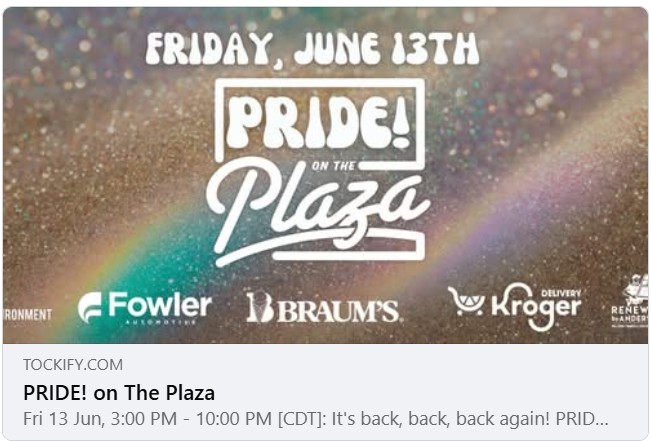
This morning I was reading a post on the wall of a friend. It was an open letter to Braum’s explaining that they would no longer shop with Braum’s because they are one of a group of sponsors for something called, “Pride on The Plaza”. “Pride On The Plaza” is the June event in a full yearly calendar cycle of something called, “Live On The Plaza” – monthly events held in the Plaza District of Oklahoma City.
Braum’s and the other sponsors in the screenshot, sponsor ALL the monthly events in the monthly Live On The Plaza, which includes the June Pride event.
Here’s the thing – I’m about liberty. “Do what you want”, is essentially my motto. BUT, there is one enormous caveat. You can’t harm others in any way during the commission of you “doing what you want”.
I personally don’t care if you want to dress in drag and perform – FOR ADULTS. I personally don’t care if you want to go see drag performances AS AN ADULT. The problem with any drag event held in a public space, however, is the propensity for children to see that event.
Children – as I’ve said multiple hundreds of times – are not adults. I don’t care if you’re an adult and think your child will love a drag performance because it’s harmless fun – they aren’t going to get it. What they WILL get, however, is that the women they’re watching don’t look like any human XX chromosome female they see on the street and that’s confusing for them.
What they WILL do is copy the behavior they’re seeing – because that’s what kids do. Because drag is solely about sex, this is a problem. Children are not ready to understand what is and isn’t healthy for them – or even what they do and don’t want on an emotional level. Because of that, the only proper way to raise a child for the benefit of that child, is to protect the innocence of that child until they’re old enough to determine for themselves what they want to be and do.
In fact, I will argue that the only way to protect a society from eating itself (which is what we’re seeing now on a very large scale) is to protect the innocence of the children in that society until they are able to make determinations for themselves.
We’ve literally, seemingly lost the desire to protect our kids from influences other than the neutral today, however and public drag shows are just a small part of the non-neutral environments we’re allowing them to be a part of. Screens – at school and at home – are the primary cause of the loss of innocence of children and parents and teachers and other adults are allowing children access to developmentally inappropriate material DAILY.
So, fine, send a communication to Braum’s and tell them you won’t support their products if they’re going to support the loss of innocence of children…
BUT, if you’re going to single out Braum’s and the other sponsors of the Plaza Live events, do this too, or you’re not really accomplishing much other than resourcing your family’s dairy needs:
1. Go to the Oklahoma City Council meetings and make it plain to them that you object to tax dollar support of ANY public event that could harm the innocence of children attending.
2. STOP FUNDING THE OKLAHOMA ARTS COUNCIL and write a letter to them telling them to stop booking public events that aren’t appropriate for children. Here is the link explaining how the Arts Council is the driving force behind the Plaza District in general.
3. Write the directors of the 16th Street Plaza District, Rachael CRAWFORD – Executive Director and Casey Longacre-marketing assistant and tell them the same thing that you’ve posted on social media about your lack of support for public drag shows and other public activities that support the loss of innocence of children.
4. Find a group of parents who want screens removed from classrooms and go to your school’s School Board meetings to protest until that Board removes screens from classrooms and begins to teach the “old fashioned” way in which students learn best and are least affected by developmentally inappropriate material.
5. Find a group of parents who will CONTINUALLY go to Board meetings and CONTINUE to complain about ANY developmentally inappropriate material in your child’s school (or better yet, take them out and homeschool them yourself – see Homeschool Oklahoma or our friends at Constitutional Home Educators Alliance for help with that).
6. TAKE SCREENS AWAY FROM YOUR CHILDREN! Simply don’t let YOUNG children use screens OF ANY KIND, and when they get old enough (early TEENS) to have some responsibility with a phone, dog the HECK out of the thing with parental controls and DO NOT ALLOW THEM TO USE THEM WHEN YOU ARE NOT AROUND TO MONITOR. Don’t let children have ANY screens in their rooms at night, period. Not a TV, not a computer, not a phone.
If you’re unwilling to do at least three of the things on the list above, please stop posting to social media about your outrage that there are drag queens in the Plaza District dancing for children. You’re right, it’s bad, but boycotting Braum’s solves very little if anything. If you really want to commit to protecting the innocence of children and our society, you’ll really do it, you won’t post on social media and consider your job completed. The innocence of our society’s children is of paramount importance. Posting to social media is easy, but putting the breaks on the wholesale destruction of the psyche of our children requires way more effort than that.
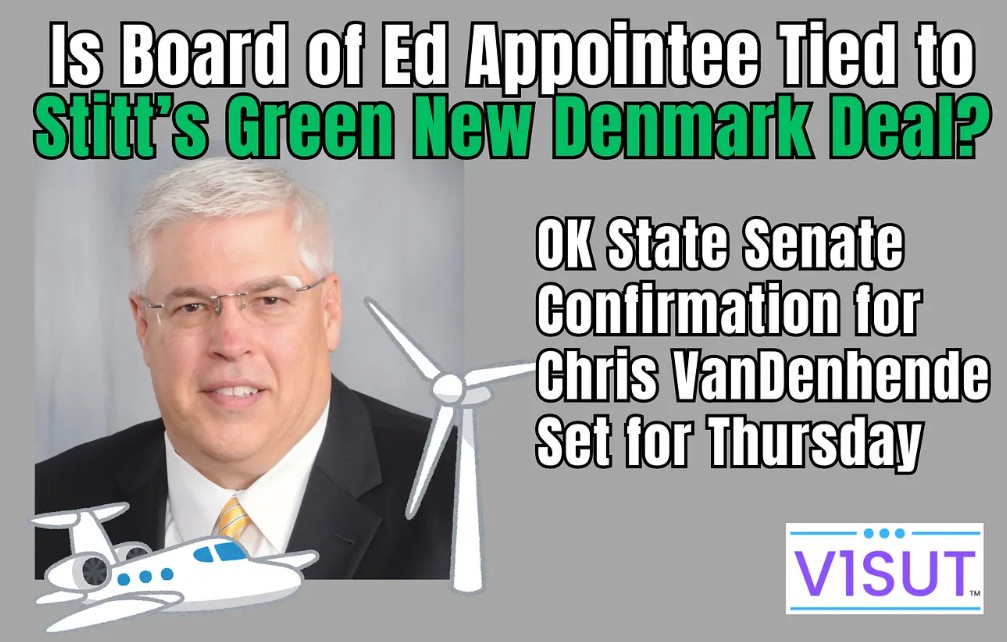
Today, Mary from V1SUT Vantage and Roberta Lewis from Moms 4 Liberty, joined me to talk about the recent Governor Stitt appointment to the Oklahoma State School Board – Chris VanDenhende.
Immediately after my friend Kendra Wesson and two other board members were unceremoniously removed from the Oklahoma State School Board by Governor Kevin Stitt due to “political drama” (which turned out to be instituting a process of enumerating the number of kids here illegally enrolled in public schools – something schools HAVE to do to satisfy federal regulations anyway), three new members were appointed.
Today, Mary also wrote a piece about VanDenhende – who has served as an appointee to the Board of Regents for the Regional University System of Oklahoma (RUSO) as well – proving again, my point about the revolving door among previous board/commission appointees, former legislators, lobbyists and government. Here, she puts businesses run by VanDenhende together with the MOU that Governor Stitt signed with Denmark earlier this year. Interestingly, Mary points out that VanDenhende makes just the kind of airplane fuel outlined in the MOU.
Roberta Lewis with Moms 4 Liberty showed us a TicTok video on The Woke Mob channel (formerly the Oklahoma chapter of the national Defense of Democracy organization apparently), where VanDenhende is arguing with Ryan Walters over what made a lie, or merely statements that weren’t “100% accurate”. It’s not the video that was so interesting, however, it was the comments section. Two women, identifying as the daughters of VanDenhende lauded their father’s actions and thanked other commenters for their appreciation.
No, children are not always chips off the old block, but this group is very leftist and quite ugly. Seeing this certainly gives a bit of pause.
The live video where we discuss all these matters – and a truly awful situation with a child at Shawnee high school – can be found on our YouTube and Rumble channels and embedded below. Please take a few minutes to pass this information on to your Senator so they may at least have exposure to this information and then ask if they would NOT confirm Chris VanDenhende to the State Board of Education.
The bill now creates a board of 10 members from 7. One will be the Secretary of Education who will be the chair plus, five members shall be appointed by the Governor by and with the advice and consent of the Senate, two members shall be appointed by the Speaker of the House of Representatives, and two members shall be appointed by the Pro Tempore of the Oklahoma State Senate.]. It also changes the way items may be added to the agenda. If three or more Board members wish to add an item to the agenda, they may – it does not have to be approved by the State Superintendent who is the chair of the board. (it was not heard 5.8)
This is a problem because if the governor has five appointments to the Board and the governor is interested in making changes to the Oklahoma State Department of Education, policy or procedure, he could conceivably ask Board members to take that issue to the full board by asking for an item to be added to the agenda. As we’ve seen, Governor Stitt – who has about a year left on his term – has made radical changes to the board in just this year alone because he didn’t like collecting data on illegal children (even though we already do that) so that conception isn’t really out of the question.
During committee hearings, Caldwell claimed the SDE under State Superintendent Ryan Walters’ (R) supports SB 224. We reached out to Supt Walters who denied any public support and asserted his agency’s neutrality concerning the bill.
“I have never publicly supported the bill. Not sure where that would be coming from,” said State Supt Ryan Walters of SB224. “SDE has always been neutral on the bill. We are required to provide data to legislators when they request it.”
OEQA’s claims of having “worked collaboratively with SDE, Regents, OESC, and CareerTech to advance the development of a Statewide Longitudinal Data System (SLDS)” are also exaggerated.
When asked if he had personally attended any meetings with any OEQA personnel concerning SB 224 or a centralized database over the last year, Walters replied, “No, I was not personally involved in that.”
Until today, the Superintendent of Public Instruction had not made a comment – publicly – about whether or not he supported the bill.
Now, put the two things together.
WHAT IS JEB BUSH’S INVOLVEMENT WITH OKLAHOMA AND SB224?
Let me be clear – I do not definitively know. What I’m about to report is pure speculation, but speculation that deserves real consideration.
We know that Jeb Bush has a long history of involvement with Oklahoma education policy. He was heavily involved in pushing Common Core here in our legislature. We know that Superintendent Barresi and others got a free trip to Bush’s – then Foundation for Educational Excellence, now ExcelInEd – during her tenure. We also know that he has come to Oklahoma – at least once – to push school “choice” in 2021.
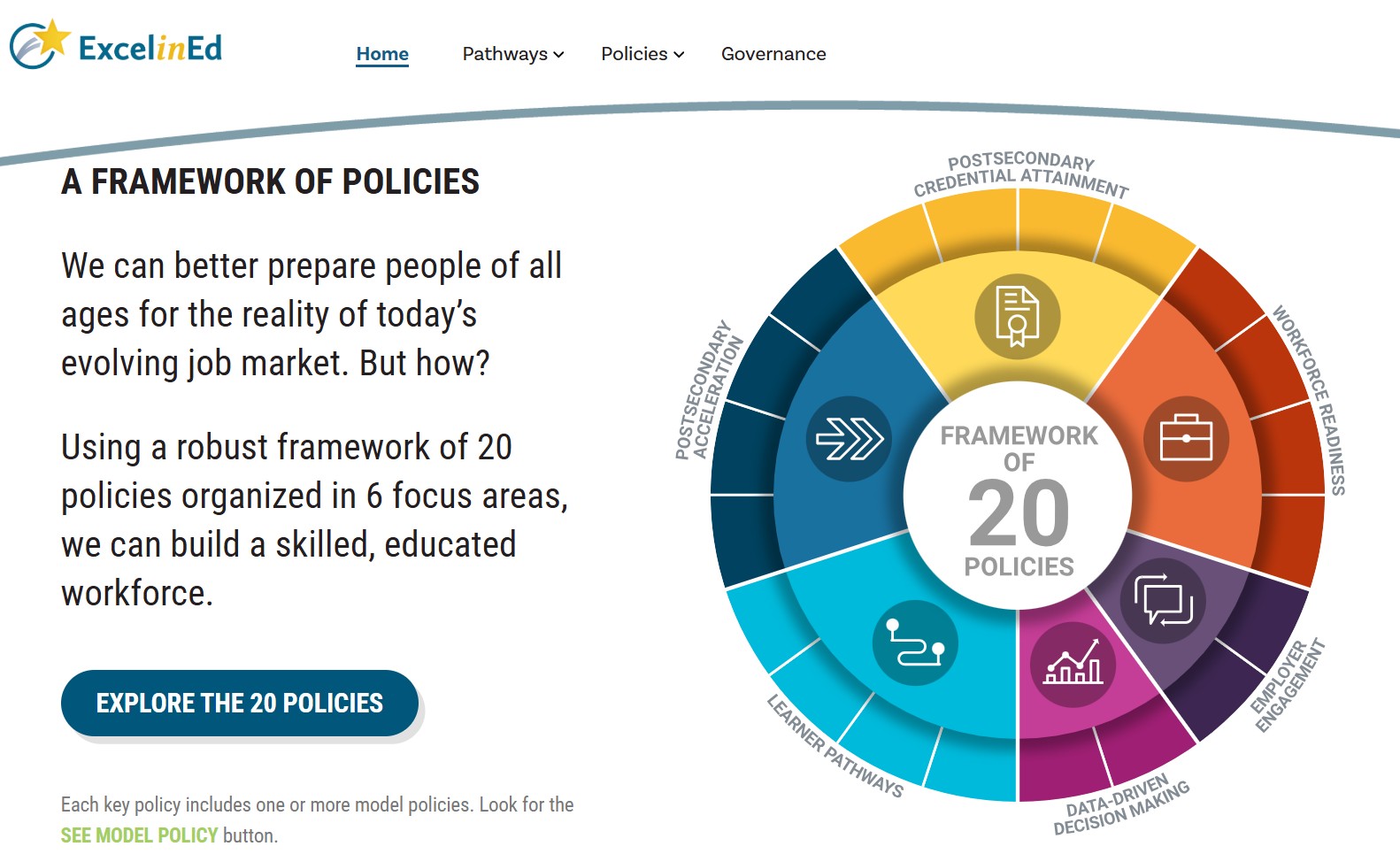
So, this initiative by the non-profit ExcelInEd organization run by Jeb Bush, has a MODEL POLICY that states can use to create an initiative in their state to allow kids to be tracked from birth through workforce to make sure they can get a job.
No, scratch that – make sure our businesses have the workers they’ll need to keep their business open, pay taxes and wine and dine legislators to create policy to help them do business. Listen below.
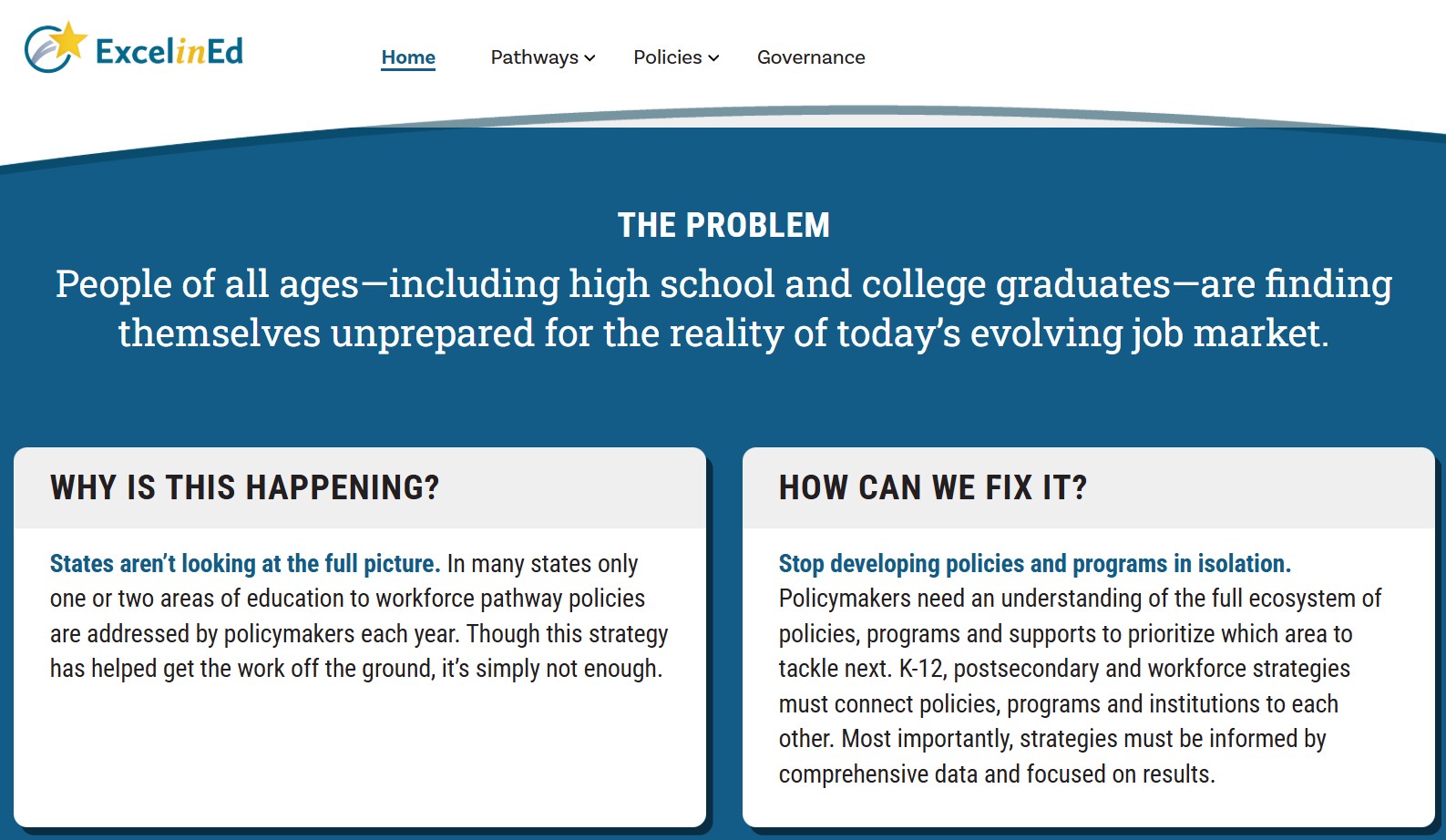
Notice “How Can We Fix It?”. Gosh. That sounds a whole lot like what bill SB224 is attempting to do, doesn’t it?
Here’s the Power Point program all about Oklahoma where – shockingly so much legislation stacks up to mesh with the intent of Bush’s initiative. Look specifically at the last three pages on data collection. So uncanny!
BOTTOM LINE
Do we know that Jeb Bush is influencing Oklahoma education? No. Do we have enough evidence to believe so? YES.
I fought hard to have Oklahoma repeal the Common Core State Standards from law. I never really thought anything had been accomplished afterward, because teachers/schools went right back to using them and there was nothing to make them stop. After reading the contents of a search I asked Grok to run for me, I’m having second thoughts.
Groks analysis indicated that the 2014 Common Core data repeal and NCLB waiver revocation “created policy turbulence, potentially disrupting COWIBs alignment with Oklahoma Works’ educational goals. Political resistance to federal mandates may have complicated WIOA implementation”.
So, call your Senator and Representative RIGHT NOW and tell them you
don’t want Oklahoma to be like every other state,
you don’t want your kids to be trained to fill a job, you want your kids to be educated so they can make up their own mind about what they want to be when they grow up
and Oklahoma doesn’t need an out-of-state globalist, policy-monkey ,wrenching up Oklahoma’s education policy.
We MUST defeat SB224 and keep the Oklahoma State Department of Education data from being hooked up with Workforce data (collected at the Department of Commerce) at the Oklahoma Educational Quality and Accountability board, helping to create the Planned Economy our overlords – like Bush! – want!
I’m not a huge fan of AI, but I’ve been a researcher since 1990 and this tool has helped me find data more quickly and completely than I ever have before.
Today, because I’m still trying find a way to explain that SB224 is NOT FOR Oklahoma’s kids, but to satisfy a broader need to plan the economy on a national level, I asked Grok “does the federal government require states to codify the need to connect education and workforce data”? I got a long, in-depth, very interesting answer. So, is this to help Oklahoma’s kids, or get more federal grants? I’ll let you be the judge.
Grok’s answer:
The federal government does not explicitly require states to codify into state law a specific mandate to connect education and workforce data as a condition for receiving federal grants. However, federal policies, grant programs, and regulations often incentivize or require states to establish systems for linking education and workforce data to meet reporting, accountability, or performance goals. These requirements can typically be met through administrative actions, interagency agreements, or data systems like Oklahoma’s Data Sharing Hub (DASH), without necessarily codifying the connection into state statutes. Below is a detailed analysis based on available information:
Federal Context for Education and Workforce Data Integration
Relevant Federal Laws and Programs:
Workforce Innovation and Opportunity Act (WIOA, 2014):
WIOA is the primary federal law governing workforce development programs. It requires states to develop integrated data systems to track participant outcomes across workforce, education, and training programs (e.g., Title I for adults, Title II for adult education, Title IV for vocational rehabilitation).
States must report performance metrics, such as employment rates, earnings, and credential attainment, which often require linking education and workforce data. For example, WIOA’s performance accountability provisions (29 U.S.C. § 3141) mandate data collection and reporting, which may involve connecting education records (e.g., high school or college completion) with employment outcomes.
While WIOA encourages states to establish data-sharing agreements or systems, it does not explicitly require codification into state law. States can comply through administrative frameworks, such as memoranda of understanding (MOUs) between agencies or platforms like DASH.
Every Student Succeeds Act (ESSA, 2015):
ESSA requires states to report on student outcomes, including college and career readiness indicators, which may involve linking education data to workforce outcomes (e.g., post-secondary enrollment or employment).
States receiving ESSA funds must submit state plans and comply with accountability requirements, but these do not mandate codifying data linkages. Instead, states often use existing data systems or establish new ones to meet federal reporting needs.
Perkins V (Carl D. Perkins Career and Technical Education Act, 2018):
Perkins V funds career and technical education (CTE) programs and emphasizes aligning education with workforce needs. It requires states to report on CTE student outcomes, such as employment or post-secondary success, which often necessitates data integration.
Like WIOA, Perkins V encourages data system interoperability but does not require states to pass laws mandating data connections. States can use administrative tools or data-sharing platforms to comply.
Higher Education Act (HEA):
The HEA governs federal student aid and includes reporting requirements for post-secondary institutions, such as graduation rates and employment outcomes. Some grant programs under HEA may encourage data linkages to track student success, but codification is not a requirement.
Federal Grant Conditions:
Federal grants, particularly those tied to WIOA, ESSA, or Perkins V, often include conditions related to data collection and reporting. For instance, WIOA grants require states to submit annual performance reports that integrate education and workforce data (e.g., 20 CFR § 677.155).
These conditions typically focus on outcomes rather than prescribing how states achieve them. States can meet requirements through data-sharing agreements, longitudinal data systems (SLDS), or platforms like DASH, without codifying policies into law.
Some competitive grants, such as the U.S. Department of Education’s State Longitudinal Data Systems (SLDS) Grant Program, explicitly fund the development of integrated data systems. While these grants require states to build capacity for data linkages, they do not mandate legislative codification. Instead, they emphasize technical and administrative solutions.
The Department of Labor’s Workforce Data Quality Initiative (WDQI) provides grants to enhance state data systems for tracking workforce and education outcomes. WDQI encourages states to link data across agencies but allows flexibility in implementation, typically through administrative means rather than statutory mandates.
Family Educational Rights and Privacy Act (FERPA):
FERPA (20 U.S.C. § 1232g) governs the privacy of education records and impacts how states link education and workforce data. States must ensure compliance with FERPA when sharing student data, which may require data-sharing agreements or secure systems like DASH.
While FERPA imposes strict requirements on data handling, it does not mandate codification of data-linking policies. States can address FERPA through administrative protocols or interagency agreements.
State Longitudinal Data Systems (SLDS):
The federal government has supported SLDS development since 2005 through the Institute of Education Sciences (IES). SLDS grants aim to create systems that link early childhood, K-12, post-secondary, and workforce data to inform policy and improve outcomes.
While SLDS grants require states to build and maintain these systems, the focus is on technical infrastructure and data governance, not on passing state laws. States can establish SLDS through executive action, agency collaboration, or platforms like DASH.
Oklahoma’s Context and DASH
Oklahoma’s Data Sharing Hub (DASH):
As noted in your previous question, DASH is Oklahoma’s platform for secure interagency data sharing, managed by the Office of Management and Enterprise Services (OMES). It supports data integration for various state functions, including those tied to federal grants.
DASH likely facilitates compliance with federal reporting requirements under WIOA, ESSA, or Perkins V by enabling secure data linkages between education agencies (e.g., Oklahoma State Department of Education) and workforce agencies (e.g., Oklahoma Employment Security Commission).
There is no evidence that DASH’s operation or Oklahoma’s participation in federal grants requires codifying a mandate to connect education and workforce data. Instead, DASH serves as an administrative tool to meet federal expectations for data integration and reporting.
Oklahoma’s Approach:
Oklahoma has pursued data integration through initiatives like the Statewide Longitudinal Data System (SLDS), supported by federal grants. These efforts focus on technical and administrative solutions, such as data governance frameworks and interagency MOUs, rather than legislative mandates.
State laws, such as those governing data privacy or agency operations, may indirectly support data sharing (e.g., compliance with FERPA or state data security standards), but there is no specific Oklahoma statute mandating education-workforce data linkages as a condition of federal funding.
Does Codification Ever Occur?
Federal Incentives, Not Mandates:
While the federal government does not require codification, it may incentivize states to formalize data-sharing frameworks to ensure sustainability or compliance. For example, SLDS or WDQI grants may encourage states to establish governance structures, which some states codify into law for clarity or permanence.
States like Tennessee and Kentucky have passed laws to formalize SLDS or data-sharing governance (e.g., Tennessee’s P-20 Council), but these are state-driven initiatives, not federal mandates. Oklahoma has not taken this approach, relying instead on administrative tools like DASH.
State Discretion:
States may choose to codify data-sharing policies to address privacy concerns, ensure long-term funding, or align with federal grant requirements. For instance, a state might pass a law to clarify agency roles in data sharing or to comply with FERPA. However, this is not a federal requirement but a state policy choice.
Limitations and Variability
Grant-Specific Requirements: Some federal grants may include conditions that indirectly require data linkages, such as reporting on employment outcomes for CTE students under Perkins V. These conditions focus on outcomes, not codification, but states may codify policies to streamline compliance.
Privacy and Security: Federal laws like FERPA and the Privacy Act (5 U.S.C. § 552a) impose strict requirements on data sharing, which may necessitate state-level policies or agreements. However, these can be administrative rather than legislative.
No Universal Mandate: There is no blanket federal requirement for states to codify education-workforce data linkages. The emphasis is on functional data systems and compliance with reporting requirements, which states can achieve through various means.
Conclusion
The federal government does not require states to codify into state law a mandate to connect education and workforce data to receive federal grants. Instead, laws like WIOA, ESSA, and Perkins V, along with grant programs like SLDS and WDQI, encourage or require states to integrate data for reporting and accountability purposes. States can meet these requirements through administrative actions, data-sharing agreements, or platforms like Oklahoma’s DASH, without passing new laws. While some states voluntarily codify data-sharing frameworks, this is not a federal mandate but a state choice. In Oklahoma, DASH likely supports compliance with federal data requirements, but there is no evidence of a codified mandate tied to federal funding. If you have a specific grant or program in mind, I can analyze its requirements further.
This is a post that will go with several other posts to come, but because we’ll be going live on Monday morning at 9am to talk about this specific issue (5.5.25), I wanted to be able to get this timeline I constructed out into the public view so the discussion was easier to follow.
The information below is just in a raw format, but it was information I collected via internet searches and using the AI research tool, GROK on X. I have saved all that information, so if you have questions, I can help answer those with the saved information.
Also, I’ve included URL linkages wherever I can so that you can see where the information came from and how to get their yourself.
The BOTTOM LINE?
Oklahoma is pushing federal Workforce policy as education and has been THROUGHOUT the years since the 1990’s assuredly. It doesn’t matter if you’re a Republican or a Democrat, this timeline makes it very easy to see how the Powers That Be, direct policy statewide (regardless of the 10th Amendment) through the carrot and string approach of federal grants to be used to create federal programming.
There is NOTHING good about tracking students across the years of their lives while saying that we’re doing it for them. WE’RE NOT! We’re doing it because the Powers That Be want a PLANNED ECONOMY which will enrich their toady friends and the useful idiots that carry their water, while making the poor poorer, decimating the middle class and turning our children into cogs to fit into the planned economy jobs machine.
SB224 was about using DASH – OMES new data sharing hub – to fit the State Longitudinal Database System holding educational data together with the Data Quality Workforce Initiative holding employment and workforce data – TOGETHER to create a seamless way of sharing data on kids from cradle to the grave. It sounds crazy, but I’ve put enough of the policy below for you to determine whether that assertion is crazy or not.
The worst part is that our STATE GOVERNOR is selling this as something good for kids. IT’S NOT! It’s good for business. Kids should be educated classically in as many subjects as we can stuff into their little heads and then they can use that information to INFORM THEIR OWN DECISIONS ABOUT WHAT THEY WANT TO DO. We don’t need the government MINIMALLY educating our students (What? Proficiency ratings are above 50% in reading and math? No.) so they know just enough to think that they’re deciding what they want to be when they grow up when the counselor at school gives them ‘suggestions’. We need WELL-EDUCATED kids.
If the repeal of Common Core from state law and the inability to secure an NCLB waiver caused the state an inability to secure a completed SLDS (to create widgets of Oklahoma kids that are only educated to fill the need for jobs), WHY WOULD WE WANT TO HOOK THESE TOGETHER NOW? Oklahomans didn’t like it in 2014, but they’re going to want that now? Not only that, but if we did that back then, what could we do NOW if we unite against this?
Help us STOP SB224. Share this. Share the video from Monday morning. Let your senators know they’ll be primaried if they vote for this nonsense. Educate others about what is going on in this state. We made a difference with Common Core – we can do it again!
1965 – President Lyndon Banes Johnson creates the first Elementary and Secondary Education Act (ESEA) to dovetail with his War On Poverty. It has been reauthorized every 5 years since.
1990 – President George H.W. Bush created Goals 2000 after he signed an international agreement entitled, “World Declaration on Education for All” 42 (EFA), the result of a summit sponsored by the United Nations, called “The World Conference on Education for All”
Included the call for the nation’s FIRST State Longitudinal Database to track student progress
1990 – Oklahoma legislature creates the Office of Accountability
Tasked with overseeing school performance through the Oklahoma Educational Indicators Program (OEIP) and the Oklahoma School Performance Review program (OSPR)
OEIP developed standards to gauge performance of schools
Required by Goals 2000 legislation
1994 – Bill Clinton’s ESEA called, “Improving America’s Schools Act of 1994. Also created School-To-Work Opportunities Act and the Goals 2000 Act in conjunction with the ESEA
School boards and elected legislators would be bypassed as applications would be made and federal funds received by state Governors and their appointees on workforce development boards.
A computer database (aka Labor Market information System) would be used into which school personnel would scan information about students and their family including medical and psychological data that could be shared from the school to others deemed important in the student’s education
1995 – Oklahoma Commission for Teacher Preparation (OCTP) created by legislature (HB1549)
Created teacher preparation system
The non-profit, Oklahoma Workforce Investment Board, Inc. (OWIB) was formed in1998 and established under the Workforce Investment Act of 1998 (WIA), which required states to establish state workforce investment boards to oversee workforce development programs.
2001 – George W. Bush – renames Clinton’s ESEA, “The No Child Left Behind Act”
Included Adequate Yearly Progress (AYP) required testing public school students in 3rd, 8th and twice in high school. State set benchmarks they then had to meet with 100% proficiency. Schools missing target two years in a row were put on a “needs improvement list”. If schools didn’t make AYP, funding could be removed.
Needed database to collect test scores at a minimum
1st slds undertaken in Florida as a pilot project
2002 the Statewide Longitudinal Data Systems (SLDS) Grant Program, authorized under the Educational Technical Assistance Act of 2002 and launched in 2005 by the U.S. Department of Education’s Institute of Education Sciences (IES). This program provided grants to states to design, develop, and implement longitudinal data systems, starting with the first round of funding in fiscal year 2005, which awarded $265 million to 41 states and the District of Columbia by 2009.
2006 – Created the Governor’s Council for Workforce and Economic Development (GCWED – codified by Senate Bill 1397 (2006) to comply with federal and state workforce development priorities – especially the WIA (1998)
The GCWED was created to support the GOVERNOR’s economic and workforce development vision (such as the initiative Oklahoma Works under Governor Mary Fallin in 2013)
2007 – National Chamber of Commerce “Leaders and Laggards” report gave Oklahoma an “F” in accountability, academic achievement and data quality
Oklahoma received an A for its teaching force
Oklahoma had no alignment between educational outcomes and workforce needs
2009 – Barrack Obama – did not reauthorize NCLB, but created a grant process called Race To The Top. States competed for funds from the American Recovery and Reinvestment Act (ARRA) funds for 4 reforms
Including “building data systems that measure student growth and success, and inform teachers and principals about how they can improve instruction”
RTT Early Learning Challenge began to collect testing data on infants, toddlers and preschoolers enrolled in preK programs
2009 – Governor Brad Henry, takes State Fiscal Stabilization Funds from the Obama Administration including to create STATEWIDE P–16 EDUCATION DATA SYSTEMS.— (A) ESTABLISHMENT OF SYSTEM.—Each State that receives a grant under subsection (c)(2) shall establish a statewide P–16 education longitudinal data system. https://www.congress.gov/110/plaws/publ69/PLAW-110publ69.pdf
2009 – Educational Accountability Reform Act created by SB111 (Republican legislators) and signed into law by Governor Brad Henry
Created in part due to Chamber of Commerce F grades in their “leaders and laggers” report
Transferred management of student data, determination of Adequate Yearly Progress (AYP from NCLB), cut scores for tests, and oversight for academic standards and testing to the Office Of Accountability created in 1990
Centralized data
2010 – Workforce Data Quality Initiative (WDQI) grant for 1 million dollars from the Department of Labor to “support the creation of data systems linking workforce and education data to evaluate training and employment outcomes
2012 – Oklahoma applied for an NCLB Waiver under Republican Chief For Change, State Superintendent Janet Barresi and Republican Governor Mary Fallin, Chair of the National Governor’s Association – we did NOT get a waiver
implementation of the A-F School Grading System (and Common Core, etc) and data collection
It will strengthen the OSDE’s ability to link students with teachers, programs, interventions and outcomes and allow the OSDE to link P-12 data with education data from other agencies.
2012 – Oklahoma Office of Educational Quality and Accountability (OEQA) created
Governor Mary Fallin signed SB1797 which consolidated the Office of Accountability and Oklahoma Commission for Teacher Preparation into the Oklahoma Office of Educational Quality And Accountability
Now under supervision of the State Secretary of Education
7-member Board created to govern the office (Commission For Educational Quality and Accountability
The OEQA uses the SLDS and National Assessment of Education Progress (NAEP) to create the school report cards
2013 – Governor Mary Fallin, announces through her position as the Chair for the National Governor’s Association, creates the America Works: Education and Training for Tomorrow’s Jobs, which spotlights improving education and workforce training systems and aligning those systems with the needs of individual state economies.
2014 – Federal Workforce Innovation and Opportunity Act (WIOA) – replaced Workforce Investment Act (WIA) of 1998
States required to strengthen their workforce systems by aligning them with economic development goals, emphasizing business-led strategies and improving data-driven decision making
2014 – Governor Mary Fallin creates Oklahoma Works
“Under the Workforce Innovation and Opportunity Act (WIOA), the Governor of each State must submit a Unified or Combined State Plan to the U.S. Secretary of Labor that outlines a four-year workforce development strategy for the State’s workforce development system.
This linked WDQI and SLDS to track education plus workforce outcomes
Provided the framework for a statewide coalition to connect education, training and job opportunities
Five goals – one of which was to “enhance data-driven decisions by using longitudinal data systems to track outcomes and evaluate program effectiveness
Oklahoma Works influenced education policy, including charter school expansion (moving Oklahoma’s charter law ranking from 37th to 10th nationally) and literacy improvements via the Reading Sufficiency
Grok
The initiative’s data-driven approach informed performance-based budgeting, shifting state funding to programs with proven outcomes Grok
The SLDS – which integrated K-12, postsecondary and workforce data gave Oklahoma Works the data to align education programs with employer needs – Grok
Changed the Central Oklahoma Workforce Board (COWB – 1998) to the Central Oklahoma Workforce Investment Board (COWIB) still a non-profit organization covering 9 counties in central Oklahoma
Board is composed of business leaders, county commissioners and representatives from education and community organizations
According to GROK the WDQI and SLDS grants are NOT CONNECTED which is a problem for implantation of its mission
GROK also says that the 2014 Common Core data repeal and NCLB waiver revocation “created policy turbulence, potentially disrupting COWIBs alignment with Oklahoma Works’ educational goals. Political resistance to federal mandates may have complicated WIOA implementation”.
2015 – State ‘reaffirmed’ Governors Council for Workforce and Economic Development in order to meet updated Workforce Innovation and Opportunity Act federal mandates in order to receive federal workforce grants.
2021 – National Chamber of Commerce calls on states to adopt the America Works Agenda to “address the nations worker shortage”
Introduce 4 ‘immediate action’ items
Help Americans acquire the skills they need to fill today’s open jobs
Improve education and job training opportunities for the jobs of tomorrow
Remove barriers to entering the workforce
Expand the workforce through immigration reform
Under number 2 we are told that every state needs Learning and Employer Records (LERs): In addition to providing a verified and authenticated record of employment history for every American worker, support the ability of education, training, and credentialing providers to produce a digital record of learning that is based on open and available data standards and used to empower learners and workers with information about their skills and qualifications.
2022 – Oklahoma’s WIOA State Plan for 22-23 is filed
Introduces ICAP: The Individual Career and Academic Plan (ICAP) was recently developed for the state’s PK- 12 system by the Oklahoma State Department of Education (OSDE) with input from students, families, educators and other partners. The ICAP equips students with the awareness, knowledge and skills to create their own individualized, meaningful exploration of college and career opportunities. In order to reflect students’ changing passions, aptitudes, interests and growth, the ICAP is a flexible, evolving document. The ICAP incorporates labor market data into occupational exploration materials to allow students to make informed decisions about education and training for future career goals.
2022 – Oklahoma Public Resource Center Commissions the Office Of Educational Quality and Accountability Transformation Proposal
Recommendation 2 was to Provide impactful P-20 (SLDS) information
Recommends that OEQA become a data hub for student data
Recommends using the Oklahoma Data Matrix visualization tool
Recommends the use of the Baldrige Excellence Framework for P-20 institutions across Oklahoma
Must have access to the data that follows a student throughout and beyond their formal participation in the education system
a data hub also helps address another core desired outcome of the stakeholder engagement process by not just knowing where kids are now, but where they are six years after high school or college graduation
2023 – Governor Stitt creates Executive Order 2023-21 to transfer the Oklahoma Office of Workforce Development under the Oklahoma Employment Securities Commission
The Oklahoma Employment Securities Commission is designated as the single point of funding and accountability for the WIOA federal Department of Labor workforce grants
2024 – Oklahoma’s WIOA required long range plan for 24-27 states the following on page 119
Improve Access to and Sharing of Data: Oklahoma recognizes the weaknesses it has faced in the past regarding access to and the possession of data critical for the success of the workforce system. We are committed to identifying and acting on opportunities to systematize the sharing of data among partners in the workforce system, to coordinate resources expended on data research and evaluations, and to expand tools available at both the state and local levels to include dashboards and other modern technologies. The main objective of these efforts is to strengthen the aligned efforts of the core, required, and additional workforce system partners for more effective outcomes.
2024 – Oklahoma’s WIOA State Plan for 24-25 is filed
Vision includes: Becoming more data-driven, using independent and objective data to drive workforce transformation.
Coordinating and “braiding” WIOA funds to drive the state’s workforce strategy
Goals include: Preparing an educated and skilled workforce and meeting employers’ skilled workforce needs go hand in hand. Oklahoma will achieve innovation and efficiency through alignment, collaboration, and education. All entities are working together to drive collective and meaningful outcomes.
2024 – Oklahoma Works, Governor’s Council for workforce and Economic Development votes to accept the plan: minutes of meeting January 19th, 2024
Discussion & Vote to approve policy informing/establishing publicly OESC’s Authority to administer the WIOA programs including policy and procedure. – this allows OESC as the agency to administer the program to DOL, standing in accordance with the Workforce Act, signed by Governor Stitt, on August 10, 2023. Chair Gray motion for a vote, Stan McCabe move the motion and David Reid seconding the motion, with all voting aye, no opposed. No further discussion.
2024 – Governor Stitt signs Executive Order 2024-24: creating a Task Force on Human Potential for Future Industries to go through 2027
Mandates coordination between Oklahoma Office of Workforce Development and Oklahoma State Department of Education, Oklahoma State Regents for Higher Education and Career Tech to align curricula with high-demand occupations.
Requires use of Oklahoma SLDS and DASH (data sharing hub at OMES) to integrate education, workforce, and economic data
Supported by MOU – Data Sharing Agreement (DSA) among 9 agencies which, according to GROK are NOT LISTED IN AVAILABLE RESOURCES
Possibly OSDE, OESC, OK dept of commerce, OSDH, Oklahoma office of workforce development
Cannot find the exact members of the task force – only the criteria are found in the EO
Not able to find any meeting agendas or minutes
2024 – October meeting of Oklahoma Works, Governor’s Council for Workforce and Economic Development speaker, Chad Warmington from the Oklahoma State Chamber
Warmington also addressed House Bill 621, which led to the creation of a new workforce commission, with its priority being the recruitment of a CEO to lead these initiatives. A secondary priority is enhancing workforce data. Warmington stressed the importance of building a strong workforce infrastructure, particularly in preparing K-12 students to be career-ready by the time they graduate. He shared Superintendent of Oklahoma City Public Schools’ vision that students should be ready to “Employ, Enroll, or Enlist” upon graduation, and he talked about the need for schools to align their programs with the state’s workforce requirements.
Our focus has been to establish OEQA as a central hub for data, analytics, and actionable information—fostering a culture of data driven decision-making that supports systemic improvements, transparency, and accountability.
With the launch of Power BI dashboards and progress toward integrating data across K-12, higher education, and workforce sectors in a Statewide Longitudinal Data System (SLDS)
2024 – December – OMES creates DASH – Data Sharing Hub in conjunction with Google (for analytical tools) and Cloudflare (for security)
According to GROK, DASH supports secure data sharing for Oklahoma Works and OLDS, but specific developer names are undisclosed
Rolled out to 6 unnamed agencies with plans for more agency use
According to GROK, DASH was needed to share data to align education and workforce programs according to Governor Stitt’s EO 2024-24 and Oklahoma Works
2025 – Oklahoma State Chamber of Commerce 2025 Legislative Priorities states:
Support improving K-12 Graduation Requirements to include Career Ready, Advanced Placement, and concurrent academic credit options.
Advocate for partnerships and the integration of workforce system partners, resources, and strategies supported by state funding, that utilize data driven strategies for skill alignment and credential attainment, ensuring alignment with economic development goals and employer needs.
Oklahoma has a data sharing agreement (DSA) among NINE state agencies which are unnamed according to GROK.
Oklahoma also has specific Memoranda Of Understanding (MOU) with
Oklahoma State Department of Education
Oklahoma Employment Security Commission
Oklahoma Department of Commerce and Local Workforce Boards including The Governor’s Council For Workforce and Economic Development
Oklahoma State Regents for Higher Education
Oklahoma State Department of Health
Oklahoma Department of Labor
The State Data Platform and DASH
DATA PROTECTIONS – listed
Government Transparency Act of 2019
Oklahoma Computer Data Privacy Act
Oklahoma Student Data Accessibility, Transparency and Accountability Act
MOUs are to align with HIPAA, FERPA and Workforce Innovation and Opportunity Act (WIOA)
DATA CONCERNS
GROK was asked “do the Government Transparency Act of 2019, Oklahoma Computer Data Privacy Act, Oklahoma Student Data Accessibility, Transparency and Accountability Act, FERPA, and HIPPA protect individual data in Oklahoma.
The following is copied from the result
Critical Examination
Strengths:
Robust Framework: The five laws collectively cover diverse data types (student, health, consumer, government), ensuring comprehensive protection in OLDS and DASH, as seen in COWIB’s secure data use.
Interagency Coordination: DSA and DASH, supported by the Government Transparency Act, streamline secure data sharing, aligning with Executive Order 2024-22’s focus on personalized learning.
Compliance Mechanisms: Audits (Student Data Act), penalties (Computer Data Privacy Act), and public disclosures (Government Transparency Act) enhance accountability, reducing misuse risks.
Weaknesses:
Re-Identification Risks: FERPA and HIPAA exemptions allow de-identified data sharing, but indirect identifiers (e.g., ZIP code, race) could enable re-identification, especially in small Oklahoma communities.
Enforcement Gaps: FERPA’s rare use of funding penalties and HIPAA’s federal oversight may limit state-level accountability, while the Computer Data Privacy Act lacks a private right of action.
Transparency Limitations: Sensitive MOUs or audit details may remain non-public to avoid security risks, as allowed by the Student Data Act, reducing full transparency.
Narrative Scrutiny:
Oklahoma’s narrative of robust data protection is largely accurate, given the layered legal framework, but overstated due to re-identification risks and enforcement weaknesses. The 60% attainment goal’s stagnation (~30%) suggests data protection alone cannot address systemic educational barriers.
The business-led focus of Oklahoma Works and GCWED may prioritize employer data needs, potentially straining privacy protections, though FERPA and HIPAA compliance mitigates this.
Political controversies, such as Stitt’s Executive Order 2023-31 (anti-DEI) or the 2024 OMES audit citing mismanagement, may erode public trust in data systems, despite legal safeguards.
Sources and Further Inquiry
Primary Sources:
Oklahoma Statutes, Title 74, § 3122 (Government Transparency Act), Title 70, § 3-168 (Student Data Act), via www.oscn.net.
U.S. Department of Health and Human Services HIPAA guidance (www.hhs.gov/hipaa).
Secondary Sources:
Oklahoma Office of Management and Enterprise Services (dash.ok.gov) for DASH and DSA details.
Central Oklahoma Workforce Innovation Board (cowib.org) for workforce metrics.
CaseGuard on Oklahoma’s Student Data Act (caseguard.com, April 6, 2022).
McAfee & Taft on HB 1030 (mcafeetaft.com, March 9, 2023).
Contact for Verification:
OMES Data Services: 405-521-2141 or data.services@omes.ok.gov (mailto:data.services@omes.ok.gov) for DASH and DSA.
OEQA: 405-522-5399 for OLDS and student data policies.
OSDH: 405-426-8000 for HIPAA MOUs.
Oklahoma Attorney General: 405-521-3921 for HB 1030 enforcement.
Accessing Details: Request MOUs or audit reports via the Oklahoma Open Records Act (51 O.S. § 24A.1 et seq.) through OMES or OSDH. Visit oklahoma.gov for transparency policies.
An Analysis of Recent Education Reforms and The Resulting Impact On Student Privacy
“Our system isn’t tapping into the potential of every student. That’s what we’re setting out to change,” Oklahoma State Secretary of Education, Nellie Sanders said. “Artificial intelligence, virtual reality and other emerging technologies can offer Oklahoma students a learning advantage. We’re going to explore ways to personalize curricula to interest, expand apprenticeship programs and define universal soft skills so our students are ready to lead us into the future.”