“You can’t drink data”. The quote from Tulsa Rep. Amanda Clinton encapsulates what many, probably most, Oklahomans feel as they struggle to comprehend the full-scale invasion of data center growth currently underway in their state. “Invasion” is an accurate term to describe what is happening, as large corporations descend on Oklahoma to exploit our relatively cheap electricity, water, and gullible city councils who are cajoled into entering into murky agreements with faceless megacorps, and in the process selling out their community and surrounding population for…what, exactly? The data center invasion is something that nobody asked for, much less the thousands of residents who feel they are being completely ignored by their elected leaders when they rubber stamp these water-and-electricity devouring atrocities. What benefit do they gain that will offset the inevitable rise in their monthly bills and blight the land near their homes? We can smell a scam coming a mile away, and we can’t help but feel powerless when we’re muscled out of the deal-making entirely. We understand that we will be the ones footing the bill for these facilities, and more than likely the last in line to reap any benefits.
Gov. Kevin Stitt is fully onboard with the data center incursion, touting “economic growth” as he always does when opening another door for large corporations to exploit our state’s low-cost resources. In his 2025 State of the State address, Stitt stated that he wanted “Oklahoma to be the high-tech capital of the world”. I think we should take his word for it. That may sound great to him, but to the rest of us it rings ominous.
Each day, a typical hyperscale, AI data center will consume roughly as much electricity as 100,000 homes, and around 5 million gallons of water. The larger data centers are expected to use 20 times as much electricity. According to one study, data centers in Texas consumed 49 billion gallons of water in 2025, and are expected to use as much as 399 billion gallons each year by 2030. In 2024, US data centers accounted for 4% of all the energy usage in the entire nation, or 183 TWh (terawatt hours). By 2030, that number is expected to jump to 426 TWh. Is this dramatic rate of increase in energy consumption really sustainable, and what does it mean for residents?
Construction of large data centers have proceeded at a break-neck pace in our state, and few residents have had the time to even understand what is happening to their communities. The lack of knowledge has been an advantage to the metastasizing industry so far, because when Oklahomans do realize what’s happening, they almost universally oppose it. What’s in it for them? How does “data” improve their lives in the slightest? The sheer cost of electricity, water, and land that these data centers consume is staggering, and many wonder how our electric grid and water reservoirs could ever supply the needed resources without averting a total disaster.
According to www.datacentermap.com, 37 data centers currently operate in Oklahoma. Many of these are small facilities that our grid can handle. But the new data centers are “hyperscale”, dedicated to processing unheard-of amounts of information for AI purposes, and will use millions of gallons of water, and more electricity per day than most Oklahoma cities.
Four hyperscale data centers currently in the planning phase or already under construction are located in Claremore, Coweta, another on the outskirts of Owasso, and another just outside of Sand Springs. Dubbed ‘Project Mustang’, Project Atlas’, ‘Project Clydesdale’, and ‘Project Spring’, all four complexes will be located within 20 miles of each other, and are projected to use vast amounts of water and electricity each day.
Project Mustang is planned 300-acre data center, estimated to use 1.5 million gallons of water per day. Project Atlas, a $1 billion, 200-acre data center, will use an estimated 400 MW of electricity per day. Project Anthem will be located on 304 acres and is projected to use 2 million gallons of water per day. Project Clydesdale will span roughly 500 acres, and use an estimated 7 million gallons per day. The developer, Beale Infrastructure, has not publicly disclosed estimated electricity demand for the complex.
Google’s Project Spring is set to be a massive, 827-acre hyperscale data center located just outside of Sand Springs. Despite overwhelming public opposition, the Sand Springs city council approved rezoning for facility in a 6-1 vote. Beau Wilson, to his credit, was the lone dissenting vote. Local grassroots group Sand Springs Alliance filed a lawsuit, alleging violations of annexation policies. Residents voiced they concerns about a doubling of their utility bills, concerns that fell on deaf ears.
One point of great contention is the fact that many city councils and counties sign non-disclosure agreements with data center developers long before the public learns anything at all, and before the backroom deals begin to take shape. Details of a deal for a planned data center in Stillwater was kept under wraps for months before the public was made aware that the new facility would be a Google-owned data center. Almost every planned data center has been wrapped in vague wording, almost up to the moment that the deal is inked.
The real questions that are never answered clearly is: is this sustainable? Do we have enough water and electricity long-term to allow these enormous facilities to operate in our state without devastating consequences for Oklahoma residents? What the residents who understand the issue want to know is simply this: what are our leaders getting us into?
The biggest AI companies in the world are bypassing our Legislature entirely, going straight to small city councils with their slick presentations about how their gargantuan facility will somehow benefit their community. Councilmembers see dollar signs, and not much else, apparently. Is it really appropriate for city councils to hold such consequential decision-making power over these ventures when the outcome could very well lead to a doubling or tripling of utility bills, or at worse, ecological disaster? And when those councils appear to completely disregard the voices of their residents, it is appropriate to ask whether they should be stripped of this power entirely.
Thankfully, several Oklahoma legislators have taken notice of this ominous development, and have offered legislation to pump the brakes on the data center invasion. Tulsa Rep. Amanda Clinton has filed a host of bills aimed at creating transparency. HB 3392 would require the Oklahoma Corporation Commission to conduct studies of the long-term impact of these large load data centers on the communities they operate in. The bill recently passed out of Committee to a unanimous vote. HB 3394 would require the Commission to keep a detailed database of all data centers in the state. HB 3397 would “quantify the electricity needs of large-load electric users, such as data centers and other industrial operations, measure their impacts and find ways to ensure these large-load users pay their fair share”, according to Clinton.
State Senator Ken Sacchieri filed SB 1488, which would impose a moratorium on data center construction until November 1st, 2029.
Rep. Brad Boles filed HB 2992, the Data Center Consumer Ratepayer Protection Act of 2026, requiring data centers to pay for their own infrastructure costs, rather than offloading it on current residents through rate hikes.
Rep. Mickey Dollins filed HB 3917, which would force large load electricity consumers to pay a surcharge during peak electricity demands. The bill passed unanimously out of the House Appropriations and Budget Natural Resources Subcommittee and now heads to the House Appropriations and Budget Committee before being slated for a vote.
The big lie surrounding this issue is that data centers are inevitable, and we should just accept it, and let them be built. But we know that this isn’t inevitable, and we do have the power to direct the destiny of our communities if we organize and oppose them. A planned data center in New Brunswick, New Jersey, was just defeated after intense pushback from local residents. Another data center project in Monterey Park, California, was scrapped after a sustained and organized opposition campaign was waged by local residents. Data Center Watch reports that $64 billion of data center projects have been successfully opposed across the nation.
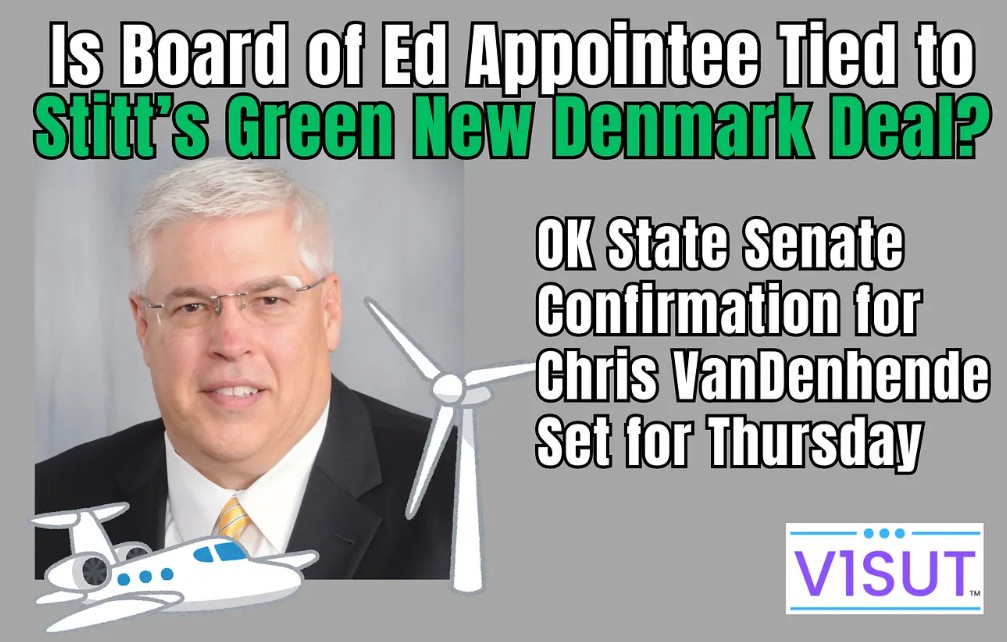
Today, Mary from V1SUT Vantage and Roberta Lewis from Moms 4 Liberty, joined me to talk about the recent Governor Stitt appointment to the Oklahoma State School Board – Chris VanDenhende.
Immediately after my friend Kendra Wesson and two other board members were unceremoniously removed from the Oklahoma State School Board by Governor Kevin Stitt due to “political drama” (which turned out to be instituting a process of enumerating the number of kids here illegally enrolled in public schools – something schools HAVE to do to satisfy federal regulations anyway), three new members were appointed.
Today, Mary also wrote a piece about VanDenhende – who has served as an appointee to the Board of Regents for the Regional University System of Oklahoma (RUSO) as well – proving again, my point about the revolving door among previous board/commission appointees, former legislators, lobbyists and government. Here, she puts businesses run by VanDenhende together with the MOU that Governor Stitt signed with Denmark earlier this year. Interestingly, Mary points out that VanDenhende makes just the kind of airplane fuel outlined in the MOU.
Roberta Lewis with Moms 4 Liberty showed us a TicTok video on The Woke Mob channel (formerly the Oklahoma chapter of the national Defense of Democracy organization apparently), where VanDenhende is arguing with Ryan Walters over what made a lie, or merely statements that weren’t “100% accurate”. It’s not the video that was so interesting, however, it was the comments section. Two women, identifying as the daughters of VanDenhende lauded their father’s actions and thanked other commenters for their appreciation.
No, children are not always chips off the old block, but this group is very leftist and quite ugly. Seeing this certainly gives a bit of pause.
The live video where we discuss all these matters – and a truly awful situation with a child at Shawnee high school – can be found on our YouTube and Rumble channels and embedded below. Please take a few minutes to pass this information on to your Senator so they may at least have exposure to this information and then ask if they would NOT confirm Chris VanDenhende to the State Board of Education.
This is a post that will go with several other posts to come, but because we’ll be going live on Monday morning at 9am to talk about this specific issue (5.5.25), I wanted to be able to get this timeline I constructed out into the public view so the discussion was easier to follow.
The information below is just in a raw format, but it was information I collected via internet searches and using the AI research tool, GROK on X. I have saved all that information, so if you have questions, I can help answer those with the saved information.
Also, I’ve included URL linkages wherever I can so that you can see where the information came from and how to get their yourself.
The BOTTOM LINE?
Oklahoma is pushing federal Workforce policy as education and has been THROUGHOUT the years since the 1990’s assuredly. It doesn’t matter if you’re a Republican or a Democrat, this timeline makes it very easy to see how the Powers That Be, direct policy statewide (regardless of the 10th Amendment) through the carrot and string approach of federal grants to be used to create federal programming.
There is NOTHING good about tracking students across the years of their lives while saying that we’re doing it for them. WE’RE NOT! We’re doing it because the Powers That Be want a PLANNED ECONOMY which will enrich their toady friends and the useful idiots that carry their water, while making the poor poorer, decimating the middle class and turning our children into cogs to fit into the planned economy jobs machine.
SB224 was about using DASH – OMES new data sharing hub – to fit the State Longitudinal Database System holding educational data together with the Data Quality Workforce Initiative holding employment and workforce data – TOGETHER to create a seamless way of sharing data on kids from cradle to the grave. It sounds crazy, but I’ve put enough of the policy below for you to determine whether that assertion is crazy or not.
The worst part is that our STATE GOVERNOR is selling this as something good for kids. IT’S NOT! It’s good for business. Kids should be educated classically in as many subjects as we can stuff into their little heads and then they can use that information to INFORM THEIR OWN DECISIONS ABOUT WHAT THEY WANT TO DO. We don’t need the government MINIMALLY educating our students (What? Proficiency ratings are above 50% in reading and math? No.) so they know just enough to think that they’re deciding what they want to be when they grow up when the counselor at school gives them ‘suggestions’. We need WELL-EDUCATED kids.
If the repeal of Common Core from state law and the inability to secure an NCLB waiver caused the state an inability to secure a completed SLDS (to create widgets of Oklahoma kids that are only educated to fill the need for jobs), WHY WOULD WE WANT TO HOOK THESE TOGETHER NOW? Oklahomans didn’t like it in 2014, but they’re going to want that now? Not only that, but if we did that back then, what could we do NOW if we unite against this?
Help us STOP SB224. Share this. Share the video from Monday morning. Let your senators know they’ll be primaried if they vote for this nonsense. Educate others about what is going on in this state. We made a difference with Common Core – we can do it again!
1965 – President Lyndon Banes Johnson creates the first Elementary and Secondary Education Act (ESEA) to dovetail with his War On Poverty. It has been reauthorized every 5 years since.
1990 – President George H.W. Bush created Goals 2000 after he signed an international agreement entitled, “World Declaration on Education for All” 42 (EFA), the result of a summit sponsored by the United Nations, called “The World Conference on Education for All”
Included the call for the nation’s FIRST State Longitudinal Database to track student progress
1990 – Oklahoma legislature creates the Office of Accountability
Tasked with overseeing school performance through the Oklahoma Educational Indicators Program (OEIP) and the Oklahoma School Performance Review program (OSPR)
OEIP developed standards to gauge performance of schools
Required by Goals 2000 legislation
1994 – Bill Clinton’s ESEA called, “Improving America’s Schools Act of 1994. Also created School-To-Work Opportunities Act and the Goals 2000 Act in conjunction with the ESEA
School boards and elected legislators would be bypassed as applications would be made and federal funds received by state Governors and their appointees on workforce development boards.
A computer database (aka Labor Market information System) would be used into which school personnel would scan information about students and their family including medical and psychological data that could be shared from the school to others deemed important in the student’s education
1995 – Oklahoma Commission for Teacher Preparation (OCTP) created by legislature (HB1549)
Created teacher preparation system
The non-profit, Oklahoma Workforce Investment Board, Inc. (OWIB) was formed in1998 and established under the Workforce Investment Act of 1998 (WIA), which required states to establish state workforce investment boards to oversee workforce development programs.
2001 – George W. Bush – renames Clinton’s ESEA, “The No Child Left Behind Act”
Included Adequate Yearly Progress (AYP) required testing public school students in 3rd, 8th and twice in high school. State set benchmarks they then had to meet with 100% proficiency. Schools missing target two years in a row were put on a “needs improvement list”. If schools didn’t make AYP, funding could be removed.
Needed database to collect test scores at a minimum
1st slds undertaken in Florida as a pilot project
2002 the Statewide Longitudinal Data Systems (SLDS) Grant Program, authorized under the Educational Technical Assistance Act of 2002 and launched in 2005 by the U.S. Department of Education’s Institute of Education Sciences (IES). This program provided grants to states to design, develop, and implement longitudinal data systems, starting with the first round of funding in fiscal year 2005, which awarded $265 million to 41 states and the District of Columbia by 2009.
2006 – Created the Governor’s Council for Workforce and Economic Development (GCWED – codified by Senate Bill 1397 (2006) to comply with federal and state workforce development priorities – especially the WIA (1998)
The GCWED was created to support the GOVERNOR’s economic and workforce development vision (such as the initiative Oklahoma Works under Governor Mary Fallin in 2013)
2007 – National Chamber of Commerce “Leaders and Laggards” report gave Oklahoma an “F” in accountability, academic achievement and data quality
Oklahoma received an A for its teaching force
Oklahoma had no alignment between educational outcomes and workforce needs
2009 – Barrack Obama – did not reauthorize NCLB, but created a grant process called Race To The Top. States competed for funds from the American Recovery and Reinvestment Act (ARRA) funds for 4 reforms
Including “building data systems that measure student growth and success, and inform teachers and principals about how they can improve instruction”
RTT Early Learning Challenge began to collect testing data on infants, toddlers and preschoolers enrolled in preK programs
2009 – Governor Brad Henry, takes State Fiscal Stabilization Funds from the Obama Administration including to create STATEWIDE P–16 EDUCATION DATA SYSTEMS.— (A) ESTABLISHMENT OF SYSTEM.—Each State that receives a grant under subsection (c)(2) shall establish a statewide P–16 education longitudinal data system. https://www.congress.gov/110/plaws/publ69/PLAW-110publ69.pdf
2009 – Educational Accountability Reform Act created by SB111 (Republican legislators) and signed into law by Governor Brad Henry
Created in part due to Chamber of Commerce F grades in their “leaders and laggers” report
Transferred management of student data, determination of Adequate Yearly Progress (AYP from NCLB), cut scores for tests, and oversight for academic standards and testing to the Office Of Accountability created in 1990
Centralized data
2010 – Workforce Data Quality Initiative (WDQI) grant for 1 million dollars from the Department of Labor to “support the creation of data systems linking workforce and education data to evaluate training and employment outcomes
2012 – Oklahoma applied for an NCLB Waiver under Republican Chief For Change, State Superintendent Janet Barresi and Republican Governor Mary Fallin, Chair of the National Governor’s Association – we did NOT get a waiver
implementation of the A-F School Grading System (and Common Core, etc) and data collection
It will strengthen the OSDE’s ability to link students with teachers, programs, interventions and outcomes and allow the OSDE to link P-12 data with education data from other agencies.
2012 – Oklahoma Office of Educational Quality and Accountability (OEQA) created
Governor Mary Fallin signed SB1797 which consolidated the Office of Accountability and Oklahoma Commission for Teacher Preparation into the Oklahoma Office of Educational Quality And Accountability
Now under supervision of the State Secretary of Education
7-member Board created to govern the office (Commission For Educational Quality and Accountability
The OEQA uses the SLDS and National Assessment of Education Progress (NAEP) to create the school report cards
2013 – Governor Mary Fallin, announces through her position as the Chair for the National Governor’s Association, creates the America Works: Education and Training for Tomorrow’s Jobs, which spotlights improving education and workforce training systems and aligning those systems with the needs of individual state economies.
2014 – Federal Workforce Innovation and Opportunity Act (WIOA) – replaced Workforce Investment Act (WIA) of 1998
States required to strengthen their workforce systems by aligning them with economic development goals, emphasizing business-led strategies and improving data-driven decision making
2014 – Governor Mary Fallin creates Oklahoma Works
“Under the Workforce Innovation and Opportunity Act (WIOA), the Governor of each State must submit a Unified or Combined State Plan to the U.S. Secretary of Labor that outlines a four-year workforce development strategy for the State’s workforce development system.
This linked WDQI and SLDS to track education plus workforce outcomes
Provided the framework for a statewide coalition to connect education, training and job opportunities
Five goals – one of which was to “enhance data-driven decisions by using longitudinal data systems to track outcomes and evaluate program effectiveness
Oklahoma Works influenced education policy, including charter school expansion (moving Oklahoma’s charter law ranking from 37th to 10th nationally) and literacy improvements via the Reading Sufficiency
Grok
The initiative’s data-driven approach informed performance-based budgeting, shifting state funding to programs with proven outcomes Grok
The SLDS – which integrated K-12, postsecondary and workforce data gave Oklahoma Works the data to align education programs with employer needs – Grok
Changed the Central Oklahoma Workforce Board (COWB – 1998) to the Central Oklahoma Workforce Investment Board (COWIB) still a non-profit organization covering 9 counties in central Oklahoma
Board is composed of business leaders, county commissioners and representatives from education and community organizations
According to GROK the WDQI and SLDS grants are NOT CONNECTED which is a problem for implantation of its mission
GROK also says that the 2014 Common Core data repeal and NCLB waiver revocation “created policy turbulence, potentially disrupting COWIBs alignment with Oklahoma Works’ educational goals. Political resistance to federal mandates may have complicated WIOA implementation”.
2015 – State ‘reaffirmed’ Governors Council for Workforce and Economic Development in order to meet updated Workforce Innovation and Opportunity Act federal mandates in order to receive federal workforce grants.
2021 – National Chamber of Commerce calls on states to adopt the America Works Agenda to “address the nations worker shortage”
Introduce 4 ‘immediate action’ items
Help Americans acquire the skills they need to fill today’s open jobs
Improve education and job training opportunities for the jobs of tomorrow
Remove barriers to entering the workforce
Expand the workforce through immigration reform
Under number 2 we are told that every state needs Learning and Employer Records (LERs): In addition to providing a verified and authenticated record of employment history for every American worker, support the ability of education, training, and credentialing providers to produce a digital record of learning that is based on open and available data standards and used to empower learners and workers with information about their skills and qualifications.
2022 – Oklahoma’s WIOA State Plan for 22-23 is filed
Introduces ICAP: The Individual Career and Academic Plan (ICAP) was recently developed for the state’s PK- 12 system by the Oklahoma State Department of Education (OSDE) with input from students, families, educators and other partners. The ICAP equips students with the awareness, knowledge and skills to create their own individualized, meaningful exploration of college and career opportunities. In order to reflect students’ changing passions, aptitudes, interests and growth, the ICAP is a flexible, evolving document. The ICAP incorporates labor market data into occupational exploration materials to allow students to make informed decisions about education and training for future career goals.
2022 – Oklahoma Public Resource Center Commissions the Office Of Educational Quality and Accountability Transformation Proposal
Recommendation 2 was to Provide impactful P-20 (SLDS) information
Recommends that OEQA become a data hub for student data
Recommends using the Oklahoma Data Matrix visualization tool
Recommends the use of the Baldrige Excellence Framework for P-20 institutions across Oklahoma
Must have access to the data that follows a student throughout and beyond their formal participation in the education system
a data hub also helps address another core desired outcome of the stakeholder engagement process by not just knowing where kids are now, but where they are six years after high school or college graduation
2023 – Governor Stitt creates Executive Order 2023-21 to transfer the Oklahoma Office of Workforce Development under the Oklahoma Employment Securities Commission
The Oklahoma Employment Securities Commission is designated as the single point of funding and accountability for the WIOA federal Department of Labor workforce grants
2024 – Oklahoma’s WIOA required long range plan for 24-27 states the following on page 119
Improve Access to and Sharing of Data: Oklahoma recognizes the weaknesses it has faced in the past regarding access to and the possession of data critical for the success of the workforce system. We are committed to identifying and acting on opportunities to systematize the sharing of data among partners in the workforce system, to coordinate resources expended on data research and evaluations, and to expand tools available at both the state and local levels to include dashboards and other modern technologies. The main objective of these efforts is to strengthen the aligned efforts of the core, required, and additional workforce system partners for more effective outcomes.
2024 – Oklahoma’s WIOA State Plan for 24-25 is filed
Vision includes: Becoming more data-driven, using independent and objective data to drive workforce transformation.
Coordinating and “braiding” WIOA funds to drive the state’s workforce strategy
Goals include: Preparing an educated and skilled workforce and meeting employers’ skilled workforce needs go hand in hand. Oklahoma will achieve innovation and efficiency through alignment, collaboration, and education. All entities are working together to drive collective and meaningful outcomes.
2024 – Oklahoma Works, Governor’s Council for workforce and Economic Development votes to accept the plan: minutes of meeting January 19th, 2024
Discussion & Vote to approve policy informing/establishing publicly OESC’s Authority to administer the WIOA programs including policy and procedure. – this allows OESC as the agency to administer the program to DOL, standing in accordance with the Workforce Act, signed by Governor Stitt, on August 10, 2023. Chair Gray motion for a vote, Stan McCabe move the motion and David Reid seconding the motion, with all voting aye, no opposed. No further discussion.
2024 – Governor Stitt signs Executive Order 2024-24: creating a Task Force on Human Potential for Future Industries to go through 2027
Mandates coordination between Oklahoma Office of Workforce Development and Oklahoma State Department of Education, Oklahoma State Regents for Higher Education and Career Tech to align curricula with high-demand occupations.
Requires use of Oklahoma SLDS and DASH (data sharing hub at OMES) to integrate education, workforce, and economic data
Supported by MOU – Data Sharing Agreement (DSA) among 9 agencies which, according to GROK are NOT LISTED IN AVAILABLE RESOURCES
Possibly OSDE, OESC, OK dept of commerce, OSDH, Oklahoma office of workforce development
Cannot find the exact members of the task force – only the criteria are found in the EO
Not able to find any meeting agendas or minutes
2024 – October meeting of Oklahoma Works, Governor’s Council for Workforce and Economic Development speaker, Chad Warmington from the Oklahoma State Chamber
Warmington also addressed House Bill 621, which led to the creation of a new workforce commission, with its priority being the recruitment of a CEO to lead these initiatives. A secondary priority is enhancing workforce data. Warmington stressed the importance of building a strong workforce infrastructure, particularly in preparing K-12 students to be career-ready by the time they graduate. He shared Superintendent of Oklahoma City Public Schools’ vision that students should be ready to “Employ, Enroll, or Enlist” upon graduation, and he talked about the need for schools to align their programs with the state’s workforce requirements.
Our focus has been to establish OEQA as a central hub for data, analytics, and actionable information—fostering a culture of data driven decision-making that supports systemic improvements, transparency, and accountability.
With the launch of Power BI dashboards and progress toward integrating data across K-12, higher education, and workforce sectors in a Statewide Longitudinal Data System (SLDS)
2024 – December – OMES creates DASH – Data Sharing Hub in conjunction with Google (for analytical tools) and Cloudflare (for security)
According to GROK, DASH supports secure data sharing for Oklahoma Works and OLDS, but specific developer names are undisclosed
Rolled out to 6 unnamed agencies with plans for more agency use
According to GROK, DASH was needed to share data to align education and workforce programs according to Governor Stitt’s EO 2024-24 and Oklahoma Works
2025 – Oklahoma State Chamber of Commerce 2025 Legislative Priorities states:
Support improving K-12 Graduation Requirements to include Career Ready, Advanced Placement, and concurrent academic credit options.
Advocate for partnerships and the integration of workforce system partners, resources, and strategies supported by state funding, that utilize data driven strategies for skill alignment and credential attainment, ensuring alignment with economic development goals and employer needs.
Oklahoma has a data sharing agreement (DSA) among NINE state agencies which are unnamed according to GROK.
Oklahoma also has specific Memoranda Of Understanding (MOU) with
Oklahoma State Department of Education
Oklahoma Employment Security Commission
Oklahoma Department of Commerce and Local Workforce Boards including The Governor’s Council For Workforce and Economic Development
Oklahoma State Regents for Higher Education
Oklahoma State Department of Health
Oklahoma Department of Labor
The State Data Platform and DASH
DATA PROTECTIONS – listed
Government Transparency Act of 2019
Oklahoma Computer Data Privacy Act
Oklahoma Student Data Accessibility, Transparency and Accountability Act
MOUs are to align with HIPAA, FERPA and Workforce Innovation and Opportunity Act (WIOA)
DATA CONCERNS
GROK was asked “do the Government Transparency Act of 2019, Oklahoma Computer Data Privacy Act, Oklahoma Student Data Accessibility, Transparency and Accountability Act, FERPA, and HIPPA protect individual data in Oklahoma.
The following is copied from the result
Critical Examination
Strengths:
Robust Framework: The five laws collectively cover diverse data types (student, health, consumer, government), ensuring comprehensive protection in OLDS and DASH, as seen in COWIB’s secure data use.
Interagency Coordination: DSA and DASH, supported by the Government Transparency Act, streamline secure data sharing, aligning with Executive Order 2024-22’s focus on personalized learning.
Compliance Mechanisms: Audits (Student Data Act), penalties (Computer Data Privacy Act), and public disclosures (Government Transparency Act) enhance accountability, reducing misuse risks.
Weaknesses:
Re-Identification Risks: FERPA and HIPAA exemptions allow de-identified data sharing, but indirect identifiers (e.g., ZIP code, race) could enable re-identification, especially in small Oklahoma communities.
Enforcement Gaps: FERPA’s rare use of funding penalties and HIPAA’s federal oversight may limit state-level accountability, while the Computer Data Privacy Act lacks a private right of action.
Transparency Limitations: Sensitive MOUs or audit details may remain non-public to avoid security risks, as allowed by the Student Data Act, reducing full transparency.
Narrative Scrutiny:
Oklahoma’s narrative of robust data protection is largely accurate, given the layered legal framework, but overstated due to re-identification risks and enforcement weaknesses. The 60% attainment goal’s stagnation (~30%) suggests data protection alone cannot address systemic educational barriers.
The business-led focus of Oklahoma Works and GCWED may prioritize employer data needs, potentially straining privacy protections, though FERPA and HIPAA compliance mitigates this.
Political controversies, such as Stitt’s Executive Order 2023-31 (anti-DEI) or the 2024 OMES audit citing mismanagement, may erode public trust in data systems, despite legal safeguards.
Sources and Further Inquiry
Primary Sources:
Oklahoma Statutes, Title 74, § 3122 (Government Transparency Act), Title 70, § 3-168 (Student Data Act), via www.oscn.net.
U.S. Department of Health and Human Services HIPAA guidance (www.hhs.gov/hipaa).
Secondary Sources:
Oklahoma Office of Management and Enterprise Services (dash.ok.gov) for DASH and DSA details.
Central Oklahoma Workforce Innovation Board (cowib.org) for workforce metrics.
CaseGuard on Oklahoma’s Student Data Act (caseguard.com, April 6, 2022).
McAfee & Taft on HB 1030 (mcafeetaft.com, March 9, 2023).
Contact for Verification:
OMES Data Services: 405-521-2141 or data.services@omes.ok.gov (mailto:data.services@omes.ok.gov) for DASH and DSA.
OEQA: 405-522-5399 for OLDS and student data policies.
OSDH: 405-426-8000 for HIPAA MOUs.
Oklahoma Attorney General: 405-521-3921 for HB 1030 enforcement.
Accessing Details: Request MOUs or audit reports via the Oklahoma Open Records Act (51 O.S. § 24A.1 et seq.) through OMES or OSDH. Visit oklahoma.gov for transparency policies.
An Analysis of Recent Education Reforms and The Resulting Impact On Student Privacy
“Our system isn’t tapping into the potential of every student. That’s what we’re setting out to change,” Oklahoma State Secretary of Education, Nellie Sanders said. “Artificial intelligence, virtual reality and other emerging technologies can offer Oklahoma students a learning advantage. We’re going to explore ways to personalize curricula to interest, expand apprenticeship programs and define universal soft skills so our students are ready to lead us into the future.”
This past February , governor Kevin Stitt’s Education task force, dubbed the “Human Potential for Future Industries Task Force”, announced that an AI math tutor program would be introduced into select Oklahoma schools in March, with the goal of rolling it out in participating districts statewide for the 2025-2026 school year, allegedly at no cost to the schools themselves. The program, “Synthesis AI”, is the creation of Josh Dahn and Chrisman Frank, co-founders of Synthesis, and they both attended the February task force meeting to promote their product.
Oklahoma Secretary of Education Nellie Sanders, who chairs the task force, is quoted in a recent OKBusinessVoice article: “Our current education system isn’t built for the future—it’s barely built for the present,”… “Oklahoma’s students are full of untapped potential, and it’s our job to ensure they have the right opportunities to thrive. This task force is focused on breaking away from outdated, one-size-fits-all education models and create real-world pathways that prepare students for their future. Oklahoma will proudly become the first state to put Synthesis’ priceless, one-of-a-kind piece of technology in our classrooms— and I couldn’t be more excited for our teachers, students, and parents. I’m grateful to Josh and Chrisman for their partnership.” (highlights mine)
Something to note here: Synthesis AI has never before been used by a school district in the nation, meaning that Oklahoma students will be using an AI tutor that remains untested in a school setting. Are our schools to be a laboratory for this unproven technology, and can we really afford to go in blind on such an endeavor?
Stitt, who dubbed the AI tutor as “revolutionary”, is quoted as saying, ““Every student needs to be prepared to leave school college-ready or career-ready. That isn’t happening for too many Oklahoma students,”…“We want kids to develop their God-given talents and apply them in high-demand industries right here in Oklahoma. I’m grateful to Secretary Sanders and her task force for doing their part to ensure students go from classrooms today to careers tomorrow.”
Every parent wants their child to succeed, but we must be wary of misguided attempts at a solution that ends of making the situation worse. Initial research on the use of AI in the classroom has not produced glowing results, and in fact has shown that AI has resulted in poorer performance outcomes than tried-and-true education strategies.
Chrisman Frank, the co-founder of Synthesis AI, praised his meeting with Stitt’s task force in a post on X: “Thrilled to partner with visionary Governor@GovStitt and Education Secretary @NellieSandersOK to bring the magic of the Synthesis AI tutor to Oklahoma schools and families. Tutor will be available to ALL third grade students in the state this fall. Proud to work with the administration to serve the people of the great state of Oklahoma!”
So the Synthesis AI Tutor is a done deal for Oklahoma’s students? According to Chrisman’s post, it is. The replies to Chrisman’s X post seem suspiciously bot-like. Did he pay for artificial engagement on what is arguably his most important post on X, as co-founder of an AI startup that could potentially be used across the nation?
The task force released what it considers to be “priority actions”, and it reads like the familiar, meaningless buzzword glop we’ve seen elsewhere:
Strengthening workforce-aligned education by integrating industry-driven skills into curricula.
Expanding hands-on learning through apprenticeships, internships, and immersive learning experiences.
Leveraging artificial intelligence, virtual reality, and other emerging technologies to create immersive classroom experiences.
Assessing teacher preparation programs to ensure Oklahoma educators are equipped to meeting evolving student needs.
Long, hard experience shows that these wildly-optimistic bullet points never deliver. Parents and legislators should be very wary of anyone promising Heaven on Earth in order to push through another education “revolution”, when students here are already struggling to read and perform math at grade level. Long before “Ed Tech”, schools were able to successfully teach math, reading, and reading comprehension. Something terrible has happened along the way that has resulted in plummeting scores across the board. Rather than the savior, many point to just this type of Ed tech as the culprit.
In an article entitled, “The EdTech Revolution Has Failed”, Jared Horvath argues that, since the widespread introduction of internet-connected devices into the classroom beginning in the 2010s, student scores have dropped across the board. Rather than a mere coincidence, Horvath places the blame on EdTech itself, citing multiple large-scale studies that equate the omnipresence of internet-connected devices in the classroom with a significant drop in learning.
The logical solution, albeit one that no one in the business of education wants to hear, is to remove Ed Tech from our classrooms entirely, not double or triple-down on what has clearly been a massive boondoggle.
If an AI math tutor is indeed “revolutionary”, then Oklahoma should require proof, rather than allow students here to themselves become the test subjects. Untested, experimental EdTech has no place in Oklahoma schools, and our government should understand that before pitching us headlong into uncharted waters, when we are barely keeping our state’s students afloat as it is.
Friday, April 4th, Michael and I welcomed Jason Hardaway to the show. Jason is a Constitution Coach trained through the Patriot Academy – an organization spearheaded by attorney and former Texas Representative, Rick Green.
Jason got involved in learning more about his government when he became a Precinct Chair at his Republican county convention in 2020. He had no idea what a Precinct Chairman did, but he also realized he didn’t know much about government – including the Constitution – so he set out to educate himself.
One day, he went to an event with David Barton and was able to see the Constitution Alive series that David has. That excited Jason and he went home and started having friends and family come to his house to watch the videos and discuss the founding of the country. About a year ago, he became a Constitution Coach with Patriot Academy and he’s never looked back!
In the video below, Jason explains why America is NOT a Democracy, America is governed via a Constitutional Republic. If you want to share this video, you can find it on our YouTube channel. Chances are, we ALL know someone who is completely misinformed about this and needs a good bit of explanation on the topic!
We talked about so many different issues during the time Jason was on! I know it’s two hours, but you should really take the time to go back and watch the entire video if you can. You can find it here on our YouTube and Rumble channels. In the next clip, we talked to Jason about the fact that we don’t even use the Constitution in the Judicial Branch the way it was supposed to have been used. Instead of lining up laws with the Constitution itself to determine if they’re ‘constitutional’ or not, now we use CASE LAW to make those determinations and it’s just wrong.
One of the things we talked quite a lot about was the Supreme Court deciding whether or not the state of Oklahoma can provide taxpayer funds to run a Catholic online charter school. Michael and I disagree with this notion entirely and we talked about what the Constitution says about that and what the Founders would say if they were here today (and not rolling over in their graves fast enough to create the gravity for earth). In the clip below, all three of us chimed in on different aspects of the Separation of Church and State argument. Again, I just put together several different segments from the full video to make this clip, it’s best to watch the whole video to get the full idea of our arguments.
Please, look up Patriot Academy online to find out what they can offer you in terms of education on the Constitution and our Republican form of government. Also, if you have any questions for Jason, or would like to attend one of his classes, email him here coachmentorhardaway@gmail.com. And please don’t forget, Jason has a new class that he’ll be starting up on May 5th called “Biblical Literacy” at the Woodland Hills Baptist Church in Newcastle beginning at 6pm in the evenings. If you’d like to attend, reach out to Jason! He’ll be happy to sign you up!
President Reagan said, “Freedom is never more than one generation away from extinction. We didn’t pass it to our children in the bloodstream. It must be fought for, protected, and handed on for them to do the same, or one day we will spend our sunset years telling our children and our children’s children what it was once like in the United States where men were free.” If we don’t learn about the Constitution and our Republican form of government and THEN if we don’t make our elected officials follow that path, we will not recover and it will be US telling our grandkids what it was like when we were once a free people.
Friday, March 28th, President of Pike Off OTA, Amy Cerato and our friend Whitney Mullica with Pike Off, joined us to talk about the OTA’s new route for Norman and other items.
Amy was a joy to talk with! She has a Ph.D. in Geotechnical Engineering and teaches at OU. Truly, this woman is extremely knowledgeable and it was so obvious from our conversation. She also has a Substack and you should definitely check that out! Also, make sure you check out the full video of the interview on both our Rumble and YouTube channels.
During our chat, both Amy and Whitney talked about how frustrating this particular session of the legislature has been – not being able to find out when bills are getting scheduled, trying to find out when bills are being heard and even when Oversight Committee meetings are being held – something we’ve complained about. In fact, here is Amy saying what I’m sure every conservative is thinking right now – we need to give the People’s House back to THE PEOPLE.
We’ve talked quite a bit on this program about OTA and the real spirit of lawlessness they seem to embody. When we had OTA’s attorney, Richard LaBarthe on last December, he talked about how OTA doesn’t follow their own trust agreements and creates bonds before the others are paid off. It’s simply their way of doing business.
In that vein, Amy talked about how the OTA is planning to build a bridge over the South Canadian river without any kind of impact studies at all. Listen as Amy describes the situation:
How is OTA allowed to get away with these kinds of things? No one can be exactly sure, but there is a whole lot of money tied up in contractors and business developers and land developers and other economic development arms with these turnpike builds that it seems more about money than about people for certain. Certainly, it seems that the OTA has very little regard for the people who own the land they virtually steal to build their roads – roads not even needed.
Every Oklahoman needs to be very aware of what goes on with the OTA and how they operate. This all needs to be stopped. There is no reason for OTA when the Oklahoma Department of Transportation can build/repair any roads. OTA is more a jobs program than a necessity for Oklahomans and we need to make our representation at the Oklahoma State Capitol fully understand that.
Wednesday, March 26th on the regular podcast, I interviewed Oklahoma Senator David Bullard about bills in the Oklahoma Senate. Of course, the discussion delved into a bit more, but we talked about a couple of really bad bills that need to go away. You can find the full version of the interview on our Rumble and YouTube channels.
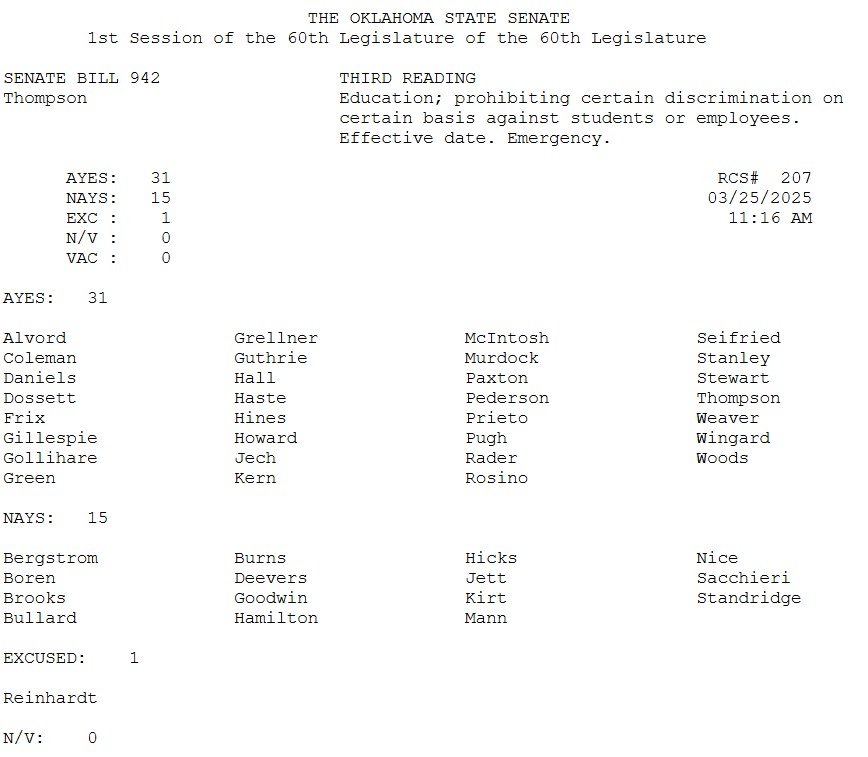
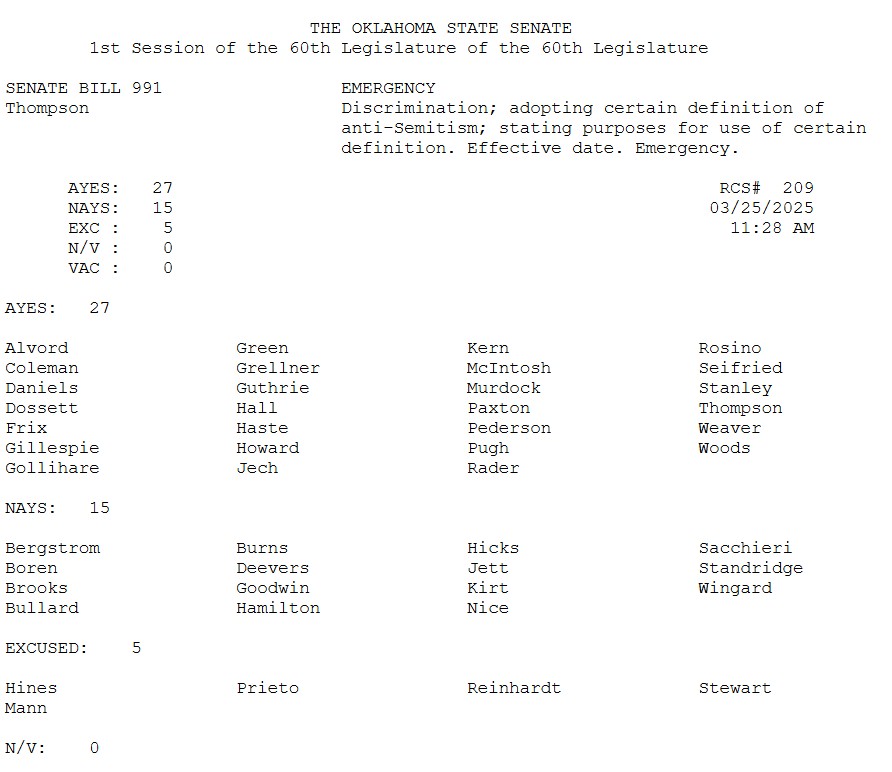
This is nonsense. Simply a whole lot of grandstanding and virtue signaling by your Oklahoma Senate. Truly, if a person is injured by another person – for any reason – or if property is damaged – for any reason, there are laws that bring perpetrators to justice and our law enforcement divisions are empowered to do that. It shouldn’t matter if someone used a racial/ethnic slur or not. THAT IS THE POINT. When the government begins to tell the people what they can and can NOT say – for any reason – we have descended into a tyranny. And, as Senator Bullard says here, if it’s anti-Semitic to say that Jesus was killed by Jews, all of Christianity is now called into question. No. Just no.
Just so you know, here are the VOTES on these bills (SB991, SB942):
These bills will go on to the House and they need to be stopped there.
We also talked about a House Bill that will be coming to the Senate that is exceedingly bad – HB2298 which will allow nurses prescribing power, “independent of supervision” by a physician. Although this will apply to Certified Nurse Practitioners, Clinical Nurse Specialists, and Certified Nurse-Midwives, these are still positions disallowed from prescriptive privileges without physician oversight currently.
There are several things wrong with this bill and Dr. Randy Grellnar also talked about this particular issue at the beginning of our interview with him when he was on several weeks ago, if you’d like to check out his perspective.
Here, Senator Bullard is talking about some of the issues that he’s concerned about with the bill – and mind you, this bill was run LAST YEAR and VETOED by the Governor.
Hopefully, between Dr. Grellnar and Senator Bullard, you get the idea. THIS IS A BAD BILL because it’s – again – government overstepping the bounds of its job – to protect our liberty – and trampling on issues that are best left to the oversight boards and the doctors themselves.
During the interview, we expanded on that topic – the topic of government trampling the liberty of citizens – and gave numerous examples of wherein the government is ruling us from the top down instead of allowing ourselves to govern ourselves from the bottom up – at the local levels of government where we have the most control. Essentially ‘top down’ systems DON’T WORK and that is what we talk about in the clip below. THIS is the concept ALL our legislators must be made to understand!
Please make a note of these bills and contact your Senator and Representative and tell them to be on the lookout for these bills and to vote NO when they see them.
Our friend, author ‘Mary’ of the V1SUT Vantage Substack joined the podcast at a SPECIAL TIME – at 1pm on Friday, March 21st to talk about some very unsettling things going on in the world of Oklahoma Education Reform. This is another one of those videos (I know…I write that all the time!) for which you’ll want to watch the full video and you can do that here on our YouTube and Rumble channels.
Mary talked about a number of bills, but the one we talked about arguably the most was HB1937, the bill that would change the law passed last year authored by Sherrie Conley, that prevented Oklahoma public school employees from communicating with students without a parent on the call/text/email/etc. HB1937 – a bill by two former public school employees – now allows parents to opt out of the law. Mary talks about what a bad idea that is in the clip below.
We also talked about HB1491 – a horrible bill that I can’t imagine wasn’t a request bill from the Governor. Don’t forget, back in February, Governor Stitt fired three Oklahoma State Department of Education Board members because of ‘political drama’. We found out later that Stitt fired them because he didn’t want anyone counting the number of illegal alien students here in Oklahoma (then we produced evidence that that information is collected for the Oklahoma State Longitudinal Database called The Wave, anyway).
And so the newest installment in the story is that, suddenly, and out of thin air, Representative Ronny Johns and Senator Aaron Rheinhardt gutted HB1491 – already a bad bill because it essentially watered down the requirements for removing teaching certifications from Oklahoma teachers – and inserted language that would allow State Board of Education members to add items to the agenda. Below, Mary explains why this is a very, very bad idea.
Who knows how poorly the state is really doing in educating our youth. The National Assessment of Educational Progress (NAEP) has us as 48th in reading and 45th in math for 8th graders. What’s going on at the state capitol right now is not helping. Let your Senators know that you don’t like EITHER of these bills and you want a big fat NO vote when they reach the Senate. Stay tuned and watch Mary’s substack for more!
Friday, March 21st, former Oklahoma Representative Jason Murphy came on with Michael and I to talk about legislation making its way through the Oklahoma legislature. I would really urge you to watch this particular FULL video (Rumble or YouTube) because we talked about a number of bills. Here, in this synopsis, I’ll touch on the ones we felt were most important.
HB2289 is the one Jason calls, “the thin-skinned congressman bill” because it sounds like one of our elected congressional whiners (that would be all of them but Josh Brecheen and Kevin Hern ) made it up and asked leadership to run it. It basically gives an entire list of things you can’t do/say about our elected federal officials. Bad. And NO. Please contact your Senators at this point and ask them to watch for this crappy bill. Here’s Jason talking about it.
Feel free to go directly to this video clip on YouTube and share to friends and Senators from there.
Another thing Jason wanted to stress, is that the grassroots is rising. More and more people in Oklahoma are paying attention to the games being played at 23rd and Lincoln and who holds power and why. This is such a great thing because it will allow us to finally get our LIBERTY back – finally control our destinies a bit as our forefathers expected us to do. So many of us – like Jason and ROPE – are creating Substacks and media channels that tell the public what is actually going on and not what the legacy media is telling us is going on. The spread of this kind of information is VITAL to an educated populace, so SUBSCRIBE to as many new media authors as you can stand, get educated, educate others and stand up against the global mindset that wants to subjugate us!
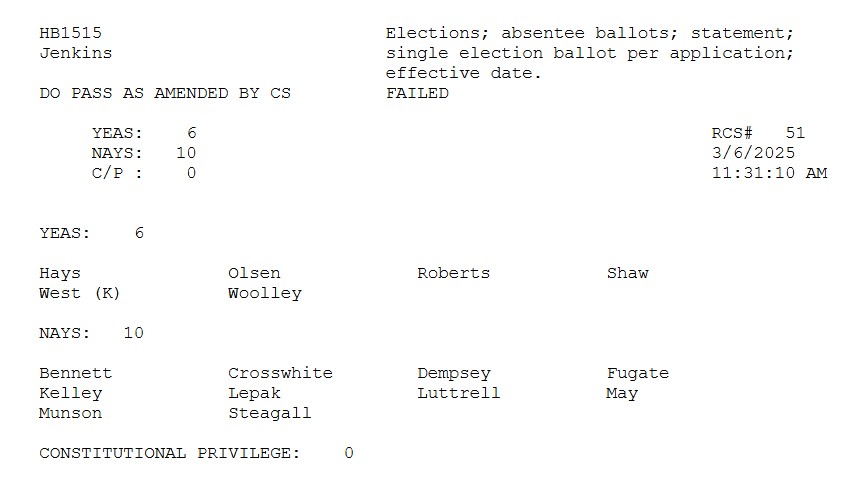
As I said, check out the full video where we talk about what happened with new Representative Jim Shaw – absolutely ZERO of his bills were heard in the House this year as payback for beating out entrenched RINO Kevin Wallace – and other bills that weren’t heard, as well as those that were heard but voted down. He even had a few GOOD ones in the mix, like HB1162 – to allow raw milk sales – and HB1515 – the one by new Rep Molly Jenkins that would have allowed absentee voting for only those Oklahomans who had a reason to vote absentee. Interestingly a number of conservatives voted against the bill.
Rep. Steagall and I have been arguing back and forth most of the day over the bill – though it’s too late for this session. My argument is that we KNOW – certainly in Edmond – that absentee ballots have changed election results. Having absentee ballots sent out in the mail indiscriminately (which has happened) allows nefarious people to use the ballots toward their end. In addition, having as many absentee ballots as are used now, over the days that they are allowed to turn them in, poses real issues for chain of custody. It used to be that, unless you had an excuse as to why you couldn’t turn up at the poll, you had to turn up at the poll.
Rep Steagall believes that it’s no one’s business why anyone votes absentee and that it’s a security risk to the family of the deployed to have to disclose that they are not in the country or otherwise deployed. We’re still arguing…LOL.
The bottom line here is that this session – certainly in the House – has been very difficult to follow with the ‘new’ (old) committee system of ‘oversight’ committees (that didn’t work the last time they were used) and that leadership still seems to have the same lock on legislation – cutting out “we the people” – that they always have. We’ll continue to ask Jason back to give us updates when he’s able. In the meantime, make sure you’re following people who are following legislation and follow Jason’s substack at OklahomaStateCapitol.substack.com! We’re only half-way through the session.