That Dollar In Your Pocket Doesn’t Mean What You Think It Means
This morning, our conversation with guest Dr. Eric Snyder was EYE-OPENING! So much to talk about. In fact, I had all intentions of having this blog up before 3pm today, until I started going down conspiracy theory rabbit holes as follow-up to our discussion.
Dr. Snyder has his Ph.D. in Educational Policy from the University of Kentucky and has been a professor at OU and worked at a private school in Norman. He’s no slouch. In fact, you have to watch the entire video (here on YouTube and Rumble) to hear what he has to say. I warn you, however, you may have to play and replay to really think on the things he’s saying.
Suffice it to say, the dollar bill you have in your pocket is virtually meaningless. It’s not tied to any actual commodity (something like oil, gas, gold, silver, copper, etc.), which gives it the term ‘fiat’. Here’s what Investopedia says about ‘Fiat’ currency:
Key Takeaways
- Fiat money is a government-issued currency that is not backed by a commodity such as gold.
- Fiat money gives central banks greater control over the economy because they can control how much money is printed.
- Most modern paper currencies, such as the U.S. dollar, are fiat currencies.
- One danger of fiat money is that governments can print too much of it, resulting in hyperinflation.
YIKES. Not a whole lot to feel comfortable about when you really think about it.
Over the many years in this country, we have had a whole lot of monetary policy and arguments about a central bank (The Fed). In fact, we’ve had two other central banks before The Fed. Both were dissolved and the US went back on Treasury-backed coinage.
In the clip below, Eric talks about what the dollar SHOULD be based on based on actual US monetary law – yes, I know how disappointing it is to think that the US doesn’t follow its own laws (insert eye-roll).
I asked Grok for the list of monetary policy over the length of the United States. I’ve pasted what it said at the bottom of this blog so you can at least look into the Acts yourself and determine what YOUR government has done to your way of life – or not…?
During our discussion with Dr. Snyder, we talked about all kinds of things that people often shut down as conspiracy theory. Because I know that the people who write the monetary policy at the Congress and The Fed benefit in some way from the policy (or they wouldn’t write it – apologies to the three Congressmen and Senators that actually work for The People), I wanted to be sure I wasn’t shutting down any of Dr. Snyder’s ideas without at least trying to vet them.
What I found was so interesting. When I asked Grok about whether the United States of America and the United States were different, it told me that it was a conspiracy theory. When I asked DuckDuckGo’s AI answer man, it didn’t say that. It said they were the same entity, but gave me the following information, which I thought was quite fascinating and could actually be taken two ways:
Definitions of the United States
United States
- Refers to a federal corporation or an agency, department, or entity of the U.S. government.
United States of America
- Refers to the country as a whole, which includes all 50 states and the District of Columbia.
Key Differences
| Aspect | United States | United States of America |
|---|---|---|
| Definition | A federal corporation or entity | The country comprising 50 states and D.C. |
| Usage | Often used in legal contexts | Commonly used in general contexts |
| Geographic Scope | Not specifically geographic | Includes all states and territories |
The terms can sometimes be used interchangeably in casual conversation, but they have distinct meanings in legal and formal contexts.
Kind of interesting, huh? In fact, he talks about that in the video clip below – along with a theory that President Trump is moving us to an asset-backed dollar.
I’m going to pack in a bunch of links and information I found rabbit-trailing this afternoon after our interview with Dr. Snyder.
Here is a link to the President’s Order to establish a Sovereign Wealth Fund. Dr. Snyder was wrong here, this isn’t law yet, it has to be approved by Congress, but DJT most certainly did order it. We’ll have to hope they’ll do just that. It definitely seems like a move in the right direction.
Here’s a link to the Articles Of Confederation and a journal article about how the Continental wasn’t trashed, the Continental Congress (which was adjourned Sine Die) just fazed it out after they paid off their debts. Here’s a link to the Constitution and one from Justia that says it matters not whether or not something is capitalized or not, capitalization does not confer any legal title in legal documents. Here’s a link to the white paper on Units Dr. Snyder mentioned.
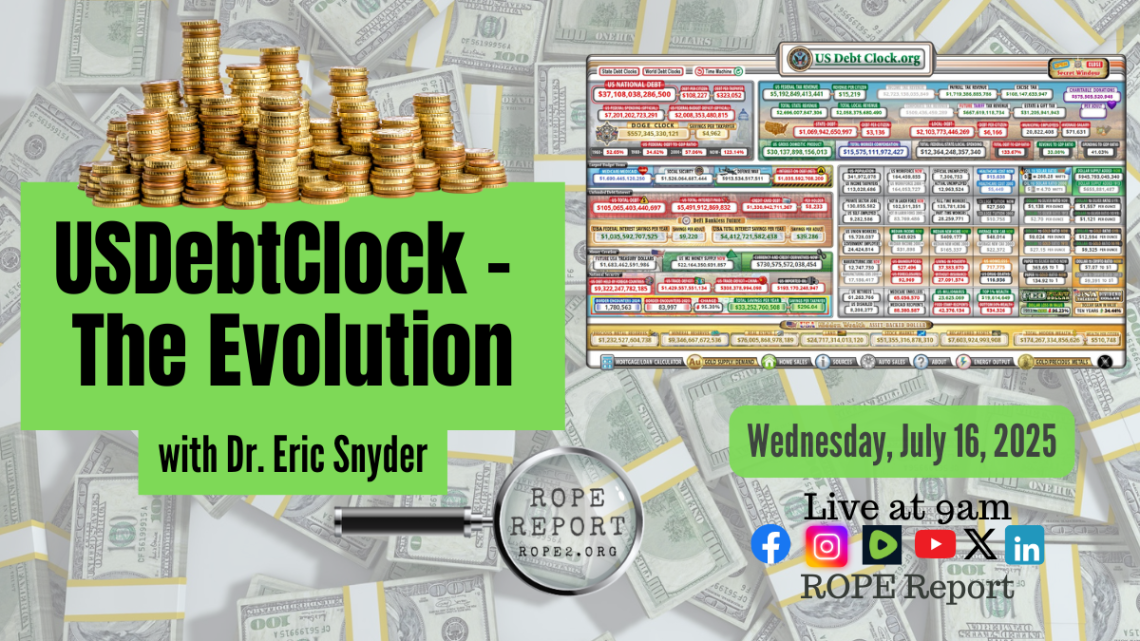
This is a GREAT article about the perpetual union and what that means, and of course, here’s the link to the US Debt Clock. Man, I went down a rabbit trail on that! I’ve posted below a very interesting PDF that you can download from the Debt Clock site itself if you click in the upper right hand corner where it says, “Secret Window”. It’s QUITE an interesting slide show. You’ll want to read it either there or below.
I have to say, the differences between Grok and DuckDuckGo AI assistant answers was fascinating – especially when asked about conspiracy theories. DDG doesn’t seem to be as resistant to those ideas, while Grok is happy to tell you right up front – dude, you’re a moron, that’s a conspiracy theory. LOL
My favorite was when I asked both about The Fed. I asked, “is the federal reserve a private or government entity”. Grok gave me numerous pages detailing how the Fed is not private, but isn’t government and only conspiracy theorists think it’s private and that bankers are making interest money off the loans it provides the government (paraphrasing in my own way). DDG, however, gave me the following answer and a couple of points to flesh it out:
The Federal Reserve is not privately owned; it is a unique entity that combines both public and private characteristics. While the Board of Governors is a government agency, the 12 regional Federal Reserve Banks operate like private corporations, with member banks holding stock in them.
The same thing happened when I asked, “are silver prices being manipulated on the market”. Grok came back with a ‘some say yes, some say no’ answer, while DDG basically said, “yup and here’s how”, providing some pretty good evidence showing it was.
SO! All that to say, DO YOUR OWN RESEARCH ON ALL THIS, but realize that the basis of what Dr. Snyder said in the video is true – our money is as detached from reality as Joe Biden and if we don’t get it back on the nation’s weights and measures law, the devaluation of the dollar will steadily continue until we’re all spending 30 bucks just to get a loaf of bread.
Please share this information with your elected representative. I have all belief that few know all the information covered here and it shows. Our Governor and legislature continue to GIVE tax dollars to private businesses while NOT protecting the property and right to the gains of their own industry, every citizen fundamentally has. We MUST stand and protect ourselves and our future posterity.
*Major Monetary Policy Acts of the United States
- Coinage Act of 1792 (An Act Establishing a Mint, and Regulating the Coins of the United States)
- Purpose: Established the U.S. Mint and defined the U.S. dollar as the official currency, based on a bimetallic standard (gold and silver).
- Key Provisions:
- Created the U.S. Mint to produce coins, setting standards for gold, silver, and copper coinage.
- Defined the dollar in terms of silver (371.25 grains of pure silver for a dollar coin) and established a gold-to-silver ratio of 15:1.
- Authorized the Treasury to oversee coinage, laying the foundation for federal control over currency.
- Impact: Provided the first formal monetary system, ensuring a standardized currency for the new nation. It tied the dollar to precious metals, influencing monetary policy until the 20th century.
- National Banking Acts of 1863 and 1864 (An Act to Provide a National Currency)
- Purpose: Created a national banking system and a uniform national currency during the Civil War to finance the Union and stabilize the economy.
- Key Provisions:
- Established nationally chartered banks, regulated by the newly created Office of the Comptroller of the Currency (under the Treasury).
- Authorized national banks to issue National Bank Notes, backed by U.S. government bonds, creating a uniform currency to replace state-issued notes.
- Imposed a 10% tax on state banknotes (1865 amendment), effectively phasing them out.
- Impact: Centralized banking and currency issuance, reducing the chaos of state banknotes. It laid the groundwork for a federal monetary framework but lacked a central bank, leading to financial panics (e.g., 1907).
- Coinage Act of 1873 (An Act Revising and Amending the Laws Relative to the Mints, Assay Offices, and Coinage of the United States)
- Purpose: Revised U.S. coinage laws, effectively moving the U.S. to a gold standard by demonetizing silver as a monetary base.
- Key Provisions:
- Ended the free coinage of silver, making gold the primary standard for the dollar.
- Reduced the role of silver dollars, limiting them to trade purposes (e.g., for international commerce).
- Impact: Known as the “Crime of 1873” by silver advocates, it sparked controversy among populists and farmers who favored bimetallism to increase money supply and ease debt burdens. It shaped monetary policy debates leading to the Federal Reserve’s creation.
- Gold Standard Act of 1900 (An Act to Define and Fix the Standard of Value)
- Purpose: Formalized the gold standard as the basis for U.S. monetary policy, clarifying the dollar’s value and stabilizing currency.
- Key Provisions:
- Defined the dollar as 25.8 grains of gold (90% pure), equivalent to $20.67 per ounce of gold.
- Required all currency (including paper notes) to be redeemable in gold.
- Reaffirmed the Treasury’s role in maintaining gold reserves to back currency.
- Impact: Solidified the gold standard, reducing monetary flexibility but ensuring international confidence in the dollar. It constrained money supply, contributing to calls for a central bank to manage liquidity.
- Federal Reserve Act of 1913 (An Act to Provide for the Establishment of Federal Reserve Banks)
- Purpose: Created the Federal Reserve System to serve as the U.S. central bank, addressing banking panics and providing a flexible monetary policy.
- Key Provisions:
- Established the Federal Reserve with a Board of Governors (a federal agency) and 12 regional Federal Reserve Banks (owned by member banks).
- Authorized the Fed to issue Federal Reserve Notes as legal tender, backed by gold and government securities.
- Gave the Fed authority to conduct monetary policy (e.g., setting interest rates, controlling money supply) and act as a lender of last resort.
- Created the Federal Open Market Committee (FOMC) to manage open market operations (formalized later in 1933).
- Impact: Fundamentally reshaped U.S. monetary policy by creating a central bank with tools to stabilize the economy, manage inflation, and respond to crises. It remains the cornerstone of modern U.S. monetary policy, as discussed in your question about the Fed’s structure.
- Banking Act of 1933 (Glass-Steagall Act)
- Purpose: Reformed the banking system post-Great Depression to restore confidence and separate commercial and investment banking.
- Key Provisions:
- Created the Federal Deposit Insurance Corporation (FDIC) to insure bank deposits, protecting against bank failures.
- Prohibited commercial banks from engaging in investment banking (e.g., underwriting securities), reducing speculative risks.
- Strengthened Federal Reserve authority over member banks, including control over interest rates on deposits.
- Impact: Stabilized the banking system and influenced monetary policy by enhancing the Fed’s regulatory role. The separation of banking functions was partially repealed in 1999 (Gramm-Leach-Bliley Act), but FDIC insurance remains a key stabilizer.
- Banking Act of 1935 (An Act to Provide for the Sound, Effective, and Uninterrupted Operation of the Banking System)
- Purpose: Strengthened the Federal Reserve’s control over monetary policy and restructured its governance.
- Key Provisions:
- Centralized monetary policy authority in the Board of Governors, reducing the influence of regional Reserve Banks.
- Formalized the FOMC as the primary body for setting monetary policy, including open market operations.
- Expanded the Fed’s ability to adjust reserve requirements for banks, enhancing control over money supply.
- Impact: Consolidated the Fed’s power to conduct monetary policy, making it more responsive to economic conditions. It solidified the modern structure of the Fed, as discussed in your question about its hybrid nature.
- Employment Act of 1946 (An Act to Promote Maximum Employment, Production, and Purchasing Power)
- Purpose: Established federal responsibility for promoting economic stability, indirectly shaping monetary policy.
- Key Provisions:
- Declared it the government’s responsibility to promote maximum employment, production, and purchasing power.
- Created the Council of Economic Advisers to advise the President on economic policy.
- Impact: Influenced the Fed’s monetary policy by emphasizing employment alongside price stability, leading to the Fed’s dual mandate (formalized later in 1977). It set a broader economic context for the Fed’s actions.
- Federal Reserve Reform Act of 1977 (An Act to Promote the Public Welfare)
- Purpose: Clarified the Federal Reserve’s objectives and increased its accountability to Congress.
- Key Provisions:
- Formalized the Fed’s dual mandate to promote maximum employment and stable prices.
- Required the Fed to report semiannually to Congress on monetary policy objectives and plans.
- Mandated greater transparency in Fed operations.
- Impact: Codified the Fed’s responsibility to balance inflation control with job creation, shaping modern monetary policy. It increased public oversight, addressing concerns about the Fed’s independence raised in works like The Creature from Jekyll Island.
- Humphrey-Hawkins Full Employment Act of 1978 (Full Employment and Balanced Growth Act)
- Purpose: Expanded on the 1946 Employment Act by setting specific economic goals and requiring detailed Fed reporting.
- Key Provisions:
- Reaffirmed the Fed’s dual mandate (maximum employment and price stability) and added goals for economic growth and balanced trade.
- Required the Fed Chair to submit biannual Monetary Policy Reports to Congress, detailing economic conditions and policy plans.
- Set numerical targets for unemployment (4%) and inflation (3% by 1983, 0% by 1988), though these were largely aspirational.
- Impact: Strengthened the Fed’s accountability and transparency, formalizing its role in achieving specific economic outcomes. The reporting requirement remains a key feature of Fed-Congress relations.
- Dodd-Frank Wall Street Reform and Consumer Protection Act of 2010
- Purpose: Reformed financial regulation post-2008 financial crisis, enhancing the Fed’s role in monetary policy and financial stability.
- Key Provisions:
- Strengthened Fed oversight of systemically important financial institutions to prevent crises.
- Created the Consumer Financial Protection Bureau (CFPB), funded by the Fed but independent in operation.
- Expanded GAO audits of the Fed’s emergency lending programs while preserving monetary policy independence.
- Established the Financial Stability Oversight Council (FSOC), chaired by the Treasury Secretary, with Fed participation, to monitor systemic risks.
- Impact: Enhanced the Fed’s regulatory powers and coordination with the Treasury (as discussed in your question about their separation), while addressing public concerns about transparency. It modernized monetary policy’s role in systemic risk management.