Search

ROPE Report

Tag

election

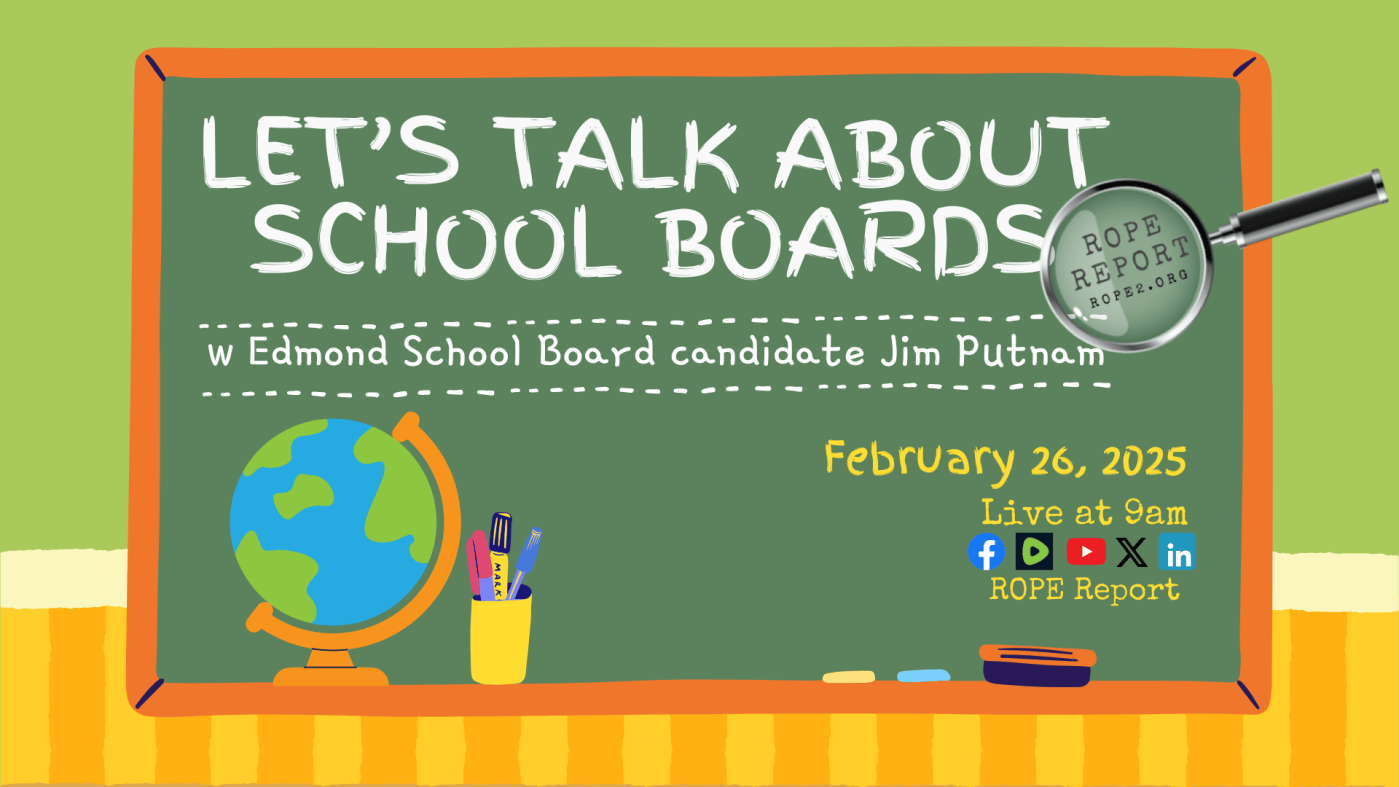
Colonel Jim Putnam, Candidate for Edmond School Board – Virtual Presence Is Actual Absence

Michael and I had so much fun talking to Colonel Putman on the show Wednesday (2.26.25). I swear, that man had some of the best stories about his military career with the Air Force – and one of them is below. Just take a few minutes to watch this because it is guaranteed to make you giggle – although you can watch the entire live program on YouTube and Rumble.

But, among the stories, the Colonel had quite a bit to say about education in our state and I, for one, was bowled over by his thoughts and ideas. At one point, we were discussing ‘distance learning’ – learning out of school and what he thought about that. “Virtual presence is actual absence“, was the comment the Colonel made. How perfect is that? And no, he’s not a fan of learning on a computer in general. Just like Michael and I, the Colonel believes that learning is more functional with a paper and pencil and a teacher in a classroom.

In the clip below, we were talking about what Michael heard from teachers when he was running for school board. So much of it was about how micromanaged they were. The Col. talks about micromanagement and also about the student surveys that the district gives to students. These bother him for the same reason they’ve always bothered Michael and I – most of these surveys actually instill ideas in kid’s heads because they’ll introduce something they’ve never heard about or even thought about. That kind of thing has to stop. It’s a waste of education time and dollars because they don’t provide any real educational opportunities for students they’re just a way to collect data.

In the last clip, we talked a bit about the culture of the public schools and how many good teachers are frustrated by that. The Col. made the most common sensical comment – you don’t quit your job, you quit your boss. He then goes on to talk about how he is a huge supporter of teachers because they are on the front lines and in the classroom with the students and how they need to be supported by administration.

After Col. Putnam ‘retired’ from the podcast (lol), Michael and I start talking about some news for the week (1:15 on the video timer) and there was a lot of pretty interesting stuff there. You’ll want to check out the full video for that and I’ve embedded it below so you can.

Please – if you’re in the Edmond area, or you know someone who lives in the Edmond area – look up Colonel Putnam’s website. Get to know him and share these videos and his website with others in the area. School Boards are the most important thing in a school – they set the tone for the entire school. Let’s concentrate on getting good candidates elected to these positions all over the state!

Citizens Of HD32 Effectively Taxed Without Representation As Representative Jim Shaw’s Bills Blocked From Hearings

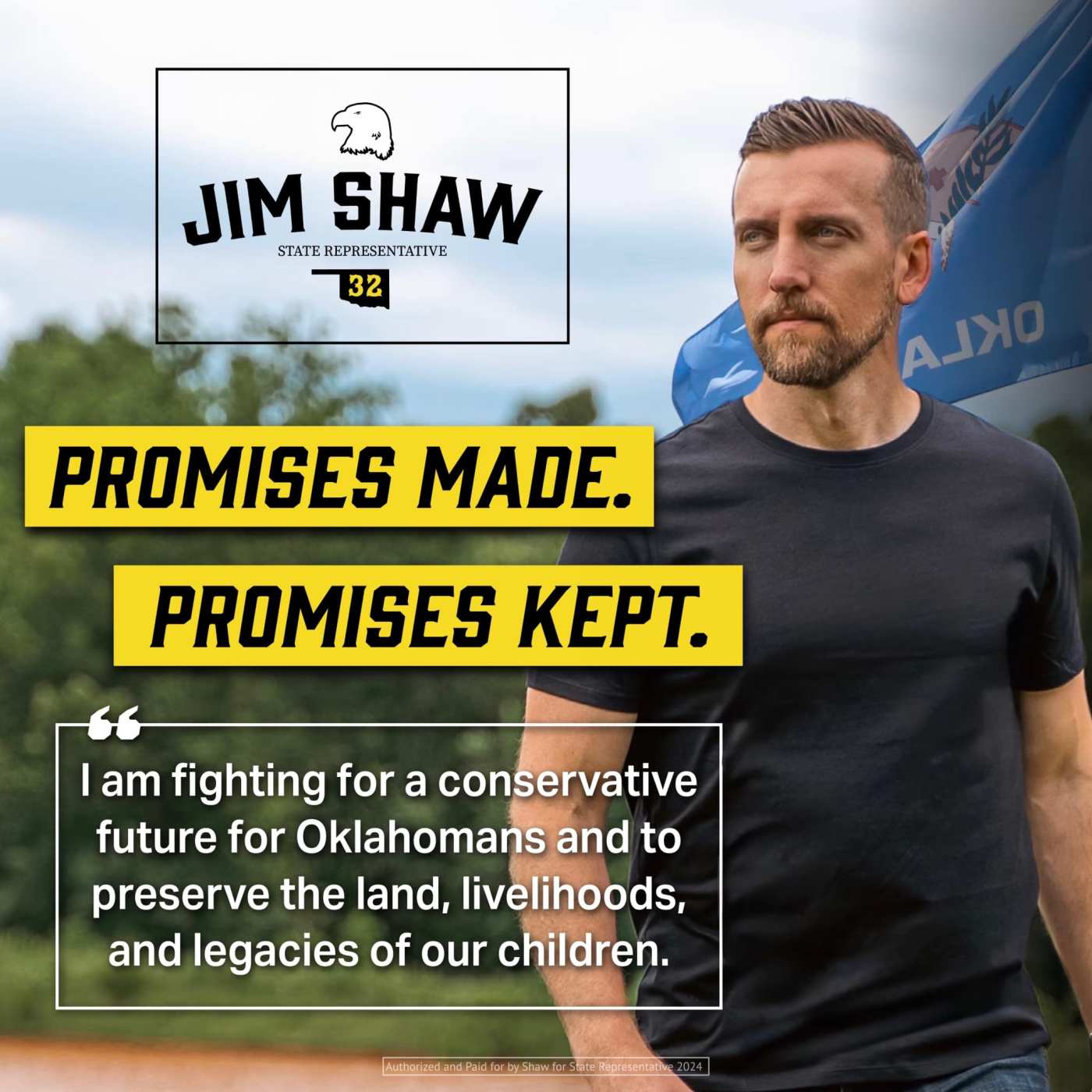
Last year, political newcomer Jim Shaw, driven by the fact that he didn’t want to see wind turbines scattered all over the Oklahoma landscape, or deal with the after effects of having human sewage dumped on the fields around him, decided to run for the Oklahoma House against a very powerful, nearly-termed-out Representative, Kevin Wallace, then House Appropriations Chair.

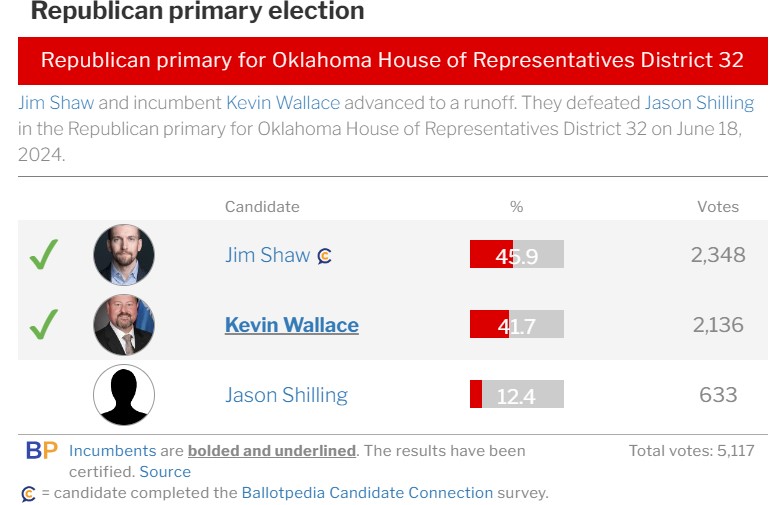
In a surprising upset, Shaw – with an army of grassroots rural Oklahomans worried about all the same things – beat Wallace in the primary.

This was unheard of. No newcomer out of nowhere beats the House Appropriations Chair running for this 5th term. And so the RINO forces gathered.

Governor Stitt put out numerous messages urging voters in the district to vote for Wallace, including this video, where he called those advocating AGAINST Wallace “Political Animals”.

Everyone from the Speaker of the House Charles McCall, to the Speaker-Elect of the House, Kyle Hilbert, came out to little ‘ole District 32 to churn up support for House Appropriations Chair Wallace.

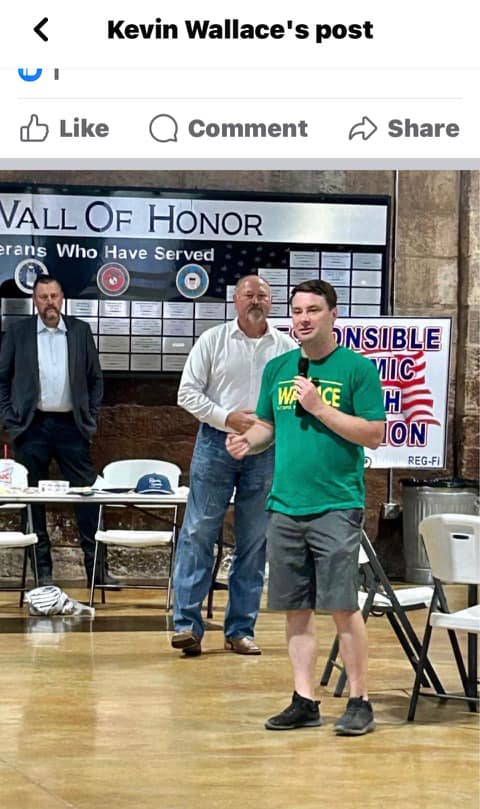
Speaker-Elect Kyle Hilbert stumps for Kevin Wallace in HD32

Here, you see Kevin Wallace in the background with then-Speaker-Elect Kyle Hilbert (foreground) stumping for Wallace at a campaign event in HD32.

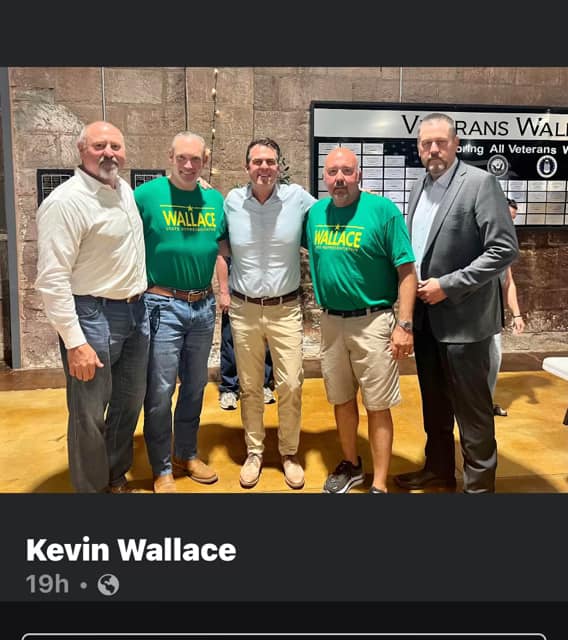
Here is Wallace (L) with (in order), Speaker of the House Charles McCall, Governor Kevin Stitt, Thomas Tillison (broadband and other business owner/Wellston) and Grant Green, Senator for SD28, which includes Shaw’s.

With that much ammunition behind him, Wallace must not have been poling well. And then came the point where Wallace apparently got desperate, and doxed Shaw, toward the end of the campaign, posting pictures of his residence to his Facebook page.

Unfortunately for Wallace and his campaign – funded nearly 100% by special interests and business professionals – none of these measures helped. In the end Shaw prevailed in the general election by a wide margin (3,291 to 2,764).

But then came Shaw’s first day on the floor. Organizational Day, the day on which the House rules would be voted on by the House for the 2025 legislative session.

Shaw had read the rules and didn’t approve of the two-tiered Committee structure and other issues. He had studied the rules in the few days they were available to him and began to debate them on the floor, when he was tersely debated (bullied?) by Counselor to the Speaker (a new leadership position just added this year), Representative Chris Kannady – the same Chris Kannady who openly admitted to working to oust 12 Conservative Republicans from the House in 2018 for being too conservative. The same Chris Kannady attached to the Conservative Alliance PAC – used to fund the campaigns of the Conservative’s opponents – which was fined 45 thousand dollars for, among other things, not filing spending reports.

Here is the Kannady/Shaw exchange on the floor February 7th, 2025. You can find more here in the full live video on YouTube where everything that happened on the House floor during Organizational Day is broken down.

Can it be proven that leadership has blocked Shaw’s bills from hearings? No. However, a simple look at the history of the HD32 election in which Shaw challenged Wallace provides ample support of that contention. In fact, people may look at the clip of Wallace and Kannady on the floor and feel that Kannady was NOT trying to intimidate Shaw, but it is well known that Representative Kannady hates conservatives so much that he actively worked to remove 12 conservative Republicans from the House in 2018 using a PAC eventually fined for unethical actions.

In the end, it matters not the actual reasons Shaw’s bills weren’t heard in Committee because the end result will ALWAYS be the same – the people that voted Jim Shaw into office deserve to be heard. In point of fact, that concept is the MAINSTAY OF OUR REPUBLIC. One would think an attorney with the self-appointed Constitutional knowledge of Chris Kannady would know this. Even young kids know that taxation without representation is the reason colonists dressed as Native Americans and dumped tea into the Boston Harbor in December 1773.

And so it stands that because none of Representative Jim Shaw’s bills were heard in the Oklahoma House of Representatives, the effect is none other than that ALL of the citizens of HD32 have now been TAXED WITHOUT REPRESENTATION and that IS UNFORGIVEABLE.

If this is the way House leadership intends to act for the duration of the session, Oklahomans had better commit to removing each and every one of these individuals for impeding the Constitutional rights of an entire county’s worth of citizens. And just in case you don’t know who these individuals are, here is the list and the link to find them on the House website. It behooves all Oklahomans to get very familiar with these elected Representatives now and to start looking for their replacements as June 2026 looms on the horizon. Included next to the name is that Representative’s 2024 conservative index according to the Oklahoma Constitution. Without a Boston Harbor, removal and replacement will be the only way to get our point across.

  1. Kyle Hilbert – Speaker; 56
  2. Anthony Moore – Speaker Pro Temp; 60
  3. Stan May – Majority Caucus Chair; 63
  4. Nick Archer – Majority Caucus Vice-Chair; 46
  5. Josh Cantrell – Majority Caucus Secretary; 80
  6. Josh West – Majority Floor Leader; 60
  7. John Pfieffer – Majority Deputy Floor Leader; 66
  8. Steve Bashore – Majority Deputy Floor Leader; 80
  9. Tammy West – Majority Whip; 60
  10. Mark Lawson – Majority Leader; 70
  11. Toni Hasenbeck – Majority Deputy Leader; 60
  12. Scott Fetgatter – Tribal and External Affairs; 70
  13. Chris Kannady – Counselor To The Speaker; 63
  14. Collin Duel – Assistant Majority Floor Leader; 70
  15. Gerrid Kendrix – Assistant Majority Floor Leader; 90

Election Bills To Support And Oppose – Oklahoma Legislative Session 2025

This list was composed by Wendi Montgomery Dial and published to her Restore Liberty Substack. You can find the whole piece here. Not all information from her Substack is reproduced here, just the basic information, so please go read for more information.

Bills that should not be passed:

HB 1116, Stewart. This bill would introduce automatic voter registration upon renewal of a driver’s license. It would also automatically register minors as soon as they receive their adult driver’s license at 18.

SB 1086, Gollihare. This bill restricts public access to voter registration rolls. This would make election integrity efforts much harder. 

SB 129, Kirt. This bill would increase the days of in person absentee voting to 14 calendar days. The goal in order to achieve secure elections is to have all elections conducted on one day, Election Day, as the US Constitution requires. Rating? Ugly.

SB 214, Goodwin. This bill changes the date of special elections and forces the governor to make the call for a special election within a specific time frame. This also takes State questions out of the general elections where they would have more votes and puts them in a special election where they would have little attention and very little participation, a hypothetical election manipulator’s dream scenario. 

SB 273, Boren. This bill would add 2 days to Early Voting and also add polling places for the practice, 1 polling place for every 15,000 voters. This also adds local law enforcement to the sheriff’s duties carried out during elections.

SB 147, Pederson. This bill mandates post election audits after each elections. The parameters of these audits would be determined by the State Election Board. Currently Oklahoma conducts risk limiting audits randomly after elections. 

SB 654, Paxton. This bill removes notarizing too many ballots from the definition of ballot harvesting, a felony, plus makes it far more difficult to prosecute a notary for breaking the law and notarizing over twenty ballots by introducing language regarding intent. This renders Oklahoma law against a notary witnessing over 20 ballots per election essentially useless. Rating? Ugly.

HB 1985, Ranson. This bill would make straight party voting illegal and require voters to fill out their individual choices for all ballot races and measures. 

SB 962, Haste. This bill increases fees for all recounts of elections. There would be penalties if irregularities are not proven in a court of law to a judge. 

SB 525, Boren. This bill would add unelected members of law enforcement to the process of securing elections and provide training for those officers.

HB 1010, Jenkins. This bill would charge a political party for all costs of the state for their candidates being on the ballot of a primary election IF the delegates to the party’s national convention cast their votes for someone other than the candidate who received the vote of the state. Rating? Bad.

Bills that should be passed or that will enhance election security:

HB1151, Banning. This bill moves school board elections to existing primary and general election dates. It also changes the terms to four years for all school board members. 

SB 834, Bullard. This bill prohibits open and jungle primaries in Oklahoma with penalties that include voiding the elections that are held with an open primary. Rating? Good.

HB1120, Lepak. This bill would prohibit the Secretary of the State Election Board or any other county secretary of an election board from implementing any new federal guidance or directives without the prior approval from the State Legislature.

SB 652, Paxton. This bill restricts the calendar dates that a special election may be called. 

SB 659, Deevers. This bill would require that state agencies verify US citizenship and Oklahoma residency of anyone before giving them voter registration materials. This bill contains a penalty of a fine not to exceed $5,000 and sets the violation at a misdemeanor. Rating? Good.

SB 536, Howard. This is a bill related to the duties of the assistant secretary of the county election board and adds to the provisions of that role.

HB 2191, Wolfley. This bill would require notaries to turn over their logs as public record if they apply for an exemption to be able to lawfully notarize more than 20 ballots in any election.

SB 1116, Sacchieri. This bill would require any State Question or proposal sent to voters to include conspicuous language if the passage of the proposal would result in a tax increase on the citizens. Rating? Good.

SB 990, Coleman. This is a bill that establishes a mechanism for recall elections in statewide races in Oklahoma. 

SB 735, Deevers. This bill sets up a requirement for each county election board secretary to submit annually a report to the state election board, as well as a requirement for the state election board to report to the legislature and governor, of their efforts to maintain the voter registration rolls of the state.

HB 1005, Olsen. This bill would require Service Oklahoma to develop a photo ID voter registration card that would be offered free to certain registered voters.

HB 1007, Olsen. This bill would not allow an ID issued by an educational institution to be used as a valid form of identification to vote.

Revision

SB953, Deevers. This is a bill that creates the Election Integrity Enforcement Act which authorizes District Attorneys to initiate civil actions on behalf of voters within their respective judicial districts in cases of alleged election irregularities or fraud. Rating? Excellent.
All About What’s On The Ballot In Oklahoma, November 5th, 2024

Michael and I took some time this morning to go over the ballot and introduce people to various websites and articles that could help them become informed voters.

We had a LOT OF VIEWERS and a whole lot of COMMENTS which were great! We thank everyone for participating so very much!

Find the full video on our YouTube and Rumble pages, but here’s a short clip about helping our elderly family members, friends and neighbors to vote…

Here is the list of all the sources we used on the show today. Check them out – heck, check them ALL out! But the bottom line is SHARE, SHARE, SHARE!

We talked about this numerous times on the live show today. Just because a group is spending hundreds of thousands of dollars to get three justices tossed out of the Oklahoma Supreme Court, check them out yourselves, don’t just vote for them because of ads that tell you they’re horrible liberals. They may be, but CHECK IT OUT YOURSELF. We’ve got to stop believing people just because we believe they’re good people or have our best interests at heart. Usually, there’s money involved somewhere and THAT’s where the heart of the interest lies – even if it’s Republican-led!

VOTER GUIDES

Oklahoma Voter Guide

Batesline – 2024 Judicial Retention Ballot

Oklahomans For Health And Parental Rights voter guide

Oklahoma Second Amendment Association voter guide

Supreme Court Justices; KarminGrider.com

OK Grassroots Voter Guide

Jake A. Merrick

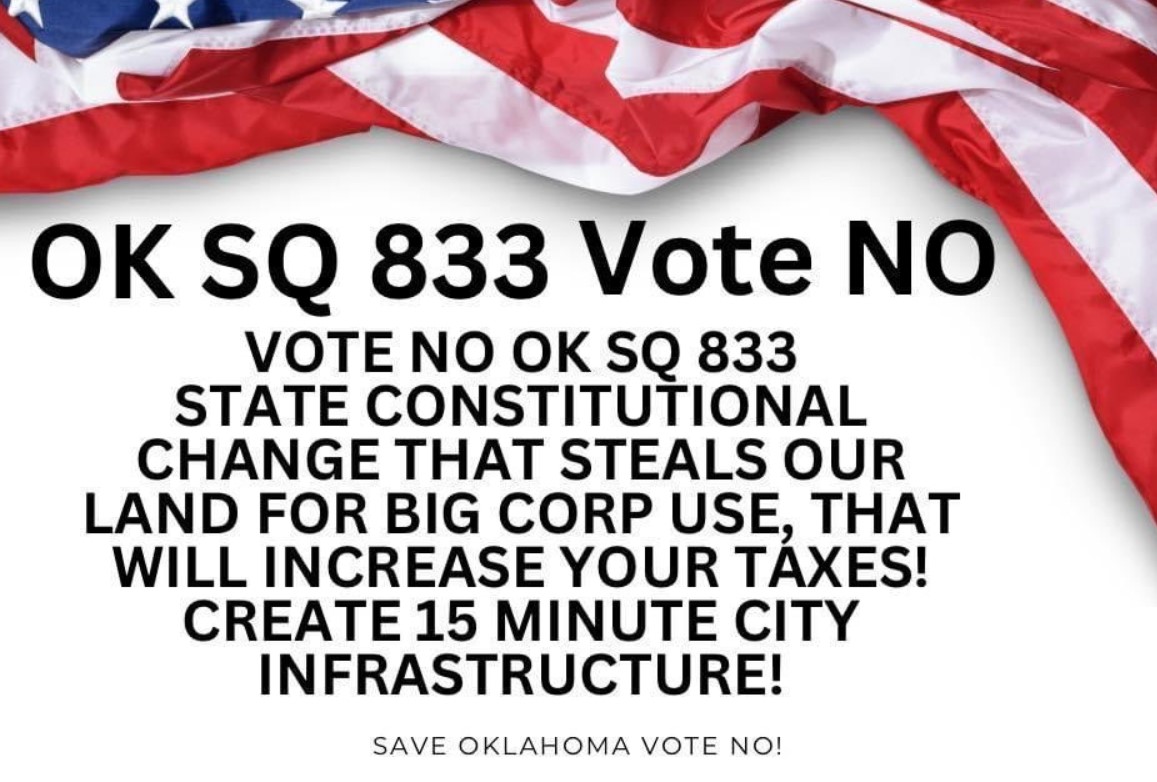
Reasons why you should VOTE NO on SQ833:

Rejecting Oklahoma SQ 833 – The Case Against Public Infrastructure Districts (PIDs)

State Question 833 (SQ 833) introduces Public Infrastructure Districts (PIDs), giving developers significant control over infrastructure financing at taxpayers’ expense. Here’s why voters should say “No” to SQ 833.

1. PIDs Burden Taxpayers with Long-Term Costs

               •             PIDs allow developers to shift infrastructure costs onto property owners through special property taxes that can last for decades, even after developers have profited and moved on.

2. Developer Influence on Local Politics by Shifting Power to Special Interests

               •             Similar to Tax Increment Financing (TIF) districts, PIDs give developers leverage over local governance. This opens the door to political favoritism, where developers can game the system to gain tax advantages and special treatment.

3. Loss of Transparency and Oversight through Complex Bureaucracy

               •             PIDs add layers of government bureaucracy with minimal public input, making oversight difficult. The lack of clear rules for dissolving PIDs and vague governance structures risk unchecked developer control.

4. Lessons in Increased Corruption from Failed TIF Districts

               •             TIFs have already shown how developers can influence local elections and bend policies to suit their interests. PIDs will likely worsen this, embedding special interests deeper into local government.

5. Threat to Simple, Accountable Government by Erosion of the Free-Market

               •             PIDs bypass traditional free-market practices, allowing government-backed financing that distorts genuine market demand and punishes developers who play by the rules.

6. Legislators Who Voted “No” on PID Legislation (SJR 16) in the 2024 Oklahoma Session

These legislators advocated for a simpler, transparent government structure that serves taxpayers, not special interests:

Senate: Nathan Dahm (R-Broken Arrow); Dusty Deevers (R-Elgin); Shane Jett (R-Shawnee); Warren Hamilton (R-McCurtain)

Oklahoma House of Representatives: David Banning (R-Bixby); Tom Gann (R-Inola); Jim Olsen (R-Roland)

7. Vote “No” to Protect Taxpayers, Keep Government Accountable, and Reject Special-Interest Schemes

               •             Voting “No” on SQ 833 keeps taxpayers from carrying the financial weight of risky, developer-driven districts and supports transparent, free-market governance.

SQ 833 is a handout to developers, enabling costly, complex government-backed districts.

Voting “No” preserves a simpler, fairer government structure that works for taxpayers—not special interests.

Anatomy Of A Political Pushcard

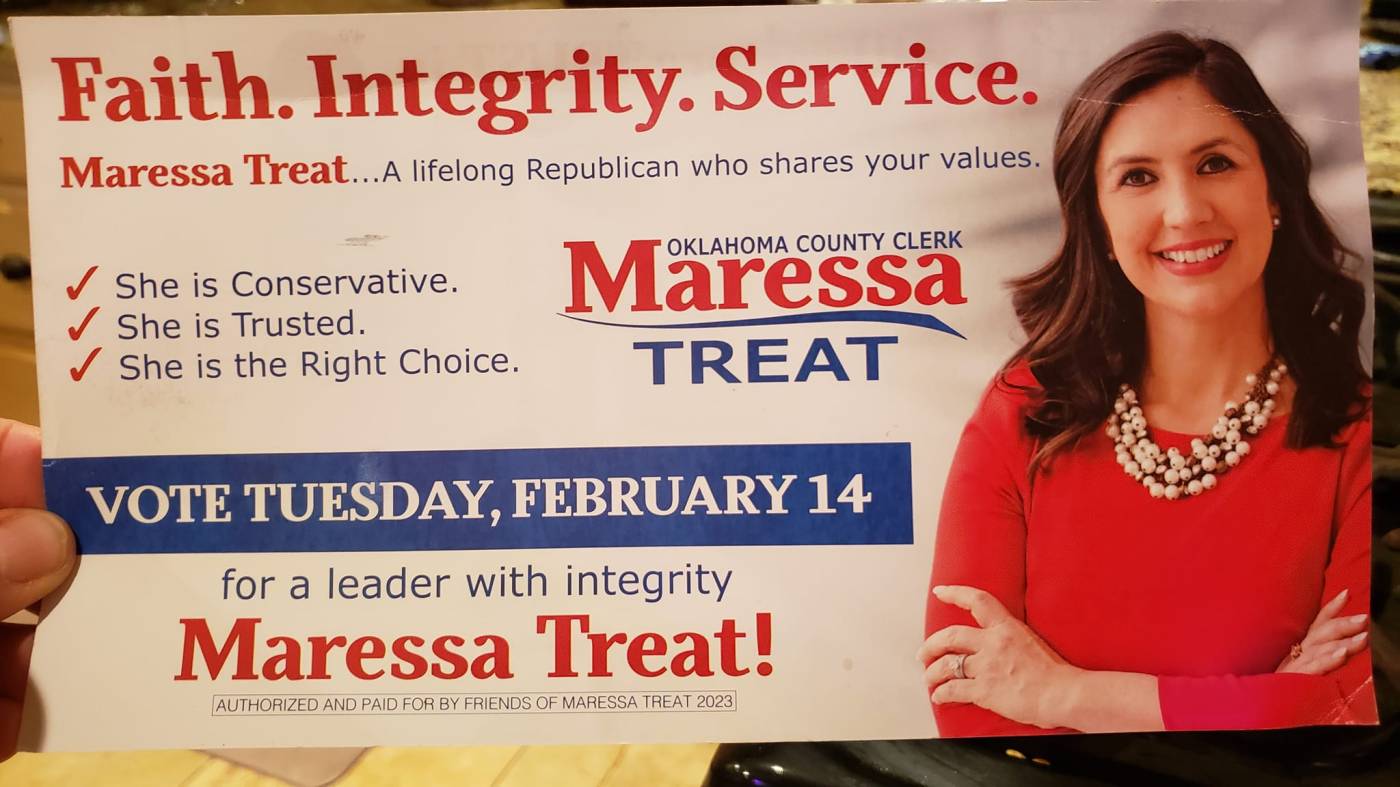
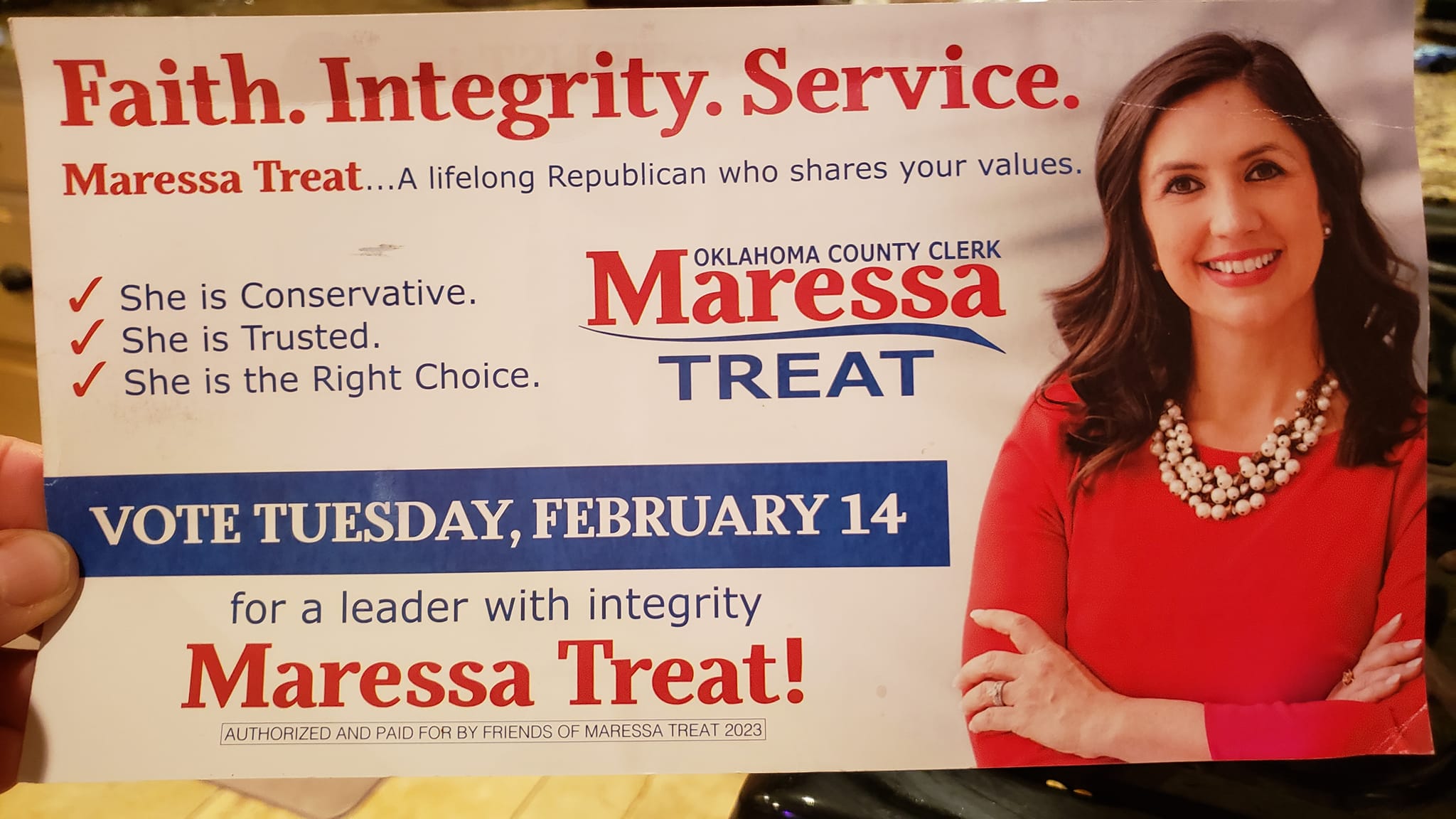
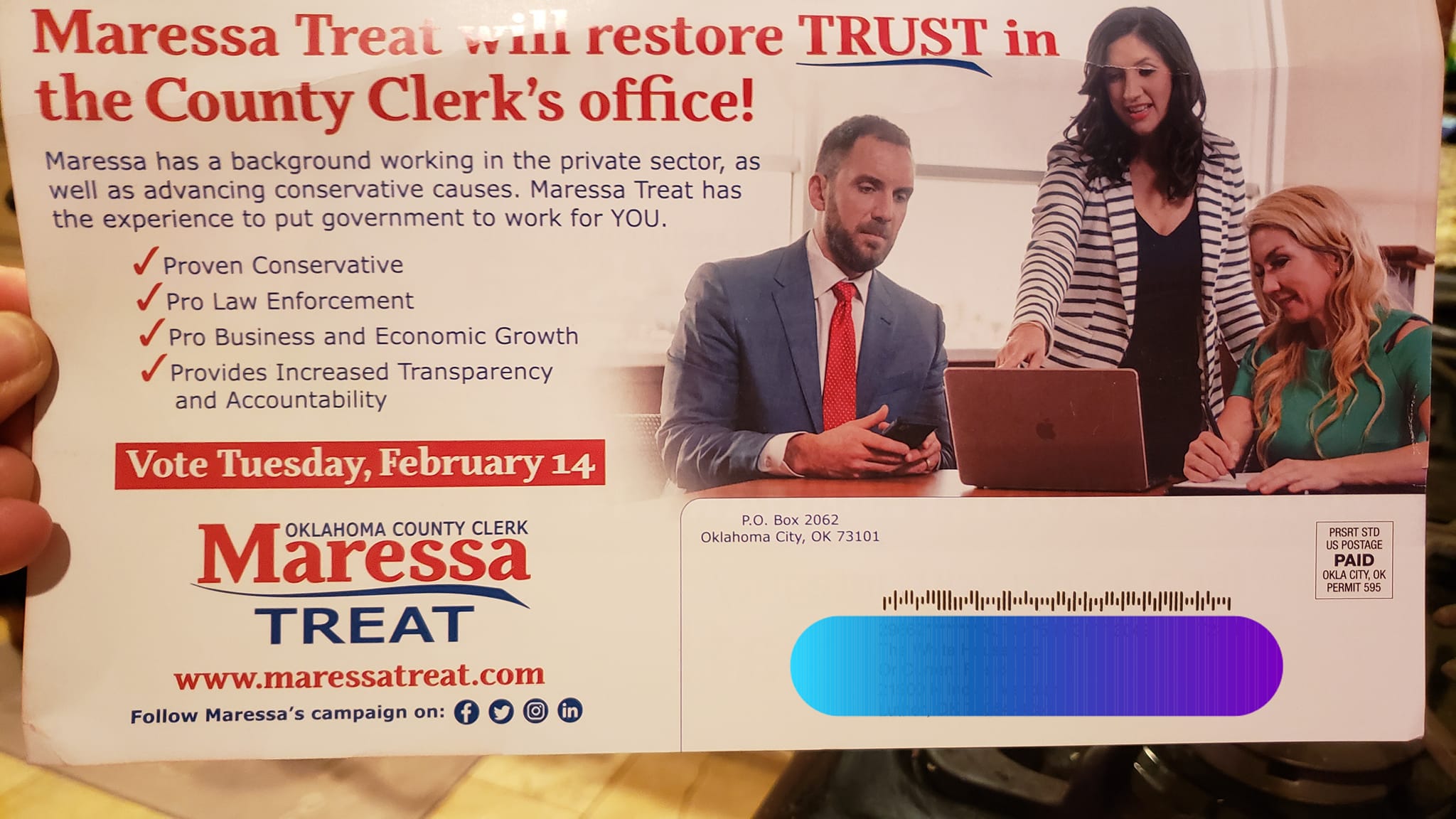
Maressa Treat – wife of State Senate ProTemp Greg Treat (who was challenged for his position as ProTemp for the 2023 session) – is running for Court Clerk.

These are photos from Mrs. Treat’s pushcard which I received in the mail the week of January 23rd. These cost money to design, print and mail. Because of this, Oklahoma Ethics Rules require that Ethics forms be filed – for transparency sake – with the Oklahoma County Election Board (OCEB) in the case of a County election such as County Clerk.

This morning, I called the OCEB. The woman who answered had to ask someone whether or not they ‘could’ provide the reports to me. She returned to the phone and explained that I would have to come to the OCEB where I could “look” at them. They would not provide these forms electronically.

Cleveland County provides Ethics forms electronically if you call them and Muskogee County posts Ethics forms online. What is the matter with the OCEB? This is PUBLIC information. Something else here to be considered.


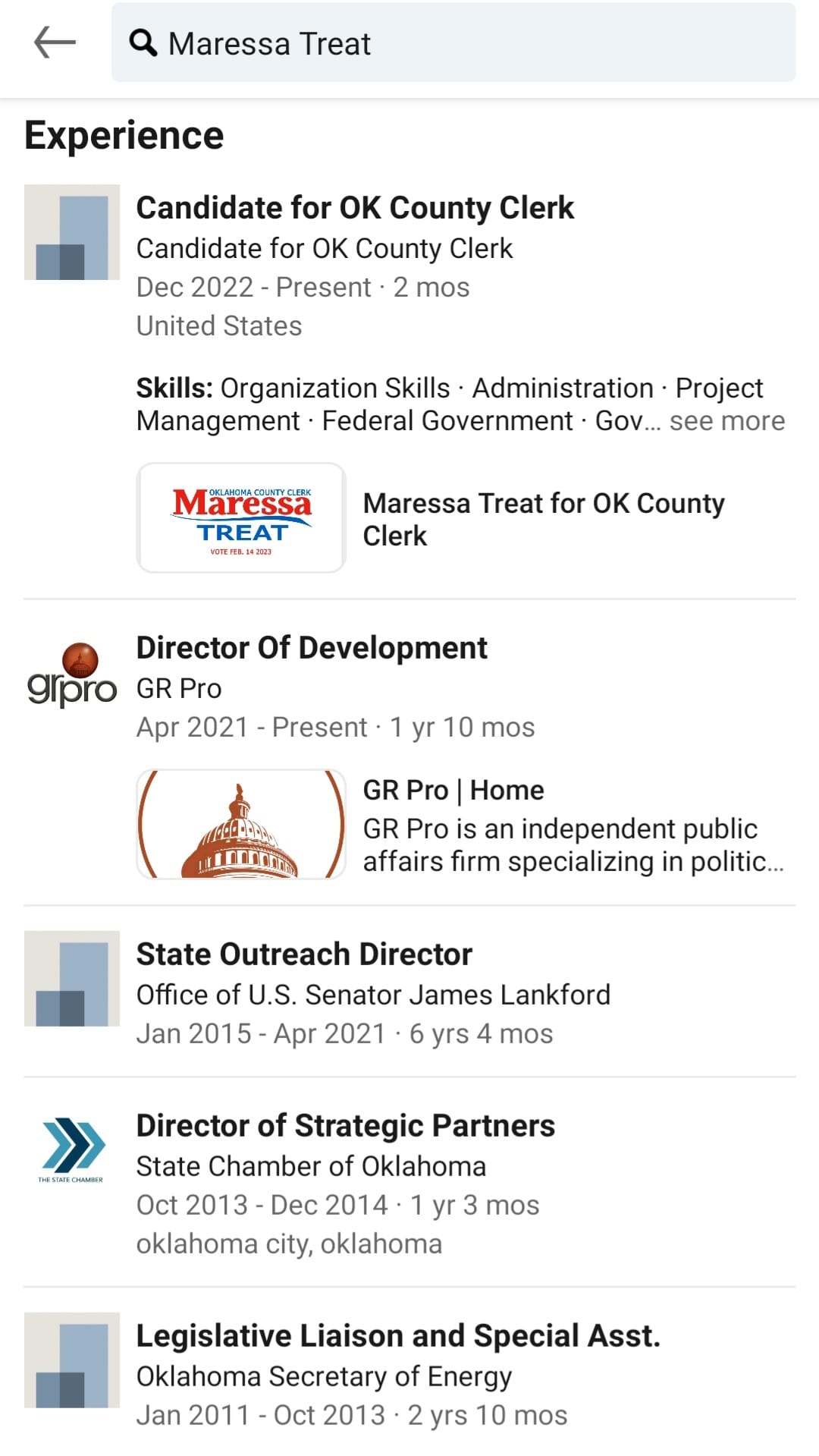
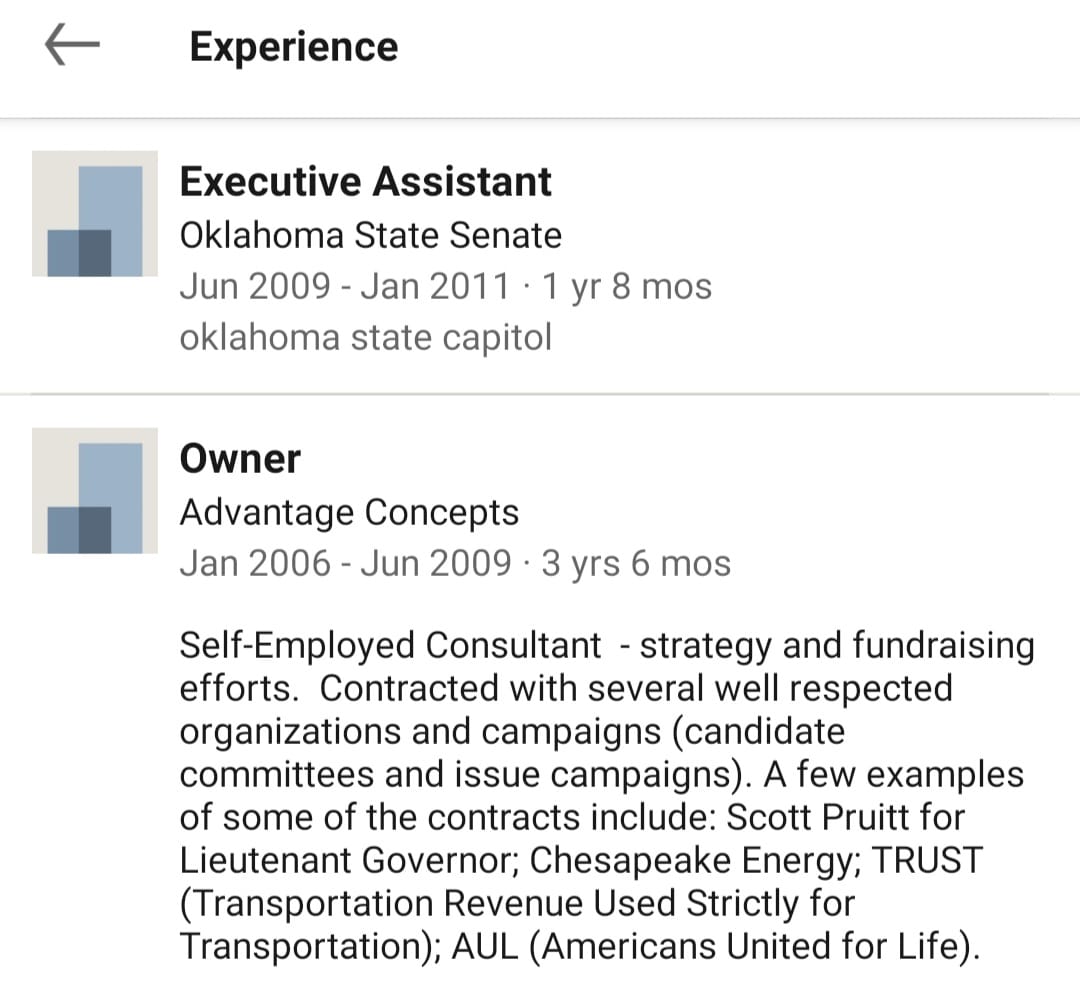
These are photos from Mrs. Treat’s LinkedIn account that describe her work history. I see nothing in her previous work history that is NOT involved in politics. Her work in the ‘private’ sector has been with the State Chamber, or firms that work as/with political consultants.


So, let’s ask the following questions:

– What makes Treat a ‘Conservative’ – let alone a PROVEN Conservative? What in her work history speaks to this statement? Her work for James Lankford? What about the State Chamber? Maybe GRPro – essentially a political consulting firm who also represents Mrs. Treat’s husband? Because she worked for Americans United for Life?

– What makes her ‘trusted’? By what group of people? Political consultants? State Chamber members? Unfortunately, none of these categories emblazon the word TRUST on my mind.

– What does being ‘pro law enforcement’ have to do with being the County Clerk? How is this connection explained on the card? Is there a connection at all, or is it a sales pitch?

– Why would it be important that she is ‘pro business’ or ‘economic growth’? What does that have to do with being the County Clerk or doing the job of County Clerk? Is this a sales pitch too?

– How does Treat provide ‘increased transparency’ and ‘accountability’? Nothing on the card speaks to that assertion at all, nor does anything in her published work history specifically.

– How do we ‘share values’? How can she make that statement without knowing mine, or anyone else’s in the County?

When you get a PUSHCARD In the mail from a candidate, ASK YOURSELF THESE TYPES OF QUESTIONS and then contact the candidate and ask them directly if you can’t ferret the answers out for yourself, or draw conclusions from their work history. DO NOT BELIEVE EVERYTHING WRITTEN ON POLITICAL MAILERS – or anything for that matter. Study everything and anything political for yourself.

The Corruption Belt: SPECIAL ELECTION STEAL ALERT: UNKNOWN Group Runs Ads Against Candidates Opposing Fount Holland (CAMP) Clients In The August 23rd Run-Off

Conservative Policy Network is yet another group in a long line of groups which is using money from who knows where (Dark Money) to influence Oklahoma elections.

As I’ve written about in previous blogs on Dark Money, campaign consultant Fount Holland was arrested on charges of conspiracy to commit a felony for breaking Oklahoma campaign laws.  At the time, Mr. Holland was running Joy Hofmeister’s campaign for State Superintendent against former SS Janet Baressi.  He was charged because it was found that he – and Mrs. Hofmeister – were working with an independent PAC to help get her elected.

FYI:  Any candidate running for office can accept donations of up to $2900 a person or $3800 per couple per each election cycle (a primary, a runoff, a general).  Think on this: that’s over $11,000.00 a couple could give a candidate during an entire election campaign.  That’s not an insignificant amount.   

Still and all, there are people who want to help candidates get elected by contributing more than what’s legal through a campaign account.  They do this by creating an “unlimited” PAC.  The PAC raises money, but doesn’t have to show where that money comes from (which is why it’s called DARK money) and then spends what they raise to help elect a candidate.  THIS IS IMPORTANT:  It is illegal for a candidate – or their campaign manager – to work with anyone associated with an unlimited PAC using money to help the candidate get elected.  They are called Independent Expenditures because the group is working to elect the candidate INDPENDENTLY of the candidate’s campaign.

Candidates have a campaign account that can be searched on the Oklahoma Ethics Commission website.  This transparency allows citizens to be able to see who is donating to that candidate.  

501c4’s only have to record WHERE and HOW their money was spent, not where it comes from.  This keeps voters in the dark about who might be influencing candidates.  Often, Dark Money IE’s are funded through an intricate web of non-profit 501c4’s and PACs which make it very hard to determine anyone associated with a group spending money on behalf of a candidate.

This set of mailers was received today.  Look more closely at the address box:

Note that it says, “Not authorized by any candidate or candidate’s committee”.  This means it’s an Independent Expenditure and it’s NOT LEGAL for a candidate or their campaign manager to be associated with the group paying for the mailer – in this case, “Conservative Policy Network”.

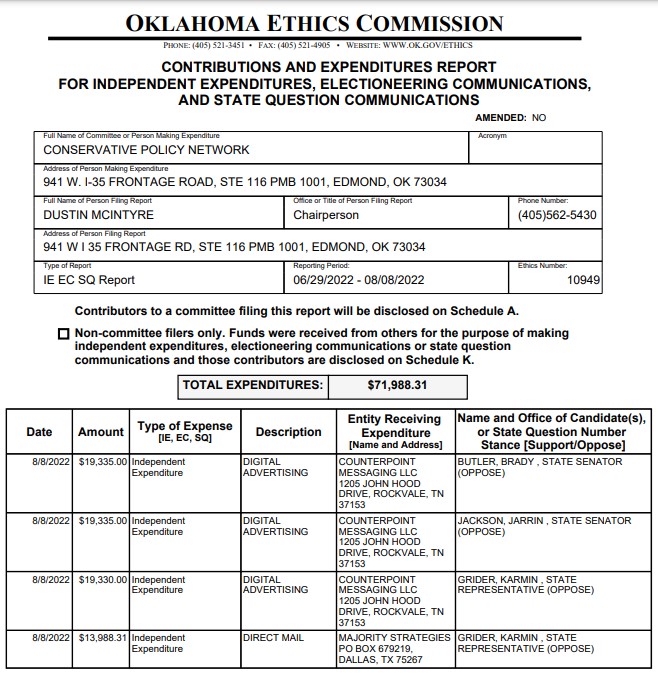
I wanted to know where this mailer came from, so I went to the Oklahoma Ethics website and searched for Conservative Policy Network.  I found the Ethics report at the top of the page.  Please note; it says it is an IE OPPOSING Brady Butler, Jarrin Jackson and Karmin Grider.

The address for the group is here:

Legitimate IE groups in Oklahoma are required to have an address to the business or group supporting the IE.  This is NOT a legal address for an Independent Expenditure in Oklahoma.  

I called the phone number associated with the group and it picks up immediately and says, “The person you are trying to reach is currently unavailable.  Please leave a message.”  (This happens with EVERY organization without a legitimate address I’ve tried.)  

Additionally, I was not able to find an associated Federal PAC, nor an associated 501c4, nor any other information at all about this group created on the 22nd of July – not even a month ago.

Who is running against the candidates being opposed by this group?  Brady Butler is running against CAMP (Fount Holland) client Darcy Jech, Jarrin Jackson is running against CAMP client Ally Seifried and Karmin Grider is running against CAMP client Collin Duel.  Odd coincidence?  Doubtful.

In a few days, I’ll be releasing a diagram of how money is flowing from 501c4 organizations and specific PACs in Oklahoma during this election year.  You’ll note at that time, that the filing agent listed on this Ethics Report is one often used by PACs/Groups associated with Fount Holland candidates or paying CAMP for work on campaigns.

DARK MONEY ADS LIKE THE ONE AGAINST KARMIN, CAN URGE VOTERS TO VOTE BASED ON LIES AND HALF-TRUTHS PAID FOR BY PEOPLE WHO WANT TO INFLUENCE ELECTIONS WITHOUT BEING KNOWN! 

DON’T MAKE AN UNEDUCATED VOTE!!

Talk to candidates directly.  Most all have websites and even phone numbers where they can be reached.  Educate yourself before you mark your ballot, don’t be misled by FAKE groups using DARK money to influence you!

Jenni White, Education Director

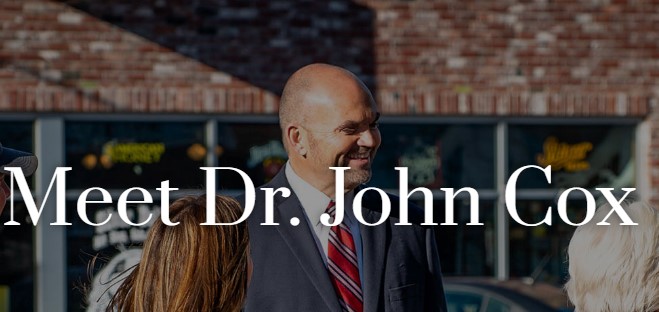
ROPE Endorses Dr. John Cox for State Superintendent

Every election since 2010, ROPE has announced support for a State Superintendent candidate.  We believe this position to be of paramount importance in the direction of education in our state.  This year is no different.

Four Republican candidates are vying for the State Superintendent’s chair:  Bill Crozier, April Grace, Dr. John Cox and Secretary of Education Ryan Walters.  ROPE held a candidate forum at Randall University on May 9th.  Mr. Crozier was unable to attend and April Grace backed out of her original commitment to appear.


WHY ROPE DOES NOT SUPPORT DR. APRIL GRACE

April Grace, Superintendent of Shawnee Public Schools, is under fire for allowing an alleged sexual predator to stay on the SPS staff.  In addition, her ethics filings find that her campaign is supported by American Fidelity Corp PAC, CCOSA administration, Former State Board Member Leo Baxter and Mid-Del Superintendent Rick Cobb, to name a few.  These are EXTREMELY concerning. 

Let’s not forget that American Fidelity, CCOSA and others were accused of conspiring with current Superintendent Joy Hoffmeister on a dark money PAC for her initial election.  Baxter and other State School Board members sued to stop the repeal of Common Core and, during the Oklahoma Standards re-write, spent significant time online lobbing verbal fireballs at any of us who dared to review the standards negatively.  In fact, there was an entire group of educators – including Rick Cobb – who fought any criticism of the standards during the re-write.  Anyone supported by a group of people so dedicated to the status quo and so hateful to others, need not be elected to statewide office.

BILL CROZIER

Bill is a very nice man – and a very interesting person – but, unfortunately, ROPE did not see him as a viable candidate in this race.

OUR TOP TWO CANDIDATES – Secretary Walters and Dr. Cox – WHY WE ENDORSED DR. COX

The ROPE Board interviewed both Secretary Ryan Walters and Dr. John Cox  several weeks after our Superintendent Forum.  They were very kind to take time with us – Dr. Cox via internet and Secretary Walters in person.

From our interviews and Superintendent’s forum, it’s abundantly clear both candidates love kids and are committed to pushing back against the educational status quo that so often inhibits parents from educating their children the way they see fit, but there are some divisions. 

ROPE has numerous concerns about the expansion of a voucher system in our state and fought vigorously to defeat SB1647 (2022) – the bill creating a voucher system for private schools.  Dr. Cox does not agree with implementation of a voucher system in Oklahoma.  Secretary Walters does.    

Though we also agree with Secretary Walters on many policy issues, he does not yet have the experience Dr. Cox has accumulated.  As Superintendent of Pegs School district for 28 years, Dr. Cox understands the difficulties imposed on educators – and superintendents – by unwieldy and burdensome state laws and federal programming, many of which negatively impact parental rights.

Recently, Dr. Cox stood up for the innocence of his students by telling a health official he would only give the CDC’s incredibly invasive, Youth Risk Behavioral Survey if he could send it home for parents to read.  He never received a return phone call asking the survey be administered.

History also plays a part.  Many of our Board remember Dr. Cox standing in solidarity with us and parents against Common Core – one of very few Superintendents who did.  We have witnessed him standing with parents and expect him to continue to do so. 

We appreciate Secretary Walters very much for running and we hope – no matter who wins the State Superintendent Chair – to work with both candidates in whatever capacity they find themselves.

Jenni White, ROPE President

Oklahoma Election Dates 2022

FEBRUARY 8 – BOARD OF EDUCATION PRIMARY ELECTION AND SPECIAL ELECTIONS
Last day to register to vote: January 14
Deadline to request absentee ballot: 5 PM, January 24
Early Voting: Thursday, February 3, 8 AM – 6 PM
                       Friday, February 4, 8 AM – 6 PM
Election Day Voting: Tuesday, February 8, 7 AM – 7 PM
APRIL 5 – BOARD OF EDUCATION GENERAL ELECTION AND SPECIAL ELECTIONS
Last day to register to vote: March 11
Deadline to request absentee ballot: 5 PM, March 21
Early Voting: Thursday, March 31, 8 AM – 6 PM
                       Friday, April 1, 8 AM – 6 PM
Election Day Voting: Tuesday, April 5, 7 AM – 7 PM
JUNE 28 – PRIMARY ELECTION AND SPECIAL ELECTIONS       
Last day to register to vote: June 3
Deadline to request absentee ballot: 5 PM, June 13
Early Voting: Thursday, June 23, 8 AM – 6 PM
                       Friday, June 24, 8 AM – 6 PM
                       Saturday, June 25, 8 AM – 2 PM (NEW HOURS)
Election Day Voting: Tuesday, June 28, 7 AM – 7 PM
AUGUST 23 – RUNOFF PRIMARY ELECTION AND SPECIAL ELECTIONS
Last day to register to vote: July 29
Deadline to request absentee ballot: 5 PM, August 8
Early Voting: Thursday, August 18, 8 AM – 6 PM
                       Friday, August 19, 8 AM – 6 PM
                       Saturday, August 20, 8 AM – 2 PM (NEW HOURS)
Election Day Voting: Tuesday, August 23, 7 AM – 7 PM
NOVEMBER 8 – GENERAL ELECTION AND SPECIAL ELECTIONS
Last day to register to vote: October 14
Deadline to request absentee ballot: 5 PM, October 24
Early Voting: Wednesday, November 2, 8 AM – 6 PM (EXTRA DAY)
                       Thursday, November 3, 8 AM – 6 PM
                       Friday, November 4, 8 AM – 6 PM
                       Saturday, November 5, 8 AM – 2 PM (NEW HOURS)
Election Day: Tuesday, November 8, 7 AM – 7 PM

Blog at WordPress.com.

Up ↑