Search

ROPE Report

Month

January 2023

Isn’t CRT Banned in Oklahoma?

Guest Post By Dayna Mooney – Chapter Chair, Moms For Liberty (Canadian County, OK)


Like many Parents, we have discovered things being taught to our children with which we disagree.

Some members have even taken it further and begun researching the curricula being used, looking into Teachers that are in our schools, books in our School Library or even considered running for a School Board seat themselves.

For me, it was the COVID lockdowns that lead me to see what my children were being taught and what they weren’t being taught, a discovery that eventually lead me to start a Chapter in Canadian County for Moms for Liberty. Moms for Liberty works to empower Parents to advocate for their children and take back their Parental Rights.

During each of our Chapter meetings, we review School Board Agendas for School Districts that are represented within our Chapter.

During the October 27th Chapter meeting of last year (2022) we discussed Out of State Approvals for Yukon Public Schools, in particular an approval for the District Social Studies Curriculum Coordinator to attend the National Council for Social Studies Conference in Philadelphia, PA, December 1-4, 2022. Curious, we researched further.

It turns out, this conference is one of the largest gathering of K-12 social studies classroom teachers in the US. While we have no idea which of the 500+ sessions this teacher chose to attend, these were the 6 Sub Themes covered in this Conference:

  1. Connecting Educators as Learners
  2. Teaching Civil Discourse
  3. Embracing Hard History
  4. Building Critical Media Literacy
  5. Fostering Global Citizens
  6. Navigating the Political Landscape in Teaching Social Studies

These were some of the Workshops/Sessions available at this Conference:

  • Teaching History for Justice
  • Critical Race Theory and Social Studies Futures
  • Be(com)ing Stranger: Towards a Posthuman Social Studies
  • Proceeding with Caution and Care: Examining Classroom Simulations Through the Lens of Educational Equity
    • Participants will investigate classroom simulations, focusing on the challenges and dangers that surround their use. Presenters will provide administrators and supervisors strategies for identifying harmful simulations and how to coach teachers away from using them and move toward more culturally responsive, culturally sensitive, and more equitable and inclusive classroom activities
  • Embracing Student Activism
    • How a Pride Flag led to lobbying in Congress: learn how a school district located on indigenous territory embraced student activism and the opportunities it created
  • Mind the Gap: Tackling Conspiracy Theories in the Classroom
    • Combatting the prevalence of misinformation available to students is a challenge in classrooms today. Discover strategies for debunking common 9/11 conspiracy theories that translate across a variety of content and subjects.
  • Exploring Primary Sources in Ethnic Studies: Using the Library of Congress to Create School District Professional Development
    • Learn how Houston ISD leveraged their Teaching with Primary Sources grant award to expand teacher access to ethnic studies knowledge, teaching resources, and curriculum
  • Teaching Critical Race Theory with Primary Source Documents
    • Learn how two educators used primary sources to support the curriculum of a dedicated Critical Race Theory class at the college level. Connections to the K-12 classroom will be shared
  • How to Teach the Truth and Not End Up in the Principal’s Office
    • The Library of Congress and the TPS Teachers Network have resources and professional support to aid educators in their quest to teach accurate history in an era of divisive topics laws.
  • Diversity and Inclusion Pedagogy for Teaching Global Learning and Leadership
    • Explore project-based instructional techniques and best practices that empower and immerse students more deeply in the Global Citizenship learning experience by utilizing diverse and inclusive student-led engagement activities
  • The 1619 Project, Critical Race Theory, Divisive Concepts Legislation: Empowering Teachers and Communities to Confront the Politicization of Social Studies
    • Unravel the politicization of the 1619 Project, Critical Race Theory, and divisive concepts legislation with other educators who seek to confront racialized rhetoric with truth
  • Fostering Community, Understanding, and Growth Through Civil Dialogue
    • Explore meaningful methods for creating, building, and fostering civil dialogue techniques with your students to increase content understanding, promote social-emotional learning, and maintain community among your students.
  • The Color of Law: Exploring Systemic Racism in Housing Policy Using PBL
    • Using the project-based learning model, U.S. History/Government teachers can position students to raise awareness of systemic racism in housing policy using Richard Rothstein’s 2017 book The Color of Law.
  • Truth and Reconciliation: Sexual Slavery During World War II
    • Inquiry about sexual slavery during World War II with embedded best Social Emotional Learning practices by examining transgressions of the past and truth and reconciliation
  • Don’t End up on the News! A Trauma-Informed Approach to Teaching Hard History
    • Don’t let the headlines scare you! New teachers, let’s talk about ways to approach hard history using trauma-informed best practices
  • Teaching Untold Stories to Inspire Children as Changemakers
    • Challenge the dominant discourse of the civil rights movement in elementary social studies and, instead, embrace teaching unsung heroes in an effort to create social justice advocates in our students
  • Combating Misinformation with Culturally Responsive Teaching
    • Explore innovative approaches for designing and implementing culturally responsive instruction. With a firm understanding of these techniques and principles, attendees will reap the benefits of these lessons
  • Reimagining Civic Action: Human Rights Close to Home
    • Hear youth scholars and educators share how Human Rights Education can serve as a blueprint for experiential learning that promotes student civic engagement and activism

As you can see, there was a theme to what was being discussed at this Conference. Any teachers in attendance will then bring what they’ve learned back to the District and share it with their fellow teachers, maybe even during a Professional Development, or other training day.

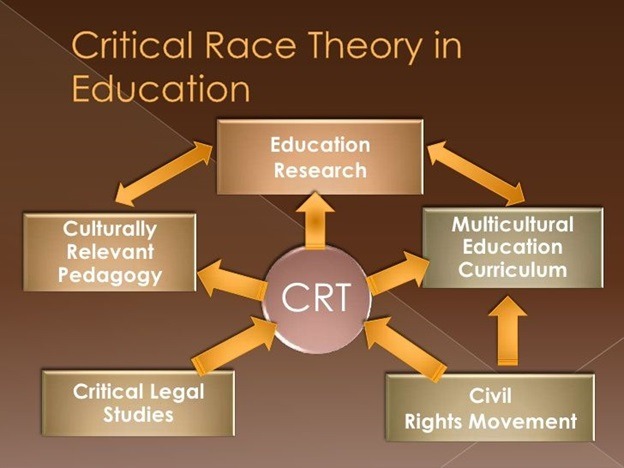
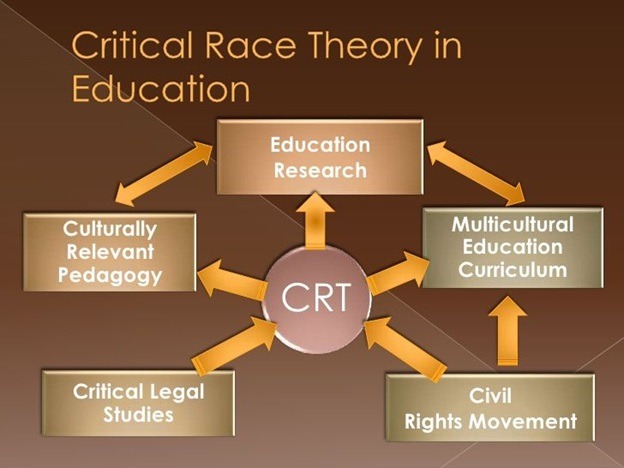
As you can see with the picture below Critical Race Theory, Cultural Relevant Pedagogy, Multicultural Education and Civil Rights Movement are all one in the same. Many use buzz words to get around Critical Race Theory laws within the State in order to continue teaching it in our Schools.
Another commonly known buzz word that we hear now is Social Emotional Learning or SEL, MANY Schools, if not all are using some type of SEL Program within our Schools. All of these are vehicles for Critical Race Theory, no matter what you call them and are designed to infringe on a Parent’s Right to educate their children in the worldview of their family. These programs promote feelings and behaviors that are not usually reflective of our teachings as the parent.

In December of 2020, CASEL (Collaborative for Academic, Social and Emotional Learning) updated their definition for SEL to showcase the value of SEL as a weapon for social justice. These SEL programs gather non-cognitive data using attributes, feelings, grit, mindsets and more that’s been gathered through various programs and different terminology. None of which can be fairly assessed with a computer.

Do you remember Common Core that’s also against the law to teach in Oklahoma? SEL, CRT are just the newest versions of Common Core, just a different name, pretty bow on the surface that ultimately pushes the same message that focuses less on academics and more on mindsets, feelings and behaviors. SEL claims to improve test scores, but as we are seeing by the latest release, it’s done the opposite. Just one of many claims, that have all proven to do the opposite.

All of these programs, no matter what you call them, get in the way of good, efficient teaching. Teachers are being asked to take on the role therapists, which they aren’t trained for, nor do they want to be therapists in most cases. Running off good teachers, to make way for the activist teachers to be the student’s parent, tell them how to think and how to hate their Country!

As Parents, we have to stand up against this agenda and do our part to get our Education System back on track! Even if your children are grown, you have a place in this fight as well! The more the merrier!

These are some results of SEL Teachings. You may already be seeing them in your School;

  • Larger Class Sizes
  • More about Diversity
  • Changes to what was once a Zero Tolerance Policy
  • Grading Policy Changes on some or all Levels
  • School(s) are becoming overpopulated

Follow the link below to see a graphic to connect CRT to SEL and more

https://drive.google.com/file/d/19j0O_0aAdQPjbazAA842ncsGfTAGxvz2/view?usp=sharing

For more information on Moms for Liberty feel free to visit www.momsforliberty.org or email me, Dayna Mooney at moms4liberty_canadiancounty@protonmail.com.

For more information on SEL, see Six Reasons Why The Oklahoma State Legislature Should Ban The Use of SEL – Social Emotional Learning Through SB1442

Senator Jett has filed SB1027 (2023) to stop the teaching of SEL.
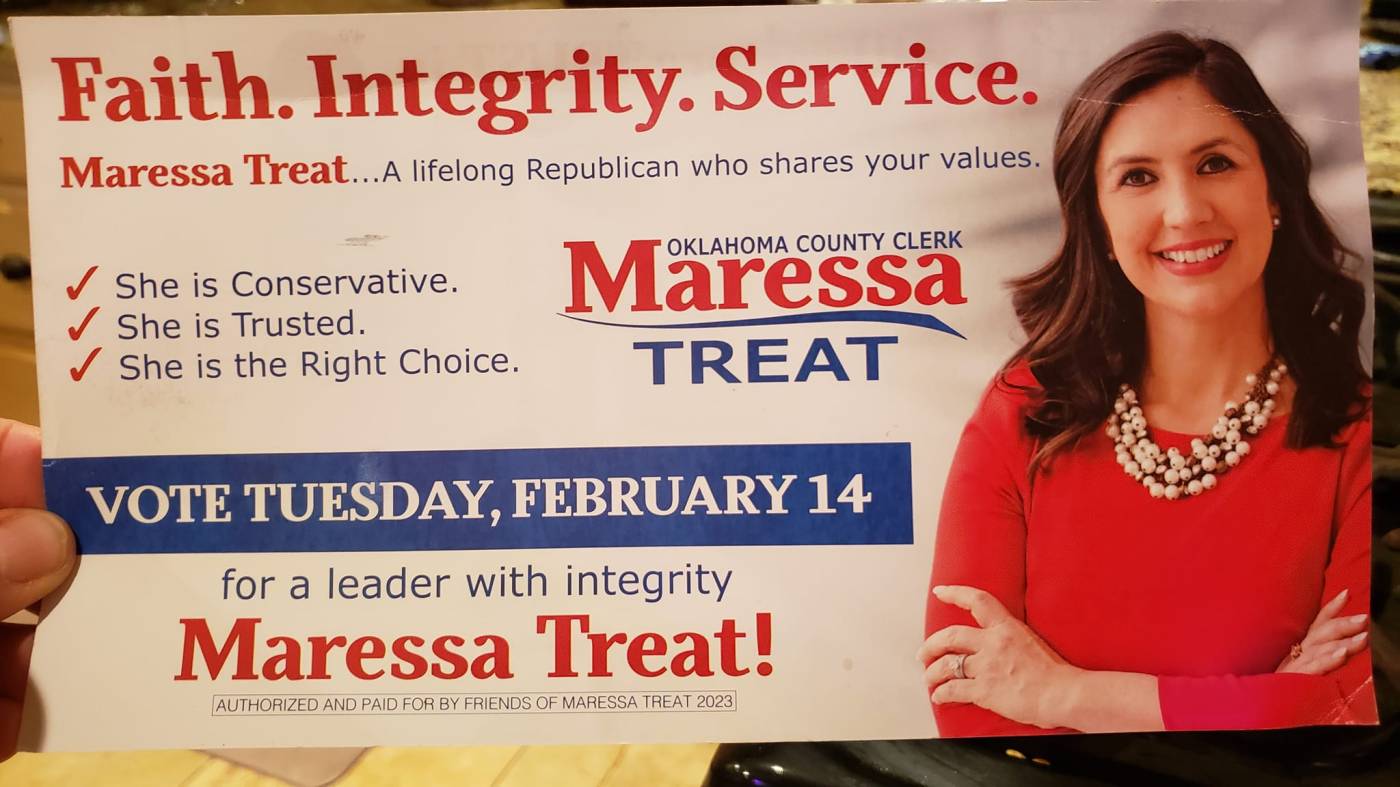
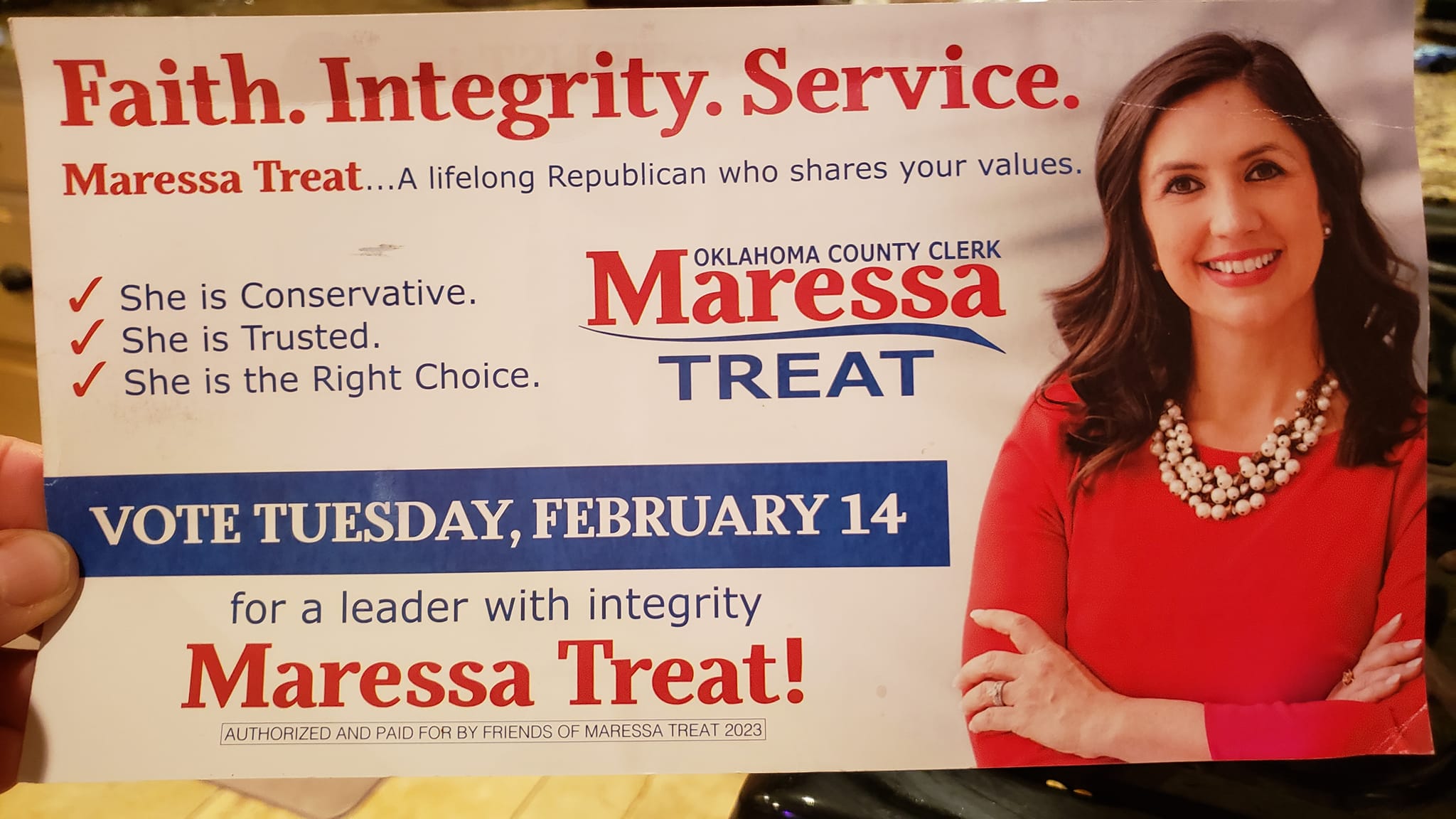
Anatomy Of A Political Pushcard

Maressa Treat – wife of State Senate ProTemp Greg Treat (who was challenged for his position as ProTemp for the 2023 session) – is running for Court Clerk.

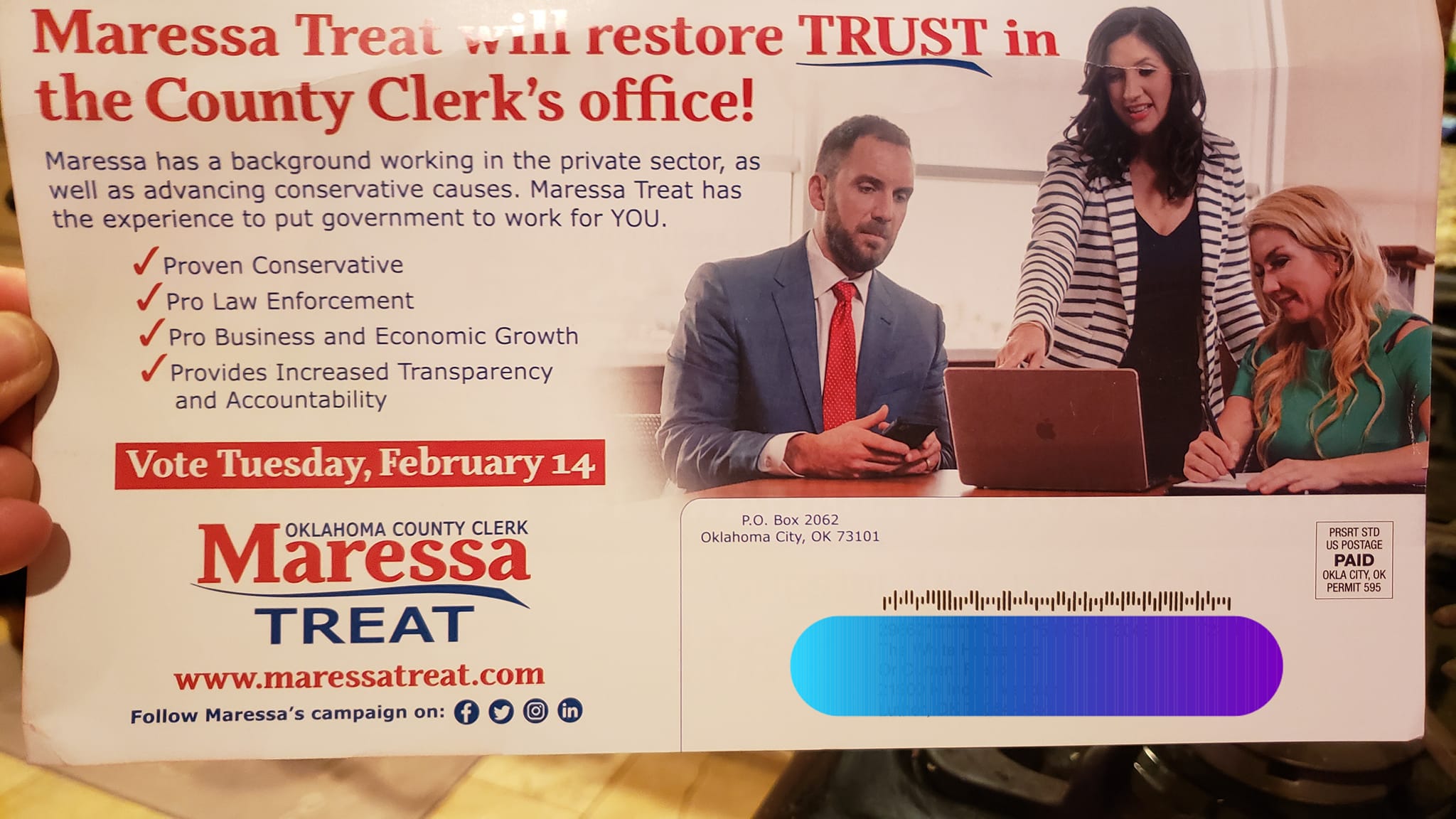
These are photos from Mrs. Treat’s pushcard which I received in the mail the week of January 23rd. These cost money to design, print and mail. Because of this, Oklahoma Ethics Rules require that Ethics forms be filed – for transparency sake – with the Oklahoma County Election Board (OCEB) in the case of a County election such as County Clerk.

This morning, I called the OCEB. The woman who answered had to ask someone whether or not they ‘could’ provide the reports to me. She returned to the phone and explained that I would have to come to the OCEB where I could “look” at them. They would not provide these forms electronically.

Cleveland County provides Ethics forms electronically if you call them and Muskogee County posts Ethics forms online. What is the matter with the OCEB? This is PUBLIC information. Something else here to be considered.


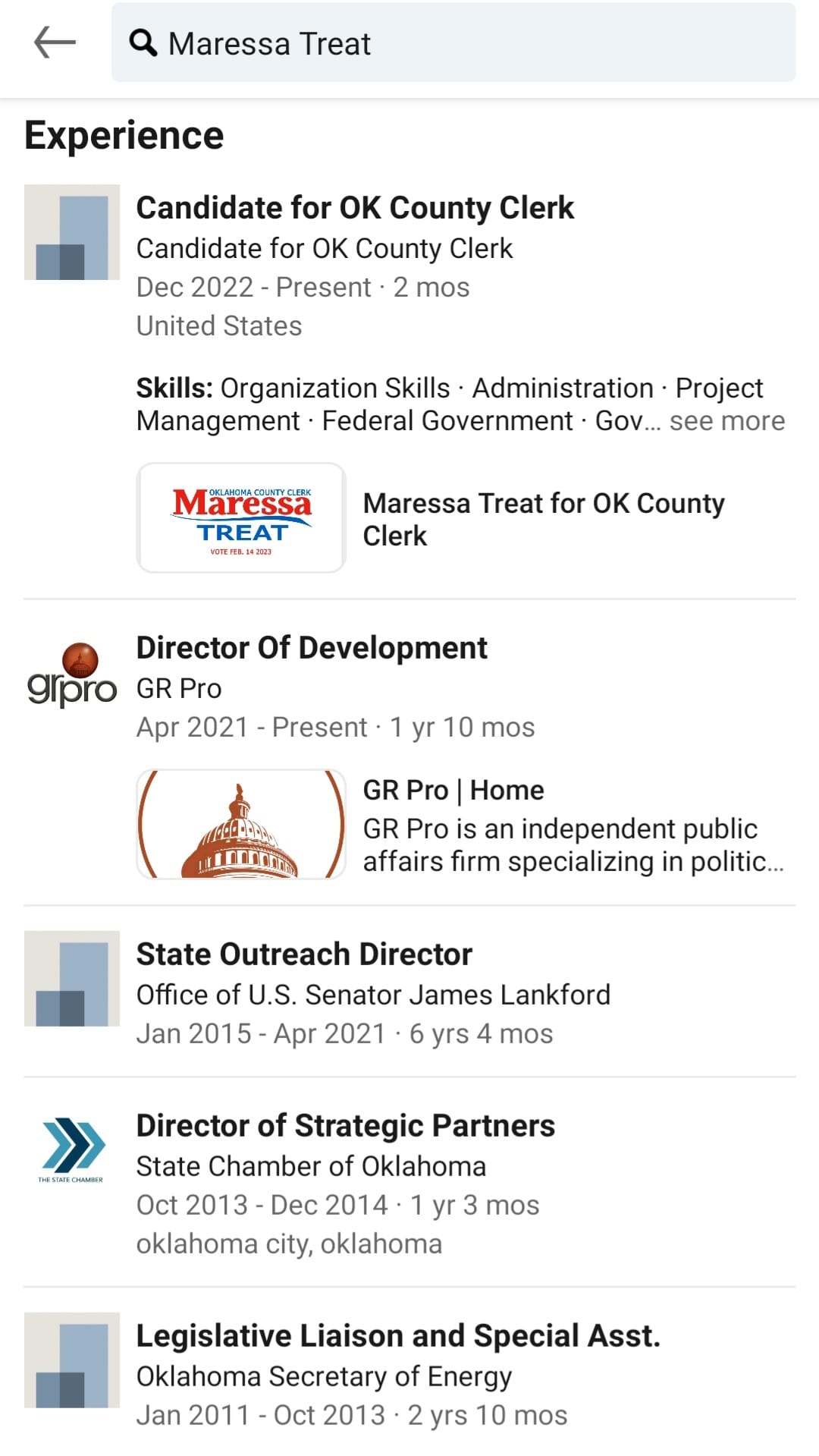
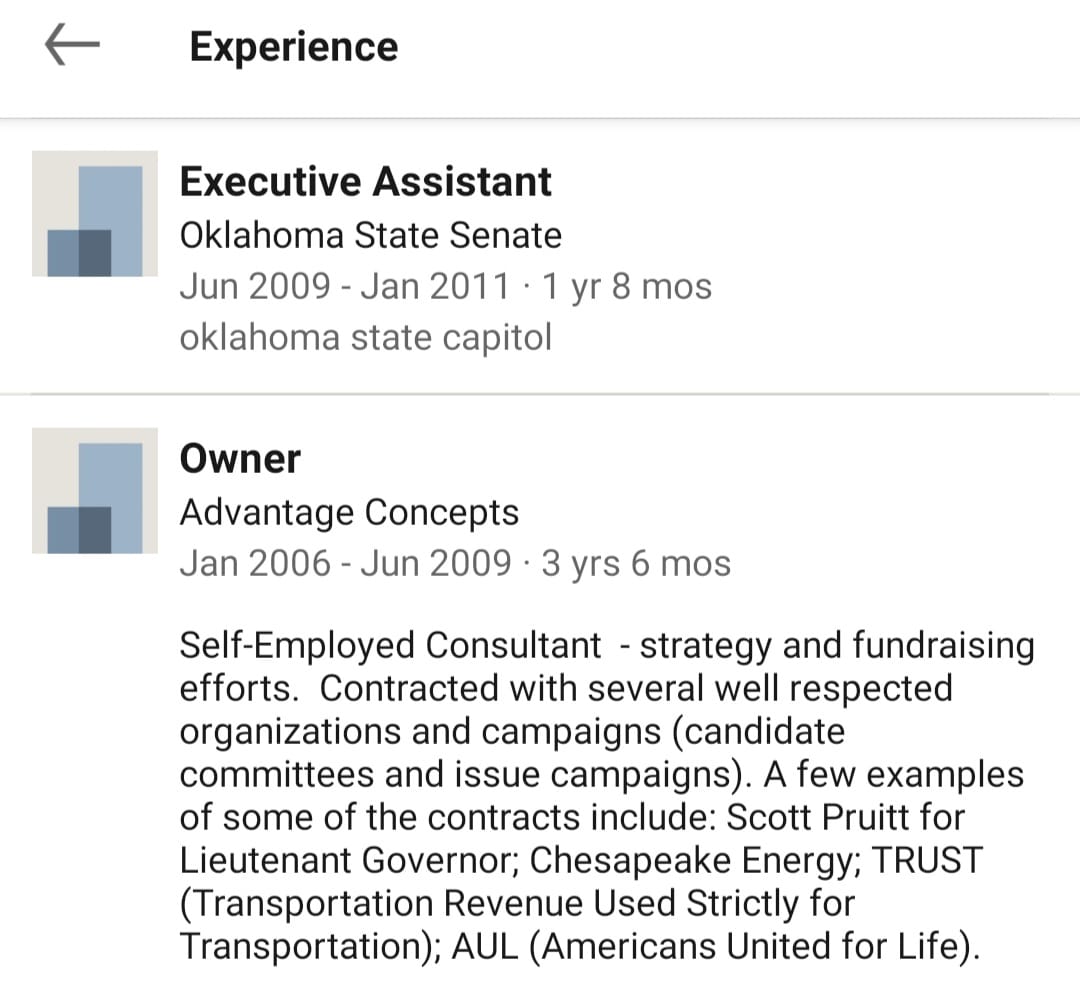
These are photos from Mrs. Treat’s LinkedIn account that describe her work history. I see nothing in her previous work history that is NOT involved in politics. Her work in the ‘private’ sector has been with the State Chamber, or firms that work as/with political consultants.


So, let’s ask the following questions:

– What makes Treat a ‘Conservative’ – let alone a PROVEN Conservative? What in her work history speaks to this statement? Her work for James Lankford? What about the State Chamber? Maybe GRPro – essentially a political consulting firm who also represents Mrs. Treat’s husband? Because she worked for Americans United for Life?

– What makes her ‘trusted’? By what group of people? Political consultants? State Chamber members? Unfortunately, none of these categories emblazon the word TRUST on my mind.

– What does being ‘pro law enforcement’ have to do with being the County Clerk? How is this connection explained on the card? Is there a connection at all, or is it a sales pitch?

– Why would it be important that she is ‘pro business’ or ‘economic growth’? What does that have to do with being the County Clerk or doing the job of County Clerk? Is this a sales pitch too?

– How does Treat provide ‘increased transparency’ and ‘accountability’? Nothing on the card speaks to that assertion at all, nor does anything in her published work history specifically.

– How do we ‘share values’? How can she make that statement without knowing mine, or anyone else’s in the County?

When you get a PUSHCARD In the mail from a candidate, ASK YOURSELF THESE TYPES OF QUESTIONS and then contact the candidate and ask them directly if you can’t ferret the answers out for yourself, or draw conclusions from their work history. DO NOT BELIEVE EVERYTHING WRITTEN ON POLITICAL MAILERS – or anything for that matter. Study everything and anything political for yourself.

An Analysis of Three Oklahoma Voucher Bills:  SB822 (Daniels, 23), SB943(Jett, 23), SB1647 (Treat, 22)

To study the Voucher (state aid – aka tax dollars/public funds – for private schools) issue in Oklahoma, I have reviewed three Oklahoma voucher bills originating in the Oklahoma Senate – one from 2022, the other two from the 2023 legislative session – and compared them against each other.

According to an article in 538 – 14 states already have universal voucher programs or are attempting them via legislation in 2023. 

Oklahoma, then, is not leading, we’re simply following the explosion of ‘universal’ voucher legislation being forwarded through the states from a variety of national, multimillion dollar private, non-profit organizations, including Milton Friedman’s EdChoice, a Charles Koch/Walton Foundation joint venture called yes. every. kid., Jeb Bush’s ExcelInEd, The Walton Family Foundation, Betsy DeVos’ American Federation for Children, and a conglomeration of many school choice advocate groups led by DeVos under the umbrella The Alliance For School Choice and Americans For Prosperity.  

Oklahoma houses state groups operating under their national parents – American Federation for Children and AFP – as well as Oklahoma-originated “choice” groups,  OCPA and Scissortail, both of which are interconnected and involved with the groups Choice Matters and the Parent Voice Oklahoma network. 

Yearly, millions of dollars are spent by ‘school choice’ advocacy groups, whose donations fund election campaigns for and against ‘choice’ candidates and lobbying efforts, instead of creating and seeding the Education Savings Accounts they spend so much money on lobbyists to force STATE TAX PAYERS to fund.

OKLAHOMA PARENTS HAVE EDUCATIONAL CHOICE

Let’s be clear.  Oklahoma parents have EDUCATIONAL CHOICE.  In fact, one of the first school “choice” organizations, EdChoice, outlines the variety of ‘choices’ available to parents in Oklahoma on their website, saying:

“Oklahoma offers K–12 students and their families several types of school choice, including two private school choice programs, charter schools, magnet schools, home schooling and inter-district public school choice via an open enrollment policy.”

So, not only does Oklahoma have a WIDE VARIETY of choices available to parents to educate their children, we also have TWO SEPARATE WAYS to help Oklahoma public school students attend PRIVATE SCHOOLS without further legislation.

If Oklahoma already has full Educational Choice, what does the term “School Choice” mean other than specifically, “universal vouchers”.

If Oklahoma already has full Educational Choice, then why must Oklahoma institute Universal vouchers?  Vouchers, like other ‘private/public’ partnerships take private schools and introduce money from the state coffers.  All state money should come with strings that provide public accountability for the money forcibly taken from the tax payer and benevolently gifted to another for use.  In that case public money MUST impose restrictions on private schools/institutions that weren’t there before the public dollars were introduced.  Thus, private becomes – in essence – public, no matter what any legislation says.

Why would Oklahomans want to be deprived of the choice of true private schools?  How does that action provide educational choice?  And for all the tin-foil-hat-wearing readers – doesn’t making all schools public provide excellent inroads toward one world government?  Just a few thoughts to mull over while reading the mechanics of the bills.

OKLAHOMA BILLS

All three bills have the same opening lines in Section 1 (the first section of New Law) – my favorite of which begins, “It is the intent of the legislature…”  Apparently the authors haven’t read the axiom about the road to hell and intent.

By my count, all three bills make the State Treasurer’s office responsible for no less than 20 EXTRA jobs – and that’s on top of the biggest job of all – accountability for a whole new Revolving Fund storing taxpayer dollars.

SB822’s (’23, Julie Daniels; co-author SB1647 ’22) voucher program is called the “Oklahoma Education Freedom Act”.  Freedom, however, isn’t provided by 7 new sections added to the overcrowded books of Oklahoma law.

SB943’s (’23, Shane Jett; co-author SB1647 ’22) voucher program is called, “The Oklahoma Parent Empowerment Act for Kids Account – or the OK PEAK Account”.  The state cannot ‘empower’ parents by taking money from their budgets by force and then offering that money to others to do something they couldn’t already do on their own budget.  That’s welfare, not empowerment. 

SB1647’s (’22 Greg Treat) voucher program was to be called, “The Oklahoma Empowerment Act”.  (To find the text of the bill, go to the Oklahoma Legislature.  From the top menu, click on “Legislation”, then click on “Advanced Bill Search”.  Type in SB1647 in left box, pull down 2022 regular session and select, then push “retrieve”.  Click on the “floor version” hyperlink as that was the bill voted on in the Senate last year.)

BASIC INFO:

DescriptionSB1647SB822SB943
Identifies the Treasury as “Agent/Agency” over created student accounts – drastically expanding that officeXXX
Number of new sections added to Oklahoma State law676
Stipulates qualifying student must be within 300% of income to qualify for free or reduced lunchX  
Calculation made for each eligible student approved to participate in the Account =  total State Aid factors including pupil category weights for the applicable school year X grade weight generated by the student for the applicable school yearXXX
Constitutional homeschoolers carved out of participation with specific language “other means of education”X––

Here I will summarize ALL parts of the bills.  In some cases, I will copy the bill word-for-word and CAPITALIZE the lettering.  These are the points that need careful consideration and the points on which I will opine in my next piece.

FYI:  ESP = Education Service Provider, OSDE = Oklahoma State Department of Education, Agency = The Oklahoma State Treasurer’s Office.  Act is used to cover EVERY Act since they are nearly 100% similar and Account is used to denote every Account though the bills give them specific names.

SPECIFIC INFO:

DescriptionSB1647SB822SB943
*Section 2 (New Law); definitions are all the same excepting Act/Account names XXX
Section 2C1; Applications made to Agency – no deadline for submissionXXX
Section 2C2; Agency establish procedures to approve applications – parents agree to: Use Account for only qualified expenses, NOT ENROLL STUDENT IN FULL-TIME PUBLIC SCHOOL, Comply w/Agency rules, NOT ACCEPT Lindsey Nicole Henry SCHOLARSHIP FOR STUDNETS W DISABILITIESXXX
Section 2C3; Antidiscrimination provision–XX
Section 2D; Student not required to be ENROLLED FULL OR PART TIME IN A PRIVATE BRICK/MORTAR OR ONLINE SCHOOLXXX
Section 2E; Accounts may be closed if: Student RE-ENROLLS IN PUBLIC SCHOOL FULL TIMEX––
Student ENROLLED FULL TIME IN PUBLIC SCHOOL–XX
Intentional misuse, Graduation, or age 21XXX
Section 2F; If student moves to PUBLIC SCHOOL deposits suspended/remitted to GR fund at year endXXX  
Section 2G1; Agency requests state aid eligibility from OSDE (via calculation listed above) Student accounts funded monthlyAgency notifies OSDE regarding account changesXXX
Section 2H; ESP can’t share/refund/rebate money to parent or student only to AccountXXX
Section 2I; PARENTS PROBHIBITED FROM DEPOSITING INTO ACCOUNTXXX
Section 2J; Account monies NOT TAXABLEXXX
Section 2K; Funds accrue monthly/yearlyXXX
Section 3 (New Law)A; Agency maintains public list of ESPsXXX
Section 3B; Agency provides Account holders information including the ROLE OF ANY PRIVATE FINANCIAL MANAGEMENT FIRM OR OTHER PRIVATE ORGANIZATION WITH WHICH THE AGENCY MAY CONTRACT TO ADMIN THE ACTXXX
Section 3C; Agency provides Account students w/disabilities notice  that PARTICIPATION IN THE ACCOUNT SHALL HAVE THE SAME EFFECT AS A PARENTAL REVOCATION OF CONSENT PURSUANT TO 20 U.S.C., SECTIONS 1414(a)(1)(D) AND 1414(C) OF THE INDIVIDUALS WITH DISABILITIES EDUCATION ACT (IDEA) and rights parents of Account holders have under IDEA and any applicable state laws/regulations.XXX
Section 3D; AGENCY MAY CONTRACT WITH PRIVATE FINANCIAL MGT FIRM OR OTHER PRIVATE ORG TO ADMIN ACCOUNT.XXX
Section 3E; Agency may withhold funding from deposits to admin Account at 5% first 2 yrs and 3% yearly afterXXX
Section 3F; Agency SHALL establish system to pay ESPs from Account via electronic or online funds transferXXX
Section 3F1; Payment system requirementsXXX
Section 3F2; AGENCY MAY CONTRACT W PRIVATE ENTITIES TO DEVELOP PAYMENT SYSTEMXXX
Section 3G; Agency implement rating system for ESPsXXX
Section 3H; Partial payments in advance of services may be paid to ESP and then deducted from depositsXXX
Section 3I; AGENCY HAS AUTHORITY TO CONDUCT/CONTRACT FOR ACCOUNT AUDITING – SHALL CONDUCT RANDOM AUDITS OF 10% OF ACCOUNTS ANNUALLYXXX
Section 3J; Agency as authority to remove eligibility if intentional/substantial misuse of Account fundsXXX
Section 3J1; Agency creates procedures to determine misuse. If misuse by parent, student shall be eligible in future X X X
Section 3J2; Agency has authority to refer to AG for fraud investigationXXX
Section 3J3; Parents may appeal revocation of account eligibilityXXX
Section 3K; Agency may cease payments to ESP for: Intentional misrepresentation/failed to refund overpaymentsRoutine failure to provide servicesXXX
Section 3L; Agency shall create procedures for ESP sanctions, ESP must notify parents if prohibited, ESP may appeal prohibitionXXX
Section 3M; AGENCY MAY ACCEPT GIFTS AND GRANTS FROM ANY SOURCE TO SUPPORT ADMINISTRATION OF ACCOUNT TO – ADVERTISE PROGRAM – AND FUND ADDITIONAL ACCOUNTSXXX
Section 3N; Agency promulgate rules for Act Creation of anonymous online fraud reporting service, Creation of anonymous phone hotline for fraud reporting, Requiring surety bond for ESPs funded over 100KRefunding payments from ESPs back to AccountsXXX
Section 4 (New Law)A; AGENCY MAY APPROVE ESPs ON OWN INITIATIVE, AT REQUEST OF PARENTS, AT REQUEST OF A PROSPECTIVE ESP.XXx
Section 4B; Prospective ESP shall Submit notice to Agency of desire to participate and receive funds, AGREE NOT TO REFUND, REBATE, OR SHARE ACCOUNT FUNDS WITH PARENTS/STUDENTSXXX
Section 4C; Public school of Account student must provide records to PRIVATE SCHOOL ESPXXX
Section 4D; NOTHING IN THIS ACT SHALL LIMIT THE INDEPENCE OR AUTONOMY OF AN ESP OR MAKE THE ACTIONS OF AN ESP THE ACTIONS OF STATE GOVERNMENT. ESPs SHALL BE GIVEN MAXIMUM FREEDOM TO PROVIDE FOR THE EDUCATIONA NEEDS OF ACCOUNT STUDENTS WITHOUT GOVERNMENAL CONTROL. AN ESP ACCEPTING PAYMENTS FROM ACCOUNT AS DIRECTED BY PARENTS PURSUANT TO THIS ACT SHALL NOT BE CONSIDERED AN AGENT OF THE STATE OR FEDERAL GOVERNMENT.AN ESP SHALL NOT BE REQUIRED TO ALTER ITS CREED, PRACTICES, ADMISSIONS POLICY OR CURRICULUM TO ACCEPT PAYMENTS AS DIRECTY BY PARENTS FROM AN ACCOUNT.XXX
Section 4E; NOTHING IN THIS ACT SHALL BE CONSTRUED TO EXPAND THE REGULATORY AUTHORITY OF THE STATE, ITS OFFICERS, OR ANY PUBLIC SCHOOL TO IMPOSE ANY ADDITIONAL REGULATION OF ESPs BEYOND THOSE NECESSARY TO ENFORCE THE REQUIREMENTS OF THE ACCOUNT.XXX
Section 4F; If judicial finding of noncompliance w D/E Agency docked 5% in state funding for following fiscal year–XX
Section 4G; Account student/parent has cause of action against Agency in case of noncompliance w D/E_XX
Section 5 (New Law); Creates continuing, yearly, revolving fund for Account.  Account SHALL CONSIST OF ALL MONIES RECEIVED BY THE OFFICE OF THE STATE TREASURER FROM APPROPRIATIONS, GIFTS, GRANTS, DONATIONS AND BEQUESTS. Agency budgets, appropriates and expends Account monies. Expenditures made by Agency issued warrants.XXX
Section 6 (New Law)A; State bears burden in legal proceedings challenging application of Act to ESPXXX
Section 6B; NO LIABILITY SHALL ARISE ON PART OF AGENCY, THE STATE, A PUBLIC SCHOOL DISTRICT/CHARTER/MAGNATE SCHOOL BASED ON AWARD OF OR USE OF AN ACCOUNTXXX
Section 6C; If the Act is challenged in court, parents are allowed to defend the Act against the challengeXXX
Section 6D; The Act provisions are severable so that if one is struck by the court, the rest of the Act survivesXXX
Section 7 (New Law); An additional $274,743,402 will be appropriated to the OSDE to support public schools X 
Section 7 (Section 8, SB822); Act effective July 1, 2023XXX
Section 8 (Section 9, SB822); Emergency clauseXXX

* Selected definitions:

            4. Education Service Provider (ESP) = person, business, public school district, public charter school, magnet school, institution with The Oklahoma State System of Higher Education, or organization that receives payments from a parent directing an Account to provide educational goods and/or services to Account students.

            5. Eligible Student = resident of the state eligible to enroll in a public school in the state

            6. Account student = eligible student approved to participate in Account

            7. Qualified Expenses include: tuition/fees to PRIVATE school, NON-PUBLIC ONLINE school, services contracted for and provided by a PUBLIC DISTRICT or PUBLIC SCHOOL, instructional materials, computer/technology needs, tuition/fees for extracurricular activities, NATIONALLY STANDARDIZED ASSESSMENTS, tuition/fees for summer programs, tuition/fees to a technology center school, OCCUPATIONAL/BEHAVIORAL/PHYSICAL/SPEECH-LANGUAGE/AUDIOLOGY therapies, tuition/fees concurrent enrollment, transportation fees, ANY OTHER QUALIFIED EXPENSE APPROVED BY THE AGENCY

SB943 (Jett) includes the following definitions not found in the other bills. Though the definitions are included in SB943, there is not a single place in the bill that mentions either definition:

            9. “Reporting Agency” =

                        a. parent’s state representative or senator

                        b. the board of education for the resident district of the parent, as determined by Section 1-113 of Title 70 of the OK Statutes

                        c. the State Board of Education, or

                        d. the county sheriff for the county in which the parent resides

            10. “Trigger district” = a school district in this state where (a whole range of liberal/woke concepts/activities) have been tolerated:

                        a. example; obscene books, furries, sex ed, gender identity/sexual orientation instruction

Blog at WordPress.com.

Up ↑