Search

ROPE Report

Tag

voters

OK Initiative Petition Legislation – Does It Threaten Our ‘Democracy’?

No. We live in a Republic.

Okay. Trick question, but that’s (I hope obvious) to make a point here. Sometimes when the shrieking about something is so loud you have to put your hands over your ears (hypothetically), it’s Kabuki Theater, not reality.

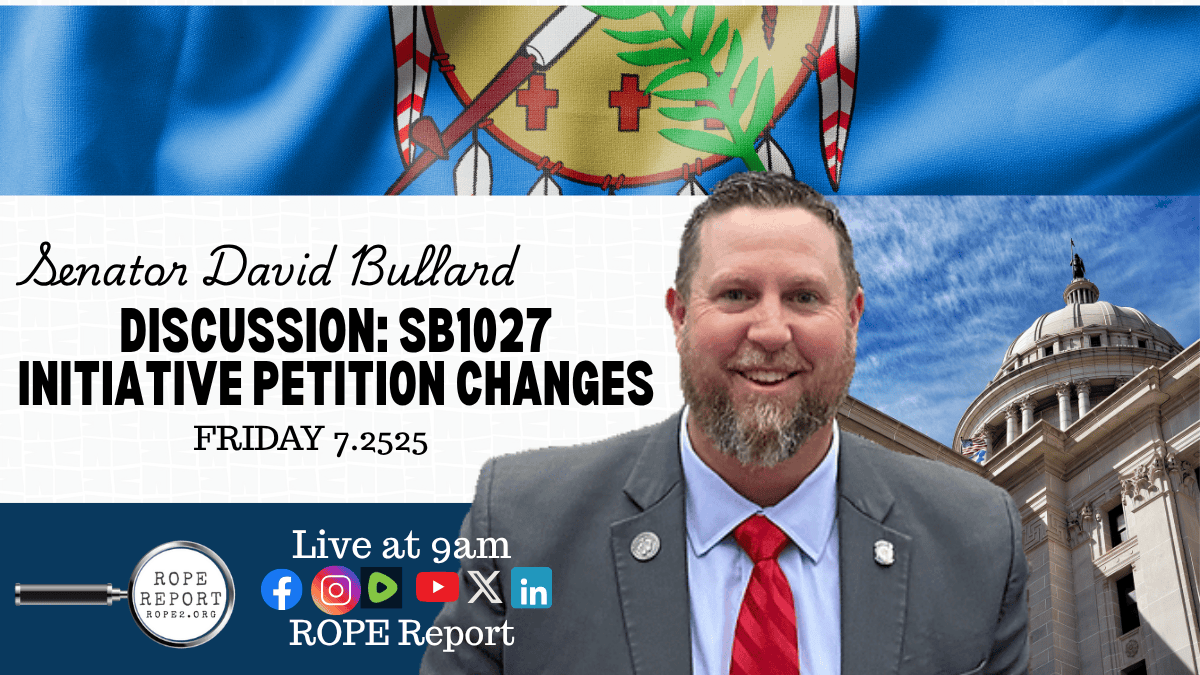
The shrieking SB1027 received was LOUD and varied. There were even conservatives up in arms. Consequently, we had the author of the bill – Senator David Bullard – on with us to WALK US THROUGH the bill. You can see the full live video on our Rumble and our YouTube channel.

Early on in the bill’s legislative cycle, I had an elected official call me and ask what I thought of the bill. I hadn’t read it, so I read it quickly (it’s not a big bill) and decided pretty early on in my reading that Bullard was on to something. I never had a problem with the bill from the beginning – it made sense to me.

Lots of state questions that have made it to the ballot have defied my ability to figure out how they got there. They just didn’t make sense for Oklahoma. Criminal justice ‘reform’, medical marijuana and the expansion of Medicaid are a few that pop into my head virtually immediately.

I’ve known we’ve had a problem writing our gists (the gist of the question is the ‘explanation’ you see on the ballot) for a long time. If you can’t read the gist of the state question and know EXACTLY what you’re voting for (or against), there is a HUGE problem. Citizens get snookered that way. They think they’re voting one way, but then they weren’t voting the way they thought they were voting because they didn’t understand the gist.

The first part of SB1027 fixes that (don’t forget, NEW LANGUAGE in a bill is UNDERLINED).

Section 2 amends the existing language to specify that YOU MUST BE A REGISTERED OKLAHOMA VOTER to circulate an initiative petition in Oklahoma. This is huge. Part of the biggest problem we’ve had with initiative petitions is that people come into Oklahoma from outside the state with initiative petitions that will try to change Oklahoma values – do you REALLY believe MOST people in Oklahoma wanted medical marijuana, or expanded Medicaid?

Section 3 does several things:

  1. Any person collecting signatures HAS TO display a statement saying whether or not they’re getting paid to collect signatures.
  2. If you feel you were duped by the petitioner and/or you didn’t understand the gist as it was written, you can petition the Secretary of State (SOS) to have your name removed from the petition.
  3. Any organization paying a person to collect signatures SHALL LIVE IN THE STATE and any person being paid to collect signatures SHALL LIVE IN THE STATE and SHALL DISCLOSE TO THE SOS WHO IS PAYING THEM and they can’t be paid per sheet or signature, they must be paid an hourly wage. (This is huge for accountability.)
  4. Anyone paying petition circulators SHALL turn in a weekly summary of expenditures to be published on the SOS website until conclusion of the petition.
  5. Petitions amending state statute SHALL have 11.5% the number of votes cast during the most recent statewide general election for Governor for each county.
  6. Petitions amending the Oklahoma Constitution SHALL have 20.8% the number of votes cast during the most recent statewide general election for Governor for each county.

Section 4 adds that the ballot title may not contain words or euphemisms (etc.), that would confuse or deceive voters.

Section 5 declares the law to have severability (if one part is struck down, the rest stays).

Section 6 declares the law to be in effect for any initiative petition upon which the SOS has not yet set a circulation date and section 7 declares an emergency so that it can take effect upon passage.

Now, seriously. Where is/are the problems here? Why wouldn’t we want petitioners to live in the state, declare who’s paying them and not get paid by someone – or organization – who/that doesn’t live/reside in the state? You don’t really want to understand the State Question (or initiative petition) you’re voting for (or signing)? Come on. This is a no-brainer.

The only thing about which there was some concern during the podcast, was how the law would be monitored – how do we make sure initiative petitioners are following the law? There were a couple of ideas mentioned during the podcast and Senator Bullard asked people to send him the suggestions that were voiced, but truly, it’s up to WE THE PEOPLE! We need to be informed (and now that you are, you need to inform your neighbor) of the provisions in this now state law.

The other thing that’s up to WE THE PEOPLE is NOT to put a bunch of garbage on social media that isn’t true. In the clip below, Bullard talks about how the ‘talk’ about the bill ran over the ‘truth’ of the bill. We can’t do that. We need to READ THE BILLS OURSELVES, not just push the ‘share’ button from our social media page.

Learn to look up bills on the state legislature webpage, or on a webpage called LegiScan. It’s not hard. All you do is type in the number of the bill on which you want information and it pops right up! You can read everything from the number of amendments the bill has to the number of votes the bill has. Truly, this is something EVERY member of WE THE PEOPLE need to learn how to do for themselves. We can’t trust social media, but we can trust ourselves.

Now, just because I want you to know what the bill says for yourself, here it is below. Read it and SHARE this post with your friends and neighbors today!
Is Everyone Listed On Oklahoma Voter Rolls A Qualified Elector?

Not according to our friend Amber Evans – who has pulled Oklahoma voter roll data for examination.

What does this mean?

According to state law, everyone who votes in Oklahoma must be a valid elector. What is a valid elector? Watch and Amber will show you and explain.

How do these people get left on the rolls? Because they aren’t noticed by election personnel and deleted. What personnel would delete them? Personnel at either the County, or State, Election Board (SEB). Why isn’t this getting done – especially when we were just given the talking point by the state that the SEB purged 450,000 voters since 2021? That answer is unclear.

The SEB performed an official audit of the state’s Primary Elections which was released at the end of August. I urge you to review it. We are told at the beginning, “The post-election audits were conducted pursuant to the procedures developed in advance under the direction of the Secretary of the State Election Board”, but we’re not told what those procedures were or where they were located in state law, so we know nothing about the procedures used in the audit.

Were the absentee ballots checked to make sure they followed state law? I’ve said on numerous occasions that – before I was fired from the Oklahoma County election board – we didn’t check to make sure there weren’t more than 20 absentee ballots submitted by one notary as state law required. What about the notary themselves? They’re required to maintain a log of their absentee ballots for two years so their records can be checked against absentee ballots submitted to county election boards. Have any of those been audited? If not, why have the law?

Notice these things about the released audit;

  • Not every race was fully audited – they were ‘spot’ audited, meaning one race was audited for absentee ballots and another for precinct reports (machine tabulations) – so it was not a full audit as we were led to believe by the press release.
  • Not every precinct, or race, was audited.
  • Only certain results were printed in the audit ‘report’, the public was not provided a link to the database with the information collected. This is important because we have no way of ‘checking up’ on the results, we’re just told by the SEB what they were.
  • The ‘audit’ results given are not broken down. All we’re given in the ‘audit’ is a list indicating that ‘everything’ (whatever that is) matched up 100%, which results in the following questions:
    • how many absentee ballots were there in the race?
    • how many in-person voters were there in the race?

Consequently, when you stop to really examine the ‘audit’ released by the SEB, how do we really know that what we’re being told – that the primary elections were 100% accurate – is true? Where is the data? Why wasn’t the report specific in nature? All the information I mentioned that wasn’t included, could have been collected in a spreadsheet and a link provided to the public.

Again, this information doesn’t even take into consideration the VOTER ROLLS.

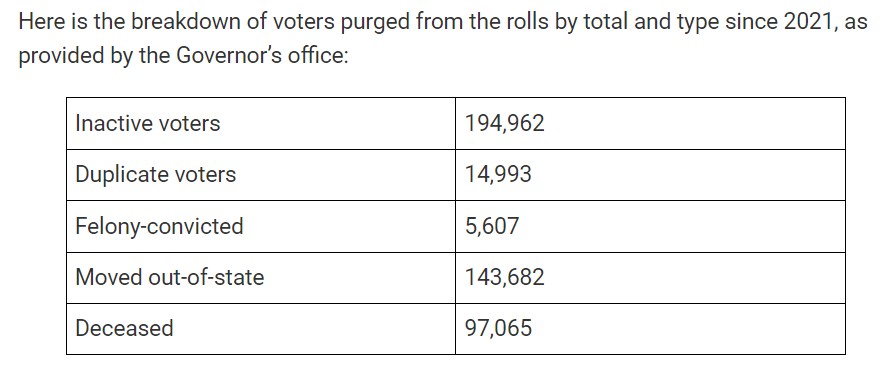
We were told by the Governor on September 18th, about the numbers of voters who have been purged from Oklahoma’s voter rolls since 2021. KOSU, received actual data from the Governor’s office, as it was not provided in his press release.

Look, I’m a former scientist. I understand data. This is nonsense. Again, actual data would be listed in a spreadsheet and broken down for all to see. This is meaningless data that requires us to take the SEB at their word.

The SEB insists that we have 100% accuracy in the Oklahoma primaries, however – and again – how is it that Amber found all the non-eligible electors on the Comanche County voter rolls and over 100,000 on the state rolls AFTER the multiple purges this ‘data’ represent.

But it’s not only that.

What about people who have moved into and out of Oklahoma? The clip on that topic was too large to create, but if you find the FULL LIVE video on our Rumble or YouTube account and fast forward to 34:27 and watch until about 1:13:20(ish), you’ll get a great discussion on the fact that it isn’t clear how often Oklahoma’s voter rolls are run against the National Change of Address database as per law.

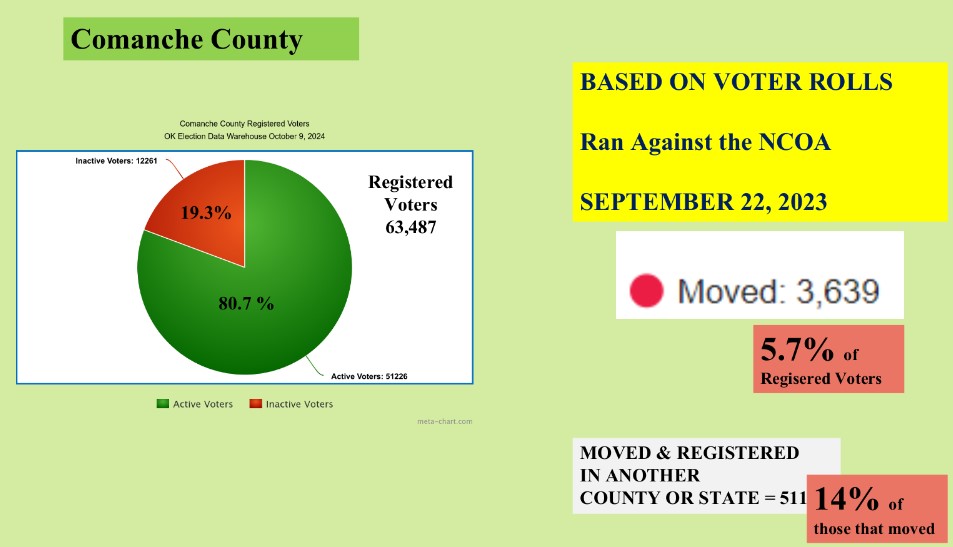
Amber ran Comanche county data against the NCOA in September of last year and found that 19.3% of the registered voters in the county had moved and/or registered in another county or state. That’s a very large number of INELIGIBLE VOTERS on the rolls in that county and who’s to say if people are double voting? How would anyone know?

In addition, she also found a voter with double registration – another thing that was supposed to be in the purged data according to our Governor and the SEB. Again, without real data on the purge – which we’re not given – Oklahoma citizens are unable to examine these issues for themselves. THAT is a problem.

And one last thing that we briefly covered on the full LIVE video, how can Oklahoma have a law that says that election board members SHALL certify an election? At 28:42 on the full video, we talk about that. That’s a problem in and of itself.

The takeaway here is this: Oklahoma’s elections are probably some of the safest in the country, but are they 100% accurate as the SEB and Secretary Ziriax have asserted? No. There’s no way they could be. There are way too many unanswered questions about the number of unqualified electors on the roll according to the data Amber has pulled and analyzed.

We need to find legislators willing to make changes to Title 26 to clarify the ways in which Oklahoma’s voter rolls are cleaned and maintained. Without that, Oklahoma’s election results still can’t be guaranteed. Hopefully, after the video, that’s 100% obvious.

Parental Rights Foundation Press Release Regarding The Rights of Parents

The Parental Rights Foundation was pleased to send the following press release earlier today, featuring exciting new polling data about public support for parental rights:

FOR IMMEDIATE RELEASE // June 1, 2022 // Purcellville, VA – The Parental Rights Foundation, working with Heart and Mind Strategies, recently asked the following question of a national audience: “In general, parents have the constitutional right to make decisions for their children without government interference unless there is proof of abuse or neglect. Do you agree or disagree with this view of parental rights?” 

Overall, 83% of Americans agree with the statement above, and 51% strongly agree, according to the survey. Only 10% disagree, with just 3% strongly disagreeing.  And only 6% are not sure.

Among Republicans, 90% support the question, with 64% strongly supportive. Among Democrats, 83% support, with 44% strongly supportive. And among Independents, 78% support, with 47% strongly supportive.

Both Trump voters (91% agree, 65% strongly agree) and Biden voters (84% agree, 44% strongly agree) are supportive.

Support is strong across ethnicity: Whites 85% agree, 53% strongly agree. Blacks 75% agree, 49% strongly agree. Asians 76% agree, 36% strongly agree. Hispanics 85% agree, 53% strongly agree. 

Support is strong across additional demographics surveyed as well, including education, religion, age, employment status, household income, and region. 

“Parental rights are truly universal,” said Will Estrada, President of the Parental Rights Foundation. “As we saw when Governor Youngkin won election in Virginia last year in a state that President Biden had won handily, as we saw this spring when parents in San Francisco voted their radical school board members out of office, and now as we see in this incredible survey, parental rights cut across party lines, ethnic lines, and gender lines.”

“Americans overwhelmingly agree that parents have the right to make decisions for their children,” said Bruce Blakeman, Senior Vice President at Heart and Mind Strategies, who conducted the survey. “It’s about as close to unanimity as you can get on an issue with Americans. These results show that any candidate who opposes parents’ rights does so at their own peril. This survey quantifies across the country what happened in the Virginia governor’s race last year.”

“Moms and dads love their children, raise their children, spend sleepless nights concerned for their children. Parental rights truly means protecting our precious children by empowering parents. That’s the heart of what this survey shows,” said Estrada.

The entire survey can be viewed online at www.ParentalRightsFoundation.org/poll2022.Thank you for standing with us in support of this vital cause. Your ongoing support enables us to stand up for children by empowering parents through protection of these important rights—rights upon which we all agree!
Sincerely,
Michael Ramey
Executive Director

Blog at WordPress.com.

Up ↑