Over and over again, Governor Stitt has touted his “more of everything” energy policy as he welcomes everything from the (possibly very dangerous) carbon capture facility Bantam in Shidler, Oklahoma, to an Italian green energy company (Enel) who’s intent it was to build a one billion dollar solar cell factory around the Port of Catoosa – a project which now looks as though it won’t get off the ground – even with 180 MILLION in legislature-approved tax incentives specifically for the project.
They’ve had enough of the endless millions of dollars worth in TAX BREAKS AND GIFTS that are given to ‘green’ companies like Canoo, and NextEra – the latter so they can effectively employ something like 50 workers – many of whom are seasonal, or maintenance workers.
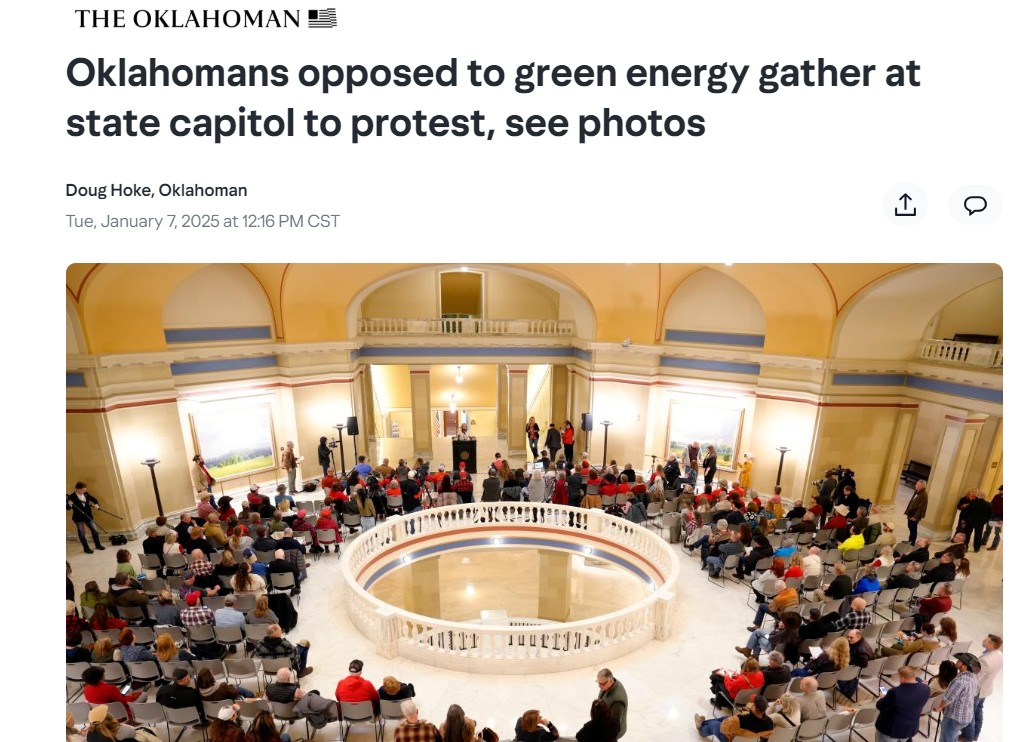
In fact, Oklahomans have had so much of ‘enough’ of it, that 100’s of them gathered in February on a single-digit temperature day at the state capitol to push back against the green energy agenda.
There’s even a petition signed by THOUSANDS of Oklahomans asking Governor Stitt to declare a MORATORIUM on green energy projects to at least get a handle on the projects going up today – many of which no one seems to know about until the first windmill shows up!
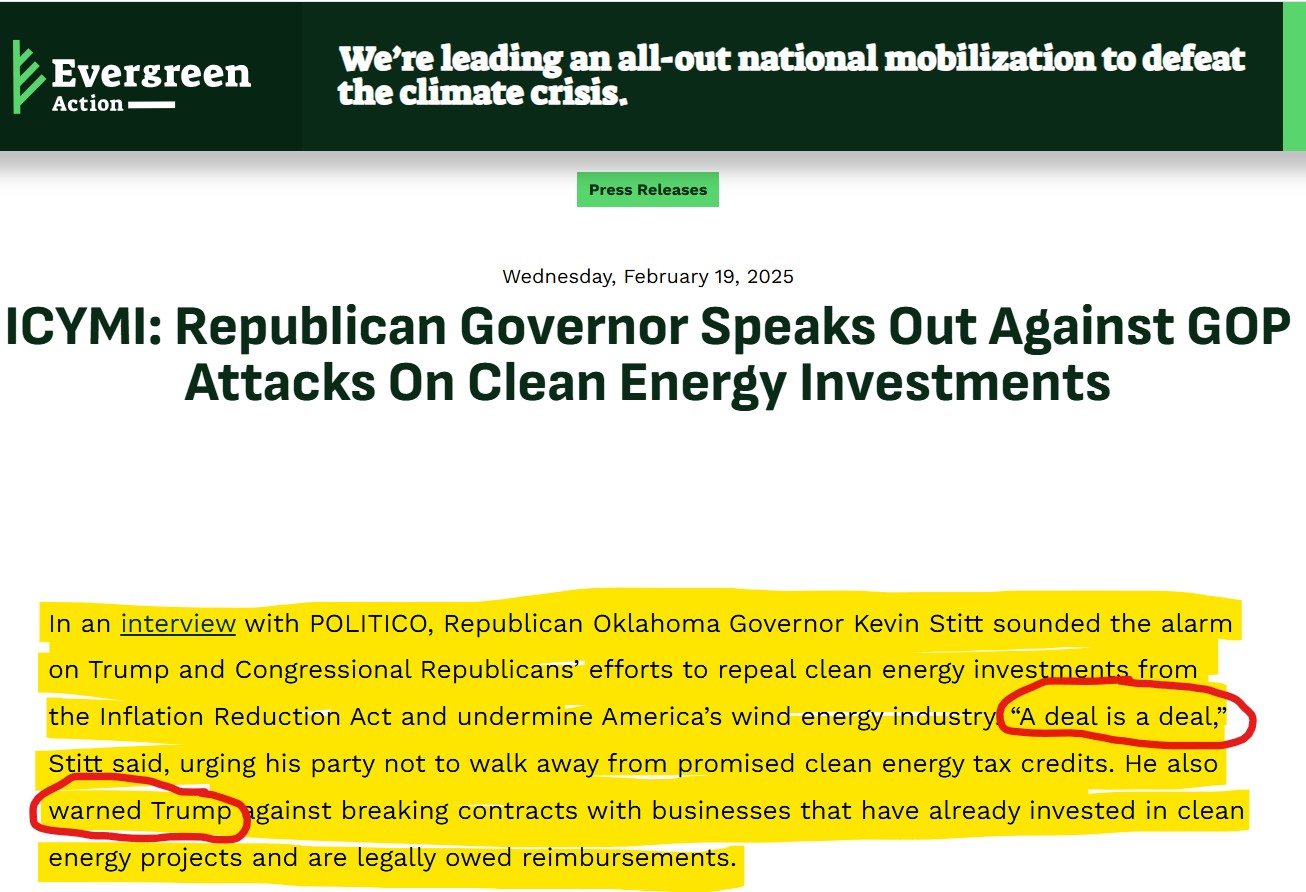
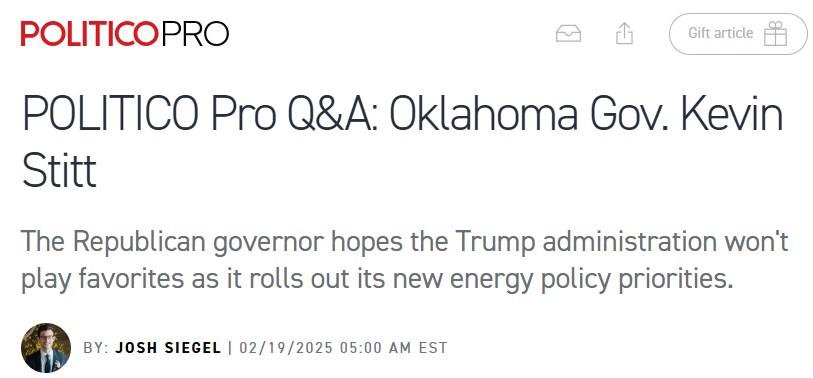
And yet, here’s our REPUBLICAN governor, giving an interview to the very left-leaning Politico (you know the one that had over 8 million in very expensive subscription fees canceled by DOGE?) where he WARNS PRESIDENT TRUMP not to “break contracts” with green energy companies and continue the subsidies from the IRA pouring in!! How in the world does Governor Kevin Stitt have an R by his name? What does that R stand for? RAPING and RUINING farmland in pursuit of a “all of the above” energy policy?
Okay, maybe not that, but certainly, from the recorded interview with POLITICO our takeaway has to be that Governor Kevin Stitt cannot define the concept of free markets and has no clue what it means when he talks about the government picking winners and losers. Unfortunately, for Oklahoma citizens, this is an enormous problem. Whether we like green energy or not, it will likely be shoved down our throats by a man who thinks he’s somehow doing us a favor.
Granted, in a recommended appropriation budget of 10,060,793,526 for 2024, a million dollars here and a million dollars there, isn’t that big a deal – it’s chump change.
But then again, every dime of this money is taken by force from a working citizen of the state, ostensibly to provide services to the taxpayer – not to enrich the multibillion dollar corporations of billionaires – even ones that make Oklahoma their homes.
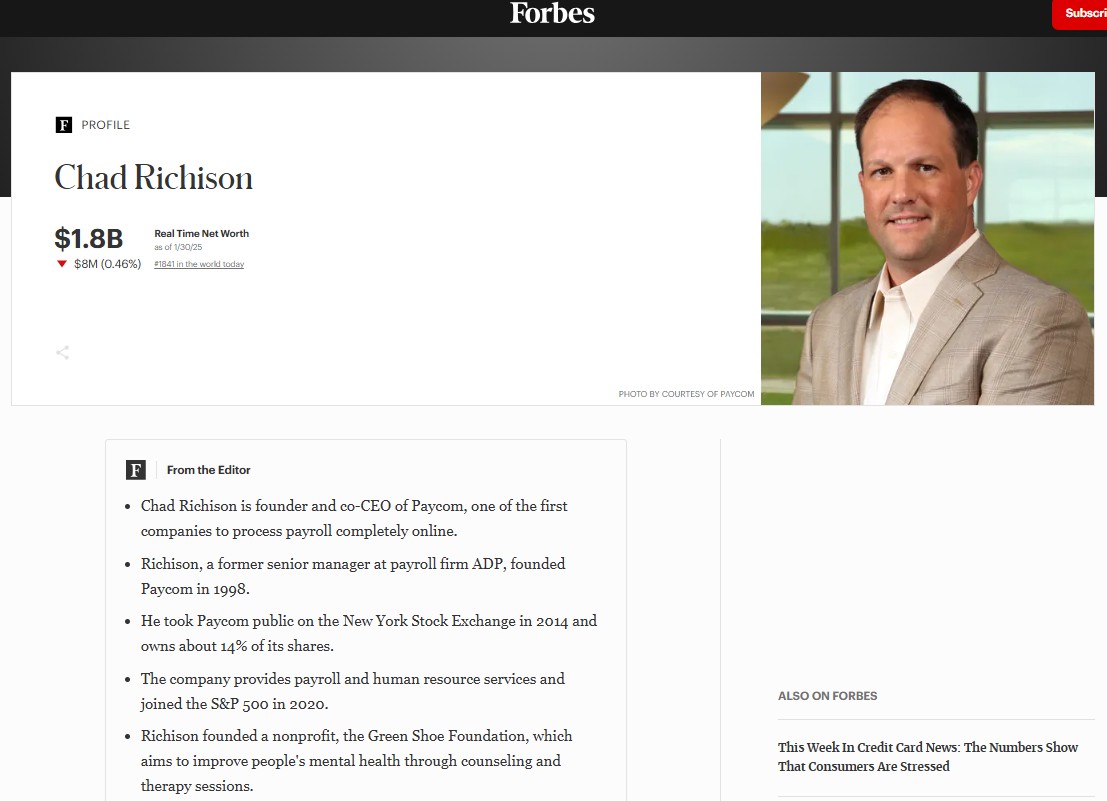
Let’s take Paycom, for example. Paycom is an online payroll company created by Oklahoman, Chad Richison. Here is a bit about Mr. Richison from Forbes.
As you can see, Mr. Richison is personally worth over 1 billion dollars. Here are a few articles about Mr. Richison that pop up in a simple internet search:
Unfortunately, Mr. Richison is also a liberal who is not at all shy about announcing his thoughts on state policy. For example, during the COVID nonsense, Mr. Richison wrote a letter to Governor Stitt complaining about a lack of leadership on COVID and that further restrictions must be made on business and movement in the state.
Also in 2020, Mr. Richison wrote a letter to OU saying that he was pulling his advertising because the University was essentially racist and didn’t have adequate training to establish an understanding of ‘racial equity’. Not long afterward, OU became a bastion of DEI training. But that’s not all.
In yet another letter written to the Regional University Board of Reagents, Richison criticized their pick for UCO’s University President, former Republican Lt. Governor, Todd Lamb.
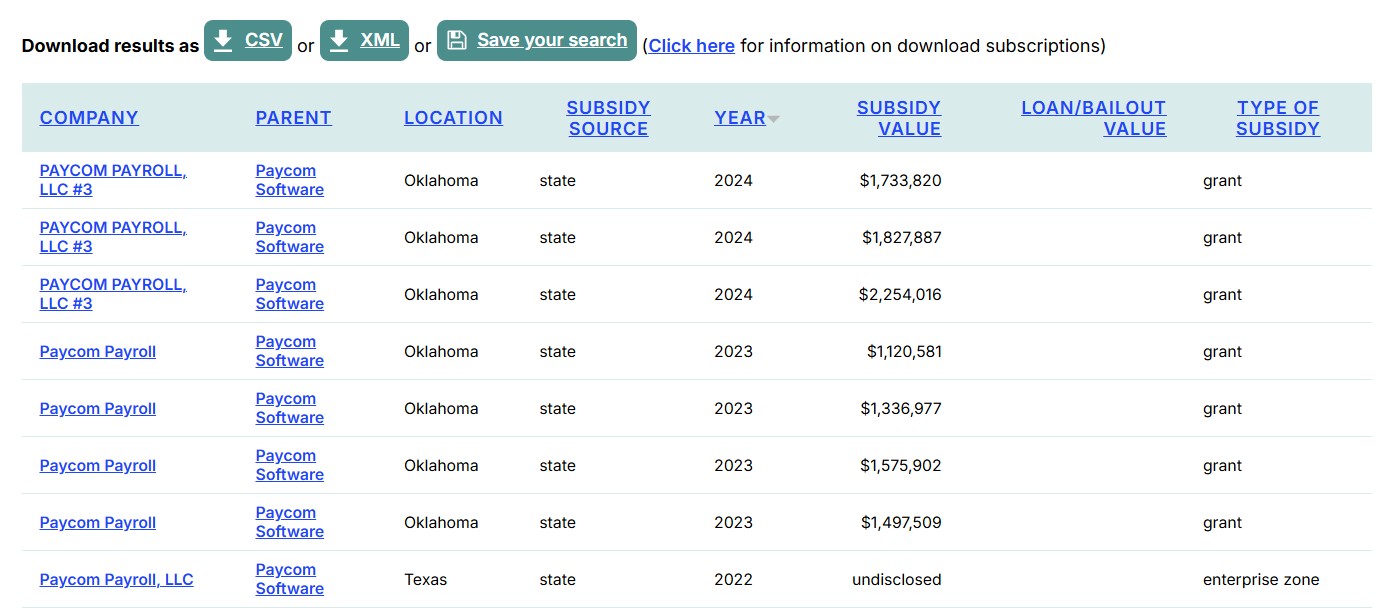
Why then, has the State of Oklahoma Commerce Department given Paycom Payroll over ELEVEN MILLION dollars in taxpayer funds during the years of 2024 and 2023 and, beyond that, why has it been granting them funds since 2009?
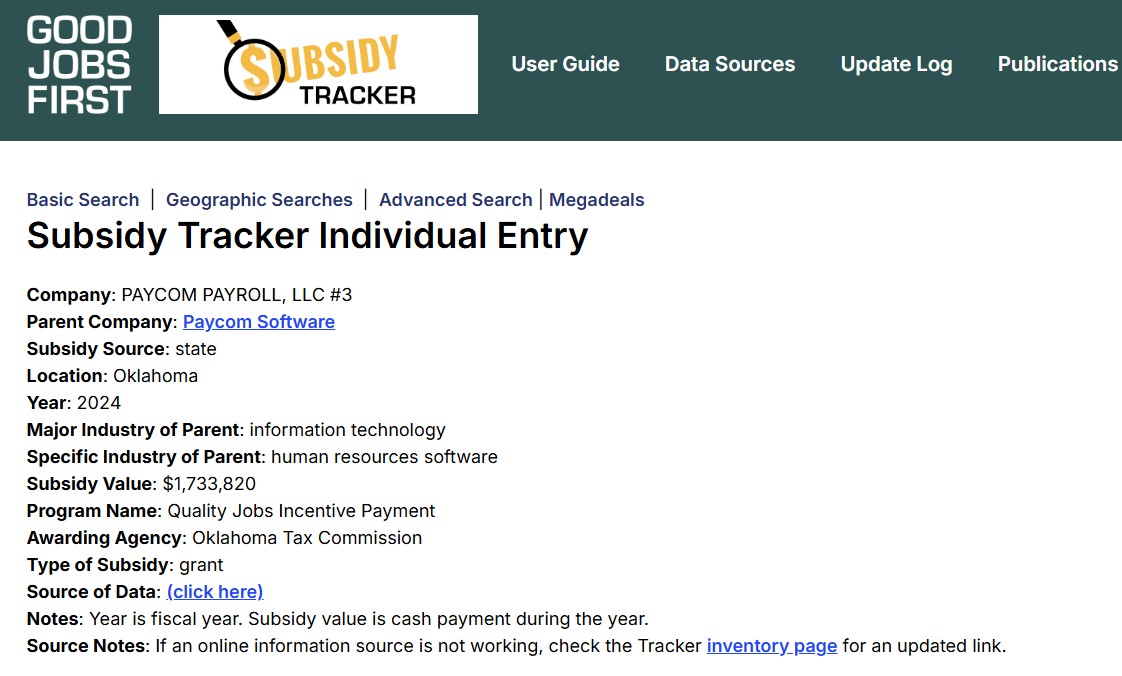
The information above is from a very useful website called, “Subsidy Tracker” by “Good Jobs First”. If you click on the hyperlink on the left side of the spreadsheet (which can be found here), it tells the origin of the subsidy. Note, on this page, apparently Texas is providing subsidies as well, though very limited. Overwhelmingly, Paycom’s incentives are Oklahoma based.
Note, the origin of the subsidy is the “Quality Jobs Incentive” program. Though the money is dispersed through the Oklahoma Tax Commission, the Quality Jobs Incentive Program is a product of the Oklahoma Commerce Department (OCD). Here’s what the website says about the program:
The Oklahoma Quality Jobs Program serves as an incentive for companies to expand or relocate jobs to Oklahoma by providing a rebate of a portion of newly created payroll in the state. The program induces the creation of well-paid full-time jobs and promotes economic development. Companies may receive benefits during the first three years of participation while working to achieve the required payroll threshold for full qualification.
How are these grants dispersed?
The agency – in this case Paycom – that wants one of the many taxpayer subsidies dispensed though the OCD, must fill out a request. Then, at some point, the OCD Incentive Approval Committee calls them in for a meeting during which the asking business may speak. After that, the Committee adjourns to an Executive Session during which they decide how much of a grant to provide the business.
There are several problems here other than the glaringly obvious:
Who is on the Incentive Approval Committee? Internet search turned up no answers, but a concerning Frontier article – Committee approves request for state jobs incentive money by company founded by Gov. Kevin Stitt. This article states that the Committee consisted (when the article was written in 2020) of Department of Commerce Executive Director Brent Kisling and Oklahoma Tax Commission Chairman Charles Prater – both of whom were directly appointed by Governor Stitt. The third board member was Dan Ross, director of capital assets for the Office of Management and Enterprise Services.
The article mentioned above, also points out the lack of transparency in this process – all of the grants given out through the Quality Jobs Incentive Program are done so through Executive Session of the Committee. The only way to find out how much any company gets is by going to the Oklahoma Tax Commission website and scrolling through the yearly Excel files housing the HUGE number of tax dollar giveaways supported by Oklahoma citizens.
On the website where agendas are stored for the various taxpayer giveaway committees, the only agendas for a program that was created in 1993 (according to the Frontier article), are from 2024 and January 2025. Even then, five months of 2024 agendas are missing. Why?
Every agenda must be scoured to find out the names of the businesses going to the OCD with their hands out asking for taxpayer dollars. There is no searchable list, so each agenda must be read individually – if it’s available for inspection on the website.
Obviously, taxpayer dollars are being provided to certain private businesses and the taxpayer – the people funding these ‘grants’ – have to go through quite a process to find out how much of their dollars are going where. How very transparent. But then, the Frontier article is about how Governor Stitt’s mortgage company was receiving grants from the Committee he peopled to make decisions about how to give away state taxpayer dollars.
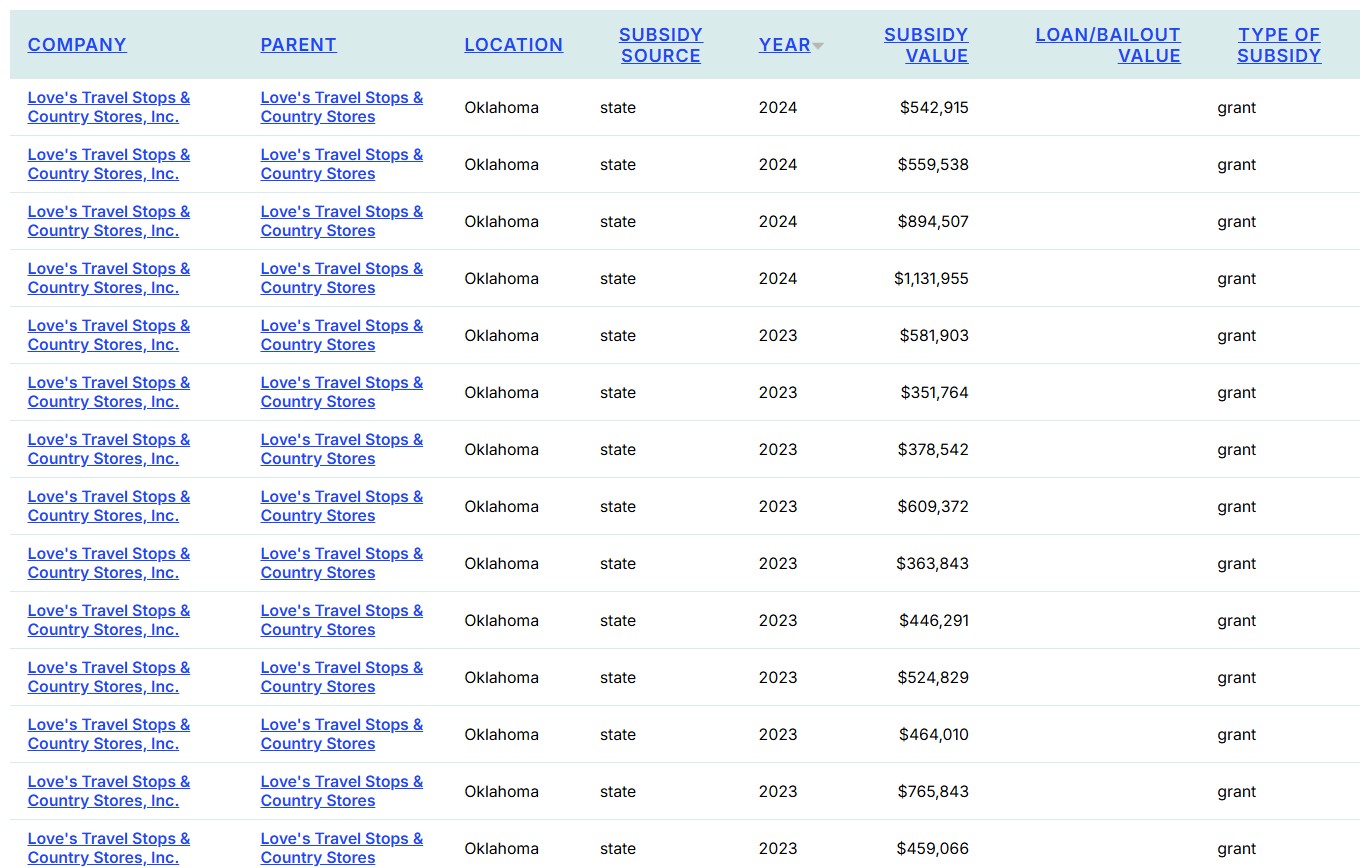
Unfortunately, this is the same for Love’s Travel Stops & Country Stores, Inc. According to Subsidy Tracker, Love’s has a large number of ‘grants’ given it by the state of Oklahoma for both 2023 and 2024. In fact, the taxpayers of Oklahoma have given Love’s Travel Stops and Country Stores EIGHT MILLION DOLLARS – $8,074,378 to be exact.
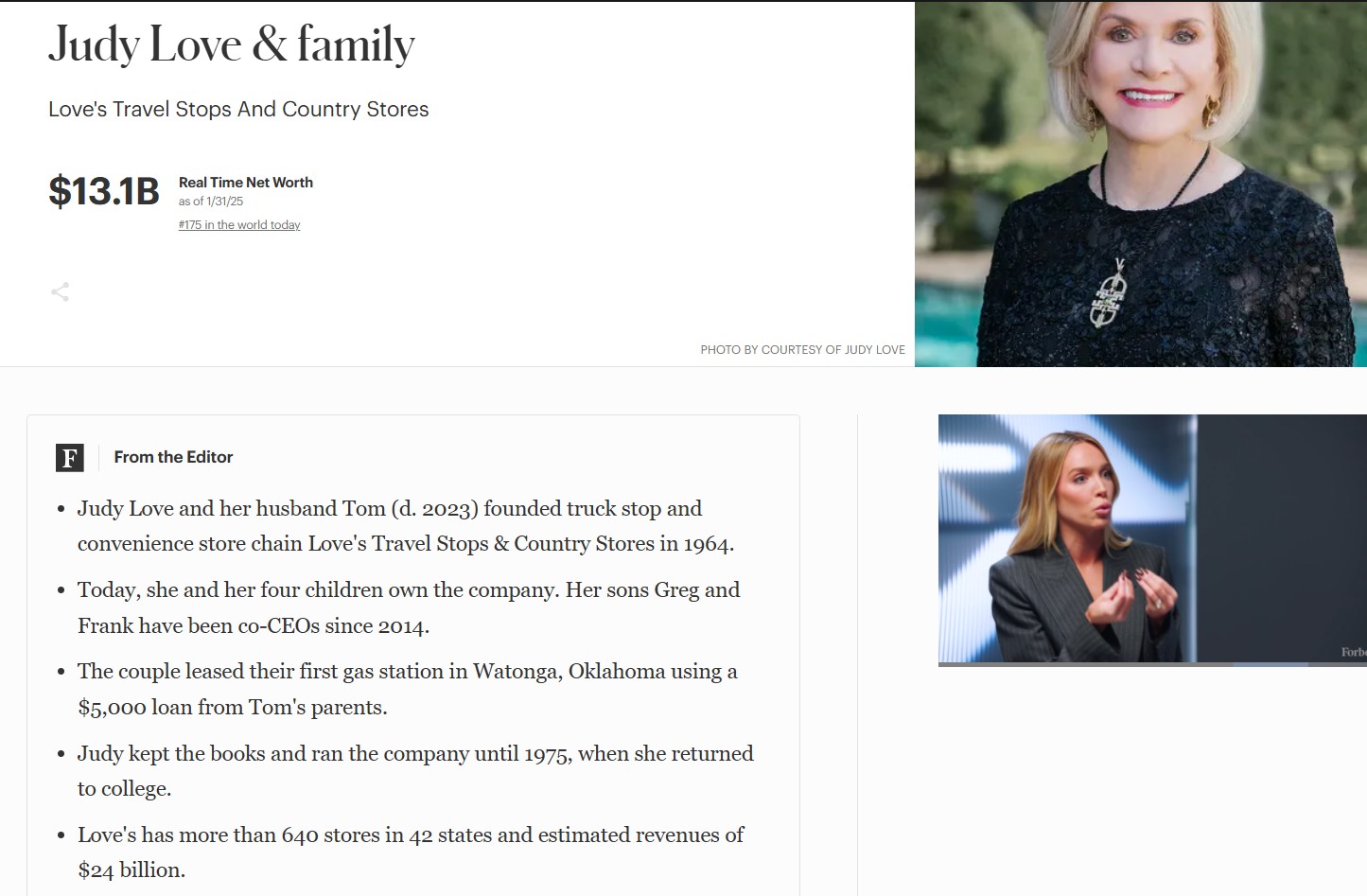
Tom and Judy Love, who together founded the Love’s dynasty here in Oklahoma, have both recently passed away (Tom in March of 2023 and Judy in November of 2024). Both Tom and Judy were tremendously generous with their self-made billions in their home state.
A story in the Oklahoman published just before Judy died, listed her as the second wealthiest self-made woman in America, pegging the Love’s net worth at over 10.2 billion dollars. It also provided a long and varied list of their philanthropy in Oklahoma, including Positive Tomorrows, the Oklahoma Hall of Fame and the Archdiocese of Oklahoma City. The Loves were also famous for their support of the Oklahoma City Thunder.
Love’s has benefited from tax credits, TIFs, grants or rebates from the states of Nebraska, Colorado, Mississippi, Virginia., Iowa, Illinois and Ohio. All of these subsidies have been a mere fraction of the 8 million dollars provided by their home state of Oklahoma, however.
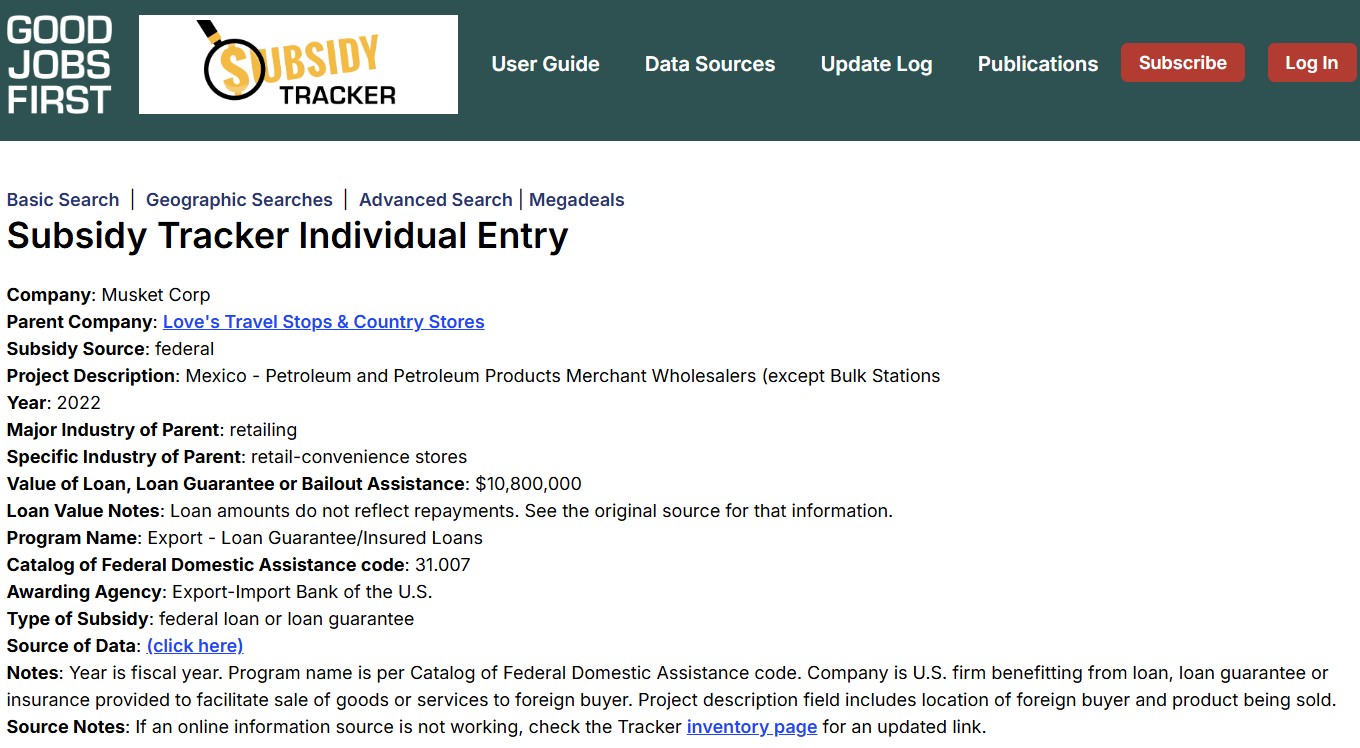
In 2022, a subsidiary of Love’s, the Musket Corporation, received a $10,800,000 guaranteed loan from the federal Import/Export Bank.
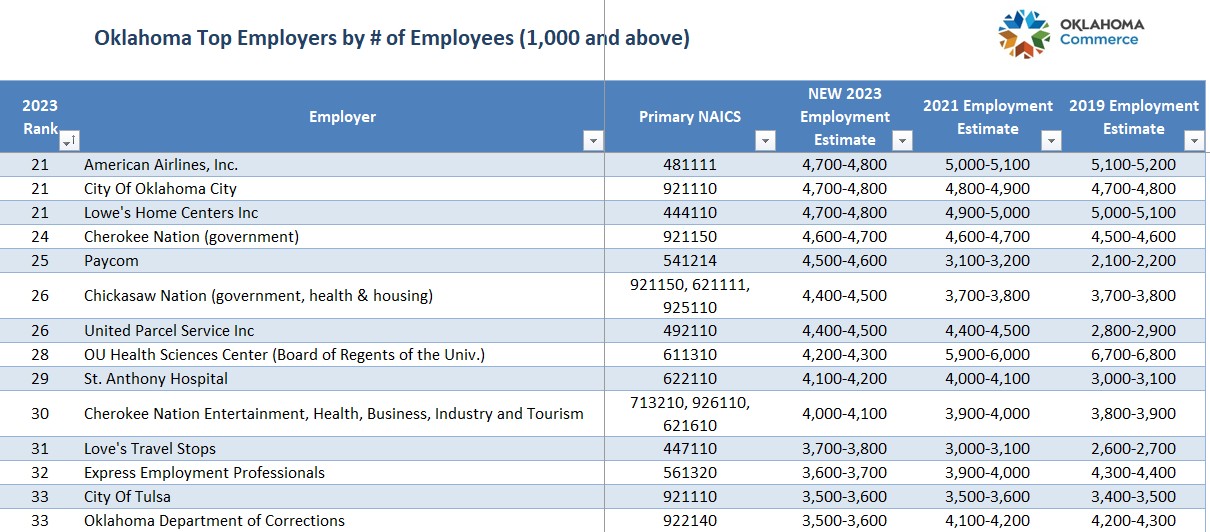
One last piece of information collected by the Oklahoma Commerce Department, indicates that neither Love’s, nor Paycom is in the top 10 hiring companies in Oklahoma. Which begs the question – why are so many millions given to both multiBILLION dollar private corporations for ‘quality jobs’? Paycom is number 25 and Love’s is even lower at 31. Consequently, taxpayers are paying for job recruitment and retention for two billionaire corporations of Oklahoma billionaires that aren’t even top 10 employers in the state.
Just this week, Governor Stitt has announced that he wants to reduce and eliminate the Oklahoma income tax. That’s wonderful. No citizen of America – let alone Oklahoma – should be forced to give their hard-earned wages to their government to be redirected to private entities and other nonsense that doesn’t benefit them directly. Oklahomans should applaud that idea.
It is a cause for curiosity, however, as to how this miracle can occur until Oklahoma stops handing out the millions upon millions in tax-payer funded incentives for private business we continue to shell out on the back of the Oklahoma taxpayer, yearly.
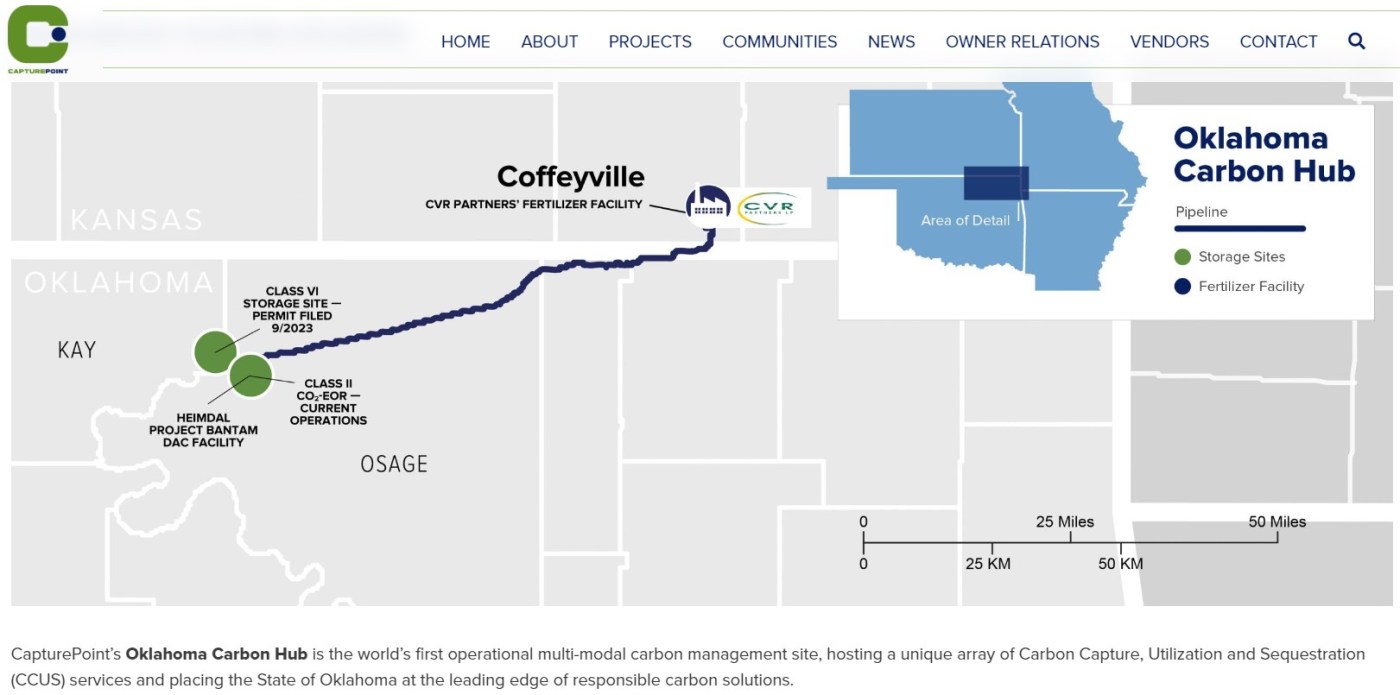
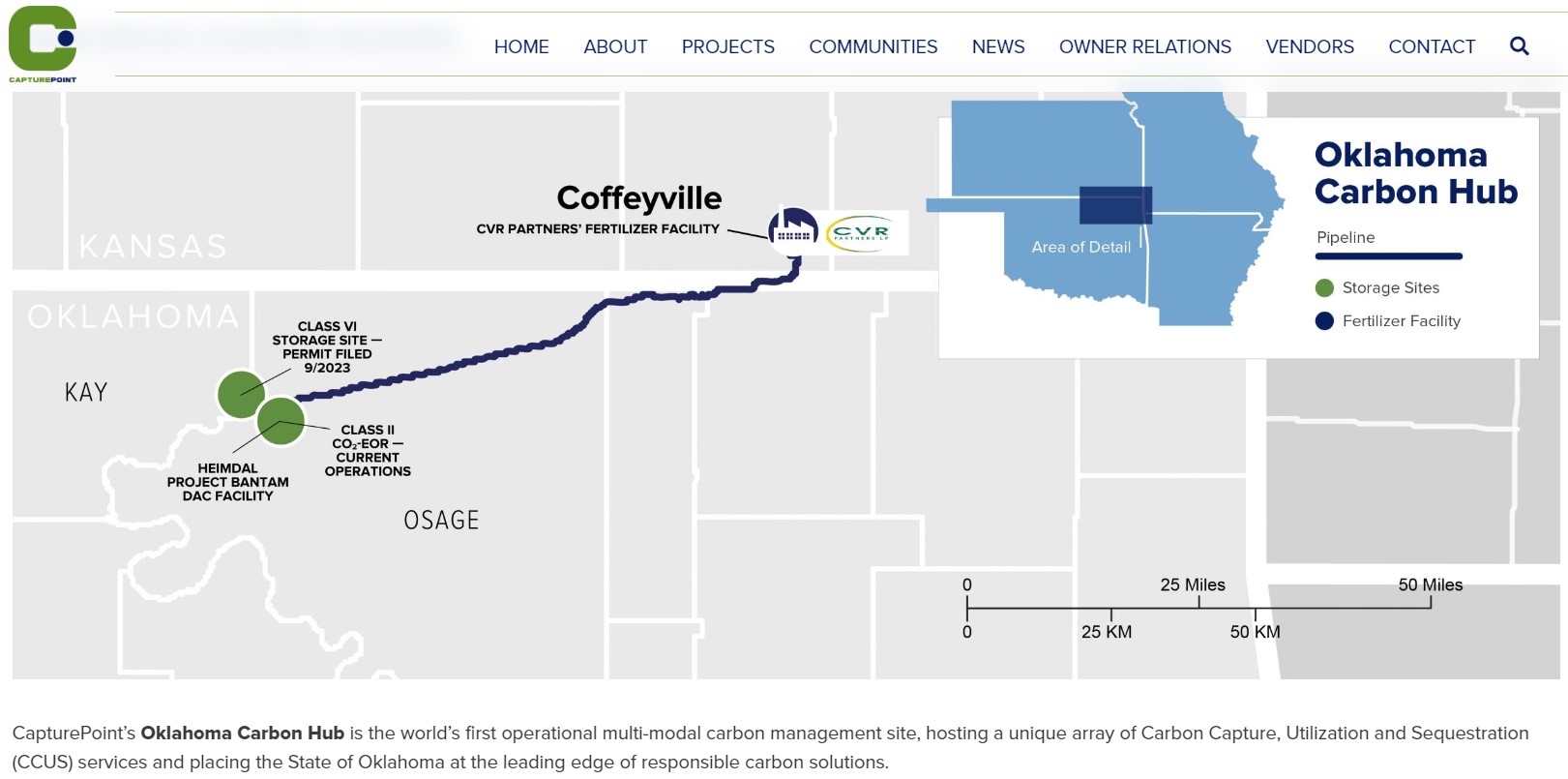
Dubbed Bantam, this facility is a project of Colorado-based Heimdal, Inc., and is located at the CapturePoint Carbon Hub in Osage county in northwest Oklahoma. The facility itself will allegedly remove 5,000 tons of CO2 every year which will be permanently stored in underground facilities being developed by CapturePoint.
This project is just one of many that have emerged since the passage of the Inflation Reduction Act of 2022, which increased the 45Q carbon sequestration tax credit (initially added to the tax code as a part of the Energy Improvement and Extension Act of 2008) for every ton of CO2 stored from $50 to $85.
A chorus of Oklahoma Republicans praised the new project, with governor Kevin Stitt stating, in a post to Heimdal’s LinkdIn page:
According to CapturePoint’s website, the company owns and operates on 6,900 acres, but has contracted rights to 10,000 acres in Oklahoma for use as carbon storage space. CO2 is transported from CVR’s facility in Coffeyville, Kansas, via a 68-mile pipeline to CapturePoint’s Oklahoma facility for storage.
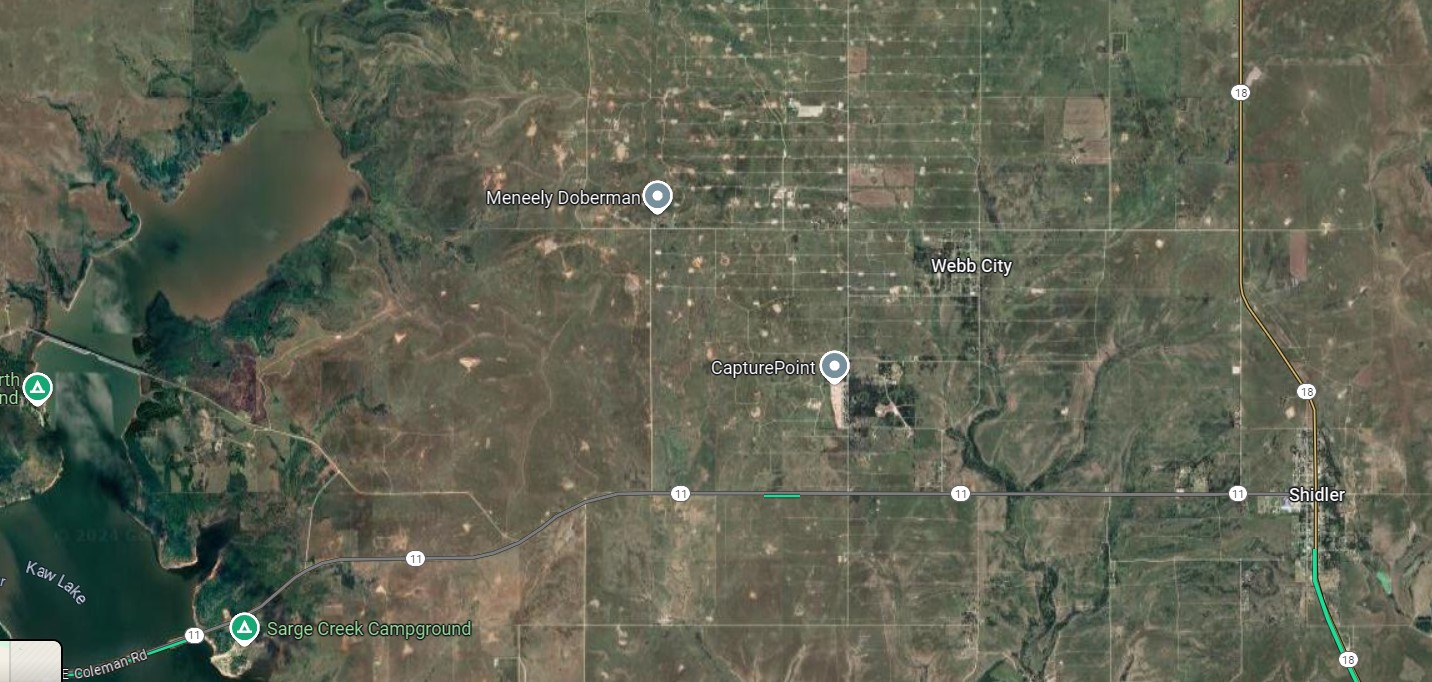
Below is a Google map of the area showing the CapturePoint facilities in relation to Kaw Lake and the city of Shidler. (C02 + H2O yields H2CO3, carbonic acid)
Despite the fact that no local news sources covered the opening of the nation’s largest carbon capture plant and that subsequent information can only be gleaned from industry magazines, Oklahoma’s leaders have been deeply involved in making this state a home for the carbon capture and sequestration industry for some years now.
Our oil industry has been using CO2 for enhanced oil recovery since 1982.
In October of 2020, current governor Kevin Stitt signed the “Regional Carbon Dioxide Transport Infrastructure Action Plan”, along with Kansas, Louisiana, Maryland, Montana, Pennsylvania, and Wyoming. The signatories to this plan entered into a “Memoranda of Understanding”, committing to jointly develop “the buildout of regional CO2 transport infrastructure”. According to document, “the vision of this memorandum is to accelerate, through state leadership and coordination, the deployment of regional CO2 transport infrastructure networks and the development of carbon hubs…”
Last year, the Oklahoma legislature released SB200, Oklahoma Carbon Capture and Geological Sequestration Report. This report attempted to inform legislation eventually created via SB200 (Boles, Rader) regarding jurisdiction of dangerous class VI injection wells, yet according to a statement submitted by the Petroleum Alliance, “It is unclear if projects for direct air capture and sequestration are allowed under the Oklahoma Carbon Capture and Geologic Sequestration Act.”
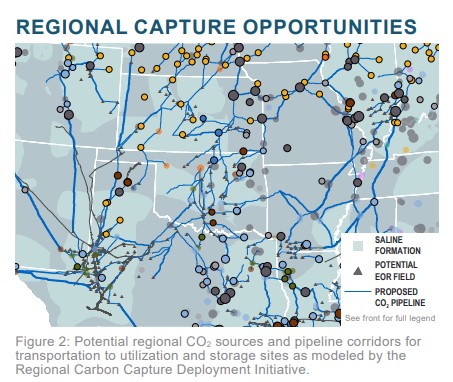
With the opening of the Bantam facility, it appears that Oklahoma is set to see an explosion of investment and build-out of CO2 pipeline throughout our state. At the Great Plains Institute website, in a document entitled, “Implementing Carbon Capture and Storage Technology”, the Institute provides a map of Oklahoma with potential CO2 pipeline corridors that crisscross our state like a spiderweb, transporting the liquified carbon dioxide.
But is this what Oklahomans want? How many residents know what carbon capture is, let alone that the world’s second largest carbon capture facility is located in their state? How would they feel if they found out? Capture point is seeking permits for an additional two class VI (CO2 sequestration) wells in the area – one would think that eventually nearby residents would want to know that something so dangerous is near to them and Kaw Lake now, with the possibility of more to come.
These pipelines are far different from the more familiar oil or natural gas pipelines, in that the CO2 being transported must maintain immense pressure. To transport carbon dioxide via pipeline, it must first be compressed into a liquid state, known as “supercritical CO2”. This requires up to 3000 psi of compression, which, as you can imagine, is extremely dangerous. The CO2 must maintain this compression as it travels through the pipeline.
Because of this immense transmission pressure, CO2 pipelines run the risk of “running ductile fractures”, where an initial rupture creates a chain reaction as escaping CO2 converts to a gas, rapidly opening a tear along the pipe at 100 meters per second. CO2 is heavier than air. Should the pipeline rupture, any released CO2 will settle on the ground, sucking the oxygen from every living thing in the vicinity, just like it did to the people of Satartia Mississippi last year.
Could these pipelines withstand an earthquake or other unpredictable accident? What is the protocol for cleaning up a massive CO2 leak? How will first responders get close enough with their equipment to seal the leak and clear the area of the dangerous gas?
The Biden administration seems to think that a simple increase of the 45Q tax credit will magically jumpstart a green revolution, with the oil and gas industry leading the way. But, perversely, this subsidy has drafted Big Oil into the Green Agenda, with Oklahoma actively seeking to place itself at the forefront.
An analysis by Taxpayers for Common Sense found that, from 2010 to 2019, 90% of 45Q tax credits were based on fraud. Do we have any reason to believe that this level of fraud won’t continue in expanded form as greater numbers of these facilities are built across our state?
A 2021 article from FORBES denotes no less than 6 taxpayer green boondoggles funded by American taxpayers. But then Oklahoma need look no further than Canoo – a troubled electric vehicle company to which Governor Stitt gifted 15 million Oklahoma taxpayer funds to locate to Oklahoma, only to have them struggle against bankruptcy, unable to fund themselves, let alone return an investment to the state.
Several questions need to be asked: Should Oklahoma really become a dumping ground for out-of-state CO2? How much land would be enough to even make a small dent in the amount of CO2 produced yearly? Even if a DAC facility functioned as intended, it would remove only an insignificant fraction of CO2 from the environment. The CO2 itself, once moved to a permanent underground storage, would need to be monitored for centuries to ensure that it doesn’t leak back to the surface. Who will bear liability, should the carbon dioxide leak to the surface?
A 2022 report by the Institute for Energy Economics and Financial Analysis found that these facilities fail far more often than succeed. Of the 13 carbon capture facilities examined, seven underperformed, two failed, and one was abandoned entirely.
In a later report, the Institute for Energy Economics and Financial Analysis found that the premier Norwegian CCS facilities, the ones used to justify much of the push for expanded carbon capture, experienced significant anomalous CO2 storage behavior that could have led to a disastrous gas leak. This directly contradicts the rosy predictions of Bantam and CapturePoint’s press releases and statements from their supporters.
Another point of concern is whether these carbon capture facilities are generating more CO2 than they capture, completely undercutting the stated reason for their existence. Has this been a concern at all among the supporters of this subsidy-created gold rush? Several analyses have found that the process of capturing carbon, liquifying it, and either transporting, storing, or using it in enhanced oil recovery actually produces more CO2 emissions than it captures.
Another question is: how much land is enough? As money continues to flow into the carbon capture industry, more land will continue to be permanently taken out of use in order to build more facilities. But it will never be enough. The International Energy Agency found that 32 billion metric tons of carbon dioxide would need to be removed from the atmosphere yearly in order to prevent global temperatures from rising a mere 1.5 celsius. It’s an impossible goal that our leaders are apparently ready to sacrifice much in a vain attempt to reach.
Tens of thousands of acres have already been scooped up by the carbon capture industry. When our leaders finally admit that atmospheric CO2 removal has been a massive, enormously expensive boondoggle, how will these carbon hubs and wells be disposed of? Is it even possible to do so safely?
Our children and grandchildren will be forced to clean up the mess created by the futile attempt to “capture” carbon and store it. Why is our state intent on placing this burden on its future generations? Why not a nuclear reactor facility instead of carbon capture? Why not something that directly benefits the people of our state? There’s nothing more “green” than nuclear power, so why the push to instead make our state a reservoir for CO2?
Carbon capture is a costly dead end. We need to force our leaders to realize it before its too late.