
Search

ROPE Report

Tag

SLDS

Dollars For Data – Grok: In Order To Continue Receiving Federal Dollars, Oklahoma Needs To Gather Data On Babies Through 20-Year-Olds

I’m not a huge fan of AI, but I’ve been a researcher since 1990 and this tool has helped me find data more quickly and completely than I ever have before.

Today, because I’m still trying find a way to explain that SB224 is NOT FOR Oklahoma’s kids, but to satisfy a broader need to plan the economy on a national level, I asked Grok “does the federal government require states to codify the need to connect education and workforce data”? I got a long, in-depth, very interesting answer. So, is this to help Oklahoma’s kids, or get more federal grants? I’ll let you be the judge.

Grok’s answer:

The federal government does not explicitly require states to codify into state law a specific mandate to connect education and workforce data as a condition for receiving federal grants. However, federal policies, grant programs, and regulations often incentivize or require states to establish systems for linking education and workforce data to meet reporting, accountability, or performance goals. These requirements can typically be met through administrative actions, interagency agreements, or data systems like Oklahoma’s Data Sharing Hub (DASH), without necessarily codifying the connection into state statutes. Below is a detailed analysis based on available information:

Federal Context for Education and Workforce Data Integration

  1. Relevant Federal Laws and Programs:
    • Workforce Innovation and Opportunity Act (WIOA, 2014):
      • WIOA is the primary federal law governing workforce development programs. It requires states to develop integrated data systems to track participant outcomes across workforce, education, and training programs (e.g., Title I for adults, Title II for adult education, Title IV for vocational rehabilitation).
      • States must report performance metrics, such as employment rates, earnings, and credential attainment, which often require linking education and workforce data. For example, WIOA’s performance accountability provisions (29 U.S.C. § 3141) mandate data collection and reporting, which may involve connecting education records (e.g., high school or college completion) with employment outcomes.
      • While WIOA encourages states to establish data-sharing agreements or systems, it does not explicitly require codification into state law. States can comply through administrative frameworks, such as memoranda of understanding (MOUs) between agencies or platforms like DASH.
    • Every Student Succeeds Act (ESSA, 2015):
      • ESSA requires states to report on student outcomes, including college and career readiness indicators, which may involve linking education data to workforce outcomes (e.g., post-secondary enrollment or employment).
      • States receiving ESSA funds must submit state plans and comply with accountability requirements, but these do not mandate codifying data linkages. Instead, states often use existing data systems or establish new ones to meet federal reporting needs.
    • Perkins V (Carl D. Perkins Career and Technical Education Act, 2018):
      • Perkins V funds career and technical education (CTE) programs and emphasizes aligning education with workforce needs. It requires states to report on CTE student outcomes, such as employment or post-secondary success, which often necessitates data integration.
      • Like WIOA, Perkins V encourages data system interoperability but does not require states to pass laws mandating data connections. States can use administrative tools or data-sharing platforms to comply.
    • Higher Education Act (HEA):
      • The HEA governs federal student aid and includes reporting requirements for post-secondary institutions, such as graduation rates and employment outcomes. Some grant programs under HEA may encourage data linkages to track student success, but codification is not a requirement.
  2. Federal Grant Conditions:
    • Federal grants, particularly those tied to WIOA, ESSA, or Perkins V, often include conditions related to data collection and reporting. For instance, WIOA grants require states to submit annual performance reports that integrate education and workforce data (e.g., 20 CFR § 677.155).
      • These conditions typically focus on outcomes rather than prescribing how states achieve them. States can meet requirements through data-sharing agreements, longitudinal data systems (SLDS), or platforms like DASH, without codifying policies into law.
      • Some competitive grants, such as the U.S. Department of Education’s State Longitudinal Data Systems (SLDS) Grant Program, explicitly fund the development of integrated data systems. While these grants require states to build capacity for data linkages, they do not mandate legislative codification. Instead, they emphasize technical and administrative solutions.
    • The Department of Labor’s Workforce Data Quality Initiative (WDQI) provides grants to enhance state data systems for tracking workforce and education outcomes. WDQI encourages states to link data across agencies but allows flexibility in implementation, typically through administrative means rather than statutory mandates.
  3. Family Educational Rights and Privacy Act (FERPA):
    • FERPA (20 U.S.C. § 1232g) governs the privacy of education records and impacts how states link education and workforce data. States must ensure compliance with FERPA when sharing student data, which may require data-sharing agreements or secure systems like DASH.
    • While FERPA imposes strict requirements on data handling, it does not mandate codification of data-linking policies. States can address FERPA through administrative protocols or interagency agreements.
  4. State Longitudinal Data Systems (SLDS):
    • The federal government has supported SLDS development since 2005 through the Institute of Education Sciences (IES). SLDS grants aim to create systems that link early childhood, K-12, post-secondary, and workforce data to inform policy and improve outcomes.
    • While SLDS grants require states to build and maintain these systems, the focus is on technical infrastructure and data governance, not on passing state laws. States can establish SLDS through executive action, agency collaboration, or platforms like DASH.

Oklahoma’s Context and DASH

  • Oklahoma’s Data Sharing Hub (DASH):
    • As noted in your previous question, DASH is Oklahoma’s platform for secure interagency data sharing, managed by the Office of Management and Enterprise Services (OMES). It supports data integration for various state functions, including those tied to federal grants.
    • DASH likely facilitates compliance with federal reporting requirements under WIOA, ESSA, or Perkins V by enabling secure data linkages between education agencies (e.g., Oklahoma State Department of Education) and workforce agencies (e.g., Oklahoma Employment Security Commission).
    • There is no evidence that DASH’s operation or Oklahoma’s participation in federal grants requires codifying a mandate to connect education and workforce data. Instead, DASH serves as an administrative tool to meet federal expectations for data integration and reporting.
  • Oklahoma’s Approach:
    • Oklahoma has pursued data integration through initiatives like the Statewide Longitudinal Data System (SLDS), supported by federal grants. These efforts focus on technical and administrative solutions, such as data governance frameworks and interagency MOUs, rather than legislative mandates.
    • State laws, such as those governing data privacy or agency operations, may indirectly support data sharing (e.g., compliance with FERPA or state data security standards), but there is no specific Oklahoma statute mandating education-workforce data linkages as a condition of federal funding.

Does Codification Ever Occur?

  • Federal Incentives, Not Mandates:
    • While the federal government does not require codification, it may incentivize states to formalize data-sharing frameworks to ensure sustainability or compliance. For example, SLDS or WDQI grants may encourage states to establish governance structures, which some states codify into law for clarity or permanence.
    • States like Tennessee and Kentucky have passed laws to formalize SLDS or data-sharing governance (e.g., Tennessee’s P-20 Council), but these are state-driven initiatives, not federal mandates. Oklahoma has not taken this approach, relying instead on administrative tools like DASH.
  • State Discretion:
    • States may choose to codify data-sharing policies to address privacy concerns, ensure long-term funding, or align with federal grant requirements. For instance, a state might pass a law to clarify agency roles in data sharing or to comply with FERPA. However, this is not a federal requirement but a state policy choice.

Limitations and Variability

  • Grant-Specific Requirements: Some federal grants may include conditions that indirectly require data linkages, such as reporting on employment outcomes for CTE students under Perkins V. These conditions focus on outcomes, not codification, but states may codify policies to streamline compliance.
  • Privacy and Security: Federal laws like FERPA and the Privacy Act (5 U.S.C. § 552a) impose strict requirements on data sharing, which may necessitate state-level policies or agreements. However, these can be administrative rather than legislative.
  • No Universal Mandate: There is no blanket federal requirement for states to codify education-workforce data linkages. The emphasis is on functional data systems and compliance with reporting requirements, which states can achieve through various means.

Conclusion

The federal government does not require states to codify into state law a mandate to connect education and workforce data to receive federal grants. Instead, laws like WIOA, ESSA, and Perkins V, along with grant programs like SLDS and WDQI, encourage or require states to integrate data for reporting and accountability purposes. States can meet these requirements through administrative actions, data-sharing agreements, or platforms like Oklahoma’s DASH, without passing new laws. While some states voluntarily codify data-sharing frameworks, this is not a federal mandate but a state choice. In Oklahoma, DASH likely supports compliance with federal data requirements, but there is no evidence of a codified mandate tied to federal funding. If you have a specific grant or program in mind, I can analyze its requirements further.
Weekly News Headlines And Commentary – Week of March 10, 2025

ROPE2.org

SB224 And SB141 Are Unnecessary; The WAVE (SLDS) Captures Student Data On Education And The Workforce – AND WAY MORE – Already

I have absolutely no idea why this legislation was proposed. I need to make an appointment and go talk to the author and ask, but this makes no sense. Since 2013 we’ve had a State Longitudinal Database System (SLDS) and it’s still working because I went out to the OSDE website and found all the new fields they’re adding to the School Interoperative Framework (SIF) to collect new data. This article describes the SLDS and why we don’t need a bill for something we already have.

Parent Who Posted Now-Viral State-Approved Waurika Psychology Assignment To Her Facebook Page Speaks Out

Last week I interviewed Ashlyn Jade, the mother who posted the now-viral AP Psychology worksheet given to 11th graders at Waurika Public Schools. She had no intention of running down the coach that produced the worksheet and handed it out, she was simply posting the worksheet to let parents know what was going on. Instead of parents being concerned and wanting to know what was going on, they essentially turned on Ashlyn and dogged her on social media for getting the coach ‘fired’. As our friend V1SUT has pointed out, for some reason, parents in small towns seem to circle the wagons around the school and throw whistleblowers under the bus. This seems to be happening here.

A Discussion About Oklahoma Homeschool And Other Education Legislation

Michael and I talked to Jana Belcher and Robert Scott about some legislation being floated this year. At the end, Robert talked about the tax credits being offered to homeschoolers. The state keeps all the data on all the many tax credits they hand out – and that includes the homeschooling credit and the tax credit for the Parental Choice educational credit – where your name is publicly listed in the Oklahoma Tax Commission data report. Robert essentially makes the point that, if you’re homeschooling, it’s likely that you don’t want your child to be tracked by the government. However, if you take the tax credit, the government not only tracks you, they release your name as well.

Citizen Lobbying 101 – Learning How To Work With Legislators On Important Issues

Our discussion with Carolyn McLarty of Eagle Forum (and former Oklahoma State Republican Committee Woman for 12 years) was a lot of fun. We talked about how citizens should go about dealing with their elected representatives and talked about how people who’d like to go to the Capitol could connect with her through Eagle Forum. It’s always a lot more effective to have more than one person lobby on an issue and Carolyn can help you with that.

Kaiser Partners With OK To Fund Birth To Three ‘Early Education’ Collecting Data On Babies For Tax Dollars To Justify Putting Them In Daycare

All the work I’ve been doing on the SLDS this week got me very concerned when I found that organizations are keeping data on babies at the taxpayer expense. Of course it all stems from money ‘gifted’ to the state in a public/private partnership to ‘help’ the underprivileged in our state. Unfortunately for babies and families, this money comes from the George Kaiser Family Foundation. This is truly a huge problem, taking babies and toddlers away from their parents to be raised by the state while the state collects data on them that they then use to justify getting more tax dollars to keep babies and toddlers away from their parents. Please read this and pass it on to others. It needs to stop.

LEGISLATION

Next week, all the bills must change houses – House bills that have been voted off the floor of the House must go to the Senate and vice-versa. At this point, we will look at the bills that have been passed and make a list of the ones that need to be stopped and the ones that need to be passed. We should have that for you by next week’s news wrap up.

OKLAHOMA SUBSTACK AUTHORS

V1SUT – This week, our friend Mary had two great articles, but the last one is definitely an issue everyone needs to know about. OK Speaker Hilbert Pulls Shady Bill Flip in Gov Stitt’s Ongoing War Against Supt Walters’ Board of Ed tells the tale of gutting one bill and dropping new language into that bill. From the substack: “After 5:00 pm on Wednesday, March 4th, that amended bill was gutted and replaced with language giving Stitt’s new appointees control over the State Board of Education agenda, a right and responsibility historically reserved for the State Superintendent as the only member of that board elected by We the People.” Read the rest of her article to find out why this is bad.

The Sooner Sentinel – Author Marvin Goodman writes multiple times a week so it’s hard to put all his substacks in each week, but PLEASE check out the one he wrote yesterday. It. Is. Scary. The Invisible Eye in the Sky: Dirtbox and the Silent Expansion of Surveillance in 2025. Americans are being heavily surveilled to the point that it’s out of control. We need legislators who have the guts to protect WE THE PEOPLE from these constant invasions of our 4th and 1st and 5th Amendment rights. Please read. I had no idea about any of the things he wrote about here and I’m imagining maybe you might not either and knowledge is power.

Restore Liberty Oklahoma – Wendi Montgomery Dial writes often about election issues. Her latest, is an audio note posted the 7th where she discusses the Make Elections Secure Act (MESA) and what Oklahoma can do to get rid of it.

The Oklahoma State Capitol – Author Jason Murphy’s last post was about the passing of Governor David Boren. Did you know that during his time as Governor he was a staunch advocate of transparency? I didn’t. Check out his substack on Boren for more information.

David Arnett – David is the publisher of Tulsa Today and also writes on his personal substack. Check it out.

Shooting The Oklahoma Breeze – Oklahoman Ryan Kester is sick of the ‘green agenda’. As he has time, he writes about it. Check out his latest post, Another Mirage.

Critical Thinking Still Matters – Okie Author J Ossenkopf writes about various subjects pointing to the lack of critical thinking we humans seem to display currently as a general rule. Her latest is, “The Golden Age of Common Education Funding and Union Influence (Not Academics, Students, Families) in Oklahoma” and it’s a really great summation of all the educational BS that’s been going on and why it is meaningless to outcomes of students. Lots of great data here to mine!

LOCAL MEDIA

Governor calls for audit of Oklahoma mental health agency, says it may need additional funding

Oklahoma Voice: In a shocking turn of events, we find that government misuses the money that is stolen from taxpayers. Worse, we’ll have to pay even more out of the treasury to keep open a government office that has no business being a government office in the first place. Once, long ago now, churches and other private organizations took care of the mentally and physically infirm and little ones. Now, Big Brother does it for us and we’re shocked when we find out they not only don’t do the jobs they were appropriated to do, they misspend they money stolen from us for the cause.

Regent says employee tip led to internal OSU audit that showed alleged misspending

The Oklahoman: Rinse and repeat from above. Government money means little to people using it who often like to believe it’s ‘their’ money.

Governor’s DOGE-OK initiative takes shape ahead of reporting deadline

The Frontier: So, Oklahoma’s very own DOGE is up and running. Here’s a quote from the article: “Stitt appointed Marc Nuttle, a businessman and political insider who worked on the presidential campaigns of Ronald Reagan and Pat Buchanan, to administer DOGE-OK. Nuttle also coordinated fundraising efforts for Stitt’s inauguration as governor.”

SD 8 GOP primary: Bryan Logan, David Nelson advance to runoff

Non-Doc: BOY WAS THIS GREAT NEWS! Bryan Logan knocked it out of the park with a whopping over 40% in the primary. Now, we’ve just got to stay focused and help him finish out the homestretch on May 13th. (Let’s not ask why our Governor took so long to call this election, since the people of SD8 will have had no representation through nearly the ENTIRE legislative session – and let’s not ask why Senator Roger Thompson had to throw such a baby fit and quit and leave his district without representation for nearly the ENTIRE legislative session.) Let’s also remember that the swamp would prefer Bryan’s opponent, so all the stops will come out before May. Here’s an interview we did with Bryan for our Candidate Corner. Please share.

NATIONAL MEDIA

Chris Wright: “We need more energy. Lots more energy.”

Robert Bryce Substack: Bryce quoting Wright, “Everywhere wind and solar penetration have increased significantly, prices on the grid went up and stability of the grid went down.” Now, can we convince our tax-credit-happy Governor to get away from the stupidity? Who knows, but we can’t quit trying.

Breaking News: South Dakota Governor Signs HB 1052

FreeSoil Foundation: “South Dakota Governor Larry Rhoden signed HB 1052 to protect property rights and prohibit the use of eminent domain for CO2 pipeline projects.” This is great news for SD and I’m hoping that, not far behind, will come a real repudiation of the whole C02 carbon credit scheme that’s driving so much of this stuff from Harold Hamm (Continental Oil) down.

With lawyers and judges like those the American Bar Association advances, the United States will quickly discard what’s left of our constitutional order

The Federalist: Hopefully, people are learning that nearly ALL the organizations they had believed to be at least politically ‘neutral’ have been taken over by leftists. Look at the AMA and other US medical groups. A study just last year found that, “Overall, activism is common across specialty medical societies. Among the 26 societies that take stances, 23 (88%) do so on multiple issues.” From the Federalist article, “By endorsing race and sex discrimination, presidents unilaterally changing the Constitution, and forbidding elected executive control of unelected executive bureaucrats, the ABA has disqualified itself as a legal organization or any kind of legitimate player in American public life. No elected official who has made a public vow to preserve and protect the Constitution should give this anti-American pressure organization the time of day.”

Honors Student Sues After Graduating Without Being Able to Read

The Liberty Sentinel/Alex Newman: From the article, “Despite graduating from high school with “honors” and being accepted into the University of Connecticut on a scholarship, 19-year-old government-school victim Aleysha Ortiz cannot read or write. At all. Literally. And she’s hardly alone. Now, with help from an attorney, Ortiz is suing the city and the school board. And the national media is paying attention.” I knew social promotion was happening back in the early 2000’s – it’s one of the reasons I left public school teaching. We can write laws against social promotion all we want, but it’s still done and it will CONTINUE to be done until parents wake up and decide to take an interest in what their kids are learning at school. As our friend Kendra Wesson has said before, all it takes is a parent who will listen to a child read on a regular basis to tell how well they’re doing in school. If you can’t do even that, you’re dooming your child to this same outcome. That is a parental responsibility and until parents accept their responsibilities, they don’t have parental rights.

SB224 And SB141 Are Unnecessary; The WAVE (SLDS) Captures Student Data On Education And The Workforce – AND WAY MORE – Already

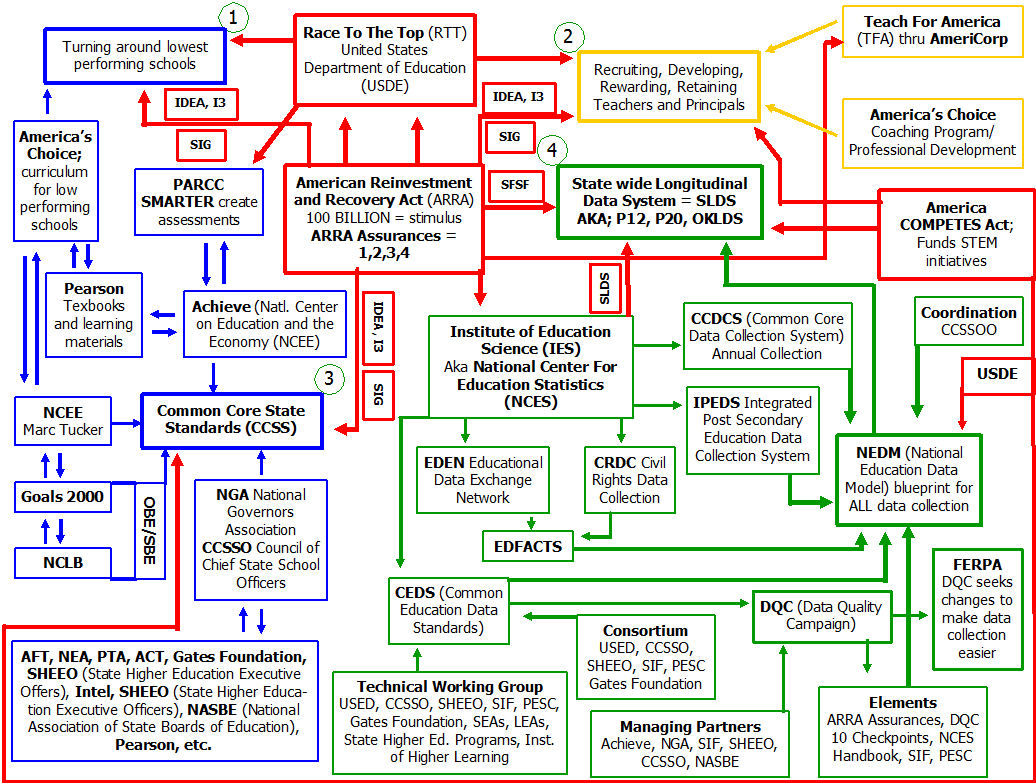
For those of you who have followed ROPE since the days (2008-2014) when we were called Restore Oklahoma Public Education (ROPE), you’ll recognize the flowchart, that Lynn Habluetzel (former ROPE Board member) and I created together to show how Obama’s Race To The Top grant program was fueling ways in which the government would track YOUR CHILDREN all under the guise of ‘helping’ them. What did Reagan say, “The nine most terrifying words in the English language are ‘I’m from the government and I’m here to help”?

This session, our ‘helpful’ legislature – particularly Representative Chad Caldwell and Senator Ally Seifried – have decided to add to the State Longitudinal Database System (SLDS) so loved by former REPUBLICAN State Superintendent Janet Baressi. Here is the text of the bill. In addition, Seifried and Dick Lowe (SB141) are directing the OSDE to issue RFP’s for a “statewide student information system”. I guess, we’re the only ones that remember the information below apparently.

I was going to publish a list of reasons why this bill shouldn’t even be considered, but I’ll just say this – WE ALREADY HAVE A STATE LONGITUDINAL DATABASE (aka Statewide Student Information System) and according to everything we learned years ago, it was set up to do all the same stuff outlined in the bill by the person responsible for setting the whole scheme up by the Obama administration in the first place, John Kraman – now the Chief Information Officer for the Mississippi State Department of Education.

Here’s what we know.

We know that the state got a Race To The Top grant for $4,997,082 to construct the SLDS in 2012.

We know that Oklahoma created a P20 Council via law to oversee the project which was supposed to have sunset (gone away) in 2015.

We know that The Wave is “OSDE’s primary system for collecting data from schools to perform necessary duties and functions” (Oklahoma’s SLDS). Incidentally, the link that is supposed to tell parents exactly what data is collected via The Wave is not working, which violates section C.1 of the law we helped implement in 2013 (2013 Student Data Accessibility, Transparency, and Accountability Act, 70 O.S. § 3-168) until we realized it didn’t say what we expected it to say – story on that here.

We know that the OSDE has a data governance board.

We know that the OSDE has a Data Privacy Program Plan.

Here is a list of The Wave Code Tables to give you an idea of the kind of data our SLDS is storing.

We know that the OSDE is continually updating the Schools Interoperative Framework (SIF) and has new updates ready this year (2025).

And finally, we know that The Wave allows data researchers/teachers/etc., to pull information on students regarding their post-secondary and (‘workforce’) ‘opportunities’.

In closing:

STOP COLLECTING DATA ON KIDS! THERE IS NO NEED FOR THIS UNLESS THE IDEA IS FOR THE GOVERNMENT TO EDUCATE STUDENTS FOR JOBS LIKE THE EU DOES.

And if there’s still any concern that Oklahoma needs more excuses to collect data on kids, below is the presentation I made to the House Admin rules, Government Oversight and Repealer Committee during October of 2013. It’s a MUST WATCH because it contains the flowcharts I prepared that show how the state – and the feds – collect student data.

Here is the paper that contains all the LIVE links to all the research Lynn, Julia Seay (former ROPE Board member) and I did on the SLDS during the time Oklahoma was implementing that monster.

PLEASE, PLEASE, PLEASE share this information with every parent and grandparent you can and IMMEDIATELY contact your Representative and Senator and tell them that they MUST vote NO for SB224 and SB141 and any other data collection bill in the state legislature.

Blog at WordPress.com.

Up ↑