
Search

ROPE Report

Tag

public education

Dollars For Data – Grok: In Order To Continue Receiving Federal Dollars, Oklahoma Needs To Gather Data On Babies Through 20-Year-Olds

I’m not a huge fan of AI, but I’ve been a researcher since 1990 and this tool has helped me find data more quickly and completely than I ever have before.

Today, because I’m still trying find a way to explain that SB224 is NOT FOR Oklahoma’s kids, but to satisfy a broader need to plan the economy on a national level, I asked Grok “does the federal government require states to codify the need to connect education and workforce data”? I got a long, in-depth, very interesting answer. So, is this to help Oklahoma’s kids, or get more federal grants? I’ll let you be the judge.

Grok’s answer:

The federal government does not explicitly require states to codify into state law a specific mandate to connect education and workforce data as a condition for receiving federal grants. However, federal policies, grant programs, and regulations often incentivize or require states to establish systems for linking education and workforce data to meet reporting, accountability, or performance goals. These requirements can typically be met through administrative actions, interagency agreements, or data systems like Oklahoma’s Data Sharing Hub (DASH), without necessarily codifying the connection into state statutes. Below is a detailed analysis based on available information:

Federal Context for Education and Workforce Data Integration

  1. Relevant Federal Laws and Programs:
    • Workforce Innovation and Opportunity Act (WIOA, 2014):
      • WIOA is the primary federal law governing workforce development programs. It requires states to develop integrated data systems to track participant outcomes across workforce, education, and training programs (e.g., Title I for adults, Title II for adult education, Title IV for vocational rehabilitation).
      • States must report performance metrics, such as employment rates, earnings, and credential attainment, which often require linking education and workforce data. For example, WIOA’s performance accountability provisions (29 U.S.C. § 3141) mandate data collection and reporting, which may involve connecting education records (e.g., high school or college completion) with employment outcomes.
      • While WIOA encourages states to establish data-sharing agreements or systems, it does not explicitly require codification into state law. States can comply through administrative frameworks, such as memoranda of understanding (MOUs) between agencies or platforms like DASH.
    • Every Student Succeeds Act (ESSA, 2015):
      • ESSA requires states to report on student outcomes, including college and career readiness indicators, which may involve linking education data to workforce outcomes (e.g., post-secondary enrollment or employment).
      • States receiving ESSA funds must submit state plans and comply with accountability requirements, but these do not mandate codifying data linkages. Instead, states often use existing data systems or establish new ones to meet federal reporting needs.
    • Perkins V (Carl D. Perkins Career and Technical Education Act, 2018):
      • Perkins V funds career and technical education (CTE) programs and emphasizes aligning education with workforce needs. It requires states to report on CTE student outcomes, such as employment or post-secondary success, which often necessitates data integration.
      • Like WIOA, Perkins V encourages data system interoperability but does not require states to pass laws mandating data connections. States can use administrative tools or data-sharing platforms to comply.
    • Higher Education Act (HEA):
      • The HEA governs federal student aid and includes reporting requirements for post-secondary institutions, such as graduation rates and employment outcomes. Some grant programs under HEA may encourage data linkages to track student success, but codification is not a requirement.
  2. Federal Grant Conditions:
    • Federal grants, particularly those tied to WIOA, ESSA, or Perkins V, often include conditions related to data collection and reporting. For instance, WIOA grants require states to submit annual performance reports that integrate education and workforce data (e.g., 20 CFR § 677.155).
      • These conditions typically focus on outcomes rather than prescribing how states achieve them. States can meet requirements through data-sharing agreements, longitudinal data systems (SLDS), or platforms like DASH, without codifying policies into law.
      • Some competitive grants, such as the U.S. Department of Education’s State Longitudinal Data Systems (SLDS) Grant Program, explicitly fund the development of integrated data systems. While these grants require states to build capacity for data linkages, they do not mandate legislative codification. Instead, they emphasize technical and administrative solutions.
    • The Department of Labor’s Workforce Data Quality Initiative (WDQI) provides grants to enhance state data systems for tracking workforce and education outcomes. WDQI encourages states to link data across agencies but allows flexibility in implementation, typically through administrative means rather than statutory mandates.
  3. Family Educational Rights and Privacy Act (FERPA):
    • FERPA (20 U.S.C. § 1232g) governs the privacy of education records and impacts how states link education and workforce data. States must ensure compliance with FERPA when sharing student data, which may require data-sharing agreements or secure systems like DASH.
    • While FERPA imposes strict requirements on data handling, it does not mandate codification of data-linking policies. States can address FERPA through administrative protocols or interagency agreements.
  4. State Longitudinal Data Systems (SLDS):
    • The federal government has supported SLDS development since 2005 through the Institute of Education Sciences (IES). SLDS grants aim to create systems that link early childhood, K-12, post-secondary, and workforce data to inform policy and improve outcomes.
    • While SLDS grants require states to build and maintain these systems, the focus is on technical infrastructure and data governance, not on passing state laws. States can establish SLDS through executive action, agency collaboration, or platforms like DASH.

Oklahoma’s Context and DASH

  • Oklahoma’s Data Sharing Hub (DASH):
    • As noted in your previous question, DASH is Oklahoma’s platform for secure interagency data sharing, managed by the Office of Management and Enterprise Services (OMES). It supports data integration for various state functions, including those tied to federal grants.
    • DASH likely facilitates compliance with federal reporting requirements under WIOA, ESSA, or Perkins V by enabling secure data linkages between education agencies (e.g., Oklahoma State Department of Education) and workforce agencies (e.g., Oklahoma Employment Security Commission).
    • There is no evidence that DASH’s operation or Oklahoma’s participation in federal grants requires codifying a mandate to connect education and workforce data. Instead, DASH serves as an administrative tool to meet federal expectations for data integration and reporting.
  • Oklahoma’s Approach:
    • Oklahoma has pursued data integration through initiatives like the Statewide Longitudinal Data System (SLDS), supported by federal grants. These efforts focus on technical and administrative solutions, such as data governance frameworks and interagency MOUs, rather than legislative mandates.
    • State laws, such as those governing data privacy or agency operations, may indirectly support data sharing (e.g., compliance with FERPA or state data security standards), but there is no specific Oklahoma statute mandating education-workforce data linkages as a condition of federal funding.

Does Codification Ever Occur?

  • Federal Incentives, Not Mandates:
    • While the federal government does not require codification, it may incentivize states to formalize data-sharing frameworks to ensure sustainability or compliance. For example, SLDS or WDQI grants may encourage states to establish governance structures, which some states codify into law for clarity or permanence.
    • States like Tennessee and Kentucky have passed laws to formalize SLDS or data-sharing governance (e.g., Tennessee’s P-20 Council), but these are state-driven initiatives, not federal mandates. Oklahoma has not taken this approach, relying instead on administrative tools like DASH.
  • State Discretion:
    • States may choose to codify data-sharing policies to address privacy concerns, ensure long-term funding, or align with federal grant requirements. For instance, a state might pass a law to clarify agency roles in data sharing or to comply with FERPA. However, this is not a federal requirement but a state policy choice.

Limitations and Variability

  • Grant-Specific Requirements: Some federal grants may include conditions that indirectly require data linkages, such as reporting on employment outcomes for CTE students under Perkins V. These conditions focus on outcomes, not codification, but states may codify policies to streamline compliance.
  • Privacy and Security: Federal laws like FERPA and the Privacy Act (5 U.S.C. § 552a) impose strict requirements on data sharing, which may necessitate state-level policies or agreements. However, these can be administrative rather than legislative.
  • No Universal Mandate: There is no blanket federal requirement for states to codify education-workforce data linkages. The emphasis is on functional data systems and compliance with reporting requirements, which states can achieve through various means.

Conclusion

The federal government does not require states to codify into state law a mandate to connect education and workforce data to receive federal grants. Instead, laws like WIOA, ESSA, and Perkins V, along with grant programs like SLDS and WDQI, encourage or require states to integrate data for reporting and accountability purposes. States can meet these requirements through administrative actions, data-sharing agreements, or platforms like Oklahoma’s DASH, without passing new laws. While some states voluntarily codify data-sharing frameworks, this is not a federal mandate but a state choice. In Oklahoma, DASH likely supports compliance with federal data requirements, but there is no evidence of a codified mandate tied to federal funding. If you have a specific grant or program in mind, I can analyze its requirements further.

Why is Gov. Kevin Stitt pushing an AI tutor into Oklahoma schools?

This past February , governor Kevin Stitt’s Education task force, dubbed the “Human Potential for Future Industries Task Force”, announced that an AI math tutor program would be introduced into select Oklahoma schools in March, with the goal of rolling it out in participating districts statewide for the 2025-2026 school year, allegedly at no cost to the schools themselves. The program, “Synthesis AI”, is the creation of Josh Dahn and Chrisman Frank, co-founders of Synthesis, and they both attended the February task force meeting to promote their product.

Oklahoma Secretary of Education Nellie Sanders, who chairs the task force, is quoted in a recent OKBusinessVoice article: “Our current education system isn’t built for the future—it’s barely built for the present,”… “Oklahoma’s students are full of untapped potential, and it’s our job to ensure they have the right opportunities to thrive. This task force is focused on breaking away from outdated, one-size-fits-all education models and create real-world pathways that prepare students for their future. Oklahoma will proudly become the first state to put Synthesis’ priceless, one-of-a-kind piece of technology in our classrooms— and I couldn’t be more excited for our teachers, students, and parents. I’m grateful to Josh and Chrisman for their partnership.” (highlights mine)

Something to note here: Synthesis AI has never before been used by a school district in the nation, meaning that Oklahoma students will be using an AI tutor that remains untested in a school setting. Are our schools to be a laboratory for this unproven technology, and can we really afford to go in blind on such an endeavor?

Stitt, who dubbed the AI tutor as “revolutionary”, is quoted as saying, ““Every student needs to be prepared to leave school college-ready or career-ready. That isn’t happening for too many Oklahoma students,”…“We want kids to develop their God-given talents and apply them in high-demand industries right here in Oklahoma. I’m grateful to Secretary Sanders and her task force for doing their part to ensure students go from classrooms today to careers tomorrow.”

Every parent wants their child to succeed, but we must be wary of misguided attempts at a solution that ends of making the situation worse. Initial research on the use of AI in the classroom has not produced glowing results, and in fact has shown that AI has resulted in poorer performance outcomes than tried-and-true education strategies.

Chrisman Frank, the co-founder of Synthesis AI, praised his meeting with Stitt’s task force in a post on X: “Thrilled to partner with visionary Governor@GovStitt and Education Secretary @NellieSandersOK to bring the magic of the Synthesis AI tutor to Oklahoma schools and families. Tutor will be available to ALL third grade students in the state this fall. Proud to work with the administration to serve the people of the great state of Oklahoma!”

So the Synthesis AI Tutor is a done deal for Oklahoma’s students? According to Chrisman’s post, it is. The replies to Chrisman’s X post seem suspiciously bot-like. Did he pay for artificial engagement on what is arguably his most important post on X, as co-founder of an AI startup that could potentially be used across the nation?

The task force released what it considers to be “priority actions”, and it reads like the familiar, meaningless buzzword glop we’ve seen elsewhere:

  • Strengthening workforce-aligned education by integrating industry-driven skills into curricula.
  • Expanding hands-on learning through apprenticeships, internships, and immersive learning experiences.
  • Leveraging artificial intelligence, virtual reality, and other emerging technologies to create immersive classroom experiences.
  • Assessing teacher preparation programs to ensure Oklahoma educators are equipped to meeting evolving student needs.

Long, hard experience shows that these wildly-optimistic bullet points never deliver. Parents and legislators should be very wary of anyone promising Heaven on Earth in order to push through another education “revolution”, when students here are already struggling to read and perform math at grade level. Long before “Ed Tech”, schools were able to successfully teach math, reading, and reading comprehension. Something terrible has happened along the way that has resulted in plummeting scores across the board. Rather than the savior, many point to just this type of Ed tech as the culprit.

In an article entitled, “The EdTech Revolution Has Failed”, Jared Horvath argues that, since the widespread introduction of internet-connected devices into the classroom beginning in the 2010s, student scores have dropped across the board. Rather than a mere coincidence, Horvath places the blame on EdTech itself, citing multiple large-scale studies that equate the omnipresence of internet-connected devices in the classroom with a significant drop in learning.

The logical solution, albeit one that no one in the business of education wants to hear, is to remove Ed Tech from our classrooms entirely, not double or triple-down on what has clearly been a massive boondoggle.

If an AI math tutor is indeed “revolutionary”, then Oklahoma should require proof, rather than allow students here to themselves become the test subjects. Untested, experimental EdTech has no place in Oklahoma schools, and our government should understand that before pitching us headlong into uncharted waters, when we are barely keeping our state’s students afloat as it is.

SB224 (re Student Data Collection) Passed By House On Fourth Vote After Failing In First Three

Tuesday, April 29th, SB224 – Creating the Oklahoma Education and Workforce Statewide Longitudinal Data System – was brought to the floor for a House vote following passage in the Senate 33 to 13. The bill failed in the House 35 to 56 with 7 absent.

At that time, author Representative Caldwell captured the bill to be reheard at a later time.

Thursday, May 1, the bill came to the House floor again, where it was voted down Ayes: 46 Nays: 37.

Then, a Motion to Rescind THAT vote was adopted Ayes: 51 Nays: 32.

The measure THEN passes Ayes: 51 Nays: 36 without the emergency clause.

Representative Tom Gann – who argued against the bill on the floor – wrote a Press Release concerning the unprecedented THREE votes the bill received on the 1st. That press release was read live on the air after it was sent, but Gann was advised that it would NOT be placed on the House website for publication. Please see below for a copy of that press release.

Rep.-Tom Gann, R-Inola Issues Statement on Bonus Vote of SB224 and Warns of the Dangers of Setting New Policy

Representative Tom Gann released the following statement on the unprecedented bonus vote taken by the house on Thursday on Senate Bill 224.

“On Thursday, May 1, 2025, Representative Kyle Hilbert, Speaker of the House, took actions regarding SB224 that did not align with the House Rules of the 60th Legislature. 

House rules dictate that once a bill is defeated it is not eligible for additional consideration. The House vote to defeat SB224 was considered final action under the rules.

However, Hilbert, while presiding over the house allowed an additional bonus vote to occur by which the bill was approved. This breaks with years of clearly established House precedent that prevents never ending bonus votes on failed legislation and opens up a Pandoras box of potential abuse. 

What other bills will be allowed a bonus vote?”

The relevant house rule and written precedent are attached to this release.

House Rule 6, Bills And Resolutions,

6.8 – Final Action

(a) The following action shall constitute final action on any bill or resolution:

1. committee recommendation, including any oversight committee recommendation or any policy committee recommendation of “Do Not Pass”;

2. if a motion to reconsider the vote on Third Reading or Fourth Reading fails to prevail or expires;

3. if a motion to table the motion to reconsider prevails; or

4. if a vote is taken on Third Reading or Fourth Reading and no notice is served to reconsider the vote.

(b) If final action is such as to defeat a bill or resolution, no other bill or resolution having the same effect and covering the same specific subject matter shall be considered by the House of Representatives during either session of the current Legislature.

Page 53

On page 209 of Precedents

6.8 – 4 (2010) Motion to Rescind May Not Be Used to Avoid Final Action

Rule – House Rule 6.8, paragraph (a) states in part:

(a) The following action shall constitute final action on any bill or resolution:

…a motion to reconsider the vote on Third Reading or Fourth Reading [that] fails to prevail…

History – Representative Nelson moved to reconsider the vote whereby Senate Bill 2207 failed, which motion failed of adoption. Representative Nelson moved to rescind the vote whereby the reconsideration motion failed.

Representative Reynolds raised a point of order stating that the motion to rescind was dilatory.

15 Okla. H. Jour., 1542, 1543, 52nd Leg., 1st Reg. Sess. (April 27, 2009).

V1SUT Vantage Substack Author Discusses The Ways In Which How OK Legislators Are Sabotaging Ed Reform

Our friend, author ‘Mary’ of the V1SUT Vantage Substack joined the podcast at a SPECIAL TIME – at 1pm on Friday, March 21st to talk about some very unsettling things going on in the world of Oklahoma Education Reform. This is another one of those videos (I know…I write that all the time!) for which you’ll want to watch the full video and you can do that here on our YouTube and Rumble channels.

Mary talked about a number of bills, but the one we talked about arguably the most was HB1937, the bill that would change the law passed last year authored by Sherrie Conley, that prevented Oklahoma public school employees from communicating with students without a parent on the call/text/email/etc. HB1937 – a bill by two former public school employees – now allows parents to opt out of the law. Mary talks about what a bad idea that is in the clip below.

We also talked about HB1491 – a horrible bill that I can’t imagine wasn’t a request bill from the Governor. Don’t forget, back in February, Governor Stitt fired three Oklahoma State Department of Education Board members because of ‘political drama’. We found out later that Stitt fired them because he didn’t want anyone counting the number of illegal alien students here in Oklahoma (then we produced evidence that that information is collected for the Oklahoma State Longitudinal Database called The Wave, anyway).

And so the newest installment in the story is that, suddenly, and out of thin air, Representative Ronny Johns and Senator Aaron Rheinhardt gutted HB1491 – already a bad bill because it essentially watered down the requirements for removing teaching certifications from Oklahoma teachers – and inserted language that would allow State Board of Education members to add items to the agenda. Below, Mary explains why this is a very, very bad idea.

Who knows how poorly the state is really doing in educating our youth. The National Assessment of Educational Progress (NAEP) has us as 48th in reading and 45th in math for 8th graders. What’s going on at the state capitol right now is not helping. Let your Senators know that you don’t like EITHER of these bills and you want a big fat NO vote when they reach the Senate. Stay tuned and watch Mary’s substack for more!

SB224 And SB141 Are Unnecessary; The WAVE (SLDS) Captures Student Data On Education And The Workforce – AND WAY MORE – Already

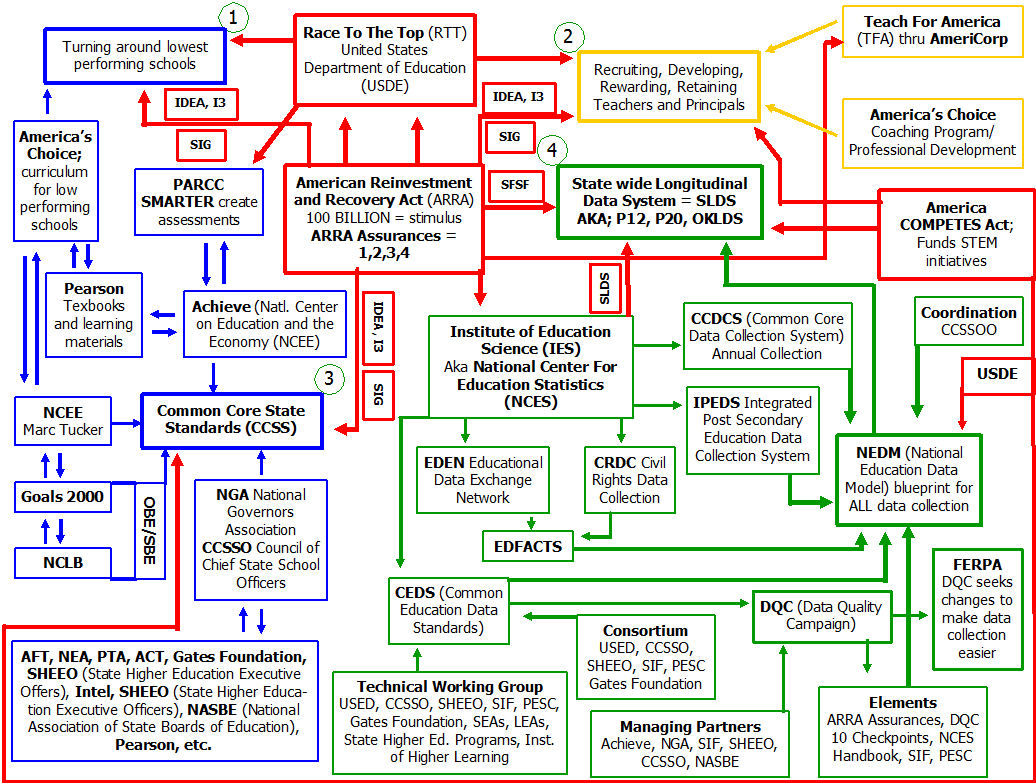
For those of you who have followed ROPE since the days (2008-2014) when we were called Restore Oklahoma Public Education (ROPE), you’ll recognize the flowchart, that Lynn Habluetzel (former ROPE Board member) and I created together to show how Obama’s Race To The Top grant program was fueling ways in which the government would track YOUR CHILDREN all under the guise of ‘helping’ them. What did Reagan say, “The nine most terrifying words in the English language are ‘I’m from the government and I’m here to help”?

This session, our ‘helpful’ legislature – particularly Representative Chad Caldwell and Senator Ally Seifried – have decided to add to the State Longitudinal Database System (SLDS) so loved by former REPUBLICAN State Superintendent Janet Baressi. Here is the text of the bill. In addition, Seifried and Dick Lowe (SB141) are directing the OSDE to issue RFP’s for a “statewide student information system”. I guess, we’re the only ones that remember the information below apparently.

I was going to publish a list of reasons why this bill shouldn’t even be considered, but I’ll just say this – WE ALREADY HAVE A STATE LONGITUDINAL DATABASE (aka Statewide Student Information System) and according to everything we learned years ago, it was set up to do all the same stuff outlined in the bill by the person responsible for setting the whole scheme up by the Obama administration in the first place, John Kraman – now the Chief Information Officer for the Mississippi State Department of Education.

Here’s what we know.

We know that the state got a Race To The Top grant for $4,997,082 to construct the SLDS in 2012.

We know that Oklahoma created a P20 Council via law to oversee the project which was supposed to have sunset (gone away) in 2015.

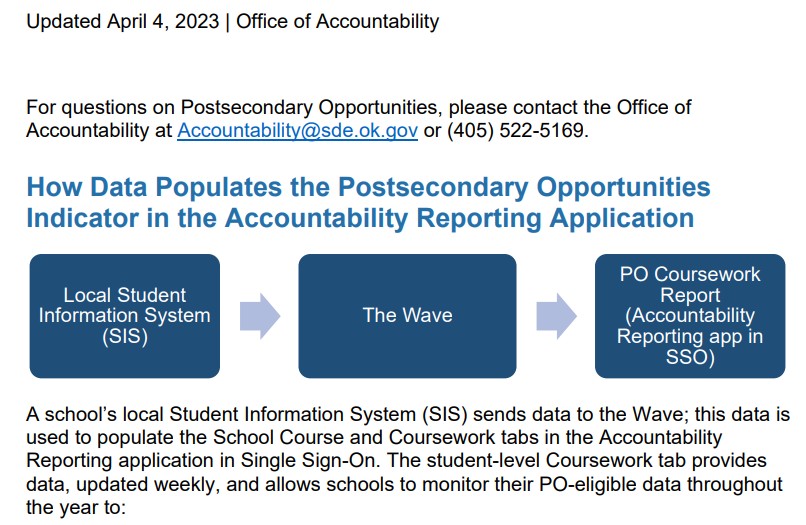
We know that The Wave is “OSDE’s primary system for collecting data from schools to perform necessary duties and functions” (Oklahoma’s SLDS). Incidentally, the link that is supposed to tell parents exactly what data is collected via The Wave is not working, which violates section C.1 of the law we helped implement in 2013 (2013 Student Data Accessibility, Transparency, and Accountability Act, 70 O.S. § 3-168) until we realized it didn’t say what we expected it to say – story on that here.

We know that the OSDE has a data governance board.

We know that the OSDE has a Data Privacy Program Plan.

Here is a list of The Wave Code Tables to give you an idea of the kind of data our SLDS is storing.

We know that the OSDE is continually updating the Schools Interoperative Framework (SIF) and has new updates ready this year (2025).

And finally, we know that The Wave allows data researchers/teachers/etc., to pull information on students regarding their post-secondary and (‘workforce’) ‘opportunities’.

In closing:

STOP COLLECTING DATA ON KIDS! THERE IS NO NEED FOR THIS UNLESS THE IDEA IS FOR THE GOVERNMENT TO EDUCATE STUDENTS FOR JOBS LIKE THE EU DOES.

And if there’s still any concern that Oklahoma needs more excuses to collect data on kids, below is the presentation I made to the House Admin rules, Government Oversight and Repealer Committee during October of 2013. It’s a MUST WATCH because it contains the flowcharts I prepared that show how the state – and the feds – collect student data.

Here is the paper that contains all the LIVE links to all the research Lynn, Julia Seay (former ROPE Board member) and I did on the SLDS during the time Oklahoma was implementing that monster.

PLEASE, PLEASE, PLEASE share this information with every parent and grandparent you can and IMMEDIATELY contact your Representative and Senator and tell them that they MUST vote NO for SB224 and SB141 and any other data collection bill in the state legislature.

Weekly News Headlines And Commentary – Week of February 24, 2025

ROPE2.org

This week (and last, since I wasn’t able to post last week due to a farm emergency) there are a number of new posts to the blog. Most of these are about legislation since we’re quickly reaching the date (3.6.25) for bills to switch houses (from House to Senate or vice-versa).

Republican Governor Stitt Sides With Democrats To Keep The Education Status Quo By Firing State Education Board Members Engaged In Protecting Oklahoma Kids

This is the most infuriating situation. Citing “political drama”, Governor Stitt fired three members of the State School Board on February 12th. The “political drama” apparently had to do with an agenda item on the previous week’s State School Board agenda wherein the Board would vote to find a way to count the number of ILLEGAL immigrants in Oklahoma classrooms. There is definitely some “political drama” here if not “political intrigue” and I hope to expose all that in upcoming weeks. This all stems from a very influential man in Oklahoma politics who has an R after his name, who believes illegal immigration is essentially fine and works deals with elected officials to create policies – written or not – that protect them in this state. The saddest part here is that these three board members were doing Yeoman’s work ridding Oklahoma public education of school employees that sexually abuse students. Our governor is – AGAIN – completely wrong. Read the blog for information on who was selected to replace the three removed members. None have any educational experience whatsoever, so, there’s that.

Dumping Human Waste On Farmland Must Stop

Unfortunately, we’ve lost several lambs on the farm this winter season, so I used them as the backdrop to talk about the horror show that is spreading human waste on cropland in Oklahoma. This is as bad as it sounds and now the EPA and other organizations, have shown that this material contains ‘forever chemicals’, cancer-causing molecules cause PFAS. Unfortunately, an excellent bill to stop the practice, written by new Representative Jim Shaw (from Lincoln County where this has been done regularly for many, many years) has been denied a hearing in Committee this year. This will not just hurt farmers and ranchers who use the stuff, but PFAS and other chemicals have been shown to migrate from where they were dumped and into water sources, effecting neighboring farmsteads as well. Please read the blog to find out more about the practice and why you should want this stopped even if you live in a city.

This article was published in The Federalist under the headline; “Your ‘Farm Fresh’ Produce Might Be Fertilized With Forever Chemicals And Human Waste“.

Jason Murphy Divulges The ‘Scam’ That Runs The Oklahoma Legislature

Former Representative, Jason Murphy knows a lot about the legislature, having served there a full 12 year term. Today, he is making the most of that knowledge by writing a Substack called, “The Oklahoma State Capitol“. He joined Michael and I on the podcast last week to talk about how the legislative process – at least the way its been run in recent history – is simply a shell game to keep the citizenry appeased and the lobbyists/big business interests that run the state, happy. You’ll want to read the blog to see who all these interests are so you can keep your eye out for them.

Former SD15 Candidate Robert Keyes, His Fight For Election Integrity, The Evidence In His Case And SB654 To Remove The Election Law At The Center Of It All

We’ve had Robert on the show before and his descriptions of what happened to him during his campaign for SD15. It was eye-opening. Here, he gives us some updates on his current case. This blog is SUPER IMPORTANT to read because I’ve embedded Robert’s Supreme Court documents. These documents include photographs and specific instances of the Oklahoma State Election Board irregularities over which Robert took them to court. These are MORE than eye-opening. It shows that there are real concerns with our State Election Board and the processes that govern election law in Oklahoma – and this knowledge is important to EVERY Oklahoman.

File Under, ‘Too Much Too Little Too Late’; James Lankford Comes Out Swinging In Favor Of Smaller Government

This last week, Senator Lankford has hit social media hard to capitalize on the Elon Musk/DOGE efforts at right-sizing government. Over and over again he’d Tweet (X) out a message about how government is ‘fumbling’ (a take on his 5th Federal Fumbles, just out) with spending. Unfortunately, it hit me as being pretty disingenuous because he’s never seen a budget he didn’t like. After Tweeting back at him a couple times, I decided to stop and actually write a piece on his voting record and why Lankford needs to leave DC and find a new job. In order to be fair, I went to the VOTE SMART website and looked through every one of the votes they had posted there. While some of his votes are quite good, all but one time, he’s voted for the budget and for continuing appropriations. Check out the article. Lankford may be one of your very favorite people, but at least read this knowing that I’ve been fair. If you’ve never seen his voting record, it might be pretty interesting….

This Week At The Capitol, Legislators Dick Lowe and Danny Sterling UNprotect Students With HB1937

This is a SUPER IMPORTANT article because HB1937 is still alive. Contact your Representative immediately and tell them that this must be a NO vote if it’s brought to the floor. This bill basically undoes the good legislation former Rep. Sherrie Conley had passed before she left the House that prevents public school employees from communicating with a student without the knowlege of a parent. Unfortunately, perennial public school employees Lowe and Sterling, felt that this created an undue burden for public school employees and created a bill to allow parents to ‘opt out’ of the law’s requirement. This is a really bad idea and if you’re not quite sure how, please read the piece where Michael, Mary from V1SUT and I spell it out clearly.

The New World Order Needs Compliant Kids, So Government Schools Educate Them To Be Compliant

We’ve talked about this fact many times on the podcast – the fact that we all seem to think that public schools were created to educate children – but they’re not. Here, Julianne Romanello, Michael and I talk about what public schools actually do and what the educational trend will be for students over time if we don’t STOP it now.

Citizens Of HD32 Effectively Taxed Without Representation As Representative Jim Shaw’s Bills Blocked From Hearings

If bills were not assigned to a Committee for the upcoming week (2.24), they will not get a hearing in the Oklahoma legislature this year. NONE of new Representative Jim Shaw’s bills received a hearing in a committee. Why? I make the case that Shaw’s defeat of Kevin Wallace (former House Appropriations Chair) is at the epicenter of this situation in which citizens of HD32 will be taxed without representation during the 2025 legislative session. This is unforgivable. Personal pettiness should NEVER stand in the way of the democratic process in America and certainly not in a ‘red state’ like Oklahoma.

LEGISLATION

So much legislation has been passed through Committees this session, with more coming up this week. The cell phone bill is still in play (Usurping Local Control – Cell Phone Restrictions In Oklahoma – NO on SB1389 and HB1276). Please read the article to find out the many reasons this is a BAD bill that needs to be voted down by the House and Senate both.

To be honest, with the new two-tiered committee structure in the House, it’s been hard to follow bills. I’ve been hoping that different groups following bills would let me know what’s out there and what needs to be followed, but I think the system is doing it’s job and making it hard for people to follow the legislation they want to see stopped or followed.

OKLAHOMA SUBSTACK AUTHORS

Don’t forget to check out our Substack authors this week!

The Oklahoma State Capitol by Jason Murphy

The Sooner Sentinel by Marven Goodman

V1SUT Vantage by ‘Mary’

LOCAL AND NATIONAL MEDIA

Survey: Homeschooled Adults Are More Religious And Less Anxious

House lawmakers reject communism education bill, advance new scholarship requirements

African prosperity activist says “the west is committing suicide.” Speaking to the packed auditorium at ARC, the Senegalese entrepreneur, said that the west is currently “committing suicide” by limiting the use of emergy sources like oil, coal, and gas.

Voting by mail? Oklahoma bill would require voters to give reason for absentee ballots

Oklahoma’s OMA Exemptions Enables a Possible Cloak of Secrecy for County Commissioners’ Backroom Deals

Traffic ticket scheme was netting millions for Oklahoma DA’s office – how much of this is going on in every county, we just haven’t found out about it yet?

Republican Governor Stitt Sides With Democrats To Keep The Education Status Quo By Firing State Education Board Members Engaged In Protecting Oklahoma Kids

(edited after publication)

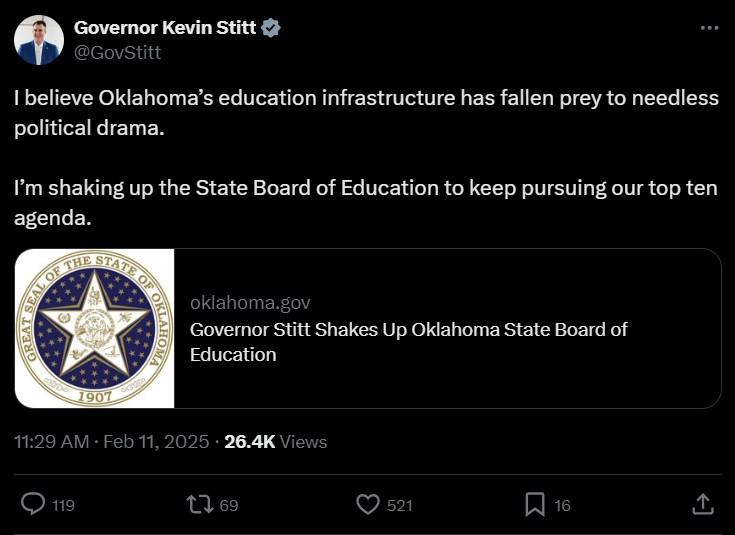
So interesting today to see that Governor Stitt has fired three members of the state school board because, “…it’s clear that our education infrastructure has fallen prey to needless political drama.”

Political drama. What does that actually mean? But then the Governor loves to use catch phrases – you know – like political animal – the term he used when he was out in Chairman of the House Appropriations and Budget Committee, Representative Kevin Wallace’s district, trying to get him re-elected over the grassroots, common family man the people preferred, Jim Shaw?

Seriously. What political drama? Literally. What exactly was the DRAMA the Board was engaging in?

I never saw a one of them talking about their jobs outside the Board in a way that invoked DRAMA. None of them were going before a camera to talk about their jobs or to condemn the Superintendent or the Governor or creating MAGA videos in their cars. SO WHAT DRAMA?

I think he means the DRAMA of removing the teaching certificates of taxpayer-supported public school employees who were preying upon children. THAT drama!

Seriously, does anyone realize that we’ve had a drag queen principal with a drunk driving and child pornography charge – who only went away because of outside pressure by local media outlet V1SUT – and a Superintendent in Shawnee and a coach in Shawnee and incidents in Kingfisher and Ninnekah and Salina and Perry and Wewoka where districts are being sued because NO ONE WOULD PROTECT STUDENTS FROM EMPLOYEES WHO WERE HURTING CHILDREN? THAT kind of drama Mr. Stitt?

Kendra Wesson – one of the removed Board members – is one of the most transparent, hard-working, smart, committed women I know. She was always prepared for a meeting and truly had a heart for kids – a not-so-surprising-fact when you find out that she has eight of her own. Her removal is absolute NONSENSE. She wasn’t engaged in any kind of political drama in any way. All she was trying to do in her position was go over and above to help Oklahoma kids.

WHO IN THE HELL FIRES SOMEONE LIKE KENDRA WESSON????

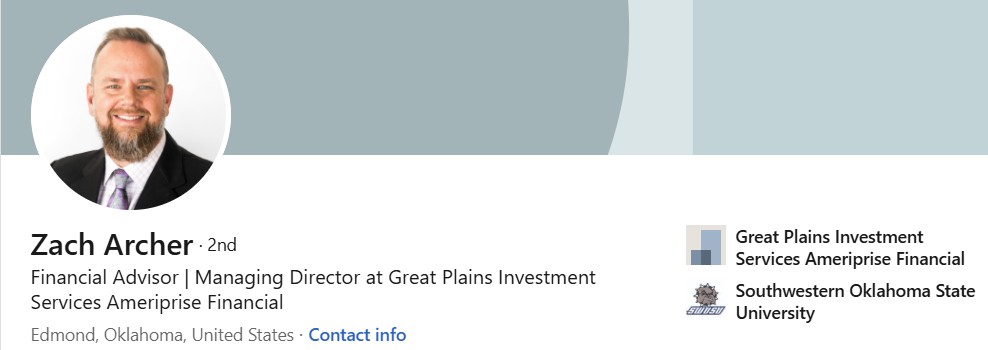
She and this Board were actively involved in attempting to remove teachers and other public school personnel who were a danger to children – and now all of them but two – Governor Stitt’s attorney at Gateway Mortgage, Sarah LePak – and Zach Archer – who, like Governor Stitt, works in the financial industry – are left. What do they know about education? Apparently, they know how to be an attorney and a financial analyst – but, dang it – that is the kind of person our Governor admires!

So what about these new Board members?

Michael Tinney is the husband of Ginger Tinney of Professional Oklahoma Educators. Mr. Tinney is an oil and gas attorney with Ames, Ashabranner, Taylor, Lawrence, Laudick & Morgan in Oklahoma City. I guess we should be happy that he’s at least CONNECTED to someone who knows about education, ‘cuz at this point, we’re 0-2 there.

Ryan Deathridge is a small business owner and the Kingfisher County 911 Director. He has a double major in Agriculture and Finance.

If he is from Kingfisher, he is resident of the Kingfisher Public School system where the district was slapped with a $5 million dollar lawsuit over charges of abuse by Kingfisher Football Coach Jeff Myers. Myers, who was banned from any further activity with the team and whose contract was not to be renewed by the Board, was still employed as of December, when Kingfisher had to let go 22 positions to pay the settlement from the suit after the Kingfisher County Excise Board refused to pass the settlement cost on to tax payers.

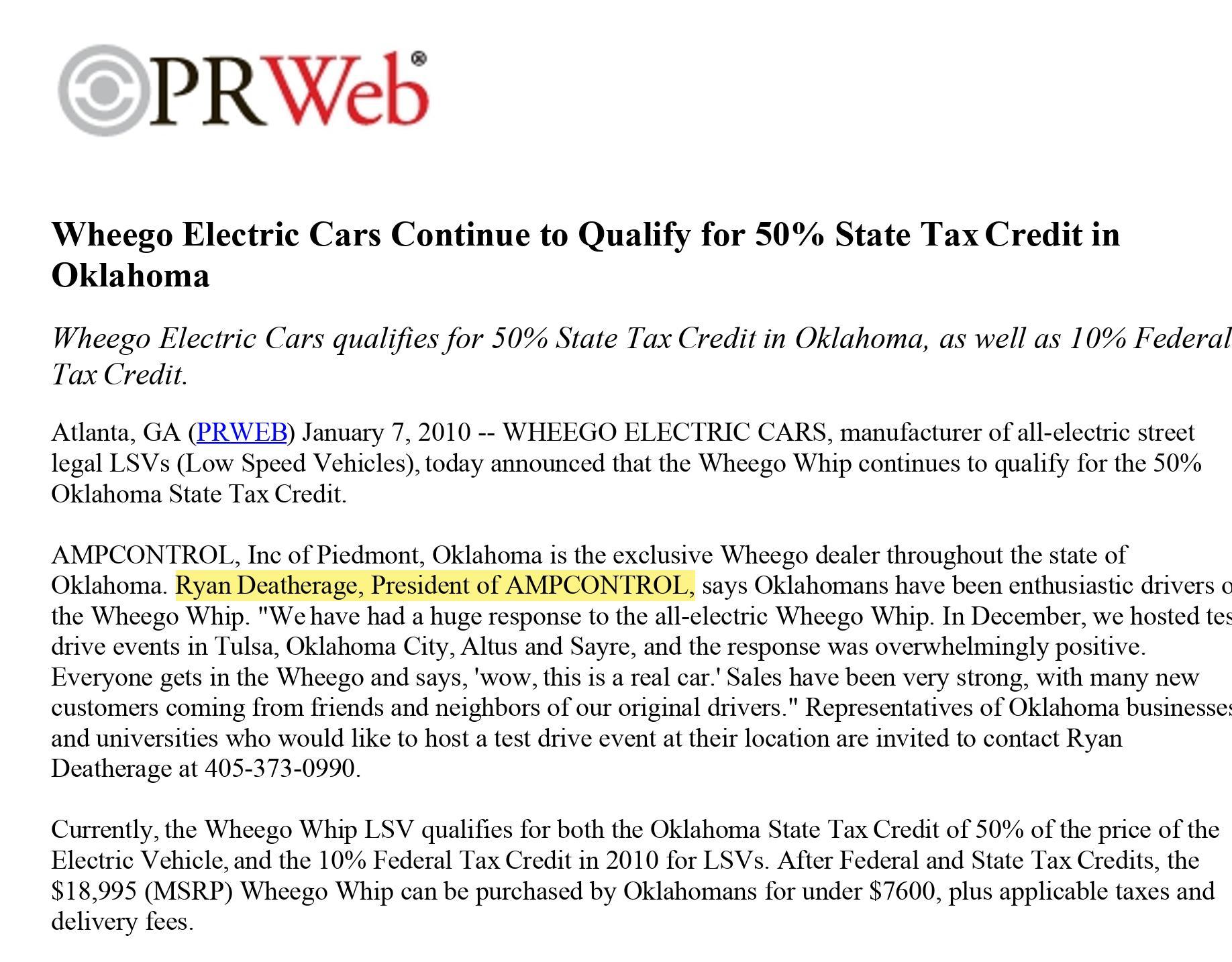
And then we found this:

Apparently, in the 20-teens Deathridge was associated with the electric ‘car’ tax credit craze. And yes, there were federal income tax subsidies taken for the vehicles.

What an interesting choice for the State School Board. He has no education experience either.

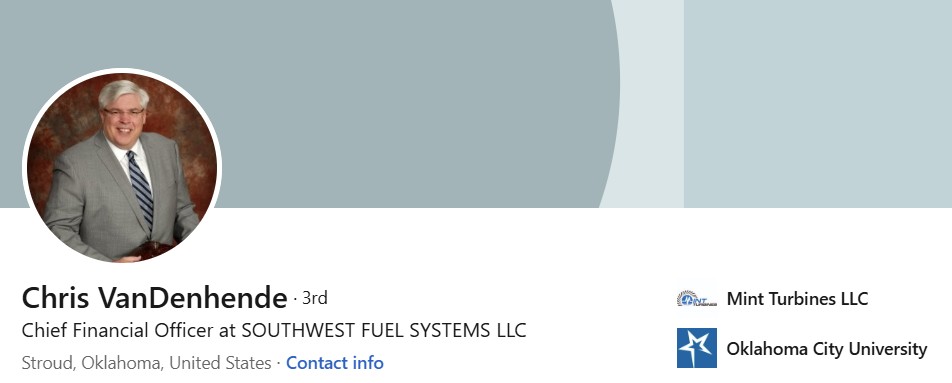
And then there’s Chris VanDenhende who is listed in the Governor’s press release as being from Tulsa. According to VanDenhende’s LinkdIn page, he is from Stroud, Oklahoma, in Lincoln County, where he is Chief Financial Officer at Southwest Fuel Systems, LLC. and Mint Turbines.

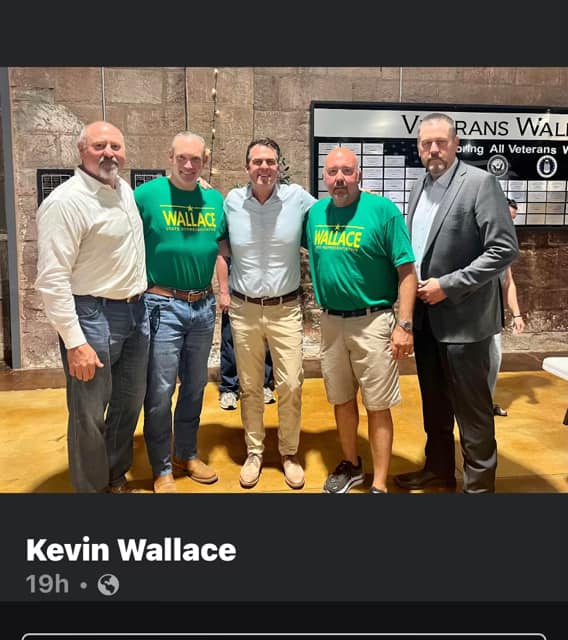
Interesting choice Mr. VanDenhende. Apparently, he is friendly with Mr. Stitt’s friend, Kevin Wallace.

In a Lincoln County News Herald “Report From Kevin Wallace” on April 6, 2022, Mr. Wallace says, “I was fortunate to be invited to dinner on the eve of this event with many representatives from the industries. Chris VanDenhende, chief financial officer and chief strategy officer for Southwest Fuel Systems and Mint Turbines in Stroud, also attended. VanDenhende spoke recently at the Stroud Chamber banquet. It was a pleasure to get to see him again and to discuss his company’s growth in our House district.”

But, that’s not all (I feel like Monty Hall). Mint Turbines has been collecting Oklahoma Quality Jobs Incentive Payments since 2020. In 2024, his company got a ‘shout out’ from the Oklahoma Commerce Department, that included the following text:

Strategic Public/Private Partnerships and Industry Engagement

With nearly 72,000 square feet of factory and warehouse space, Mint Turbines is one of the few certified MRO facilities in North America. Known for its commitment to quality and customer service, the company serves both commercial and military sectors, ensuring top-tier turbine engine performance and reliability. Mint Turbines has partnered with ACES at numerous trade shows to boost their visibility within the aerospace industry and showcase their capabilities to key industry leaders.

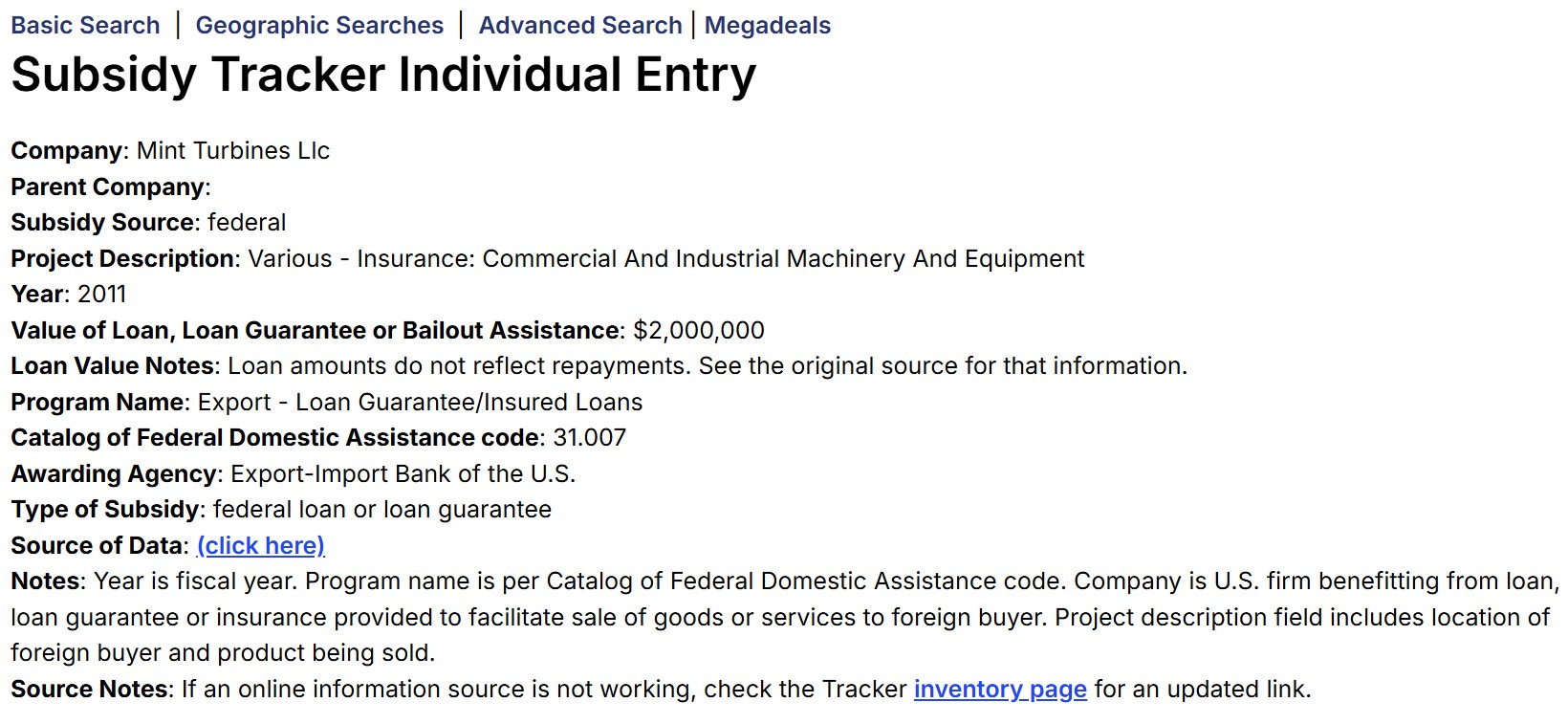
They also received about $100,000 in training reimbursements from Department of Career and Technology Education and a 2 MILLION DOLLAR Federal Loan from the Export Bank.

So, no one on the State School Board has ANY EDUCATION EXPERIENCE at all and only attorney Mike Tinney is involved with someone who does. I’m sure that will be SUPER helpful to Oklahoma’s kids and will put us well on the way to improving our NAEP scores.

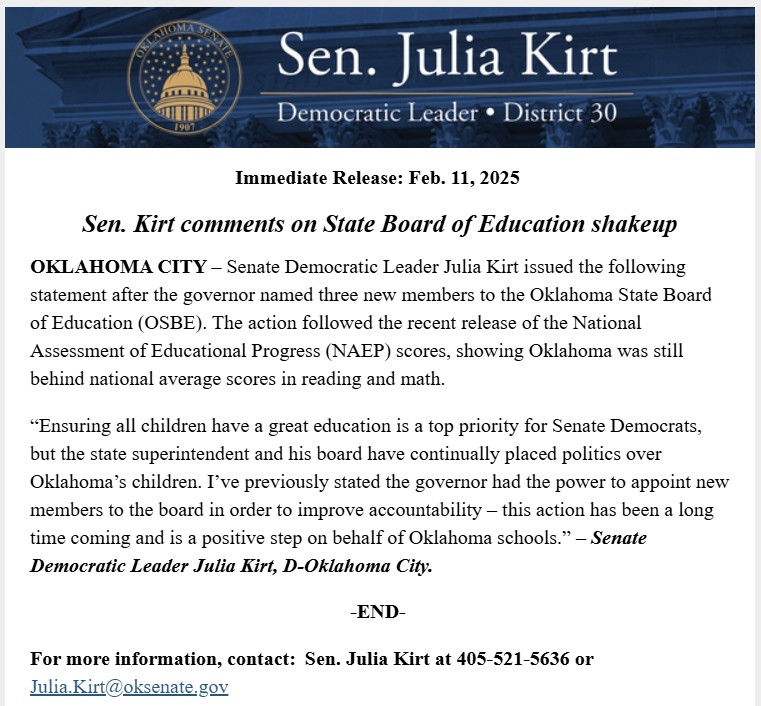
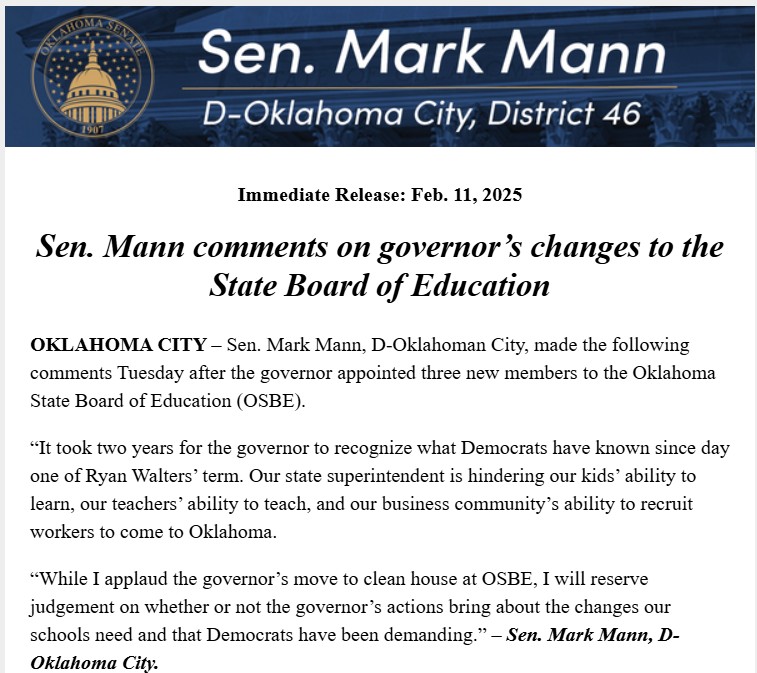
What’s even more interesting, is that Senator Julia Kirk put out THIS press release shortly after the “shake up” occurred.

Followed shortly by Senator Mark Mann.

Well thank God the DEMOCRATS are happy! That’s certainly why we elected another Republican Governor – to make Democrats happy!

The only other thing that sounds SUPER FISHY here, is that the Governor would decide TODAY, the day that Auditor Cindy Byrd was to make her audit of Tulsa Public Schools public, to make this School Board ‘shake up’ announcement based on the stupid premise of “political drama”. The Governor just had Bixby Superintendent Rob Miller stand with him for his state of the state address – touting the equally stupid cell phone bill (even funnier…Supt. Miller created his district’s policy without a law, yet the Governor pointed to him for support of the bill) and, as we all know, the Governor is from Tulsa.

Interestingly (I know, I keep using that word), Auditor Byrd was unable to release the findings because a truckload of lawyers working for TPS invoked an obscure law to halt its release. At her press conference she said the findings are significant and that she wasn’t allowed to provide the results to the public because of a law that no one had ever used in her 28 years as an auditor.

People, this state is in trouble. The people who run it do NOT HAVE OUR BEST INTERESTS AT HEART.

In fact, did you know that Governor Stitt still had financial interest in Gateway Financial Services and other Gateway entities as of 2019? Did you know that Oklahoma has given Gateway First – the fusion of Gateway Mortgage and Farmers Exchange Bank of Cherokee – hundreds of thousands of dollars in Quality Jobs Incentive Payments since 2019?

This State Board of Education ‘shake up’ was WRONG. Dead WRONG. It won’t help our NAEP scores, but I guarantee it’ll help score political points with someone somewhere – and that has to be what ALL of this is about. So, make no mistake, none of this was about helping Oklahoma kids!

Community Schools Are The Marxist Solution For Oklahoma Schools – Vote NO on HB1467 by West

Wednesday of this week (2.12.25) Representative Tammy West’s bill to “authorizing the State Board of Education to assist in establishing Community School pilot projects” is once again being heard in the Common Education Committee.

This is a national move to create schools that are all things to all parents – they would include everything from health care to psychological counseling. Here is a screenshot from the front page of their website.

Below is a one-pager I wrote when this bill first came up in 2022. In fact, that should say something in and of itself. Representative West keeps introducing this bill and it keeps getting voted down. Is it because our schools are already socially Marxist? Why does she keep bringing this up?

But then what do we know? When we wrote to the Common Education Committee members to ask them to vote against the bill, Former Senate author for West (and no longer in the senate) Dewayne Pemberton, assured members that he had been to a Community School in Tulsa (which made one of our points by the way) and that he hadn’t seen Karl Marx hiding behind the shrubs.

What Are Some Concerns With Community Schools?

HB3374 – Tammy West and Pemberton (Senate) – Community schools; authorizing the State Board of Education to assist in establishing community school pilot projects

(2025 BILL IS HB1647)

1.  President Obama placed Full Service Community Schools into the Elementary and Secondary Education Act in 2016.  They are called “full service” schools because they provide every need for a child that a family/parent would including education, counseling services, healthcare and nutrition. (https://www2.ed.gov/programs/communityschools/index.html)

2. The Biden Administration provided grants for Full Service Community Schools programs (https://oese.ed.gov/offices/office-of-discretionary-grants-support-services/school-choice-improvement-programs/full-service-community-schools-program-fscs/) through President Obama’s reauthorization of ESEA – the Every Student Succeeds Act. 

3.  There are two national organizations which help support the Community Schools model – Community Schools (communityschools.org) and the National Center For Community Schools (nccs.org)

            a. Community Schools have an agenda called “Policy by The People” the tenets for which they are lobbying Congress (https://www.communityschools.org/wp-content/uploads/sites/2/2021/01/2021-01-13_IEL_PolicybythePeopleagenda_FINAL.pdf).  Here are a few points from their agenda which essentially involves expanding government programming and funding of every service involving children:

                        – Prioritization of populations that have historically experienced systemic racism, discrimination, and/or disinvestment

                        – End the school to prison pipeline/school pushout crisis through stronger enforcement of civil rights protections and incentives for a restorative approach including restorative justice, trauma-informed practices, and hiring additional school counselors, social workers, and psychologists

                        – Raise the minimum wage to $15/hour and/or establish a universal basic income

            b. National Center For Community Schools follow three principles: Transformation, Equity and Excellence.  The ‘Equity’ portion of the website says the following:  Strong community schools counter systemic racism, increase opportunity, and move society toward equity and justice.  Too many children are expected to overcome structures designed to diminish them. Schools should model anti-racism, not perpetuate systems that divide us and limit opportunity.  We want students to feel not just welcomed, but valued for their race, religion, identification, origin, family, and community.

4.  Community Schools follow the model proposed by John Dewey (a socialist with Marxist views often considered the father of modern education) of a ‘democratic school-based social center’ where the school provided every possible need for students.  An article in the AFT’s American Educator Magazine in Summer of 2009 – “The Enduring Appeal of Community Schools” – provides a quote from Dewey’s 1902 address, “The School as Social Centre”, “The conception of the school as a social centre is born of our entire democratic movement. Everywhere we see signs of the growing recognition that the community owes to each one of its members the fullest opportunity for development.”  This, a quote which can’t help comparison to the quote of Marx, “From each according to his ability, to each according to his needs”.

5.  Enshrining a Community Schools pilot program in law while allowing the OSDE to create rules for that program is a recipe for creating further progressive, leftist inroads into the education of our children.

6.  Oklahoma communities HAVE BEEN creating their own Community Schools independent of state law.  The only reason to pass a state law, then, would be to allow the growth of the Community Schools movement throughout Oklahoma and provide the necessary validation for the Federal Government to provide tax dollars for these schools.  Federal/State tax dollars should NOT be provided for socialist, progressive education efforts in this country, let alone this state.


Please write the members of the Common Education Committee and ask for their NO vote on HB1467 by West. Just copy and paste the block of addresses and put them into your ‘to’ field.

dick.lowe@okhouse.gov, danny.sterling@okhouse.gov, chris.banning@okhouse.gov, chad.caldwell@okhouse.gov, rob.hall@okhouse.gov, molly.jenkins@okhouse.gov, ronny.johns@okhouse.gov, cody.maynard@okhouse.gov, ellen.pogemiller@okhouse.gov, jacob.rosecrants@okhouse.gov, mark.tedford@okhouse.gov

Weekly News Headlines and Commentary – Week of 2.3.25

This week’s headlines include lists of legislation posted to the site to watch for this year’s legislative session. More items will be posted this week.

Blog at WordPress.com.

Up ↑