We lost our third sheep of the week last night and I fell asleep – exhausted – on a pillow wet with tears.
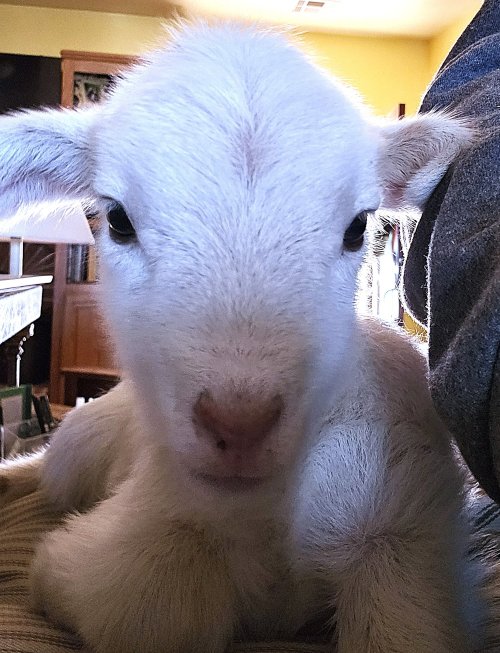
She was an adorable little ‘elf-eared’ lamb that had been born too small and apparently with a heart condition. We brought her in to the house when we noticed her odd respirations and I struggled all day to save her, but her heart gave out about 10 minutes after I’d turned out the light and laid down on my sleeping bag next to her so she could still feel part of a flock.
Though I had to see her die, I got the joy of watching her have what we call, a baby ‘lamb’ dream about five minutes before. Happily, she’d gotten comfortable enough for a few minutes at least, to start feeling as though she was running through the grass, her little legs pawing the air as she lay otherwise quietly on her side.
Earlier in the week, we’d been forced to put down an ewe who had twin 6-week-old lambs at her side because of a fast-moving skin cancer that started on her eyelid. We thought she could make it until the lambs were weaned – and she was close – but we hadn’t noticed that her milk had dried up as her body fought the illness. Consequently, dehydrated, and hypothermic thanks to the super cold we’ve been having, we lost the little girl and had to take the little boy to the vet to become the 6-million-dollar lamb.
Though this is often the kind of thing farmers deal with, I can’t help wondering if there might be something more at play.
Farmers Hurting Farmers
My husband and I have a little 10-acre farm where we raise chickens, ducks, turkeys, a completely loveable (but ungrateful) mother/daughter donkey pair, four dogs and two small flocks of sheep. We happily exist without government subsidies and we wedge our sometimes-burgeoning vet bills into our one salary budget and struggle to make ends meet.
In the nine years we’ve farmed it, our place has never turned a profit, but our large garden – and the sheep – would absolutely keep us able to feed ourselves if the crap ever hit the fan and that means a lot to us.
Where I live, there are tons of little farmers like us who don’t go to the sale barn with their cattle herds or time the market so they can make the most of their soybean crop. I support the bigger, independent ranchers and farmers out here, though, because they feed a lot of people in our area and beyond. That is, to a point.
There are some even bigger differences between us and some of them beyond size. For instance, we won’t pour ‘free’ human sewage on ANY of our pastures, like some of our bigger neighbors who use this as a way to keep from having to buy expensive commercial fertilizers.
Yes, you read that right. Human sewage – the solid remnants of wastewater treatment plants, which is collected, dried, ‘treated’ and then provided to farmers as FREE fertilizer.
I had no idea about any of this until about 5 years ago when a neighbor/homeschool friend told me about the process.
Dumping Human Waste On Farmland Stinks
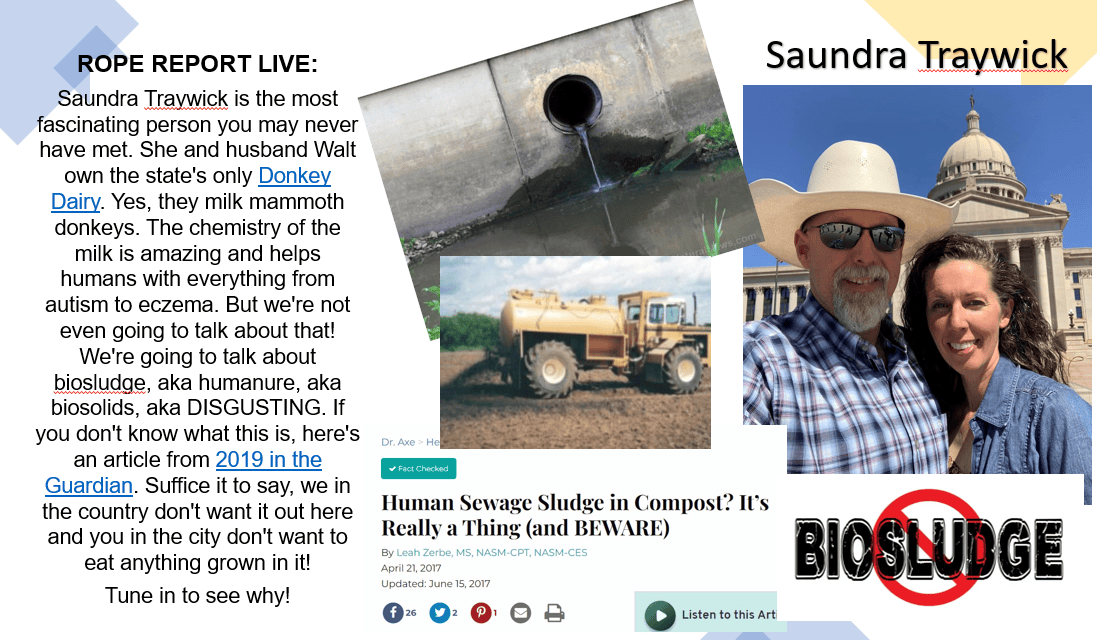
Saundra has a farm where she and her husband raise American Mammoth donkeys, which they milk (yes, like a cow). Studies indicate that donkey milk is one of the best substances in the world for treating numbers of human ailments. She not only sells the milk to appreciative families, but she uses it to make a line of soaps and beauty products for sale on her website.
One day when we had our kids at co-op, Saundra began telling me about the practice of dumping human waste on farmland. She told me she’d first found out about it after smelling something horrible coming from her neighbor’s property. After visiting with the neighbors and finding that they were literally spreading human feces on the land next door to her donkey dairy, she began to do lots of research.
Essentially, biosludge/humanure/biosolids, contain ANYTHING that goes down a sewer and into a water treatment plant. Anything: viruses, bacteria, hormones, pharmaceuticals, heavy metals and products from industrial processes, including PFAS – known cancer-causing chemicals used in things like firefighting foam and waterproofing compounds that are classified as ‘forever’ chemicals, because removing them from the environment is virtually impossible.
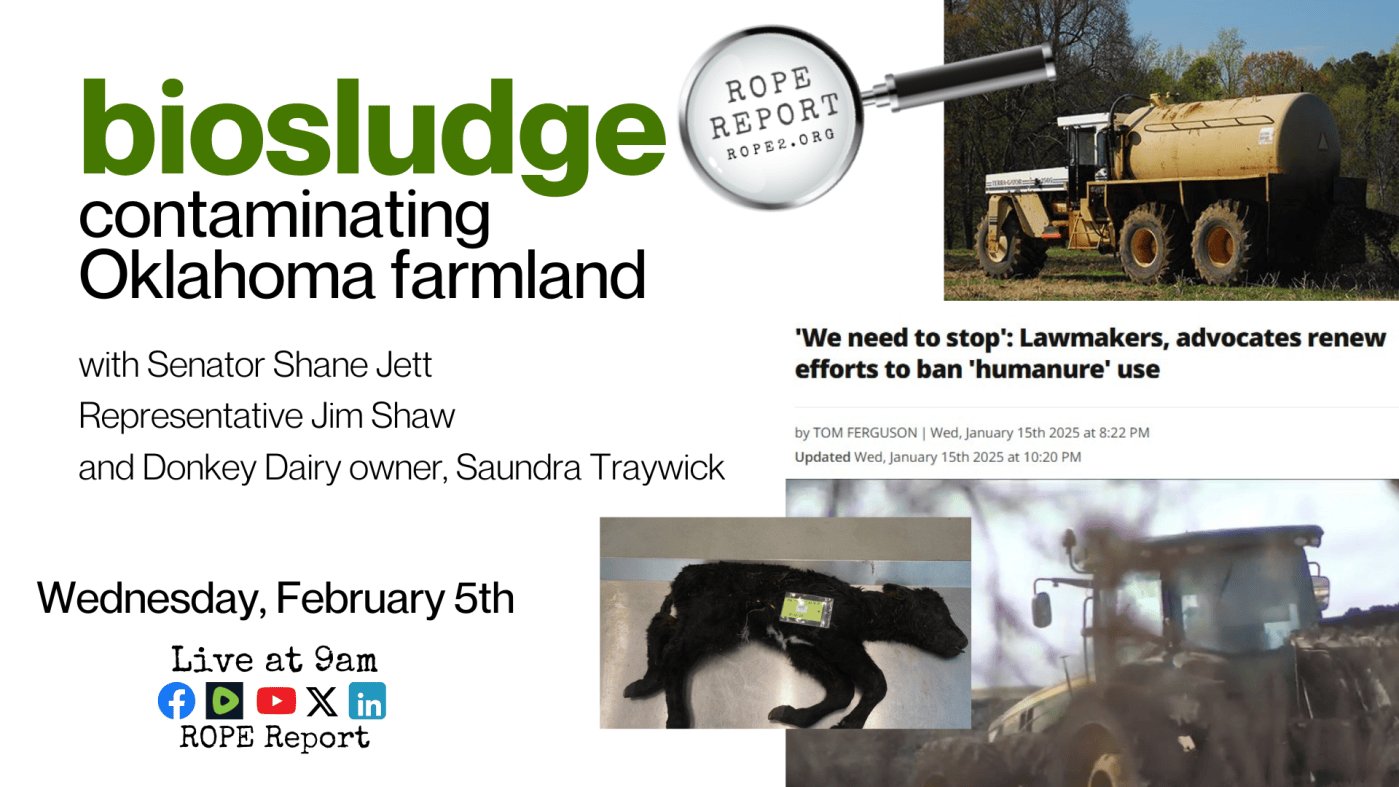
This disgusting concoction is trucked out to pastures, sprayed or dumped onto the land and disc’ed into the soil with a tractor. Unfortunately, neighbors often report seeing biosludge resting on the top of the soil like a toxic coat for weeks, or even months and – during that time – the smell is palpable. Truly – even if it’s disc’ed in – the odor is unlike anything that can be described; an unholy union between something toxically chemical and something about midway through the decay process.
We’ve had it dumped near us and what’s worse, months after the original horrific assault to the senses, when it rains, the smell comes back as bad, or worse, than before.
But the smell tells only part of the story. The rest resides in the ground, where that slurry of chemicals and human waste can leach through the ground, or runoff into water sources that livestock and people drink, or get baked into the hay fed to livestock, that are then fed to people.
Human Waste + Farmland = Toxic Produce
Maine has had its share of destruction from this practice. Farmer after farmer has been forced out of business due to the ripples of PFAS toxicity across Maine’s cropland and water supplies.
In 2021, Maine was testing 34 towns found to have substantial PFAS contamination – including a town where one farm produced milk with more than 150 times the state standard level. By 2022, Maine had become the first state in the union to ban the spreading of biosludge, yet today, PFAS contamination due to biosludge ‘fertilizer’ has been found on over 100 Maine farms and 500 residential properties. For consumers buying locally to provide ‘healthier’ food choices, this is truly concerning.
Unfortunately, Maine isn’t the only state struggling with PFAS contamination from biosludge.
In Texas, concerned landowners are speaking out against the practice after two Texas farms have sued Synagro – a company which provides biosludge ‘fertilizer’ to farmers – for not being transparent about the chemicals in their wastewater slurry. Dead fish and calves from affected farms have been tested by the county and found to have “30,000 times higher than EPA’s standard for daily [PFAS] exposure”.
In Oklahoma, where Synagro also distributes ‘free’ biosludge to farmers in east central Oklahoma where Saundra and I live, farmers like us have been speaking out against the practice for years, but our pleas have fallen on deaf ears at the state Capitol.
Shane Jett, an Oklahoma Senator who is one of a very few lawmakers fighting to curtail and/or ban the practice in Oklahoma, recently summed up the issue with enormous clarity, “Effectively, we have a government agency [municipalities] that is colluding – to save money, or make money – with a private corporation [wastewater treatment companies] competing with the private sector and they’re assuring us that it’s ‘safe and effective’. Does that sound like anything we’ve heard before?”
Free Doesn’t Mean “Good”
And this is the tale. Farmers want to save money, so they take biosludge to use as ‘fertilizer’ from companies that promise they’ve tested the constituents of the slurry, and municipalities that pay hundreds of thousands of dollars to wastewater treatment companies like Synagro to rid themselves of their municipal waste. Farmers then defend the practice because it saves them thousands of dollars and they’re told it’s ‘safe and effective’ by everyone from the EPA to their local environmental quality agency .
Yet, if the Texas lawsuit against Synagro tells us anything, it’s that something is missing in the transparency of the process that’s leaving farmers and – down the line – consumers at risk.
In 2020, while I was Mayor of our little town, Saundra gave a presentation to our town board about the dangers of PFAS contamination through biosludge. Our town has a very high water table which provides a very real possibility of PFAS percolation through the soil, or run off from the soil, into our local aquifer. Our Town Council sided with Saundra and became the first (and so far only) Town in Oklahoma to ban the practice of spreading biosludge on farmland, even after a presentation from a California-based Synagro employee designed to show us the rainbows and unicorns associated with its use.
Many legislators make this issue about property rights. “It’s the landowner’s decision to use this on their land”, they’ll tell us – more than likely after a waste-water treatment lobbyist has dropped by to suggest they should be protected from lawsuits resulting from biosludge application – but it’s not. Your property rights end when they infringe upon mine and I have just as much right to clean water and chemical-free produce as everyone else who buys “farmfresh” produce expecting it to mean what it says.
And I can’t help but wonder, as I bury my little ‘elf-eared’ lamb this morning, if her condition – or the other ewe’s – had anything to do with our well-water. Is it contaminated with PFAS thanks to all the biosludge dumping in my area? I can’t know. I haven’t tested. But I shouldn’t have to – if farmers won’t stop dumping biosludge on their property, the state should stop them. It’s the only way to ensure consumers that “farm fresh” actually means what it implies.