Jenni White
I have simply copied and pasted much of the information from the OSDE website’s Administrative Rules page into this document, so please pay attention to the PUBLIC HEARING DATES in BOLD. Also, if you’d like to provide any commentary on these rules to the state prior to the hearing, you may do so here: rules@sde.ok.gov, or through their address:
Office of Legal Services
State Department of Education
Hodge Education Building
2500 North Lincoln Boulevard
Oklahoma City, Oklahoma 73105-4599
A public hearing will be held at 2:00 p.m. on Thursday, February 15, 2024, in Room 1-20 (State Board Room) at the Oliver Hodge Building, 2500 North Lincoln Boulevard, in Oklahoma City for the following rules.
Subchapter 3. Standards for Elementary, Middle Level, Secondary, and Career and
Technology Schools
Part 22. Standard XII: Academic Performance
210:35-3-210. Purpose. [NEW]
210:35-3-211. Applicability of the Standard. [NEW]
210:35-3-212. Metrics for Academic Deficiencies. [NEW]
Text of proposed rule
Rule Impact Statement
These appear to be reasonable rules to specifically address schools with low academic proficiencies. The only question here is, upon what tests will the school year district data assessment be predicated? Oklahoma’s state tests, NAEP, or something else. Without knowing from what assessment tool the data to be considered will be culled, how can the rule be enforced? That issue needs to be addressed.
Subchapter 3. Standards for Elementary, Middle Level, Secondary, and Career and
Technology Schools
Part 9. Standard V: The School Staff
210:35-3-86. Qualifications; personnel records; health and safety. [AMENDED]
Text of proposed rule
Rule Impact Statement
This rule appears to be addressing the issue at Western Hills Elementary School exposed by ROPE Report Regular V1SUT.
These rules, under the NEW heading of Health and Safety, require all administrative assistants in a school building overseeing staff or an education program to have appropriate teaching certification for the job they hold. Same for staff. All certifications must be filed in the school of employment throughout the school year.
Additional PROPOSED rules say:
(g) Health and safety regarding certified employees. If a district maintains the active employment or contract of, or renews a contract of, a certified employee currently under investigation for certificate revocation, and that employee’s certificate is revoked at the conclusion of that investigation, the district shall be given a health and safety deficiency.
(h) Health and safety regarding non-certified employees. If a district maintains the active employment or contract, or renews a contract, of a non-certified employee currently under investigation by law enforcement for a felony; and that employee is convicted of a felony, pleads guilty to a felony, or pleads nolo contendere to a felony at the conclusion of that investigation; the district shall be given a health and safety deficiency.
The problem to me here is the word CURRENT. It appears to be a grandfather clause. If there are staff or teachers with a felony record in the past, there is no provision for that. This is an absolutely REQUIRED rule to protect the safety of children in public schools, but – in my mind – it should include ALL CURRENT employees regardless of whether they are ‘currently’ under investigation. If a teacher or employee in a public school has a felony record, they should – more than likely – not be around children.
Also, what impact is a “health and safety deficiency” in a school’s accreditation? If it is a slap on the wrist, why even create the rule? This question speaks to the rule below.
Subchapter 3. Standards for Elementary, Middle Level, Secondary, and Career and
Technology Schools
Part 21. Standard XI: Accreditation Status
210:35-3-201. Statement of the standard. [AMENDED]
Text of proposed rule
Rule Impact Statement
I’m unclear how specific are these rules. Here’s an example of the 3rd accreditation standard:
3. Accredited With Deficiencies: A school site or district fails to meet one or more of the standards but the deficiency does not seriously detract from the quality of the school’s educational program.
Question: We learned above that a “Health and Safety” deficiency will be added if schools continue employment of certified or non-certified personnel under current investigation for a felony or found to have a current felony. One could argue that employees under investigation of a felony do “not seriously detract from the quality of the school’s educational program”. Consequently, this needs to be tighter language – or it should at least be made clear that the State School Board retains the right to use recorded deficiencies based on the evidence at hand for each school. Even that doesn’t work, however, because that kind of language will be construed in whatever way an Administration decides to use it – for good or for evil.
Maybe we should keep the number of ‘deficiencies’ very small and very meaningful and then make the accreditation based on the number of deficiencies alone.
A public hearing will be held at 10:00 a.m. on Friday, February 16, 2024, in Room 1-20 (State Board Room) at the Oliver Hodge Building, 2500 North Lincoln Boulevard, in Oklahoma City for the following rules.
Subchapter 1. General Provisions
210:25-1-2. Equal Protection [NEW]
Text of proposed rule
Rule Impact Statement
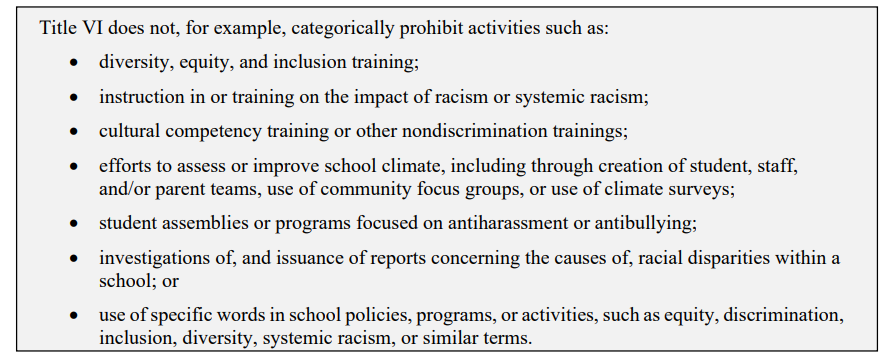
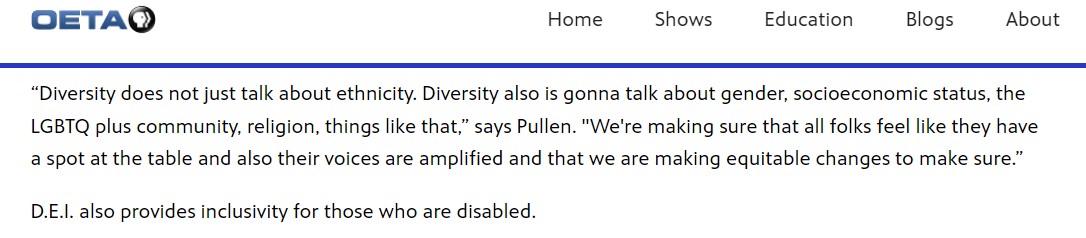
This is the highly anticipated DEI rule that our Superintendent has been talking about. I see no reason for this rule. What the rule states in a-d is effectively wiped out by e-f. Here’s what I mean:
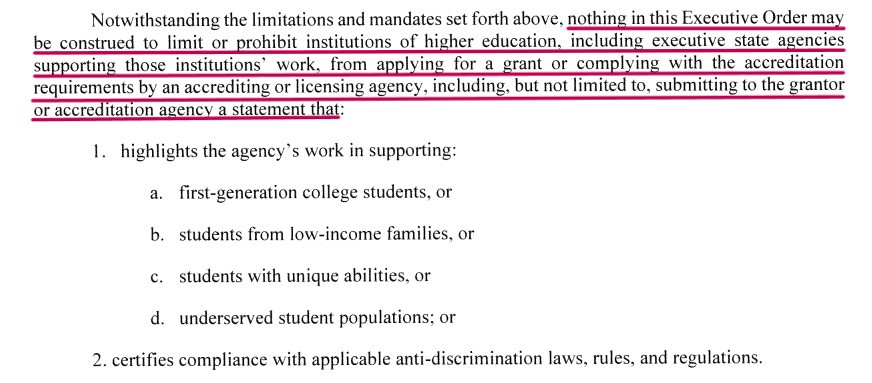
(e) Nothing in this rule prohibits the Department or any recipient of funds from the Department from applying for a grant or complying with the accreditation requirements by an accrediting or licensing agency, including, but not limited to, submitting to the grantor or accreditation agency a statement that:
And then it goes on to specify services for poor and underserved populations. Following this, the rule exempts situations:
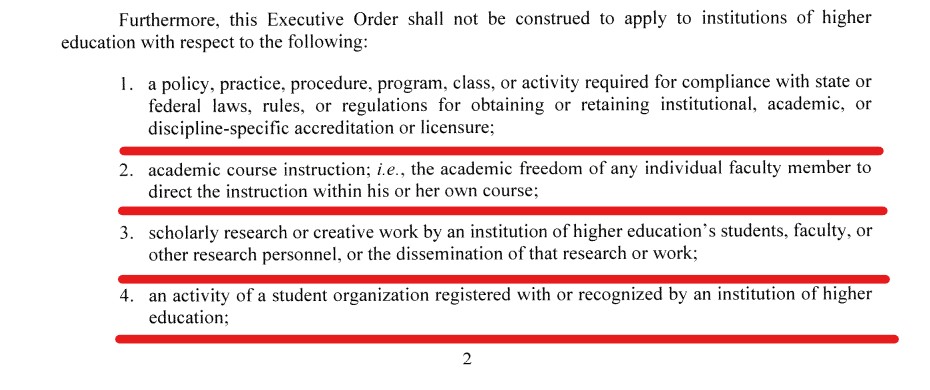
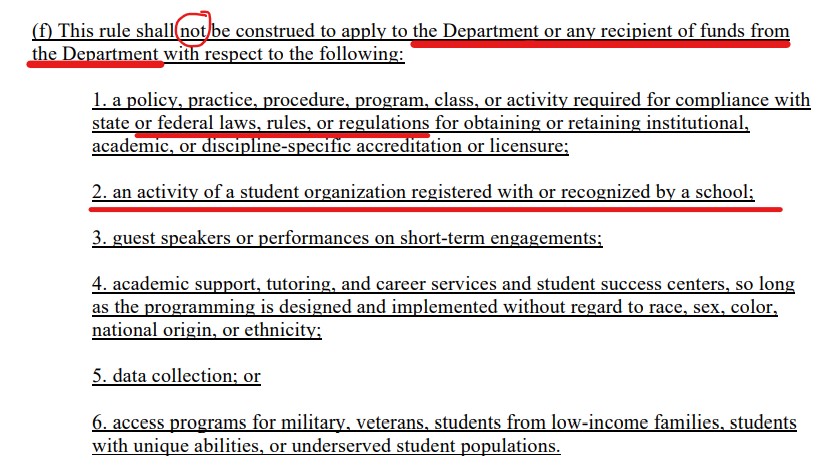
(f) This rule shall not be construed to apply to the Department or any recipient of funds from the Department with respect to the following:
Included under (f) is this specification:
- a policy, practice, procedure, program, class, or activity required for compliance with state or federal laws, rules, or regulations for obtaining or retaining institutional, academic, or discipline-specific accreditation or licensure;
Here’s an example of an accreditation organization for K-12 institutions including Catholic schools;
“Standard 1 Leaders cultivate and sustain a culture that demonstrates respect, fairness, equity, and inclusion, and is free from bias.”
So, if the OSDE is going to exempt accreditation organizations, you’re gonna get DEI. There are other exemptions in this list. I’m not going to list them all here, but I’ve pasted in the URL, please look at it yourself and let me know your thoughts, but if these rules DON’T APPLY to any of the items listed under (f) – THEY ARE COMPLETELY MEANINGLESS IN TERMS OF STOPPING DEI.
A public hearing will be held at 2:00 p.m. on Friday, February 16, 2024, in Room 1-20 (State Board Room) at the Oliver Hodge Building, 2500 North Lincoln Boulevard, in Oklahoma City for the following rules.
Subchapter 29. Standards of Performance and Conduct for Teachers
210:20-29-5. Principle III [AMENDED]
Text of proposed rule
Rule Impact Statement
Here is the text of the rule:
(e) A teacher may be dismissed, refused employment, or not reemployed after a finding that such person has, either in the presence of a minor or in a manner available to a minor online, engaged in sexual acts, acts that appeal to the prurient interest in sex as found by the average person applying contemporary community standards, or acts that excessively promote sexuality in light of the educational value of the material and in light of the youngest age of any student with access to said material.
Again, this seems to be a perfectly reasonable rule that SHOULD stop predators from being around public school kids. HOWEVER: here are some concerns:
- This is similar language to that used by many parents to try and remove sexually inappropriate library books from school libraries – this has only worked in isolated incidences. Sexually inappropriate library books are still littering the shelves of libraries across the campuses of Oklahoma public k-12 schools.
- The left will argue until they turn blue in the face that whatever sexually disgusting nonsense they’ve brought into the classroom “has educational value”.
- In addition, they MAY be dismissed etc? What does THAT mean? That means that no one could be removed from the classroom.
This rule basically needs to say that ANY STAFF MEMBER OF A PUBLIC SCHOOL WILL be dismissed if – after a law enforcement investigation AND/OR a school inquiry of the individual – has found that they engaged in ANY sex act with a minor student – including inappropriate online communications.
So much of this stuff ends up being useless because the wording doesn’t say what it needs to say (not that mine is perfect either, just saying what’s written is NOT good)
A public hearing will be held at 10:00 a.m. on Tuesday, February 20, 2024, in Room 1-20 (State Board Room) at the Oliver Hodge Building, 2500 North Lincoln Boulevard, in Oklahoma City for the following rules.
Subchapter 3. Departmental Precepts
210:1-3-4. Annuities contracts. [REVOKED]
Subchapter 5. Due Process
210:1-5-7. Teacher evaluation, dismissal, and nonreemployment. [REVOKED]
Subchapter 9. Interlocal Cooperative Agreements [REVOKED]
210:1-9-1. Purpose. [REVOKED]
210:1-9-2. Definitions. [REVOKED]
210:1-9-3. Enabling provisions/restrictions. [REVOKED]
210:1-9-4. Conditions applicable to interlocal cooperative agreements. [REVOKED]
Text of proposed rule
Rule Impact Statement
Not sure why all these are being revoked, but nothing much to say about revoked law. The more revoked laws we can get, the happier I’ll be!
Subchapter 1. General Provisions
210:1-1-1. Purpose Declaration of Foundational Values [AMENDED]
210:1-1-7. Purpose [NEW]
Text of proposed rule
Rule Impact Statement
Oh my goodness. So much of this is completely unnecessary. While I agree with many of the sentiments, this is a Department of Public Education supported by the tax dollars of ALL Oklahomans. This entire document should be scrapped excepting the BASICS contained in (a), (b) – I suppose, (e), (f), (i) and (j). Because it’s been said in many of the other rules that the Department of Education of the State of Oklahoma follows that State and Federal Constitutions, there is no reason to take up space banging that ideal on the head. It simply serves to put liberals into spasms and why should we use tax dollars for that? We must educate kids properly as asserted in letter (e) and move on. The more strife this department stirs up with the Left, the harder it becomes to get business done.
Subchapter 5. Due Process
210:1-5-6. Suspension and/or revocation of certificates [AMENDED]
Text of proposed rule
Rule Impact Statement
This rule inserts a single paragraph that states the number of days in which the OSDE must be notified if contesting the revocation of a teaching certificate. Nothing here out of the ordinary.
Subchapter 1. General Provisions
210:10-1-6. Computer assisted pupil accounting [REVOKED]
210:10-1-10. Accreditation rating [REVOKED]
Text of proposed rule
Rule Impact Statement
It appears the accreditation rating was revoked in favor of the language submitted under 210:35-3-201. Statement of the standard.
Subchapter 1. General Provisions
210:10-1-16. Oklahoma Academic Scholar and other student recognitions [AMENDED]
Text of proposed rule
Rule Impact Statement
This is VERY HELPFUL. It adds language including the CLT (Classic Learning Test) – a test that is being used by some universities now instead of the SAT and ACT (or at least in conjunction with). My kids took the CLT as 8th graders and while there was still some iffy gunk on it about global warming for example (according to my kids), there was nothing at all as just downright confusing and indoctrinating as some of the ACT and/or SAT language.
But again, this goes back to my question about Metrics for Academic Standards at the beginning of this document. What test will the state use to make those determinations? We can’t have some kids tested with the state test, but then include ACT/SAT or CLT scores. We need to pick a test and we have long advocated for an independent testing service like CLT or the Iowa Test of Basic Skills as the ACT is HORRID.
Subchapter 2. Parental Rights
210:10-2-2. Definitions [AMENDED]
210:10-2-3. Requirements [AMENDED]
210:10-2-4. Noncompliance [AMENDED]
Text of proposed rule
Rule Impact Statement
This language has been added to the existing rule:
“Independent Contractor” means an individual, organization, or entity that is engaged by and/or contracted by a school district to provide services or instruction, whether directly or indirectly, to students or within a school district on a temporary or contractual basis and is not an employee of the school district.
Does this person have to be certified? The school is responsible for them ultimately, but it makes me uncomfortable. I’m not sure exactly what this might be. If it’s a health coordinator, what information could they bring in the parent might not be aware of. It’s a tricky business. We have always wanted the public schools to have more ability to be flexible, but with all that has been going on in the last 10 years, one could argue that many are already way more flexible with education providers than we want them to.
Subchapter 13. Student Assessment and School Accountability
210:10-13-2. Oklahoma School Testing Program (OSTP) scope and general administration [AMENDED]
210:10-13-18. Oklahoma School Accountability System [AMENDED]
Text of proposed rule
Rule Impact Statement
I couldn’t really find anything that was problematic in either of these rules. Basically it’s allowing for remediation for schools who do not score at least satisfactory on the state criterion-referenced tests (very specific test, thankfully). The only problem is that the school only gets remediation if there’s funding.
The second rule gives schools a way to challenge their A-F score and makes it clear that F schools must get comprehensive support and show improvement – but then it doesn’t say here what will happen if they don’t. It’s always the follow-up that kills the best rules/laws/plans…
Subchapter 17. Federal Programs complaint procedures
210:10-17-1. Complaint Procedures [AMENDED]
Text of proposed rule
Rule Impact Statement
This is HUGE! So huge in fact, that I wrote a whole blog just about that. Please read it.
Subchapter 9. Professional Standards: Teacher Education and Certification
Part 1. General Teaching Certificate Requirements
210:20-9-12. General education requirements of individuals who already hold baccalaureate
degrees [REVOKED]
210:20-9-14. Alternative plan for student teaching requirements [REVOKED]
Subchapter 11. Professional Standards: Accreditation Standards for Approved Teacher Education Programs
210:20-11-1. Evaluation process [REVOKED]
210:20-11-2. Specific Standards for Program Approval [REVOKED]
210:20-11-3. General education and professional education [REVOKED]
210:20-11-4. Specialization standards [REVOKED]
210:20-11-6. NCATE/State joint visits [REVOKED]
Subchapter 15: Residency Program
210:20-15-3. Residency committee [REVOKED]
210:20-15-4. Variations to the residency program regulations [REVOKED]
Subchapter 24. Science and Mathematics Advanced Recruiting Technique (SMART) Program
210:20-24-1. Purpose [REVOKED]
210:20-24-2. Science and Mathematics Advanced Recruiting Technique (SMART) Program [REVOKED]
Subchapter 26. Academic Achievement Award Program
210:20-26-1. Purpose [REVOKED]
210:20-26-2. Selection and payment criteria [REVOKED]
210:20-26-3. Qualified employees [REVOKED]
Text of proposed rule
Rule Impact Statement
Again, not sure why, but happy to revoke any laws, rules or regulations. LOL
Subchapter 23. School Board Members
210:20-23-3. Requirements for new and incumbent school board member training [AMENDED]
210:20-23-4. Requirements for continuing education; certificates; costs [AMENDED]
Text of proposed rule
Rule Impact Statement
Interesting; the only thing changed about this rule is that the Oklahoma State School Boards Association (OSSBA) has been removed from the wording of the rule under training. Unfortunately, I’m not sure how this will help anything because state law has not been changed. We tried to get it changed, but we were not successful. Several times in the rules I’ve read today it says that if the rule disagrees with state law, state law prevails, so I’m not sure how this will do anything. If you’d like to see why I say that, please read this article.
SB1447 STOPS MANDATORY SCHOOL BOARD TRAINING and SB1445 REDUCES ALL SCHOOL BOARD TERMS TO TWO YEARS
Subchapter 5. Budgeting and Business Management
Part 1. Implementation
210:25-5-4. Accounting [AMENDED]
Text of proposed rule
Rule Impact Statement
Apparently this removes the ability of a charter school to appeal any changes in the data they’ve sent the OSDE regarding their financial reporting and accounting. They can show cause that changes are warranted before the data is locked, but the appeal process no longer would exist.
Subchapter 3. Standards for Elementary, Middle Level, Secondary, and Career and Technology Schools
Part 5. Standard III: Administration and Organization
210:35-3-48. Local board responsibilities/staff relationships [AMENDED]
Text of proposed rule
Rule Impact Statement
Nothing really much to say about this. These look to be changes required by reorganizing the text after removing this statement:
(3) The local board and its individual members shall refrain from involvement in or interference with the administrative functions of the school.
I’m surprised that was in the rules, but then I was also surprised that THIS was in the rules previously:
(B) Lack of harmony in the teaching staff, board, or community, when such conditions affect the quality and effectiveness of instruction and climate of the school, shall be considered sufficient cause for not accrediting a school. Political and special interest groups or individuals shall not interfere in the operation of the schools.
Subchapter 3. Standards for Elementary, Middle Level, Secondary, and Career and Technology Schools
Part 17. Standard IX: Financial Support
210:35-3-167. School District Transparency Act [NEW]
Text of proposed rule
Rule Impact Statement
This is a new section of rules that basically say that if a school’s website does not comply with accountability law they’ll get a deficiency on their accreditation if they don’t fix it within 30 days.
A public hearing will be held at 2:00 p.m. on Tuesday, February 20, 2024, in Room 1-20 (State Board Room) at the Oliver Hodge Building, 2500 North Lincoln Boulevard, in Oklahoma City for the following rules.
Subchapter 3. Standards for Elementary, Middle Level, Secondary, and Career and Technology Schools
Part 25. Standard XIV: Freedom of Religion [NEW]
210:35-3-251. Voluntary prayer [NEW]
210:35-3-252. Minute of silence in public schools [NEW]
Text of proposed rule
Rule Impact Statement
I’ll be honest. I think this is nonsense. I think it’s detracting from the REAL issues which are that our kids can’t read or do math proficiently, and while I love Jesus personally, I don’t think adding one minute of quiet time to their school day will affect a single thing about that. Making teachers teach properly and schools follow the law will do more for that than a single silent minute.
In fact, I don’t see anything different in this section of ‘new’ law than what has already been happening in public schools for many years.
The only thing different about this ‘new’ rule is that it provides for a complaints process if the school isn’t following the law and:
(c) The State Department of Education shall annually verify that districts have adopted policies that comply with this rule and shall recommend an accreditation deficiency to the State Board of Education for any school district that fails to comply.
Getting an accreditation deficiency for not enforcing a single silent minute is way over the top to me. Now, if a school is not allowing a coach to say a prayer before a game, or teachers to keep Bibles on their desks – I think there’s a problem, as those are personal issues, not state issues – but those situations aren’t addressed in this rule, most probably because they’ve been adjudicated frequently at numerous levels of the judiciary.