
Search

ROPE Report

Tag

federal dollars

Dollars For Data – Grok: In Order To Continue Receiving Federal Dollars, Oklahoma Needs To Gather Data On Babies Through 20-Year-Olds

I’m not a huge fan of AI, but I’ve been a researcher since 1990 and this tool has helped me find data more quickly and completely than I ever have before.

Today, because I’m still trying find a way to explain that SB224 is NOT FOR Oklahoma’s kids, but to satisfy a broader need to plan the economy on a national level, I asked Grok “does the federal government require states to codify the need to connect education and workforce data”? I got a long, in-depth, very interesting answer. So, is this to help Oklahoma’s kids, or get more federal grants? I’ll let you be the judge.

Grok’s answer:

The federal government does not explicitly require states to codify into state law a specific mandate to connect education and workforce data as a condition for receiving federal grants. However, federal policies, grant programs, and regulations often incentivize or require states to establish systems for linking education and workforce data to meet reporting, accountability, or performance goals. These requirements can typically be met through administrative actions, interagency agreements, or data systems like Oklahoma’s Data Sharing Hub (DASH), without necessarily codifying the connection into state statutes. Below is a detailed analysis based on available information:

Federal Context for Education and Workforce Data Integration

  1. Relevant Federal Laws and Programs:
    • Workforce Innovation and Opportunity Act (WIOA, 2014):
      • WIOA is the primary federal law governing workforce development programs. It requires states to develop integrated data systems to track participant outcomes across workforce, education, and training programs (e.g., Title I for adults, Title II for adult education, Title IV for vocational rehabilitation).
      • States must report performance metrics, such as employment rates, earnings, and credential attainment, which often require linking education and workforce data. For example, WIOA’s performance accountability provisions (29 U.S.C. § 3141) mandate data collection and reporting, which may involve connecting education records (e.g., high school or college completion) with employment outcomes.
      • While WIOA encourages states to establish data-sharing agreements or systems, it does not explicitly require codification into state law. States can comply through administrative frameworks, such as memoranda of understanding (MOUs) between agencies or platforms like DASH.
    • Every Student Succeeds Act (ESSA, 2015):
      • ESSA requires states to report on student outcomes, including college and career readiness indicators, which may involve linking education data to workforce outcomes (e.g., post-secondary enrollment or employment).
      • States receiving ESSA funds must submit state plans and comply with accountability requirements, but these do not mandate codifying data linkages. Instead, states often use existing data systems or establish new ones to meet federal reporting needs.
    • Perkins V (Carl D. Perkins Career and Technical Education Act, 2018):
      • Perkins V funds career and technical education (CTE) programs and emphasizes aligning education with workforce needs. It requires states to report on CTE student outcomes, such as employment or post-secondary success, which often necessitates data integration.
      • Like WIOA, Perkins V encourages data system interoperability but does not require states to pass laws mandating data connections. States can use administrative tools or data-sharing platforms to comply.
    • Higher Education Act (HEA):
      • The HEA governs federal student aid and includes reporting requirements for post-secondary institutions, such as graduation rates and employment outcomes. Some grant programs under HEA may encourage data linkages to track student success, but codification is not a requirement.
  2. Federal Grant Conditions:
    • Federal grants, particularly those tied to WIOA, ESSA, or Perkins V, often include conditions related to data collection and reporting. For instance, WIOA grants require states to submit annual performance reports that integrate education and workforce data (e.g., 20 CFR § 677.155).
      • These conditions typically focus on outcomes rather than prescribing how states achieve them. States can meet requirements through data-sharing agreements, longitudinal data systems (SLDS), or platforms like DASH, without codifying policies into law.
      • Some competitive grants, such as the U.S. Department of Education’s State Longitudinal Data Systems (SLDS) Grant Program, explicitly fund the development of integrated data systems. While these grants require states to build capacity for data linkages, they do not mandate legislative codification. Instead, they emphasize technical and administrative solutions.
    • The Department of Labor’s Workforce Data Quality Initiative (WDQI) provides grants to enhance state data systems for tracking workforce and education outcomes. WDQI encourages states to link data across agencies but allows flexibility in implementation, typically through administrative means rather than statutory mandates.
  3. Family Educational Rights and Privacy Act (FERPA):
    • FERPA (20 U.S.C. § 1232g) governs the privacy of education records and impacts how states link education and workforce data. States must ensure compliance with FERPA when sharing student data, which may require data-sharing agreements or secure systems like DASH.
    • While FERPA imposes strict requirements on data handling, it does not mandate codification of data-linking policies. States can address FERPA through administrative protocols or interagency agreements.
  4. State Longitudinal Data Systems (SLDS):
    • The federal government has supported SLDS development since 2005 through the Institute of Education Sciences (IES). SLDS grants aim to create systems that link early childhood, K-12, post-secondary, and workforce data to inform policy and improve outcomes.
    • While SLDS grants require states to build and maintain these systems, the focus is on technical infrastructure and data governance, not on passing state laws. States can establish SLDS through executive action, agency collaboration, or platforms like DASH.

Oklahoma’s Context and DASH

  • Oklahoma’s Data Sharing Hub (DASH):
    • As noted in your previous question, DASH is Oklahoma’s platform for secure interagency data sharing, managed by the Office of Management and Enterprise Services (OMES). It supports data integration for various state functions, including those tied to federal grants.
    • DASH likely facilitates compliance with federal reporting requirements under WIOA, ESSA, or Perkins V by enabling secure data linkages between education agencies (e.g., Oklahoma State Department of Education) and workforce agencies (e.g., Oklahoma Employment Security Commission).
    • There is no evidence that DASH’s operation or Oklahoma’s participation in federal grants requires codifying a mandate to connect education and workforce data. Instead, DASH serves as an administrative tool to meet federal expectations for data integration and reporting.
  • Oklahoma’s Approach:
    • Oklahoma has pursued data integration through initiatives like the Statewide Longitudinal Data System (SLDS), supported by federal grants. These efforts focus on technical and administrative solutions, such as data governance frameworks and interagency MOUs, rather than legislative mandates.
    • State laws, such as those governing data privacy or agency operations, may indirectly support data sharing (e.g., compliance with FERPA or state data security standards), but there is no specific Oklahoma statute mandating education-workforce data linkages as a condition of federal funding.

Does Codification Ever Occur?

  • Federal Incentives, Not Mandates:
    • While the federal government does not require codification, it may incentivize states to formalize data-sharing frameworks to ensure sustainability or compliance. For example, SLDS or WDQI grants may encourage states to establish governance structures, which some states codify into law for clarity or permanence.
    • States like Tennessee and Kentucky have passed laws to formalize SLDS or data-sharing governance (e.g., Tennessee’s P-20 Council), but these are state-driven initiatives, not federal mandates. Oklahoma has not taken this approach, relying instead on administrative tools like DASH.
  • State Discretion:
    • States may choose to codify data-sharing policies to address privacy concerns, ensure long-term funding, or align with federal grant requirements. For instance, a state might pass a law to clarify agency roles in data sharing or to comply with FERPA. However, this is not a federal requirement but a state policy choice.

Limitations and Variability

  • Grant-Specific Requirements: Some federal grants may include conditions that indirectly require data linkages, such as reporting on employment outcomes for CTE students under Perkins V. These conditions focus on outcomes, not codification, but states may codify policies to streamline compliance.
  • Privacy and Security: Federal laws like FERPA and the Privacy Act (5 U.S.C. § 552a) impose strict requirements on data sharing, which may necessitate state-level policies or agreements. However, these can be administrative rather than legislative.
  • No Universal Mandate: There is no blanket federal requirement for states to codify education-workforce data linkages. The emphasis is on functional data systems and compliance with reporting requirements, which states can achieve through various means.

Conclusion

The federal government does not require states to codify into state law a mandate to connect education and workforce data to receive federal grants. Instead, laws like WIOA, ESSA, and Perkins V, along with grant programs like SLDS and WDQI, encourage or require states to integrate data for reporting and accountability purposes. States can meet these requirements through administrative actions, data-sharing agreements, or platforms like Oklahoma’s DASH, without passing new laws. While some states voluntarily codify data-sharing frameworks, this is not a federal mandate but a state choice. In Oklahoma, DASH likely supports compliance with federal data requirements, but there is no evidence of a codified mandate tied to federal funding. If you have a specific grant or program in mind, I can analyze its requirements further.
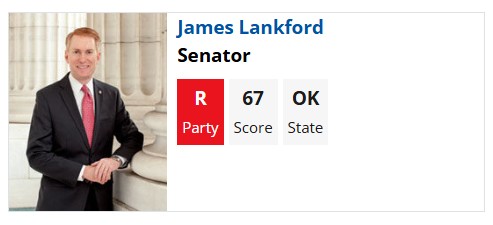
File Under, ‘Too Much Too Little Too Late’; James Lankford Comes Out Swinging In Favor Of Smaller Government

Government score taken from the Freedom Index.

Recently, Senator James Lankford has been Tweeting (X’ing?) about the number of US tax dollars our government is wasting. He points to the fact that he’s released his 8th ‘Federal Fumbles’ report this month (2.25) and includes some kind of instance where the government is screwing over taxpayers.

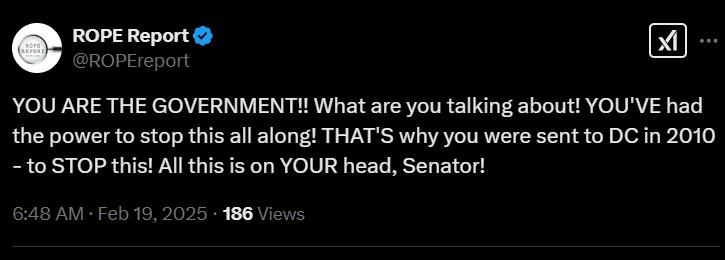
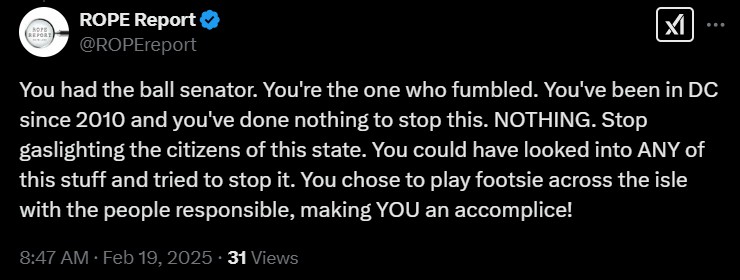
This is frustrating and I clapped back on a couple of the posts I found.

I helped start a group called the OKC912Project in 2008 after Barrack Obama was elected. In 2010, when Lankford ran for his first office, he appeared before the OKC912Project to interview. At that time, he assured us he would help stop Obamacare. He also indicated that he was in favor of smaller government, but that he felt it important to work with others toward consensus. Most of us were very keen on removing government-controlled health care, so I don’t think we worried too much about the idea of consensus as we were expecting that to mean that he’d work with other Tea Party-elected legislators to stop what we felt was the socializing of our American government.

The first year he ran for Congress, I voted for Lankford. I have not darkened a single oval for him since that time for numerous, numerous reasons – I’ve just left the space for ‘Congressman’ or ‘Senator’ blank in the general election after having voted for another candidate in the primary.

Because I want to be fair, I took some time and reviewed every Lankford vote listed on Vote Smart. It was eye-opening. Now let me say this as a disclaimer – there are a LOT of votes listed there in the 15 years he’s been in DC – I’ve done my best and I may have missed a thing here or there, so realize that as you read. I’ve mentioned a few single votes, but the most important thing here is the pattern of voting.

At first I thought his votes were all over the place, but then I realized there was a pattern (I’ve included some of the votes at the bottom of this post FYI).

Here’s the pattern: solid support against socialized medicine (Obamacare), solid support for 2A, solid support against abortion, solid support for funding the military – a pattern almost right out of the Republican playbook, though the military funding issues is more than problematic.

This funding is funding with no oversight. This is funding because “I support our military”. Well, ok. A good chunk of Americans still support the military, but to an extent – they’re certainly not for throwing money at the military without oversight or reason. Part of the reason we have the military industrial complex stoking our national debt is votes like Lankford’s.

But here’s where we really diverge. Lankford supports the continuation of government funding.

He’s voted for nearly every budget and nearly every continuing appropriation over the years. What’s worse, he’s solidly for bills that strengthen the Patriot Act and/or government spying on its citizens. For Pete sakes, he voted for the COVID-19 HATE CRIMES BILL and then justified it by saying that he and Inhofe and another senator added an amendment to protect life! Would these bills have passed even if he had voted no? YES. But the fact that ‘my no vote doesn’t matter’ is not the reason to add a ‘good’ amendment and then vote for a bad bill.

Then there are the votes to keep the military stationed in Iran, Iraq and Yemen. And possibly worse than anything to so many Americans, are the votes to fund OTHER NATIONS while American taxpayers foot the bill. Examples here include voting to aid Syrian opposition, voting yes on the 95 BILLION foreign aid package last year and sending aid to the US border to help the illegals swamping the country.

Of course, for many Oklahomans/Americans, the fact that Lankford voted to certify the Biden election was the nail in the coffin of their support.

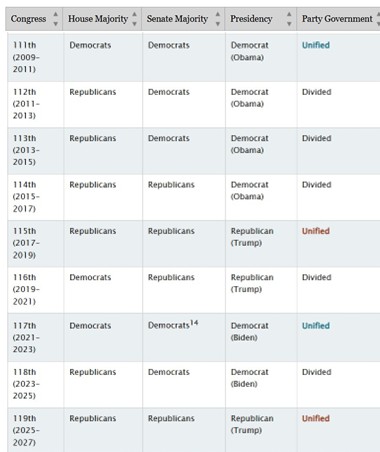
Yet there are just as many souls who support Lankford on the basis that he is a Christian and a ‘sweet man’ who worked for a short time at one of the largest Baptist summer camps in the nation. Their analysis of his votes aren’t necessarily important, he keeps babies safe and loves his fellow man. In the face of opposition, or confrontation with his votes, these people often claim that he couldn’t have done anything because ‘Republicans weren’t in control then’.

Here are the number of years Republicans have been in control since Lankford was elected.

There were at least a couple there with Republican control, where Republicans could have worked together to make some lasting changes protecting the American people, but that’s not really the point. The point is the ideology at play here.

It doesn’t matter whether he could have ‘done’ something or not, Lankford’s votes tell the tale. That, and the 3 and 4 page explainers that respond to criticisms from constituents and other citizens that justify every vote as though any criticisms are silly because, well, he knows better. He has always seemed to believe that Oklahomans sent him to DC to do what HE thought was best, not to do what the CITIZENS thought best.

Lankford’s votes tell us that he trusts government. They tell us he thinks the military is great – whether there are generals protecting a soldier’s right to wear dresses or not. They tell us he thinks government is trustworthy and would never spy on its citizens without provocation and if there was provocation, the citizen probably deserved to be spied upon, or that it’s a shame they were ‘accidentally’ caught in a net that caught a very bad person. They tell us he thinks all life is precious – and so much so – that he must vote to send Oklahoman/American taxpayers dollars to other countries to protect their citizens, even while liberals here scream that America is bad and President Trump should be impeached. And all the while the debt clock keeps ticking, whether Americans see the amount of debt piling up around them or not.

Is James Lankford a nice person? Yes – even when people aren’t kind to him. His office even helped our family get one of our children out of a National Guard deployment during COVID that became abusive and unjust and I’ve been one of his biggest critics since his first term as a Congressman.

Does Lankford vote wrong every time? No. He certainly came out strong for all of Trump’s cabinet picks this year and has definitely voted against some very destructive policies over the years. But these are exceptions to the pattern and the pattern is destructive to American sovereignty, national debt and the right of citizens to their privacy.

Unfortunately for Lankford, it’s time for Oklahomans to understand this and to ask him to let someone else take a stab at the job after 15 years. It’s time for James Lankford to move on.


Here are some of James Lankford’s votes according to Vote Smart:

  • 2011 he voted for ‘various extensions of the Patriot Act’
  • 2011 he began voting to continue federal appropriations
  • 2011 he voted for the budget
    • voted against Obamacare
  • 2012 he voted to continue federal appropriations
  • 2012 he voted for a stop-gap spending and disaster relief bill
  • 2012 he voted to both raise the debt ceiling with certain spending limits (after voting no in 2011) and for the budget
    • voted against Import/Export bank reauthorization and against Obamacare
  • 2013 he voted to continue federal appropriations
  • 2013 he voted to approve the budget
    • voted against disaster relief appropriations and Obamacare
  • 2014 he voted to aid Syrian opposition
  • 2014 he voted to continue federal appropriations
  • 2014 he voted for the budget
    • voted against Obamacare
  • 2015 he voted to continue appropriations
  • 2015 he voted for the budget (with Obamacare repeal and other ‘conservative’ items added)
    • voted against the Budget Act that would have extended the debt ceiling
  • 2017 he voted for the budget
    • voted against disaster relief appropriations and for health care freedom bill
  • 2018 he voted for continuing appropriations
  • 2018 he voted for the expensive farm bill
    • voted against consolidated appropriations, sanctuary cities, bipartisan budget act and removing the military from Yemen
  • 2019 he voted against removing military from Yemen
  • 2019 voted yes on an enormous/costly bill related to reducing recidivism in the prisoner population
  • 2019 voted for appropriations that included all kinds of money for the Census, other items and extended the Patriot Act
  • 2019 vote to send millions of dollars to the border for humanitarian aid
    • voted against the bipartisan budget bill with an extension of the debt ceiling and other pork
  • 2020 voted for the CARES Act
  • 2020 voted to keep military in Iran
  • 2020 voted for the USA Freedom Act increasing surveillance on Americans
  • 2020 voted for continuing appropriations
    • voted against impeaching Trump but then voted yes to the impeachment procedures
    • voted for John Ratcliffe
  • 2021 voted to certify Biden’s election
  • 2021 voted for Biden’s picks for Treasury, Sec. of Defense, National Intelligence, Secretary of Veteran’s Affairs, Secretary of Agriculture
  • 2021 voted for Merrick Garland as Attorney General
  • 2021 co-sponsored the Juneteenth National Independence Day Act
  • 2021 voted FOR THE COVID-19 HATE CRIMES ACT
  • 2021 voted FOR THE GROWING CLIMATE SOLUTIONS ACT so farmers can sell carbon credits
    • voted against impeaching Trump
    • voted against the budget
    • voted against Blinken, Buttigieg, Mayorkas several others
    • voted against the American Rescue Plan
    • voted against the Delivering Emergency Assistance Act
    • voted against further appropriations
  • 2022 voted for emergency funding to Ukraine
    • voted to rescind the national COVID emergency
    • voted against Ukraine funding
    • voted against Inflation Reduction Act
    • voted against Ketanji Brown
    • voted against several other Biden initiatives
    • voted against appropriations
    • voted against Respect For Marriage Act
  • 2023 voted against repealing authorization for use of force in Iraq
  • 2023 voted to provide money to United States Fire Administration and firefighter assistance grant programs
  • 2023 voted for continuing appropriations
  • 2023
    • voted against providing funds to Israel following the terrorist attacks
    • voted against numerous Biden administration rules
    • voted to repeal national COVID emergency
    • co-sponsor of bill to protect kids online
    • voted against increasing the debt limit
  • 2024 voted to stop the government shutdown and increase funding to various agencies
  • 2024 voted to extend FISA
  • 2024 voted for American Relief Act for more government appropriations
  • 2024 voted for Wildlife Innovation and Longevity Driver (WILD) Reauthorization Act which provides funds to save animals OUTSIDE the US
    • voted against national security act
    • voted against increasing EPA regs
    • voted for Social Security Fairness Act to allow people to keep the money they paid into the system
    • voted no to expand access to fertility treatments
  • 2025 voted for all Trump’s picks and the Laken Riley Act

Blog at WordPress.com.

Up ↑