Search

ROPE Report

Tag

education

Parents Have To Parent – It’s A Tough Job To Be Sure – But No One Can Do It But You

The other morning I read a horrible news story about a 12yo girl who was beaten and tortured by 2 other 12yo girls at what was supposed to be a ‘sleep over. That is a horrible situation and the girls must be punished – but let’s talk honestly here.

How many parents know the families of the children with whom their children interact? Sorry to say, I expect MOST don’t.

Sadly – and factually – most all the nonsense going on in public schools about which parents have (rightly) complained, could have been solved by parent involvement at even the basic level of knowing the families of their children’s friends – yet I will go so far as to say that a majority of parents have abdicated so much of the responsibility of caring for their children to the now-government-sponsored systems of daycare and school, that knowing the families of their children’s friends is simply meaningless and unnecessary to them.

How could I make such a statement? I’ve seen it firsthand.

I taught science for 7 years in the public system and 3 years at a homeschool coop. In between those years, I sat on the PTA of our kid’s government elementary before they were pulled to become educated at home. Consequently, I have about 30 years of involvement in many different forms and levels of education.

In EVERY educational situation in which I’ve found myself, I’ve seen FEW parents actually interact with the education of their children.

In fact, there’s even a segment of parents who call themselves “homeschoolers’ who simply drop their children off at ‘coop’ and go about their merry way – they don’t interact with other families, help with coop duties, or even inquire as to how their kids are doing in their subjects – they simply EXPECT others to do their job for them because, for whatever reason, they can’t or won’t do it for themselves.

Since the 1960’s and LBJ’s War On Poverty – where the government offered the benevolent hand of government to ‘help’ families care for themselves – we’ve seen SKYROCKETING dissolution of families, SKYROCKETING single-parenting and SKYROCKETING abandonment of even basic parental duties. 

Why would a couple stay together when they can get ‘free’ money from the government to raise their kids separately? Why would a parent make the effort to educate or feed their children when the government does it for them without them having to expend any effort to do so? ‘Free’ daycare, ‘free’ education, ‘free’ lunch… the government programs are endless.

Human nature tends toward laziness – it’s the main reason we have technology – our very nature tells us we have to “work smarter, not harder”.  Consequently, when the government inserts its ‘helpful’ hand, society is destroyed. 

Solomon said, “Idle hands are the devil’s workshop; idle lips are his mouthpiece” (Proverbs 16:27) because humans will – by and large – attempt to do very little work. Once we don’t HAVE to keep ourselves fed, or clothed, or a roof above our heads, we’ll simply stop trying and allow others to do those jobs for us.

Then comes the death spiral; government provides ‘help’ to citizens, citizens stop providing for themselves, personal responsibility fails, government increases to counteract the lack of personal responsibility by creating more and more laws, citizens become oppressed, free society falls.

America is in this death spiral – and at this point we may not be able to recover. 

If we ARE going to recover, however, MORE GOVERNMENT INTERVENTION IS NOT THE ANSWER. The answer is MORE PERSONAL RESPONSIBILITY.

So here’s my request: If your child is in a government school of any kind – get them out and assume the responsibility of educating them yourself without excuses. In this way, citizens can create lifeboats of self-educated families and individuals who can then extend a hand to those who need help exiting the system for whatever reason through their church or other non-governmental group.

Taking control of the personal responsibility for our own actions and consequences (and modeling this for our children and others) is THE ONLY WAY to improve ourselves and this country in a lasting way for generations to come.

Senate Education Bills Beginning 3/1/22

Entries in Yellow FAILED in Senate Ed Committee

Entries in Grey FAILED or NOT HEARD on the floor of the Senate

Entries in Blue FAILED or NOT HEARD in House Common Ed Committee

Entries in Orange FAILED or NOT HEARD on the Floor of the House

Entries in Green DIED IN CONFERENCE PROCESS

VETOED BY GOVERNOR

SB386 By Quinn of the Senate – Education grants; creating the Digital Wallet Program Act; providing for distribution of grant funds. Effective date. Emergency. 

Withdrawn by author


SB615 By Bullard et al of the Senate (Proposed Comm. Sub., req. #3536) – Schools; requiring curriculum and materials used in certain meeting with counselor to be available for inspection. Effective date. Emergency. Passed Aye 9 Nay 2 SENATE FLOOR 3/9/22 Aye 39 Nay 7 Bill was amended by the House (4/27/22) to include language preventing boys from using girls bathrooms in public schools. Amended bill SENATE FLOOR 5/19/22 Aye 38 Nay 7 HOUSE FLOOR 5/29/22 Aye 69 Nay 14 Sent to Governor 5/20/22 SIGNED BY GOVERNOR 5/25/22


SB626 By Bullard of the Senate and Randleman of the House (Proposed Comm. Sub., req. #3479) – Students; directing disclosure of whether a student has received certain mental health services. Effective date. Emergency.

PASSED 10-2 SENATE FLOOR 3/9/22 Aye 38 Nay 7 HOUSE Education Committee Aye 11 Nay 1 HOUSE FLOOR – 4/28/22 Aye 73 Nay 4 Excused 23 SENATE FLOOR – Aye 42 Nay 5 Excused 1 Sent to Governor 5/10/22 SIGNED BY GOVERNOR – 5/11/22


SB1112 By Dills and Pemberton – Student transfers; allowing the child of a support employee to transfer to employing district. PASSED Aye 13 Nay 0 SENATE FLOOR – 2/14/22 Aye 45 Nay 0 Excused 3 HOUSE Common Ed Committee 4/5/22 Aye 12 Nay 0 HOUSE FLOOR – NEVER HEARD


SB1108 Bergstrom of the Senate; Hasenback of the House  – School finances; adding items to be reviewed by School Finance Review Commission. Effective date. Emergency. Passed Aye 9 Nay 3 SENATE FLOOR – 2/21/22 Aye 39 Nay 9 HOUSE Common Education Committee – NEVER HEARD


SB1119 By Garvin of the Senate and Hilbert of the House – Teachers; removing clock-hour limitation for adjunct teachers. Effective date. Emergency. PASSED 9-3 SENATE FLOOR 3/23/22 Aye 35 Nay 9 Excused 4 HOUSE Common Ed Committee Aye 9 Nay 4 HOUSE FLOOR – Aye 68 Nay 25 Excused 7 Sent to Governor 4/27/22 SIGNED BY GOVERNOR 4/29/22


SB1126 By Garvin of the Senate and McEntire of the House – School funding; removing limits on school district general fund carryover; requiring online posting of carryover amounts. Effective date. Emergency. Passed – Aye 12 w title off SENATE FLOOR Aye 32 Nay 15


SB1138 Pemberton of the State and Pae et.al of the House – Schools; modifying provisions of the School Safety and Bullying Prevention Act. Effective date. Emergency. Passed Aye 10 Nay 0 SENATE FLOOR – 2/22/22 Aye 45 Nay 0 HOUSE Education Committee Aye 13 Nay 0 HOUSE FLOOR -Aye 39 Nay 49 Excused 13 FAILED ON HOUSE FLOOR


SB1139 By Bullard of the Senate and Baker of the House – Teacher pay; creating a task force to study and make recommendations on certain pay for teachers. Effective date. Emergency.  Passed – Aye 11 Nay 2 SENATE FLOOR – Aye 36 Nay 9 HOUSE Education Committee Aye 12 Nay 0 HOUSE FLOOR – NEVER HEARD


 SB 1142 Standridge – Amendment presented to change “controversial” to “predominately sexual” Amendment failed 4-8; Will pursue on the floor. NEVER HEARD ON THE SENATE FLOOR


SB1145 Taylor  – Schools; modifying requirements of the Passport to Financial Literacy Act; requiring separate course to graduate. Effective date. Emergency. PASSED 9-3 Amendment added, title off NEVER HEARD ON THE SENATE FLOOR


SB1147 By Taylor and Miller – Schools; allowing the State Board of Education to determine if certain course is eligible for certain credit. Passed – Aye 13 Nay 0 SENATE FLOOR – Aye 42 Nay 0 Excused 6 HOUSE Education Committee Aye 13 Nay 0 HOUSE FLOOR – Aye 82 Nay 1 Excused 17 Sent to Governor 4/27/22 SIGNED BY GOVERNOR 4/29/22


SB1162 By Merrick of the Senate (Proposed Comm. Sub., req. #3649) – Lindsey Nicole Henry Scholarships for Students with Disabilities Program; expanding program to certain students. Effective date. Emergency. 

LAID OVER


SB1184 By Taylor of the Senate – Schools; creating the Students’ Right to Know Act to provide certain information to high school students. Effective date. Emergency.  Passed – Aye 13 Nay 0 SENATE FLOOR – Aye 43 Nay 1 Excused 13


SB1207 – Montgomery and Baker – Student assessments; directing the State Board of Education to promulgate rules for limited exceptions to testing window. Effective date. Emergency. PASSED 2/8/22 Aye 13 Nay 0 SENATE FLOOR 2/23/22 Aye 40 Nay 4 Excused 4


SB1213 J.J.Dossett of the Senate and Miller of the House – Career and technology education; creating the Oklahoma National Guard CareerTech Assistance Act. Effective date. Emergency. PASSED Aye 11 No 0 COMMITTEE ON APPROPRIATIONS 3/2/22 Passed Aye 18 Nay 0


SB1238 By Dugger of the Senate and Ranson of the House – Schools; allowing transfer students to enroll in certain full-time virtual education program. Effective date. Emergency. request transfers in even when there is no brick and mortar room PASSED 11-0 SENATE FLOOR Aye 34 Nay 6 HOUSE Education Committee Aye 12 Nay 0 HOUSE FLOOR – Aye 87 Nay 0 Excused 13 Sent to Governor 4/28/22 SIGNED BY GOVERNOR 5/2/22


SB1278 By Garvin of the Senate and Hill of the House – Oklahoma Center of the Advancement of Science and Technology; repealing advisory committee. Emergency. PASSED 12-0 SENATE FLOOR 3/8/22 Aye 45 Nay 0


SB1280 By Daniels of the Senate and Gann of the House – Oklahoma Partnership for School Readiness Board; removing language requiring appointments from certain lists. Effective date. Emergency.   PASSED 8-5 SENATE FLOOR – Aye 28 Nay 18


SB1285 By Stanley of the Senate and Baker of the House Education – repealing language regarding the Oklahoma School for the Visual and Performing Arts. Effective date. …Creation of the Oklahoma School for the Visual and Performing Arts Revolving Fund, and authority to adopt rules PASSED 11-0 SENATE FLOOR 3/8/22 Yay 44 Nay 0 PASSED 9-0 Higher Ed and Career Tech Committee HOUSE FLOOR – NEVER HEARD


SB1307 By Coleman of the Senate (Proposed Comm. Sub., req. #3497) – Students; requiring certain schools to include certain information on student identification cards. Effective date. “…stating legislative intent that certain institutions of higher education include certain information on student identification cards; allowing issuance of certain non-compliant identification cards until a supply is depleted; providing for application; providing for codification; and providing an effective date.” PASSED 10-0 SENATE FLOOR 3/15/22 Yay 39 Nay 4 Excused 5 HOUSE Common Ed Committee Aye 12 Nay 0 HOUSE FLOOR – Aye 68 Nay 13 Excused 19 Sent to Governor 4/20/22 SIGNED BY GOVERNOR 4/21/22


SB1379 By Garvin of the Senate and McEntire of the House – School employment; allowing a school district board of education to contract for student mental health counseling with certain individual. Emergency. “allowing a school district board of education to enter into a written contract for student mental health counseling with a non-certified person if certain conditions are met; providing for inapplicability of certain definition…” Contract with a mental health professional rather than hiring school counselor PASSED 8-2 NEVER HEARD ON THE SENATE FLOOR


SB1402 By Dahm of the Senate (Proposed Comm. Sub., req. #3481) – Charter schools; creating the Professional Teacher Charter Act; providing purpose. Effective date. Emergency. Passed Aye 8 Nay 5 NEVER HEARD ON THE SENATE FLOOR


SB1403 By Daniels of the Senate – Schools; directing school district boards of education to adopt a policy regarding part-time student enrollment. Effective date. Emergency. 

Scheduled, but not heard in Committee


SB1405 By Floyd of the Senate and McEntire of the House – Schools; naming act related to suicide awareness and training Evan’s Law. Effective date. Emergency. PASSED 12-0 NEVER HEARD ON THE SENATE FLOOR


SB1408 By Rosino of the Senate and Lawson of the House – Children; adding responsibilities of Oklahoma Partnership for School Readiness Board. Effective date.  Passed 11-1 SENATE FLOOR – Aye 39 Nay 9 HOUSE Education Committee – Aye 12 Nay 1 HOUSE FLOOR – Aye 81 Nay 4 Excused 15 Sent to the Governor 4/27/22 SIGNED BY THE GOVERNOR 4/29/22


SB1412 By Dahm of the Senate (Proposed Comm. Sub., req. #3482) – Student transfers; repealing a section of law relating to eligibility to participate in certain competitions. Effective date. Emergency.  Passed Aye 8 Nay 5 NEVER HEARD ON THE SENATE FLOOR


SB1429 (SB1429) – by Sterling and Haste – Alternative Teacher certification; providing option of passing certain competency examinations; providing exemption for certain degrees. Passed Aye 13 Nay 0 Appropriations Committee Passed Aye 16 Nay 4 SENATE FLOOR – Aye 39 Nay 3 Excused 6 HOUSE Common Ed Committee – Aye 13 Nay 0 HOUSE FLOOR – Aye 81 Nay 0 Excused 19 Sent to Governor 5/2/22 VETOED BY GOVERNOR 5/6/22

SB1447 Jett of the Senate – School district boards of education; removing language requiring members to complete certain instruction. Effective date. PASSED 10-2 Title Stricken Amended SENATE FLOOR 3/23/22 Aye 17 Nay 28 Excused 3 Nays – Boren, Brooks, Burns, Coleman, Dossett (JA), Dossett (JJ), Dugger, Floyd, Garvin, Hall, Haste, Hicks, Howard, Jech, Kidd, Kirt, Leewright, Matthews, Montgomery, Murdock, Pederson, Pemberton, Rosino, Stanley, Stephens, Thompson, Weaver, Young       Excused – Dahm, David and Treat    


SB1512 By Pugh of the Senate – Higher education; stating legislative intent for institutions regarding scores required on certain examination to grant credit. Effective date. Emergency. Standardize CLEP PASSED 11-0 SENATE FLOOR 3/14/22 Aye 43 Nay 3 PASSED 9-0 Higher Ed and Career Tech Committee HOUSE FLOOR – NEVER HEARD


SB1535 Pugh of the Senate – Teachers; repealing language relating to the Oklahoma Teacher and Leader Effectiveness Evaluation System. Effective date. Emergency. PASSED 12–0 SENATE FLOOR 3/21/22 Aye 39 Nay 2 HOUSE Education Committee – Aye 12 Nay 0 HOUSE FLOOR – Aye 73 Nay 3 Excused 18 DIED IN CONFERENCE


SB1544 By Pederson of the Senate and Conley of the House (Proposed Comm. Sub., req. #3563) – Schools; prohibiting certain schools from knowingly entering into a transaction with certain individual or entity. Effective date. Emergency.  Inappropriate Planned Parenthood sex ed prohibited Passed 10-2 SENATE FLOOR 3/7/22 AYE 38 NAY 8 HOUSE Education Committee – Aye 10 Nay 3 HOUSE FLOOR – NEVER HEARD


SB1579 By Paxton of the Senate – School employees; allowing a district board of education to approve certain leave of absence for certain purpose. Effective date. Emergency. If teachers are on leave to lobby, they don’t receive benefits from State. PASSED 9-3 SENATE FLOOR 3/7/22 Aye 35 Nay 9 HOUSE Education Committee – Aye 7 Nay 6 HOUSE FLOOR – Aye 53 Nay 37 Excused 10 Sent to the Governor – 4/27/22 SIGNED BY THE GOVERNOR – 4/29/22


SB1583 By Treat of the Senate – Schools; allowing a transfer allowance to be granted to a student enrolled in certain school to attend a private school. Effective date. Emergency. PASSED Aye 9 Nay 6 – Referred to Appropriations LAID OVER


SB 1592 By Treat of the Senate – Liability insurance; creating Educators’ Professional Liability Insurance Program; requiring liability coverage for school employees. Emergency.  PASSED Aye 11 Nay 3 Referred to Appropriations COMMITTEE ON APPROPRIATIONS 3/2/22 Aye 15 No 4 SENATE FLOOR 3/24/22 Aye 34 Nay 11 Excused 3


SB1618 By Baker of the House Pugh of the Senate – State Department of Education; directing the Department to develop a website for district employment vacancies. PASSED Aye 11 Nay 2 SENATE FLOOR 3/15/22 Aye 29 Nay 14 Excused 5 HOUSE Education Committee Aye 11 Nay 1 HOUSE FLOOR – NEVER HEARD

SB1620 Pugh of the Senate – School transportation; removing language restricting transportation within certain boundaries. Effective date. Emergency. PASSED Aye 12 Nay 0 SENATE FLOOR 3/9/22 Aye 36 No 9 Excused 3 HOUSE Education Committee Aye 13 Nay 0 HOUSE FLOOR – NEVER HEARD


SB1621 By Pugh of the Senate – Charter schools; creating the Statewide Charter School Board; providing for succession to certain contracts. Effective dates. Emergency.  Passed Aye 5 Nay 3 COMMITTEE ON APPROPRIATIONS Aye 14 Nay4 SENATE FLOOR 3/23/22 Aye 38 Nay 8 Excused 2 HOUSE Education Committee – Aye 10 Nay 3 HOUSE FLOOR – Aye 56 Nay 29 Excused 15 Conference Granted 5/11/22 CONFERENCE RESCINDED 5/12/22


SB1623 By Pugh of the Senate – Schools; creating the Learn Everywhere Act to allow students extended learning opportunities. Effective date. Emergency. Allows students to count apprenticeships, internships and mentorships outside of the classroom for credit PASSED 11-0 SENATE FLOOR 3/8/22 Aye 36 Nay 8 Excused 4 HOUSE Education Committee – Aye 10 Nay 3 HOUSE FLOOR – NEVER HEARD


SB1624 By Pugh of the Senate – School meals; granting the Board of Agriculture the authority to administer the National School Lunch Act. Effective date. Emergency.  Passed 7-1 (Mirror bill passed House Ed Committee 3/1/22) COMMITTEE ON APPROPRIATIONS Aye 14 Nay 4 SENATE FLOOR 3/15/22 Aye 30 Nay 14 Excused 4 HOUSE Education Committee Aye 6 Nay 7 FAILED


SB1627 Pugh of the Senate – Higher education; creating the Workforce Development Revolving Fund; providing for award of funds. Effective date. Emergency. PASSED Aye 10 Nay 1 COMMITTEE ON APPROPRIATIONS 3/3/22 Aye 17 Nay 1 SENATE FLOOR 3/23/22 Aye 35 Nay 10 Excused 3 PASSED House Higher Education and Career Tech Committee Aye 9 Nay 0 HOUSE FLOOR – NEVER HEARD


SB1631 – Pugh and Vancuren – Teachers; directing the Commission for Educational Quality and Accountability to establish a mentor teacher pilot program. Effective date. Emergency. PASSED Aye 9 Nay 2 2/8/22 Amended PASSED Aye 12 Nay 0 2/16/22 SENATE FLOOR 2/23/22 Aye 34 Nay 6 Excused 8 HOUSE Education Committee – Aye 12 Nay 0 HOUSE FLOOR – Aye 77 Nay 4 Excused 19 Sent to Governor 4/27/22 SIGNED BY GOVERNOR 4/29/22


SB1647 By Treat of the Senate – Students; creating the Oklahoma Empowerment Act; providing eligibility for Oklahoma Empowerment Accounts. Effective date. Emergency. Passed Aye 8 Nay 7 with Treat and Floor Leader voting COMMITTEE ON APPROPRIATIONS 3/2/22 Aye 12 No 8 – with Treat and Floor Leader voting SENATE FLOOR 3/23/22 Aye 22 Nay 24 Excused 2 FAILED ON SENATE FLOOR


SB1671 By Pugh of the Senate (Proposed Comm. Sub., req. #3642) – School curriculum; directing development of curricula and materials related to Holocaust education. Effective date. Emergency.  Passed Aye 8 Nay 0 SENATE FLOOR – Aye 42 Nay 0 Excused 6 HOUSE Education Committee Aye 13 Nay 0 HOUSE FLOOR – Aye 84 Nay 7 Excused 9 Sent to Governor – 5/12/22 SIGNED BY GOVERNOR 5/16/22


SB1673 – Pugh and Nollan – Oklahoma Higher Learning Access Program; providing income qualification based on certain number of dependent children. Effective date. Emergency. PASSED Ed Committee 2/22/22 Aye 7 Nay 1 PASSED Appropriations and Budget 3/2/22 Aye 19 Nay 0 SENATE FLOOR 3/22/22 Aye 44 Nay 2 Excused 2 PASSED House Appropriations and Budget 4/4/22 Aye 12 Nay 0 HOUSE FLOOR (4th reading) – Aye 68 Nay 3 Excused 29 Sent to Governor 5/20/22 SIGNED BY GOVERNOR 5/26/22

Why Would We NOT Want Schools To Teach ‘Grit’, ‘Tenacity’ and ‘Perseverance’?

True Grit is one of my absolute favorite movies of all time (both versions!). I LOVED the plucky spunk – grit – of Mattie Ross who stood against unbelievable odds and won the respect of a drunk old cowboy named “Rooster” – to find the killer of her father. 


Note: No one in that movie taught Mattie Ross how to be ‘gritty’ – she didn’t learn it in her one-room school house – no teacher explained to her how exactly to behave.  Mattie was apparently born a gritty young woman, but throughout the movie, we see her tenacity only increase as her mettle was tested again and again through uncertain and tough circumstances.

So why have we somehow decided that schools should teach ‘grit’, ‘tenacity’ and ‘perseverance’?

ROPE asked this question during the common core years over and over and over again.

Here’s the deal – no matter what any educrat says – THESE ARE NOT TEACHABLE CONCEPTS. 

There is no curriculum that can do it. There is no teacher in the world that can instill them. They are personality traits and one cannot ‘teach’ an intangible concept, the extent of which varies from individual to individual, and the creation of which depends upon exposure to infinitely many and different tough sets of circumstances.

The idea that we can character concepts to children is inspired entirely upon the concept of collectivism – like everything else in ‘formal education’ given us by democratic socialists Horace Mann and John Dewey – who believed that somehow, collectively, once students are all in a room together, intangible personality traits can be cultivated by exposure to a teacher/counselor/guide imparting the right ‘skill set’ rather than exposure to difficult and/or trying circumstances.

Grit, tenacity and perseverance can only be developed in a classroom when students are taught age-appropriate/developmentally-appropriate content in their subjects (reading, math, history, English, science) and then expected to meet difficult, but reasonable, reachable goals set for them on a consistent basis and adhered to without exception. These circumstances PRODUCE grit, tenacity and perseverance in students, not some magical word potion from a teacher.

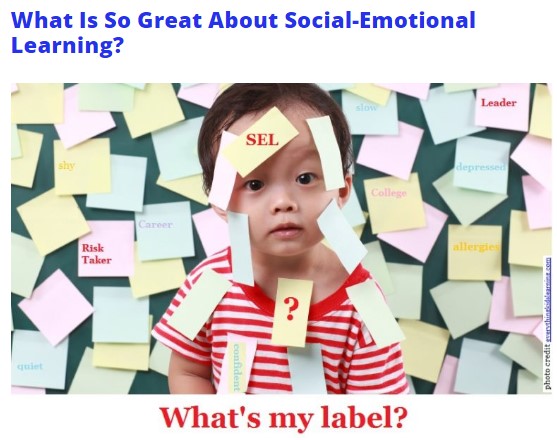
We don’t provide that circumstantial framework today, however. We don’t teach age-appropriate/developmentally-appropriate curriculum anymore – it’s been diluted by years of parent complaints that material is ‘too hard’ or there’s ‘too much’ homework, and by ever-changing guidelines established by ever-changing education fads created by authoritarian educrats who develop vapid, moronic and damaging curricula such as COMMON CORE, SEL, OUTCOMES-BASED EDUCATION, WHOLE CHILD, ect., while gazing out the windows of their ivory towers dreaming of molding the ‘perfect society’.

It’s no wonder we have kids who’d rather stay home from work when the government waves a check under their nose – they’ve never been expected to produce anything that takes even a modicum of effort during any of the formative years. They’ve never experienced the INFECTIOUS JOY of meeting a goal they once thought insurmountable, or even extraordinarily difficult.

Excepting possibly through sports – and the classrooms of the few good teachers left – students are not only not getting challenged, but they’re not being taught much that’s actually useful for either their own edification and personal growth, or for finding and sustaining gainful employment. 

Still and all, we throw hard-earned tax dollar after tax dollar at the system as though THAT will somehow overcome the fact that public education wasn’t even founded for the right purpose – exposure to the concepts of truth and beauty for the edification and personal growth of individual children – not instruction in skill sets deemed necessary by a government to sustain an economy.

GUEST POST: Dear Dr. Grunewald, If You Think You’re Not Allowing The Teaching of CRT, What Do You Call Social Emotional Learning (SEL)?


This is a guest post by an Edmond Public Schools (central Oklahoma) parent with three children in elementary grades.


Dear Dr. Grunewald,

Three of my children have attended Heritage Elementary school for 2 years and have had a wonderful experience. The teachers, counselors and administrators are amazing! 

I met with Mrs. Frank and the counseling staff on November 4 to discuss my children’s participation in the SEAL classes. I inquired about the curriculum and themes/topics covered in the sessions.

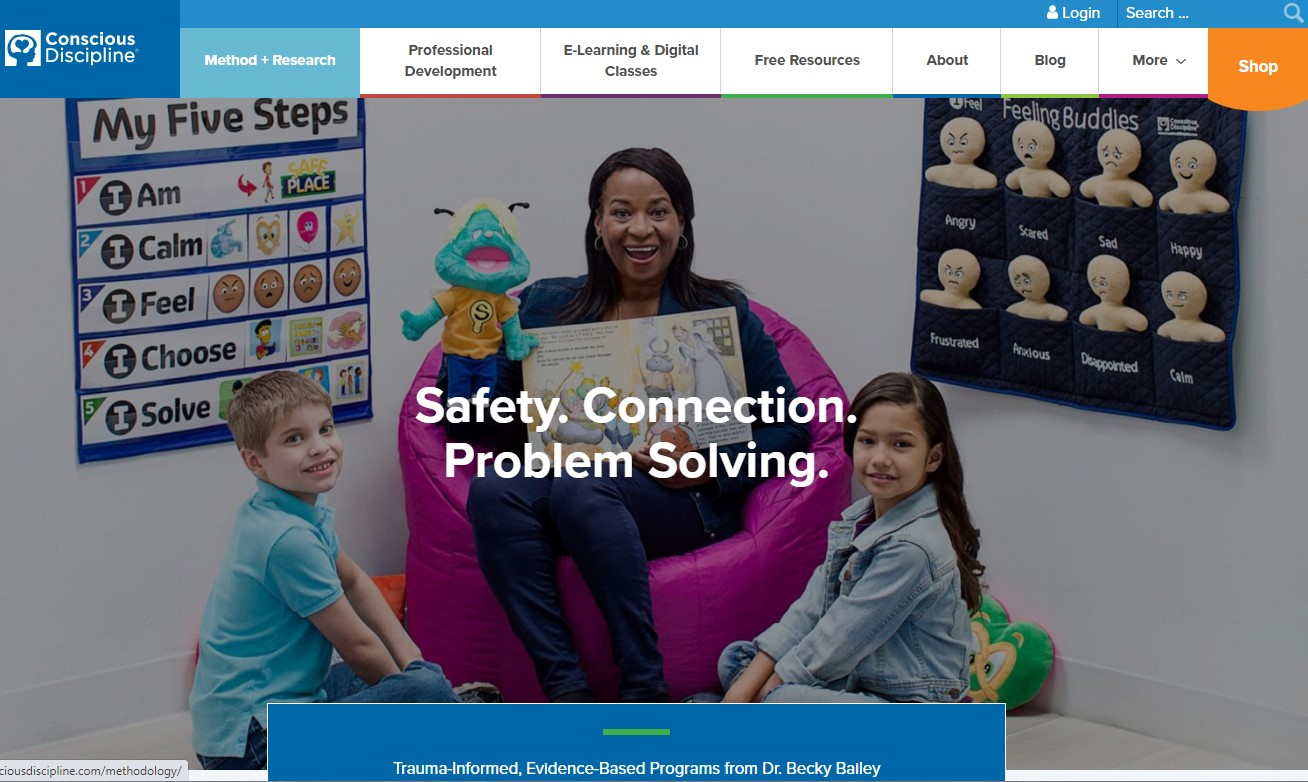
The curriculum being used is Conscious Discipline. The counselors at Heritage write their own lessons based on this curriculum. 

I was slightly familiar with Conscious Discipline since it was used at Clyde Howell where my oldest child attended pre-k, 8 years ago. I borrowed a book from the teacher and found it to be comparable to Love and Logic. These I feel were wonderful programs for elementary kids. However, upon returning home I decided to visit the Conscious Discipline website.

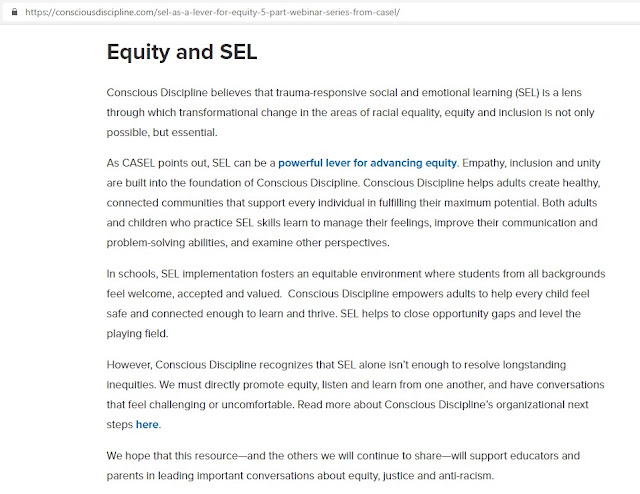
I was quite shocked at the description that popped up before clicking on the site link: Home – Social and Emotional Learning It reads: “Conscious Discipline believes that trauma-responsive social and emotional learning (SEL) is a lens through which transformational change in the areas of racial equality, equity and inclusion is not only possible but essential.” 

This sounds like a CRT, social justice, whatever you want to call it, platitude to me. A political indoctrination program for kids.

CRT is not just a legal theory taught at the college level. CRT is a movement, a conduit of identity politics which promotes the analysis of many aspects of society through the prism of racism and Marxist victim-hood mentality (oppressor vs. oppressed). 

It’s clear to me that CRT has been repackaged and renamed SEL. 

On the Conscious Discipline’s home page I also found the Collaborative for Academic, Social and Emotional Learning (CASEL) seal indicating that Conscious discipline has the CASEL SELect Program Designation. 

Until recently CASEL downplayed the leftist political bent of SEL, however CASEL CEO, Karen Niemi, announced in December 2020 that her company “has revised its definition of and framework for ‘socio-emotional learning’ to highlight the value of SEL as a weapon for social justice.” 

Karen Niemi. “We know from research that attention to students’ holistic learning and development can promote high-quality educational opportunities and outcomes for all children across race, socioeconomic status, gender, sexual orientation and other differences.

Importantly, SEL has potential to promote the academic, social and emotional development of all children. SEL can also help adults and students co-create more equitable schools and communities.

While SEL alone will not solve the deep-seated inequities in the education system, it can help adults and students build more meaningful relationships and develop knowledge, skills and mindsets to interrupt inequitable policies and practices, create more inclusive learning environments and nurture the interests and assets of all individuals.

CASEL will work alongside researchers, educators and policymakers to address issues of identity, agency and belonging that are fundamental to human development” 

This is obviously a CRT/SEL school curriculum publisher’s clearinghouse. The NoVo Foundation is a funding partner of CASEL. NoVo focuses heavily on abortion rights, LGBT interests and left-wing economics. 

CASEL is basically a political lobbyist group promoting SEL programs in schools and in the workplace.

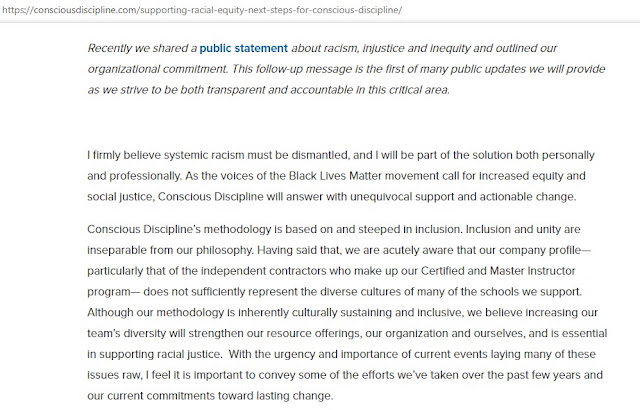
Here is just a sample of more articles and/or statements that raised CRT red flags from the Consciousness Discipline website: Conscious Discipline – CASEL Program Guide – This is the curriculum description “Strategies supporting educational equity””Conscious Discipline offers strategies for working with bias. This includes training for adults to examine bias and understand how it creates barriers to authentically connecting with students, assessing students SEL needs, and responding to conflict constructively and impartially. “Supporting Racial Equity: Essential Next Steps for Conscious Discipline – The screenshot below captures what Dr. Becky Bailey said on July 29, 2020:

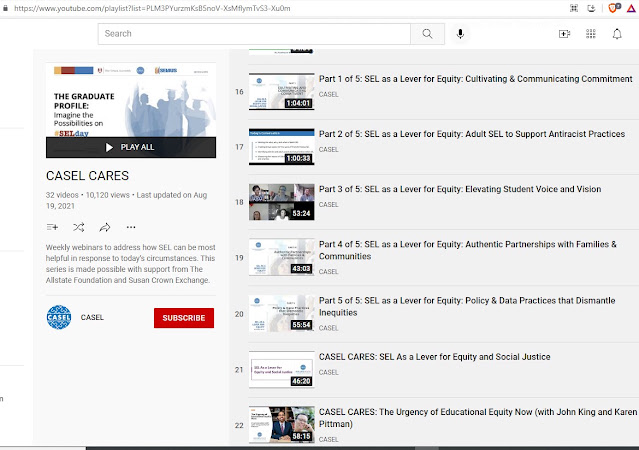
SEL as a Lever for Equity: 5-Part Webinar Series from CASEL – Posted on August 11, 2020 by Conscious Discipline:

“Conscious Discipline believes that trauma-responsive social and emotional learning (SEL) is a lens through which transformational change in the areas of racial equality, equity and inclusion is not only possible, but essential.” (See more in the screenshot below)

“However, Conscious Discipline recognizes that SEL alone isn’t enough to resolve longstanding inequities. We must directly promote equity, listen and learn from one another, and have conversations that feel challenging or uncomfortable.”

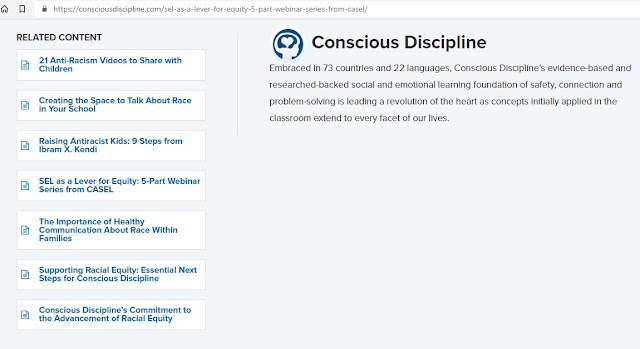
I guess “conversations that feel challenging or uncomfortable” means showing my kids Raising Antiracist Kids: 9 Steps from Ibram X. Kendi – the guy who thinks my kids are racist because they have white skin – but here he is promoted by Conscious Discipline.


Dr. Grunewald, does CASEL’s revised definition of and framework for SEL align with our SEAL program? 

How do you ensure EPS SEAL curriculums are not promoting the tenets of HB 1775?

You said in your response to the public comments made at the November 1 meeting and Wednesday night on News 9 that EPS does not teach CRT and is only taught in law schools. CRT has invaded all sectors of academia, including education. 

I beg to differ and I now believe Consciousness Discipline to be rooted in CRT. 

How is EPS using this – or any other CASEL-approved program or curriculum – NOT violating HB 1775?

The EPS website does not have any information regarding SEAL curriculum. While trying to find out what curriculum was being used SEAL, I came across a June 22, 2020 write-up:​ Sunset Counselor Wins Award and $10,000 Prize – Edmond Public Schools. The article states:”Ms. Bointy” has been a pioneer in using the Sanford Harmony social and emotional learning program.”At the end of the article, it states:”Sanford Harmony has been recognized by CASEL as a quality program.”I did some digging around on the Harmony page and clicked on the Research tab at the very top of the page.

I learned “Students participating in Harmony reported significantly more diverse friends than did those from control groups. Furthermore, these peer influences were related to improved writing and math performance in classrooms using Harmony, but not in control classrooms.”(DeLay, et al., 2016). 

Why is an SEL program concerned about collecting data on students and their friends? 

From the Harmony-Inspire Rebuilding Communities Tool-Kit page 9, titled: “How can we foster diversity and inclusion in our communities and support many students who have seen and experienced unrest and inequity?”Item 2 says:”Support students in developing their critical thinking skills and forming inclusive attitudes by providing students the tools to identify and reject stereotypes and seek friendships with a diverse group of peers. These skills help them be advocates for themselves and their families, peers, and community members now and in the future. Explore developmentally appropriate critical thinking skills about stereotypes and developing empathy for other points of view in the “Pop that Stereotype” activity.”

Is Ms. Bointy still teaching this CRT-laced program? If so, she and EPS are violating HB 1775.
The U.S. Department of Education has been pushing schools by providing funding and training in physiological, attitudinal and behavioral standards (SEL) for years. ESSER funding can be and are being used by EPS to purchase more SEL curriculum – ostensibly to curb ‘learning loss’. 
How does SEL address learning loss? I think more academic subjects should be taught to address that issue instead – art class for all elementary students, handwriting, spelling or more of the core subjects. 

Who decides what attitudes, mindsets, values and beliefs should be taught and promoted to a child? You? The government? 

No. We the parents do. There is subjectivity among adults who develop SEL curriculum that reflects their attitudes, mindsets, values and beliefs that is then taught to a class which is a group. 

SEL/CRT is pushing collective values over individual values. Impressionable elementary children and children undergoing puberty with incomplete pre-frontal cortexes are being influenced to act or think how a group or teacher or school district says or does in order to belong or be “canceled” by the group if they have a different viewpoint. Does a school have any business defining these competencies and teaching them? No. 

Why is teaching Great Expectations not enough SEL for Edmond Public School students? 

I don’t want someone else deciding who my children are – I want my children to develop their own sense of self.

Sincerely,

Emily Wright

Parents Issue Wake-up Call in Virginia

As I worked at the capitol this week with legislators we hope to work with on parental rights legislation, I’d like to make sure you saw this from ParentalRights.org. You can find it online here. Stay engaged parents, your kids are your own! Tracey Montgomery, Parental Rights Director

Will you help us ride the wave?

“I don’t think parents should be telling schools what they should teach,” said Virginia gubernatorial candidate Terry McAuliffe in a debate on September 28, 2021. Those twelve words will live on in infamy in electoral politics. Mr. McAuliffe had led every poll until then. His party comfortably won the presidential election in Virginia by ten points just a year earlier.

But telling parents that they should not be in charge of their kids’ education was a monumental miscalculation, especially in a year when many parents saw what their kids’ education actually looked like through a Zoom window; in a year when school boards began adopting social engineering above education; in a fraught year involving masks, vaccines, and in-person versus remote; in a year when many parents learned that they have real options other than public schools, like homeschooling, pods, and micro-schools.

I live in Virginia and followed this election quite closely. If ever a moment could be pointed to when the momentum shifted, that debate was it. That single sentence may be the best example of a “Kinsley gaffe”—a phrase coined by journalist Michael Kinsley several years ago. “A gaffe is when a politician tells the truth—some obvious truth he isn’t supposed to say.”

Sometimes politicians mistakenly say what they really mean. This single truthful sentence tipped the first domino that led to the Virginia election earthquake. 

And parents led the way. Parents who don’t agree that they should sit down and shut up. Parents who want to be involved in the education and lives of their children. Parents who want their schools to answer to them, not the other way around.

Parents like you and me.

The Parental Rights Foundation needs your help to keep this wave alive. Earlier this year we sued the District of Columbia when it passed an ordinance that allows children as young as 11 years old to receive vaccinations without their parents’ knowledge or consent—and then hides the fact from the parents. 

Just last week, we sued Virginia over a new statute that tells parents of faith that they may not consider religion when hiring a babysitter. That’s right: Virginia has become the ultimate nanny state, making it a human rights violation to want a babysitter caring for our children to share and support our religious beliefs and training. 

Next month, I will be traveling to San Diego to the American Legislative Exchange Council to introduce a model fundamental parental rights bill that could be used to introduce similar statutes around the country . 

The country is awakened to parental rights like never before. 

Would you consider making your best donation to help us elevate our presence and ability to take advantage of this new momentum?

Wearing one of my other hats—my vice president of HSLDA Action hat—I interviewed Mr. McAuliffe’s opponent, Glenn Youngkin, after the gaffe but before the election, to decide whether HSLDA Action could endorse Mr. Youngkin. Referring to Mr. McAuliffe’s education statement, Mr. Youngkin said he believed parents should be deeply involved in the education of their children. 

After talking about some of his education policy preferences, he enthusiastically referred to a Virginia statute that says parents have a fundamental right to make decisions concerning the upbringing, education, and care of the parent’s child. He said it as if he thought it would be a surprise to me.

It wasn’t a surprise. 

Trying not to blow our own horn too loudly, I politely told him that we had been instrumental in drafting the bill that became the statute and in shepherding it through the Virginia legislature in 2013. 

Would you consider helping us to bring bills like this to even more states in the coming year? And to prosecute lawsuits like the ones in D.C. and Virginia? 

Moments like these rarely occur with such clarity. Parental rights have been on the defensive in many ways. But pendulums do swing, and when they do, we need to strike.

We need your help now more than ever.

For freedom’s sake,

James R. Mason
President

PS: HSLDA Action did endorse Mr. Youngkin—and in case you haven’t heard, he won.

Running List of Curricula, Courses, Online Resources and Books to Help Your Family’s Educational Journey

parents and kid

I’m beginning this list January 18 of 2016. I hope to add to it every time I find a resource that I believe would be helpful to Christian parents, so bookmark the page and keep looking back! If you have any great ideas, post them in the comments section and I’ll add!

CURRICULA

Learn Our History: Positive, Patriotic, And Unbiased History; Learn Our History is US history for kids at its very best!  Each exciting animated history film features a group of time-traveling history students who go back in time to see US history in the making.

COURSES

Homeschool Programming: Computer Programming Courses for Kids and Teens; Your students can learn to create their own websites, games, and smart-phone apps with our self-study curriculum.

ONLINE EDUCATION RESOURCES

Classical Conversations: Online resources, books and helpful information to anyone looking to homeschool or enhance their child’s public education.

KNOWLEDGE IS POWER

Religious Freedom Day – A Guide For Commemorating Religious Freedom At School;  This guidebook is intended to help all Americans join the President in celebrating Religious Freedom Day as well as to clarify students’ religious liberties.

BOOKS

How Should We Then Live: In this brilliant book Francis A. Schaeffer analyzed the reasons for modern society’s state of affairs and presented the only viable alternative: living by the Christian ethic, acceptance of God’s revelation, and total affirmation of the Bible’s morals, values, and meaning.

The Core: Teaching Your Child the Foundations of Classical Education:  In this book, Leigh Bortins gives parents the tools and methodology to implement a rigorous, thorough, and broad curriculum based on the classical model.

America’s Schools, The Battleground for Freedom: America’s Schools will inform, alarm, and provoke you to action for education that promotes scholarship and freedom.

Full Text of Oklahoma’s Parents’ Bill of Rights

Parents with Child

Parents’ Bill of Rights

BE IT ENACTED BY THE PEOPLE OF THE STATE OF OKLAHOMA:

SECTION 1. NEW LAW A new section of law to be codified in the Oklahoma Statutes as Section 2001 of Title 25, unless there is created a duplication in numbering, reads as follows:

A. This act shall be known and may be cited as the “Parents’ Bill of Rights”.

B. This state, any political subdivision of this state or any other governmental entity shall not infringe on the fundamental right of parents to direct the upbringing, education, health care and mental health of their children without demonstrating that the compelling governmental interest as applied to the child involved is of the highest order, is narrowly tailored and is not otherwise served by a less restrictive means.

C. As used in the Parents’ Bill of Rights, “parent” means the natural or adoptive parent or legal guardian of a minor child.

SECTION 2. NEW LAW A new section of law to be codified in the Oklahoma Statutes as Section 2002 of Title 25, unless there is created a duplication in numbering, reads as follows:

A. All parental rights are reserved to a parent of a minor child without obstruction or interference from this state, any political subdivision of this state, any other governmental entity or any other institution, including, but not limited to, the following rights:

1. The right to direct the education of the minor child;

2. All rights of parents identified in Title 70 of the Oklahoma Statutes, including the right to access and review all school records relating to the minor child;

3. The right to direct the upbringing of the minor child;

4. The right to direct the moral or religious training of the minor child;

5. The right to make healthcare decisions for the minor child, unless otherwise prohibited by law;

6. The right to access and review all medical records of the minor child unless otherwise prohibited by law or the parent is the subject of an investigation of a crime committed against the minor child and a law enforcement official requests that the information not be released;

7. The right to consent in writing before a biometric scan of the minor child is made, shared or stored;

8. The right to consent in writing before any record of the minor child’s blood or deoxyribonucleic acid (DNA) is created, stored or shared, except as required by Sections 1-516 and 1-524.1 of Title 63 of the Oklahoma Statutes, or unless authorized pursuant to a court order;

9. The right to consent in writing before the state or any of its political subdivisions makes a video or voice recording of the minor child, unless the video or voice recording is made during or as a part of a court proceeding, by law enforcement officers during or as part of a law enforcement investigation, during or as part of a forensic interview in a criminal or Department of Human Services investigation or to be used solely for any of the following:

a. safety demonstrations, including the maintenance of order and discipline in the common areas of a school or on student transportation vehicles,

b. a purpose related to a legitimate academic or extracurricular activity,

c. a purpose related to regular classroom instruction,

d. security or surveillance of buildings or grounds, and

e. a photo identification card; and

10. The right to be notified promptly if an employee of this state, any political subdivision of this state, any other governmental entity or any other institution suspects that a criminal offense has been committed against the minor child by someone other than a parent, unless the incident has first been reported to law enforcement and notification of the parent would impede a law enforcement or Department of Human Services investigation. This paragraph does not create any new obligation for school districts and charter schools to report misconduct between students at school, such as fighting or aggressive play, that is routinely addressed as a student disciplinary matter by the school.

B. This section does not authorize or allow a parent to engage in conduct that is unlawful or to abuse or neglect a child in violation of the laws of this state. This section shall not be construed to apply to a parental action or decision that would end life. This section does not prohibit courts, law enforcement officers or employees of a government agency responsible for child welfare from acting in their official capacity within the reasonable and prudent scope of their authority. This section does not prohibit a court from issuing an order that is otherwise permitted by law.

C. Any attempt to encourage or coerce a minor child to withhold information from the child’s parent shall be grounds for discipline of an employee of this state, any political subdivision of this state or any other governmental entity, except for law enforcement personnel.

D. Unless those rights have been legally waived or legally terminated, parents have inalienable rights that are more comprehensive than those listed in this section. The Parents’ Bill of Rights does not prescribe all rights of parents. Unless otherwise required by law, the rights of parents of minor children shall not be limited or denied. The Parents’ Bill of Rights shall not be construed to apply to a parental action or decision that would end life.

SECTION 3. NEW LAW A new section of law to be codified in the Oklahoma Statutes as Section 2003 of Title 25, unless there is created a duplication in numbering, reads as follows:

A. The board of education of a school district, in consultation with parents, teachers and administrators, shall develop and adopt a policy to promote the involvement of parents and guardians of children enrolled in the schools within the school district, including:

1. A plan for parent participation in the schools which is designed to improve parent and teacher cooperation in such areas as homework, attendance and discipline;

2. Procedures by which parents may learn about the course of study for their children and review learning materials, including the source of any supplemental educational materials;

3. Procedures by which parents who object to any learning material or activity on the basis that it is harmful may withdraw their children from the activity or from the class or program in which the material is used. Objection to a learning material or activity on the basis that it is harmful includes objection to a material or activity because it questions beliefs or practices in sex, morality or religion;

4. If a school district offers any sex education curricula pursuant to Section 11-105.1 of Title 70 of the Oklahoma Statutes or pursuant to any rules adopted by the State Board of Education, procedures to opt out of a school district from providing sex education instruction to a child if the child’s parent provides written objection to the child’s participation in the sex education curricula;

5. Procedures by which parents will be notified in advance of and given the opportunity to withdraw their children from any instruction or presentations regarding sexuality in courses other than formal sex education curricula pursuant to Section 11-105.1 of Title 70 of the Oklahoma Statutes;

6. Procedures by which parents may learn about the nature and purpose of clubs and activities that are part of the school curriculum, as well as extracurricular clubs and activities that have been approved by the school; and

7. Procedures by which parents may learn about parental rights and responsibilities under the laws of this state, including the following:

a. the right to opt out of a sex education curriculum if one is provided by the school district,

b. open enrollment rights,

c. the right to opt out of assignments pursuant to this section,

d. the right to be exempt from the immunization laws of the state pursuant to Section 1210.192 of Title 70 of the Oklahoma Statutes,

e. the promotion requirements prescribed in Section 1210.508E of Title 70 of the Oklahoma Statutes,

f. the minimum course of study and competency requirements for graduation from high school prescribed in Section 11-103.6 of Title 70 of the Oklahoma Statutes,

g. the right to opt out of instruction on the acquired immune deficiency syndrome pursuant to Section 11-103.3 of Title 70 of the Oklahoma Statutes,

h. the right to review test results,

i. the right to participate in gifted programs pursuant to Sections 1210.301 through 1210.308 of Title 70 of the Oklahoma Statutes,

j. the right to inspect instructional materials used in connection with any research or experimentation program or project pursuant to Section 11-106 of Title 70 of the Oklahoma Statutes,

k. the right to receive a school report card,

l. the attendance requirements prescribed in Section 10-106 of Title 70 of the Oklahoma Statutes,

m. the right to public review of courses of study and textbooks,

n. the right to be excused from school attendance for religious purposes,

o. policies related to parental involvement pursuant to this section,

p. the right to participate in parent-teacher associations and organizations that are sanctioned by the board of education of a school district, and

q. the right to opt out of any data collection instrument at the district level that would capture data for inclusion in the state longitudinal student data system except what is necessary and essential for establishing a student’s public school record.

B. The board of education of a school district may adopt a policy to provide to parents the information required by this section in an electronic form.

C. A parent shall submit a written request for information pursuant to this section during regular business hours to either the school principal at the school site or the superintendent of the school district at the office of the school district. Within ten (10) days of receiving the request for information, the school principal or the superintendent of the school district shall either deliver the requested information to the parent or submit to the parent a written explanation of the reasons for the denial of the requested information. If the request for information is denied or the parent does not receive the requested information within fifteen (15) days after submitting the request for information, the parent may submit a written request for the information to the board of education of a school district, which shall formally consider the request at the next scheduled public meeting of the board if the request can be properly noticed on the agenda. If the request cannot be properly noticed on the agenda, the board of education of a school district shall formally consider the request at the next subsequent public meeting of the board.

SECTION 4. NEW LAW A new section of law to be codified in the Oklahoma Statutes as Section 2004 of Title 25, unless there is created a duplication in numbering, reads as follows:

A. Except as otherwise provided by law, no person, corporation, association, organization, state-supported institution, or individual employed by any of these entities may procure, solicit to perform, arrange for the performance of, perform surgical procedures, or perform a physical examination upon a minor or prescribe any prescription drugs to a minor without first obtaining a written consent of a parent or legal guardian of the minor.

B. No hospital as defined in Section 1-701 of Title 63 of the Oklahoma Statutes may permit surgical procedures to be performed upon a minor in its facilities without first having received a written consent from a parent or legal guardian of the minor.

C. The provisions of this section shall not apply when it has been determined by a physician that an emergency exists and that it is necessary to perform such surgical procedures for the treatment of an injury or drug abuse, or to save the life of the patient, or when such parent or legal guardian cannot be located or contacted after a reasonably diligent effort.

D. The provisions of this section shall not apply to an abortion, which shall be governed by the provisions of Sections 1-740 through 1-740.6 and Sections 1-744 through 1-744.6 of Title 63 of the Oklahoma Statutes or any successor statute.

E. A person who violates a provision of this section is guilty of a misdemeanor, punishable by a fine of not more than One Thousand Dollars ($1,000.00) or imprisonment of not more than one (1) year in the county jail, or by both such fine and imprisonment.

SECTION 5. NEW LAW A new section of law to be codified in the Oklahoma Statutes as Section 2005 of Title 25, unless there is created a duplication in numbering, reads as follows:

A. Except as otherwise provided by law or a court order, no person, corporation, association, organization or state-supported institution, or any individual employed by any of these entities, may procure, solicit to perform, arrange for the performance of or perform mental health evaluation in a clinical or nonclinical setting or mental health treatment on a minor without first obtaining the written or oral consent of a parent or a legal guardian of the minor child. If the parental consent is given through telemedicine, the health professional must verify the identity of the parent at the site where the consent is given.

B. This section does not apply when an emergency exists that requires a person to perform mental health screening or provide mental health treatment to prevent serious injury to or save the life of a minor child.

C. A person who violates this section is guilty of a misdemeanor, punishable by a fine of not more than One Thousand Dollars ($1,000.00) or imprisonment of not more than one (1) year in the county jail, or by both such fine and imprisonment.

SECTION 6. This act shall become effective November 1, 2014.
What Are ‘Parental Rights’?

The relationship between the parent and child is a fundamental building block of society. As we teach and guide our children, we are investing in the future of our family and the nation. The job we do today will be reflected in the quality of life our children enjoy tomorrow.

That is why our rights as parents are so important to understand. We know that we have the right to bear arms and most of us would defend that right with our lives. We have the right to privacy, freedom of speech, freedom of religion, and freedom of association. But what about the right to raise our children as we see fit? What about our right to make medical decisions for our kids without interference by the government, DHS, or doctors we disagree with? What about the right to decide that our children are not ready for certain controversial lessons at school and to request that our child be exempted from those lessons?

In a lot of states, your ability to make those choices without restriction is limited. But, in Oklahoma, we are very fortunate because those rights are codified into state law and therefore protected. The Parent’s Bill of Rights secures these rights for every parent, trusting parents to know what is best for their children.

As a parent, you are in the best position to know what is best for your children. By knowing your rights and exercising them, you ensure that decisions made regarding your kids are made by you, not a bureaucrat, doctor or social worker.

And that protects your children.

I hope to blog at least weekly on topics to educate parents about their rights. I will be discussing the law and how it affects us and when legislation is pending that affects Parental Rights. I will keep you informed so you can help protect your fundamental parental rights. If you have any comments or would like more information feel free to contact me at parentalrightsok@gmail.com.

Tracey Montgomery

Oklahoma State Director for Parentalrights.org

Ten Myths About Mathematics Education And Why You Shouldn’t Believe Them

With the advent of Common Core came the further full-court press of progressive mathematics. For years now, as Common Core math has been pushed upon the American public public, parents and kids alike have banged their heads on their desks and dinner tables across the country, trying desperately to make sense of convoluted and drawn-out mathematics problems parents never had to conquer when they were in school.

A recent article from the Hechingerreport,

Back off parents: It’s not your job to teach Common Core math when helping with homework

made me so mad my head almost exploded. Seriously, that’s just the craziest nonsense ever. The whole idea of the article was essentially, “parents don’t help your own children with their math, because you can’t understand it anyway. Just make sure the work gets done, no matter what”.

How is this not the school and a subject – math – getting right in the middle between kid and parent, essentially making the kid think the parent is stupid, pulling them – and the family – apart?

For years, I’ve tried to help parents understand the differences between progressive and traditional math because there really is no way to fight progressive math if you don’t know what is wrong with it and what is better. It wasn’t until I saw this article that I realized I didn’t have to invent the wheel.

Ten Myths About Math is written by a number of really excellent math educators who have taken the time to write out each math myth and explain fully why it simply isn’t true. Please visit the article to print out the article, but I’m going to paste the myths and explanations in below so you can read them immediately.

Myth #1

Only what students discover for themselves is truly learned.

REALITY

Students learn in a variety of ways. Basing most learning on student discovery is time-consuming, does not insure that students end up learning the right concepts, and can delay or prevent progression to the next level. Successful programs use discovery for only a few very carefully selected topics, never all topics.

REFERENCES

Dixon, R., Carnine, D., Lee, D. Wallin, J., & Chard, D. (1998). Review of High Quality Experimental Mathematical Research: Executive Summary. Eugene, OR: National Center to Improve the Tools of Educators, University of Oregon.

Klahr, D. & Nigam, M. (2004). The Equivalence of Learning Paths in Early Science Instruction: Effects of Direct Instruction and Discovery Learning.Psychological Science, 15, 10, 661-667.

Becker, W. C. and Engelmann, S.; Sponsor Findings From Project Follow Through. University of Oregon.

John R. Anderson, Lynne M. Reder, Herbert A. Simon. Applications and Misapplications of Cognitive Psychology to Mathematics Education.

R. James Milgram, “What is Mathematical Proficiency?,” March, 2004. Invited address, First Workshop on Mathematics Education. Mathematics and Science Research Institute, Berkeley, CA.

Myth #2

Children develop a deeper understanding of mathematics and a greater sense of ownership when they are expected to invent and use their own methods for performing the basic arithmetical operations, rather than study, understand and practice the standard algorithms.

REALITY

Children who do not master the standard algorithms begin to have problems as early as algebra I.

The snubbing or outright omission of the long division algorithm by NCTM- based curricula can be singularly responsible for the mathematical demise of its students. Long division is a pre-skill that all students must master to automaticity for algebra (polynomial long division), pre-calculus (finding roots and asymptotes), and calculus (e.g., integration of rational functions and Laplace transforms.) Its demand for estimation and computation skills during the procedure develops number sense and facility with the decimal system of notation as no other single arithmetic operation affords.

REFERENCES

General reference: The algebra, pre-calculus and calculus teachers and professors who must remediate or flunk these children.

From 1998 issue of the Notices of the American Mathematical Society:

“We would like to emphasize that the standard algorithms of arithmetic are more than just ‘ways to get the answer’ — that is, they have theoretical as well as practical significance. For one thing, all the algorithms of arithmetic are preparatory for algebra, since there are (again, not by accident, but by virtue of the construction of the decimal system) strong analogies between arithmetic of ordinary numbers and arithmetic of polynomials.” (The above was quoted in an open letter to Secretary of Education Richard Riley in 1999, which was signed by 200 prominent U.S. mathematicians.)

The Role of Long Division in the K-12 Curriculum; David Klein (California State University, Northridge), R. James Milgram (Stanford University)

Myth #3

There are two separate and distinct ways to teach mathematics. The NCTM backed approach deepens conceptual understanding through a problem solving approach. The other teaches only arithmetic skills through drill and kill. Children don’t need to spend long hours practicing and reviewing basic arithmetical operations. It’s the concept that’s important.

REALITY

“The starting point for the development of children’s creativity and skills should be established concepts and algorithms… Success in mathematics needs to be grounded in well-learned algorithms as well as understanding of the concepts.”

What is taught in math is the most critical component of teaching math. How math is taught is important as well, but is dictated by the “what”. Much of understanding comes from mastery of basic skills – an approach backed by most professors of mathematics. It succeeds through systematically empowering children with the pre-skills they need to succeed in all areas of mathematics. The myth of conceptual understanding versus skills is essentially a false choice – a bogus dichotomy. The NCTM standards suggested “less emphasis” on topics needed for higher math, such as many basic skills of arithmetic and algebra.

“That students will only remember what they have extensively practiced – and that they will only remember for the long term that which they have practiced in a sustained way over many years – are realities that can’t be bypassed.”

REFERENCES

Kenneth Ross, Chair, Mathematical Association of America President’s Task Force on the NCTM Standards. (June 1997). Response to NCTM’s Commission on the Future of the Standards.

Basic Skills vs Conceptual Understanding; a Bogus Dichotomy; Hung-Hsi Wu, Department of Mathematics, University of California, Berkeley (American Educator, Fall, 1999).

Willingham, D. (Spring 2004). Practice Makes Perfect-But Only If You Practice Beyond the Point of Perfection. American Educator.

Algorithms, Algebra, and Access, by Stanley Ocken (Sep 2001).

In Defense of “Mindless Rote”, by Ethan Akin (Mar 30, 2001).

On the Algorithms of Arithmetic, by Ralph Raimi (2002).

Myth #4

The math programs based on NCTM standards are better for children with learning disabilities than other approaches.

REALITY

“Educators must resist the temptation to adopt the latest math movement, reform, or fad when data-based support is lacking…”

Large-scale data from California and foreign countries show that children with learning disabilities do much better in more structured learning environments.

REFERENCES

Miller, S.P. and Mercer, C.D., “Educational Aspects of Mathematics Disabilities.” January/February 1997, Journal of Learning Disabilities, Vol. 30, No. 1, pp. 47-56.

Darch, C., Carnine, D., & Gersten, R. (1984). “Explicit Instruction in Mathematics Problem Solving.” The Journal of Educational Research, 77, 6, 351-359.

Myth #5

Urban teachers like using math programs based on NCTM standards.

REALITY

“Mere mention of [TERC] was enough to bring a collective groan from more than 100 Boston Teacher Union representatives…”

REFERENCES

Editorial, “Mathematical Unknowns,” The Boston Globe, November 8, 2004, A10.

Myth #6

“Calculator use has been shown to enhance cognitive gains in areas that include number sense, conceptual development, and visualization. Such gains can empower and motivate all teachers and students to engage in richer problem-solving activities.” (NCTM Position Statement)

REALITY

Children in almost all of the highest scoring countries in the Third International Mathematics and Science Survey (TIMMS) do not use calculators as part of mathematics instruction before grade 6.

A study of calculator usage among calculus students at Johns Hopkins University found a strong correlation between calculator usage in earlier grades and poorer performance in calculus.

REFERENCES

Calculating the cost of calculators, Lance Izumi, Capitol Ideas, Pacific Research Institute, Vol. 5, No. 51, December 21, 2000.

W. Stephen Wilson, K-12 Calculator Usage and College Grades Educational Studies in Mathematics.

Myth #7

The reason other countries do better on international math tests like TIMSS and PISA is that those countries select test takers only from a group of the top performers.

REALITY

On NPR’s “Talk of the Nation” program on education in the U.S. (Feb. 15, 2005), Grover Whitehurst, Director of the Institute of Education Sciences at the Department of Education, stated that test takers are selected randomly in all countries and not selected from the top performers.

REFERENCES

Grover Whitehurst, Director, Institute of Education Sciences; on NPR Talk of the Nation, February 15, 2005;

Myth #8

Math concepts are best understood and mastered when presented “in context”; in that way, the underlying math concept will follow automatically.

REALITY

Applications are important and story problems make good motivators, but understanding should come from building the math for universal application. When story problems take center stage, the math it leads to is often not practiced or applied widely enough for students to learn how to apply the concept to other problems.

“[S]olutions of problems … need to be rounded off with a mathematical discus-sion of the underlying mathematics. If new tools are fashioned to solve a problem, then these tools have to be put in the proper mathematical perspec-tive. … Otherwise the curriculum lacks mathematical cohesion.”

REFERENCES

The Mathematician and Mathematics Education Reform; Hung-Hsi Wu, University of California, Berkeley; in Notices of the American Mathematical Society, 43(1996), 1531-1537).

Myth #9

NCTM math reform reflects the programs and practices in higher performing nations.

REALITY

A recent study commissioned by the U.S.Department of Education, comparing Singapore’s math program and texts with U.S. math texts, found that Singapore’s approach is distinctly different from NCTM math “reforms.”

Also, a paper that reviews videotaped math classes in Japan shows that there is teacher-guided instruction (including a wide variety of hints and helps from teachers while students are working on or presenting solutions).

REFERENCES

What the United States Can Learn From Singapore’s World-Class Mathematics System (and what Singapore can learn from the United States); American Institutes for Research; for U.S. Department of Education; January 28, 2005; Washington, D.C.

Siegel, Alan R. Telling Lessons from the TIMSS Videotape: remarkable teaching practices as recorded from eighth-grade mathematics classes in Japan, Germany and the US. Chapter 5 in “Testing Student Learning, Evaluating Teaching Effectiveness,” Williamson M. Evers and Herbert J. Walberg, Eds., Hoover Institution Press, May, 2004, pp. 161-194.

Myth #10

Research shows NCTM programs are effective.

REALITY

There is no conclusive evidence of the efficacy of any math instructional program.

Increases in test scores may reflect increased tutoring, enrollment in learning centers, or teachers who supplement with texts and other materials of their own choosing. Also, much of the “research” touted by some of the NSF programs has been conducted by the same companies selling the programs. State exams are increasingly being revised to address state math standards that reflect NCTM guidelines rather than the content recommended by mathematicians.

REFERENCES

On Evaluating Curricular Effectiveness; Judging the Quality of K-12 Mathematics Evaluations; National Research Council, the National Academies Press; September, 2004.

The state tests in Maryland have a number of 3 point problems in which students are awarded 1 point for performing the math correctly and 2 points for explaining it. It is thus possible to do the math right but get half the credit that another student gets with the wrong answer.

Blog at WordPress.com.

Up ↑