Search

ROPE Report

Tag

computers

Less Than An Hour Of Screentime A Day Can Harm Your Child’s Socioemotional Health

A large study has just been published on the effects of screentime in children and the results are extremely concerning.

Sixteen authors contributed to Electronic Screen Use and Children’s Socioemotional Problems, published by the American Psychological Association this month. The study model is very interesting. It collected research papers that had studied screen use in children in any way, pulled the results of 117 of those studies and then used something called Multivariate analysis to predict the outcome of screen use in children under 18.

The studied data included research from all over the world between 1972 and 2024. American-derived studies comprised the bulk of the study (41), with Canada (13), Australia (11), Germany (7) and the Netherlands (7) coming in behind. A total of 331,391 children were represented through the researched studies – 48.1% were boys and 48.5% were girls, with the mean age reported as 10.4 years.

This study is hugely significant for two reasons:

  1. The number of children included in the study. The larger a study size, the much more likely statistical analyses are to produce accurate results. Small study sizes are harder to produce statistically significant results than larger ones. With over 300 hundred thousand children included through all the research analyzed, the statistical significance of any reported conclusions are very high.
  2. The number of years of research collected is – again – very high. It may mean one thing that a report done in 1972 finds that screen time correlates with emotional troubles in children, but to find that same result in a study from 2024 is huge. As in the numbers of children represented in the study, the number of years represented in the study also creates a very high statistical significance that the results are accurately reported.

Therefore, the conclusions from this research are NOT to be ignored. They are, by all accounts, statistically significant thanks to the robust number of children studied over a long period of time.

Please click on the link for the paper’s title to look at the study for yourself. It was very interesting research – a really ingenious way of coming to a conclusion about screens and the behavior of children.

Now, here’s the bottom line.

CHILDREN – PARTICULARLY THOSE FROM AGES 6-10 – WHO USE SCREENS MORE THAN 30 MINUTES A DAY ARE PRONE TO SOCIOEMOTIONAL PROBLEMS such as attention deficit/hyperactivity disorder (ADHD) symptoms (48), followed by aggressive behavior (39), emotional problems (37), conduct problems (including oppositional defiant behavior; 30), mental health problems (20), peer relationship problems (19), antisocial behavior (17), and low self-esteem (11).

From the research:

These data suggest that small amounts of screen use are not problematic— there appear to be few differences between outcomes for children watching 10 and 30 min per day. For children exceeding the guidelines, there was a substantial association between their screen use and socioemotional problems. At these levels, more is worse, likely because screens increasingly displace other essential protective behaviors (Roberts et al., 1993; World Health Organization, 2019). As noted earlier, meta-analyses have shown that screen usage is associated with lower levels of physical activity (Kontostoli et al., 2021), poor sleep duration or quality (Carter et al., 2016; Hale & Guan, 2015; Zhang et al., 2022), and reduced in-person social interactions (Twenge et al., 2018). Small increases in screen use are unlikely to displace these behaviors, but once exceeding guidelines, an extra hour of screen use likely means less sleep, social time, or physical activity.

And this goes both ways. From the study:

…children on screens may be at greater risk of developing socioemotional problems, just as children with preexisting socioemotional problems may turn to screens in general as a way to cope with their emotional and social distress.

So, in closing, PLEASE, PLEASE, PLEASE, aggressively limit the amount of time your child/children spend on screens. Do NOT allow them to have ANY screens in their bedrooms during the nighttime hours at all – no TVs, no computers, no phones, no pads, no Gameboys, no Nintendos, no NOTHING with a screen.

If you even scan the research, you’ll find that allowing kids to have screens at nighttime contributes to lack of sleep, which in turn – despite what they’re seeing on those screens – causes an inability to control their emotions because they are tired.

I remember when our kids turned 18. Both the boys went out and bought TVs. Our youngest daughter was happy to have her phone 24/7 because she uses her phone for everything in the world, but the boys were ecstatic to have their own TV. Hysterically, only one of them ever really used it much even after an 18 year wait!

Our future resides in our children. Let’s give them – and us – the best future we can. Let’s be the adults in the room and protect our children’s mental health by severely limiting their screen use. Pronto.
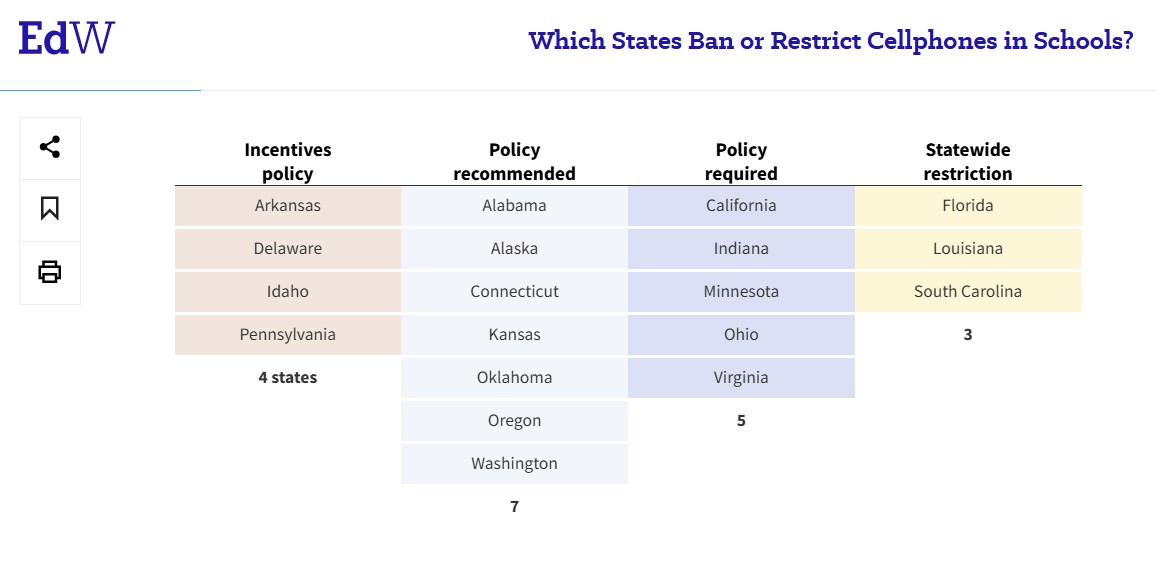
Usurping Local Control – Cell Phone Restrictions In Oklahoma – NO on SB1389 and HB1276

Here is the cell phone bill, by Senate Education Committee Vice-Chair, Ally Seifried; SB139. There is also a companion bill run by Representative Chad Caldwell in the House, HB1276 which has already passed its first Committee hurdle.

According to a press release sent out by Senate Media, the bill, “empower[s] schools to adopt ‘bell to bell’ cell phone policies”, yet the bill summary says, “An Act relating to schools; requiring school district boards of education to adopt a policy prohibiting use of cell phones while on campus during certain time period”. Requiring and ’empowering’ do not have the same meaning – the first includes force.

In fact, the bill goes on to say that it will require schools to set discipline policies for students who break the school’s required policy on cell phone use (the force part). Originally, it had allotted up to 2 million taxpayer dollars (“if available”, whatever that means) to be granted to middle and high schools so they can buy something to STORE cell phones during the day. Because a basket can’t hold cell phones in a classroom and we need a cabinet (or something) for THE SCHOOL to hold EVERY STUDENT’S cell phone.

Problems With The Bill

  1. What is the point of a school board? According to state law, individual local school boards have the right and ability to set policy – including policy over cell phones. This bill actively usurps local school board authority by forcing them to create a policy. On one hand, we expect parents to execute control over their minor children, yet so much of what the state does actually removes parental executive control in favor of a government policy, rule or law. How can a parent execute parental control if we keep removing their executive function?
  2. This is NEW LAW. How many laws do Oklahomans need to restrain them – or, in this case, their children? What about schools? Could an argument be made that part of the reason public schools in Oklahoma are failing is that they are constrained by state laws that may not have been needed at the local level? How many laws does Oklahoma actually need – especially when this one has no teeth, making it a suggestion.
  3. This law forces schools to create disciplinary actions to be meted out when students break cell phone policy. What happens if a school DOESN’T create a cell phone policy? What happens if they don’t create a discipline policy? How many times has state law required schools to create a policy, but then never forced the school to write the policy when they don’t? Tulsa attorney Maria Seidler has told us numerous times, for example, that public schools don’t adhere to all of Oklahoma’s Parental Rights law, but there isn’t an enforcement mechanism in the law to make them, forcing parents to use their own money to sue schools while schools use taxpayer dollars to fight them. How many times has the state forced schools to follow the policies they DO create – about bathrooms, free speech, bullying, or student safety, for example? This law, then, would be meaningless, just like so many others our legislature creates, because there isn’t a mechanism of enforcement.
  4. Our state has real problems with school employees who misuse and abuse children in their care. We have only to look at the number of multi-million dollar lawsuits being settled by schools in the last several years like Kingfisher and Ninnekah and Salina and Perry and Shawnee and Wewoka… Yet, parents who suggest CCTV for classrooms are confronted with an uproar like a tsunami from certain teachers and administrators against such a thing. Now, we want to remove the only way students have to ‘catch’ a school employee doing something they shouldn’t be doing. Just this thought should be concerning.
  5. So much learning is now done on computers but somehow the kid’s cell phones are causing distraction? How does that work? Countless studies have shown that computer learning isn’t the best thing for students, but not only do we still do it, there are real problems with students accessing porn and other sites, as former Oklahoma resident Denise Roberts told us during an interview on our podcast – but cell phones are the problem?
  6. This is a national movement. Why? Why we are attempting to do what so many other states are doing? Why do we play Follow The Leader so often in Oklahoma when we’re an individual state. What about, “I don’t care what the other kids do”. What about being an “laboratories of Democracy“?
  7. Each and every teacher could create their own class rules about cell phones, but we’re not letting them – “Put the phones in the basket on my desk until the end of class everyone”. We’re telling teachers that we don’t trust them with a policy over a cell phone, but you trust them to educate the kids in their class? How much sense does that make? This is all talk out of both sides of the mouth of the legislature – here, have more money teachers – but you can’t manage your own classroom.

Bottom line. This is a bill in search of a problem that already has a solution. This isn’t even a bandaid for the horrible educational results we have in this state. This bill is vanity, not good governance.

Contact the Senate Education Committee and ask them to say NO to SB1389.

adam.pugh@oksenate.gov, ally.seifried@oksenate.gov, dusty.deevers@oksenate.gov, joanna.dossett@oksenate.gov, carri.hicks@oksenate.gov, kelly.hines@oksenate.gov, mark.mann@oksenate.gov, roland.pederson@oksenate.gov, dave.rader@oksenate.gov, aaron.reinhardt@oksenate.gov, kendal.sacchieri@oksenate.gov

Blog at WordPress.com.

Up ↑