Search

ROPE Report

Category

Education

GUEST POST: Dear Dr. Grunewald, If You Think You’re Not Allowing The Teaching of CRT, What Do You Call Social Emotional Learning (SEL)?


This is a guest post by an Edmond Public Schools (central Oklahoma) parent with three children in elementary grades.


Dear Dr. Grunewald,

Three of my children have attended Heritage Elementary school for 2 years and have had a wonderful experience. The teachers, counselors and administrators are amazing! 

I met with Mrs. Frank and the counseling staff on November 4 to discuss my children’s participation in the SEAL classes. I inquired about the curriculum and themes/topics covered in the sessions.

The curriculum being used is Conscious Discipline. The counselors at Heritage write their own lessons based on this curriculum. 

I was slightly familiar with Conscious Discipline since it was used at Clyde Howell where my oldest child attended pre-k, 8 years ago. I borrowed a book from the teacher and found it to be comparable to Love and Logic. These I feel were wonderful programs for elementary kids. However, upon returning home I decided to visit the Conscious Discipline website.

I was quite shocked at the description that popped up before clicking on the site link: Home – Social and Emotional Learning It reads: “Conscious Discipline believes that trauma-responsive social and emotional learning (SEL) is a lens through which transformational change in the areas of racial equality, equity and inclusion is not only possible but essential.” 
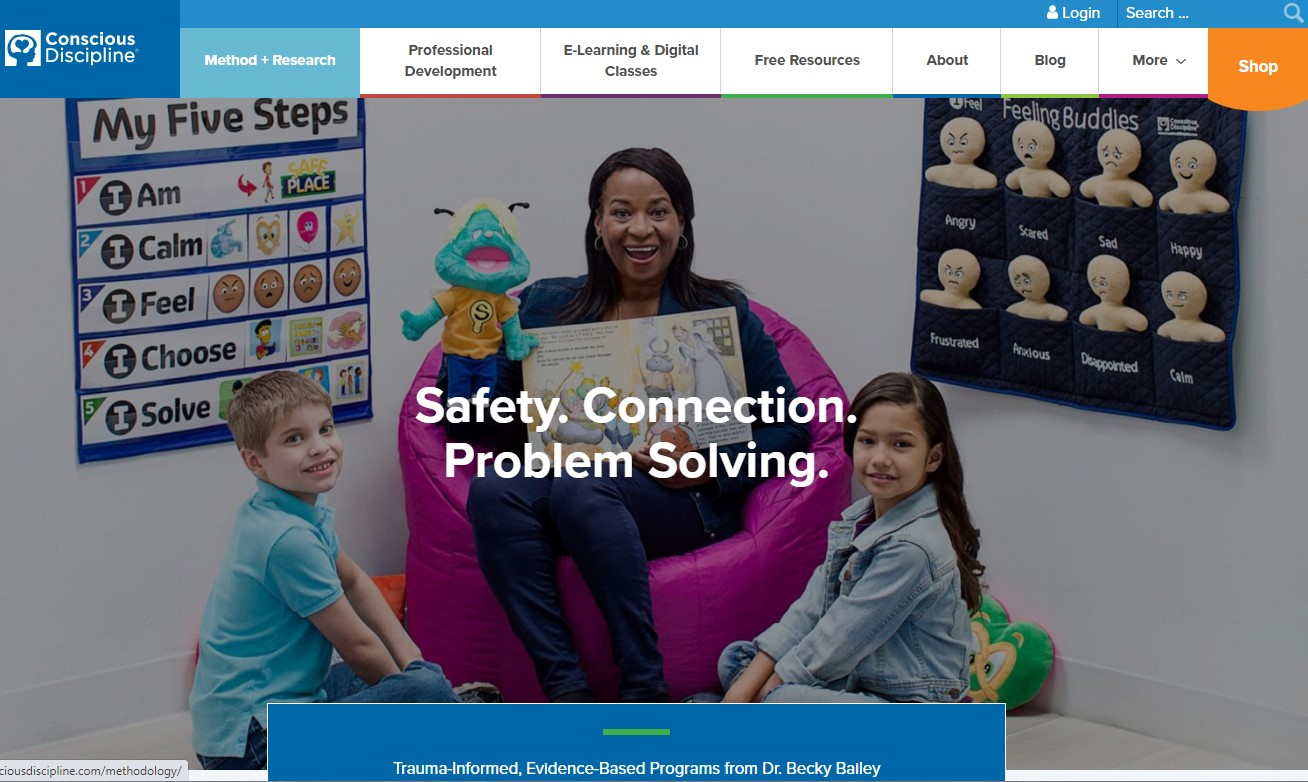
This sounds like a CRT, social justice, whatever you want to call it, platitude to me. A political indoctrination program for kids.

CRT is not just a legal theory taught at the college level. CRT is a movement, a conduit of identity politics which promotes the analysis of many aspects of society through the prism of racism and Marxist victim-hood mentality (oppressor vs. oppressed). 

It’s clear to me that CRT has been repackaged and renamed SEL. 

On the Conscious Discipline’s home page I also found the Collaborative for Academic, Social and Emotional Learning (CASEL) seal indicating that Conscious discipline has the CASEL SELect Program Designation. 

Until recently CASEL downplayed the leftist political bent of SEL, however CASEL CEO, Karen Niemi, announced in December 2020 that her company “has revised its definition of and framework for ‘socio-emotional learning’ to highlight the value of SEL as a weapon for social justice.” 

Karen Niemi. “We know from research that attention to students’ holistic learning and development can promote high-quality educational opportunities and outcomes for all children across race, socioeconomic status, gender, sexual orientation and other differences.

Importantly, SEL has potential to promote the academic, social and emotional development of all children. SEL can also help adults and students co-create more equitable schools and communities.

While SEL alone will not solve the deep-seated inequities in the education system, it can help adults and students build more meaningful relationships and develop knowledge, skills and mindsets to interrupt inequitable policies and practices, create more inclusive learning environments and nurture the interests and assets of all individuals.

CASEL will work alongside researchers, educators and policymakers to address issues of identity, agency and belonging that are fundamental to human development” 

This is obviously a CRT/SEL school curriculum publisher’s clearinghouse. The NoVo Foundation is a funding partner of CASEL. NoVo focuses heavily on abortion rights, LGBT interests and left-wing economics. 

CASEL is basically a political lobbyist group promoting SEL programs in schools and in the workplace.

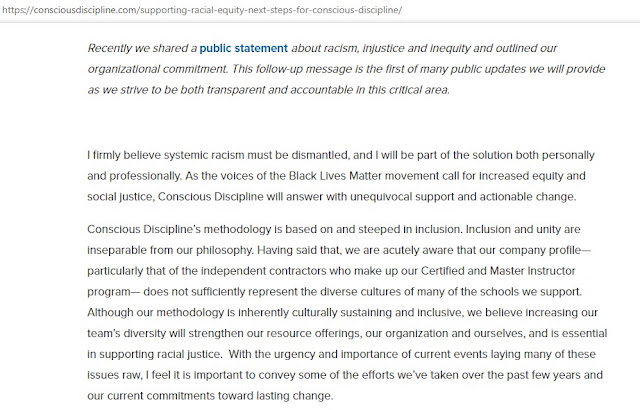
Here is just a sample of more articles and/or statements that raised CRT red flags from the Consciousness Discipline website: Conscious Discipline – CASEL Program Guide – This is the curriculum description “Strategies supporting educational equity””Conscious Discipline offers strategies for working with bias. This includes training for adults to examine bias and understand how it creates barriers to authentically connecting with students, assessing students SEL needs, and responding to conflict constructively and impartially. “Supporting Racial Equity: Essential Next Steps for Conscious Discipline – The screenshot below captures what Dr. Becky Bailey said on July 29, 2020:
SEL as a Lever for Equity: 5-Part Webinar Series from CASEL – Posted on August 11, 2020 by Conscious Discipline:

“Conscious Discipline believes that trauma-responsive social and emotional learning (SEL) is a lens through which transformational change in the areas of racial equality, equity and inclusion is not only possible, but essential.” (See more in the screenshot below)
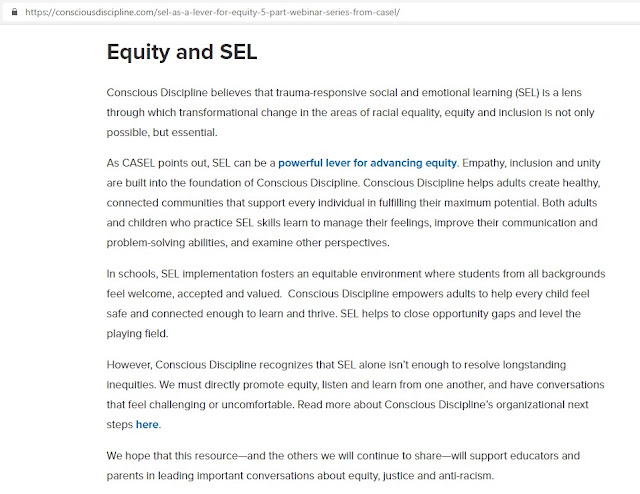
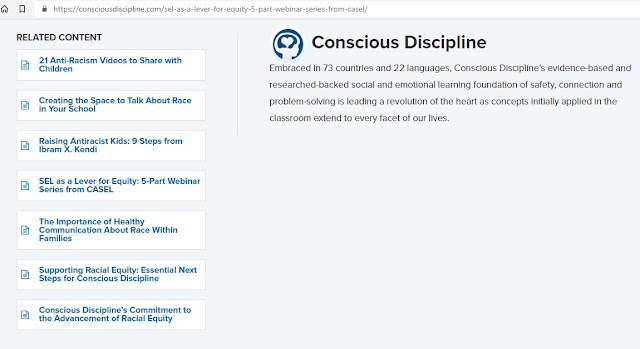
“However, Conscious Discipline recognizes that SEL alone isn’t enough to resolve longstanding inequities. We must directly promote equity, listen and learn from one another, and have conversations that feel challenging or uncomfortable.”

I guess “conversations that feel challenging or uncomfortable” means showing my kids Raising Antiracist Kids: 9 Steps from Ibram X. Kendi – the guy who thinks my kids are racist because they have white skin – but here he is promoted by Conscious Discipline.
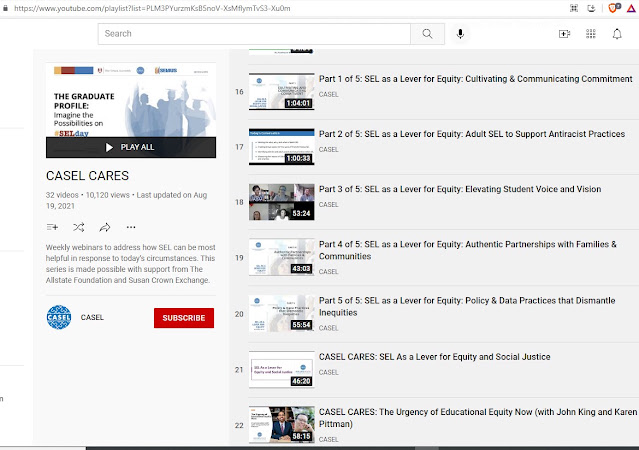

Dr. Grunewald, does CASEL’s revised definition of and framework for SEL align with our SEAL program? 

How do you ensure EPS SEAL curriculums are not promoting the tenets of HB 1775?

You said in your response to the public comments made at the November 1 meeting and Wednesday night on News 9 that EPS does not teach CRT and is only taught in law schools. CRT has invaded all sectors of academia, including education. 

I beg to differ and I now believe Consciousness Discipline to be rooted in CRT. 

How is EPS using this – or any other CASEL-approved program or curriculum – NOT violating HB 1775?

The EPS website does not have any information regarding SEAL curriculum. While trying to find out what curriculum was being used SEAL, I came across a June 22, 2020 write-up:​ Sunset Counselor Wins Award and $10,000 Prize – Edmond Public Schools. The article states:”Ms. Bointy” has been a pioneer in using the Sanford Harmony social and emotional learning program.”At the end of the article, it states:”Sanford Harmony has been recognized by CASEL as a quality program.”I did some digging around on the Harmony page and clicked on the Research tab at the very top of the page.

I learned “Students participating in Harmony reported significantly more diverse friends than did those from control groups. Furthermore, these peer influences were related to improved writing and math performance in classrooms using Harmony, but not in control classrooms.”(DeLay, et al., 2016). 

Why is an SEL program concerned about collecting data on students and their friends? 

From the Harmony-Inspire Rebuilding Communities Tool-Kit page 9, titled: “How can we foster diversity and inclusion in our communities and support many students who have seen and experienced unrest and inequity?”Item 2 says:”Support students in developing their critical thinking skills and forming inclusive attitudes by providing students the tools to identify and reject stereotypes and seek friendships with a diverse group of peers. These skills help them be advocates for themselves and their families, peers, and community members now and in the future. Explore developmentally appropriate critical thinking skills about stereotypes and developing empathy for other points of view in the “Pop that Stereotype” activity.”

Is Ms. Bointy still teaching this CRT-laced program? If so, she and EPS are violating HB 1775.
The U.S. Department of Education has been pushing schools by providing funding and training in physiological, attitudinal and behavioral standards (SEL) for years. ESSER funding can be and are being used by EPS to purchase more SEL curriculum – ostensibly to curb ‘learning loss’. 
How does SEL address learning loss? I think more academic subjects should be taught to address that issue instead – art class for all elementary students, handwriting, spelling or more of the core subjects. 

Who decides what attitudes, mindsets, values and beliefs should be taught and promoted to a child? You? The government? 

No. We the parents do. There is subjectivity among adults who develop SEL curriculum that reflects their attitudes, mindsets, values and beliefs that is then taught to a class which is a group. 

SEL/CRT is pushing collective values over individual values. Impressionable elementary children and children undergoing puberty with incomplete pre-frontal cortexes are being influenced to act or think how a group or teacher or school district says or does in order to belong or be “canceled” by the group if they have a different viewpoint. Does a school have any business defining these competencies and teaching them? No. 

Why is teaching Great Expectations not enough SEL for Edmond Public School students? 

I don’t want someone else deciding who my children are – I want my children to develop their own sense of self.

Sincerely,

Emily Wright
Oklahoma Republican Legislators Enacted President Obama’s Education Agenda During 2010 Creating Many Of The Problems We’re Seeing In Public Education TODAY

As a pre-Halloween trick, this article was released in the Tulsa World – Teacher shortage milestone: New record set for nonaccredited teachers given emergency certification in Oklahoma.

I urge you to read the article – it’s short – but even if you only have time to scan it, read the section that says;

A decade ago, applications for emergency certifications used to be a rarity, with just 32 emergency teaching certificates approved in 2011-12.  But as Oklahoma plunged into a statewide teacher shortage, school districts became increasingly reliant on underqualified new hires who had not yet completed the state’s requirements for either traditional or alternative certification. The numbers have increased annually since 2012, save for a one-year dip last year to 2,801.

Okay. This clearly says that until the 2011/2012 school year, there were only about 35 emergency certifications provided by the OSDE. So what happened in 2010 in Oklahoma?

Well, if you don’t know, I can certainly tell you because I wrote about it and studied it furtively and constantly for five years.

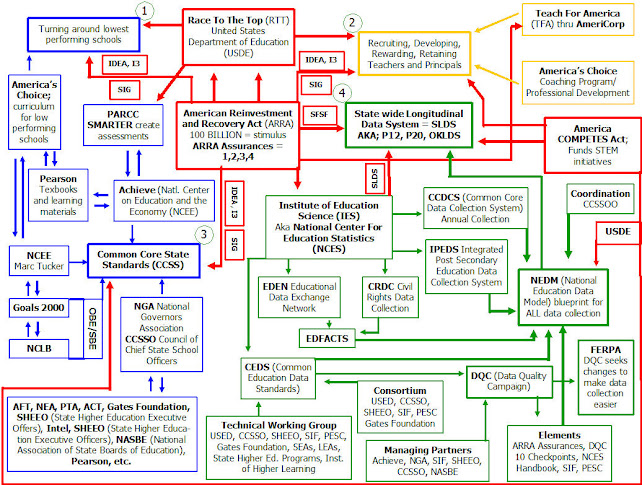
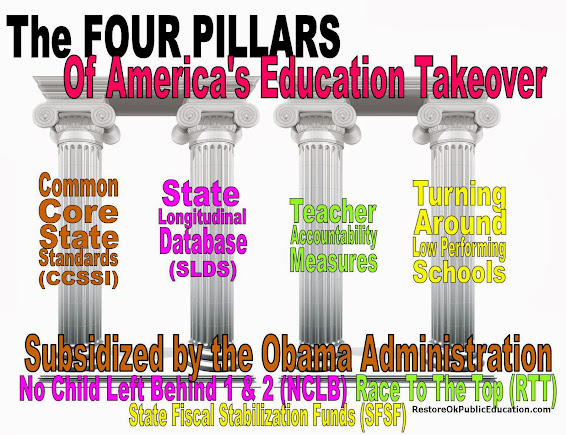
In 2010, House and Senate Republicans along with Governor Mary Fallin ushered into Oklahoma law, The FOUR PILLARS OF THE OBAMA EDUCATION AGENDA – Common Core, State Longitudinal Database, Teacher Accountability Measures and Turning Around Underperforming Schools – through an ENORMOUS omnibus bill – SB2033 – made possible by former Democrat Governor Brad Henry’s acceptance of State Stabilization Funds (SSF).

Why in the world would Oklahoma Republicans sign on to law created by a Democratic President with Marxist tendencies?

Because it would result in an ability to receive federal funds to implement something called “Race To The Top“, President Obama’s education initiative. And later, because Congress refused to re-authorize the billion page law called the ESSA (Elementary and Secondary Education Act) which President George Bush renamed the “No Child Left Behind Act” (NCLB), President Obama came up with a scheme to provide states with even more money – I mean “flexibility” – not to have to have students meet the NCLB requirement of 100% proficiency in math and reading by 2014. And guess what? Then State Superintendent Janet Barresi applied for and got those funds as well.

Unfortunately, those ALSO required the state to develop all four pillars of Obama’s education reforms.

In 2011, former colleague Lynn Habluetzel and I sat down for 2 days to come up with a map that would show as many of the players in the Obama money scheme that our Republican elected officials had bought into. Here’s what we came up with.

It went viral. You can actually internet search this thing because people were so disgusted by it. Why? Because every group on this ‘map’ exerts some kind of control over YOUR DISTRICT SCHOOL in some way. That’s what federal funds do. They tie states to FEDERAL programs whether they’re good for the state or not.

Now, let’s mosey on up to 2014 and add on to all you see above with the “Dear Colleague Letter” penned by Obama which basically told schools that they could be brought up on Civil Rights charges for disciplining black students.

The consequences of the aforementioned 4 pillars is HUGE, but the latter is the worst of all. Ask ANY teacher why they’re quitting and DISCIPLINE ISSUES are in the top two.
Schools do what they’re told by the federal government so they can get federal government money (this is why they DON’T respond to parents – parents don’t have the money carrot there to make it worth it for them in their world view of ‘kids deserve schools with more money’ whatever that means).

Look at mask mandates if you simply can’t believe me. Ask teachers the next reason they’re leaving and they’ll tell you PAPERWORK.

There’s all this data to collect on each student, there’s SEL which is used to conduct Climate Surveys and grading teachers all for the School Grade card that allows schools to get their ESSA money. (More info on school grade cards)

JUST STOP IT.

If you really want to know what’s causing the teacher shortage, it’s the results of the OBAMA-DIRECTED EDUCATIONAL GARBAGE INFLICTED UPON THIS STATE BY REPUBLICAN ELECTED OFFICIALS. Look no further. Schools got what they wanted – their Obama grants and ESSA money – so stop your griping already. You’re just reaping what you’ve sown!

Here’s the thing: I’m convinced that school officials are one of two things – ignorant of everything I’ve just outlined and documented (like the Board member at the teacher termination hearing last night who didn’t know what her job was) – or they know exactly what goes on and know it’s in their best interest to keep parents as far away from making them accountable for it as possible.

Parents, let’s quit letting the latter category think we’re simpletons who can only do Common Core math (2+2=5). TAKE BACK YOUR SCHOOL BOARDS. It’s the only way to make the madness stop and for schools to once again be accountable to student learning and the will and wishes of parents.

Jenni White – Education Director

The Charlotte Mason Method of Homeschooling

Charlotte Mason was a 19th century educator who believed “the souls of all children are waiting for the call of knowledge to awaken them to delightful living.” Some of the characteristics of a Charlotte Mason education are using living books, keeping a nature journal, and introducing music, art, poetry, and great literature among other resources.

Living books – books which are well-written, engaging, and invite the reader inside –  teach not through the dull imparting of facts but through the lives and events of the characters. They include genres such as historical fiction, nature books, and twaddle-free fiction stories such as those of Holling C. Holling. The terms “living books” and “twaddle” are commonly used by those following Charlotte Mason’s educational theories, although they are quickly being picked up in other homeschool circles.

If you’re interested in the Charlotte Mason Method, please see here.

Let children alone… the education of habit is successful in so far as it enables the mother to let her children alone, not teasing them with perpetual commands and directions – a running fire of Do and Don’t ; but letting them go their own way and grow, having first secured that they will go the right way and grow to fruitful purpose. ~ Charlotte Mason

Suzy McCracken – Homeschool Director

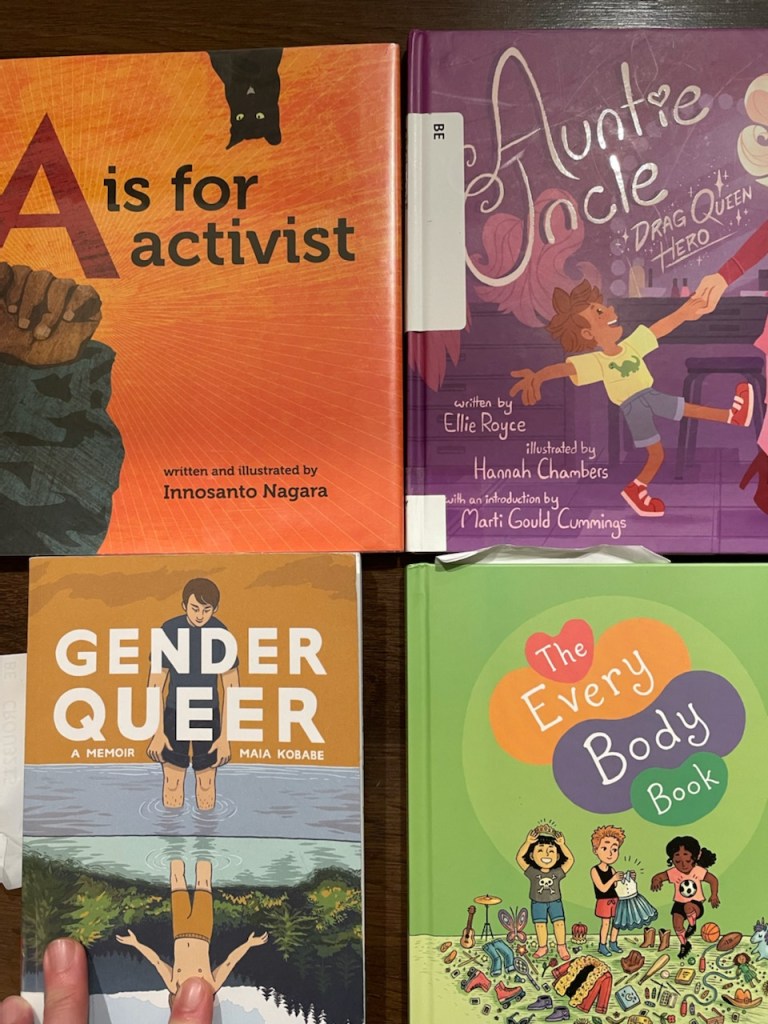
Oklahoma Metropolitan Library System Provides Inappropriate Developmental Reading – The Every Body Book by Rachel E. Simon

This summer, the tax-payer-funded Metropolitan Library System recommended LGBTQ+ books and movies to OK County children ages 5-17 within the children’s and teen’s summer reading program.

After receiving dozens of complaints, the library director, Larry White, agreed that the pop-up with links to LGBTQ+ materials would not be included in next year’s summer reading program. While that news was a small victory for us, the children of OK County who enter the doors of the MLS are not safe from confusing and harmful sexual materials.

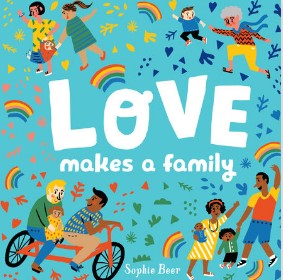
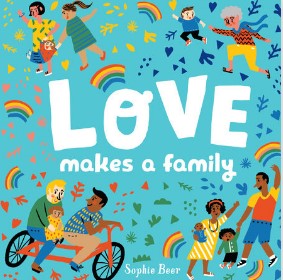
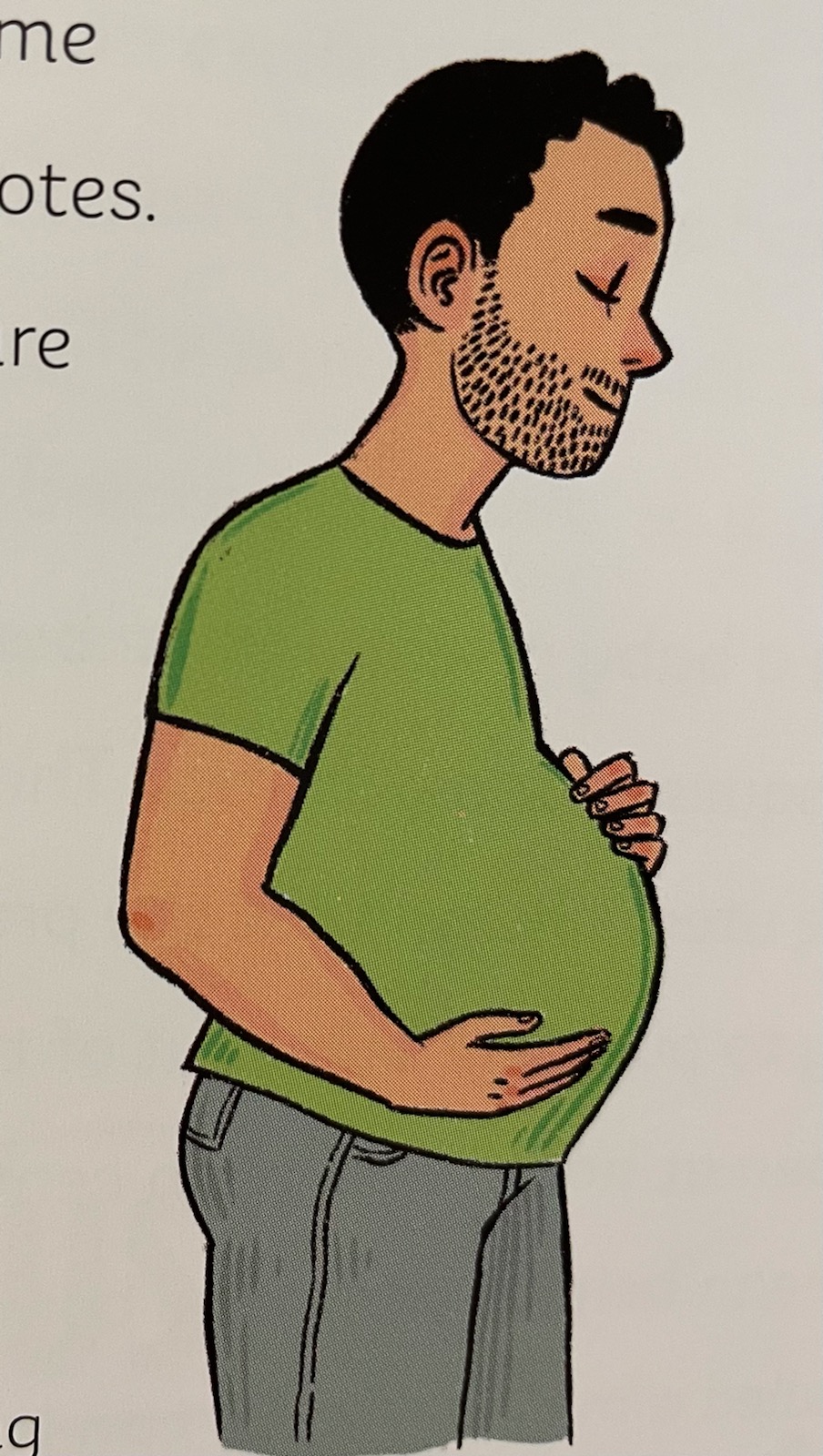
The library shelves are stocked with books promoting the LGBTQ+ lifestyle. These books are found on the shelves in the Easy, Tween, and Junior sections, where children who are browsing can find them. Even board books for early childhood with titles such as Love Makes a Family and A is for Activist are within easy reach. One Junior book, recommended for ages 8-12, The Every Body Book by Rachel E. Simon, contains a picture of a pregnant man. This book is one of the twenty books recommended this past summer to kids reading for prizes in the summer reading program.

Please follow the link, see the activities, reading materials and videos offered and you will be convinced that there are people in charge of our public libraries who are seeking to indoctrinate your children with filthy sexual messages.

We need to continue to spread awareness to friends and family and call, email, and speak with our library leaders and our Oklahoma legislators.

Andrea Crouch

If you have examples like this, or other information to share, please email Molly Jenkins at Molly@rope2.org

Being Jazz My Life as a (Transgender) Teen exemplifies everything we do not want on the library shelves of Edmond Public Schools

Being Jazz My Life as a (Transgender) Teen exemplifies everything we do not want on the library shelves of Edmond Public Schools. Why encourage behavior that places a child at risk? According to new statistics released by The Trevor Project, the world’s largest self-proclaimed suicide prevention and crisis organization created specifically for LGBTQ young people, 42% of LGBTQ youth seriously considered attempting suicide in the past year, including more than half of transgender and nonbinary youth (2021 National Survey on LGBTQ Youth Mental Health).

Book Cover: Being Jazz

Jazz Jennings, now 21 years of age, has received a good bit of attention and accolades for his (He will always be a biological male) transition.  His claims to fame include being an influencer, videos on YouTube, and having his own TV show, now in its seventh season on TLC.  And of course, Jazz is an activist. I cannot imagine that these activities do not equate to money, a lot of money. But at what cost?

For more information about gender dysphoria and how the transitioning of children destroys their bodies and their future—I would argue it is child abuse—please check out the link below to endocrinologist. Dr. Michael K Laidlaw’s book review of the first book written about and by Jazz Jennings with co-author Jessica Herthel, I Am Jazz. The first book intended for very young audiences is filled with lies and distortions which Dr. Laidlaw exposes. Dr. Laidlaw’s essay is from a scientific perspective, rather than a feel-good perspective. When it comes to our children, I side with science!

Selected textbooks on display inside Edmond North High School (2021)

By purchasing this book with taxpayer dollars, Edmond Public Schools glamorizes and promotes self-destructive lifestyles, lifestyles dangerous to our children. The placement of Being Jazz on the shelves of the Edmond library is counterintuitive to the mental health of our children. For the sake of our children, it must be removed, immediately. 

Update: After writing the above blog, I happened onto this new article on the Gateway Pundit. How tremendously sad.

Molly Jenkins

Repealing Common Core Means Nothing If Oklahoma’s New Academic Standards Are Not Better than Common Core


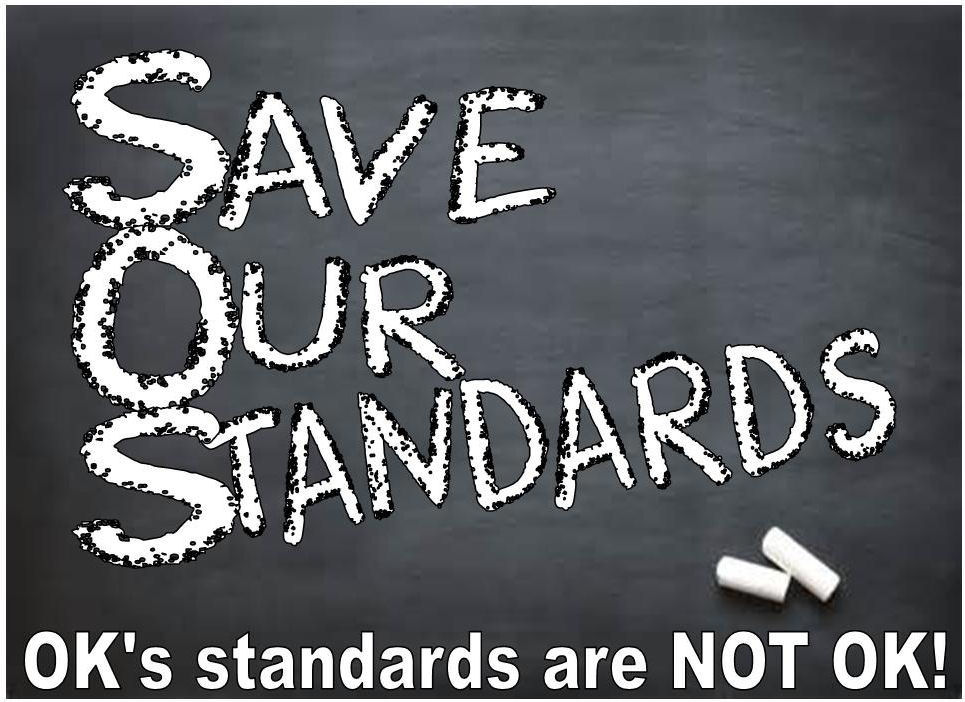
Save our standards without text

Restore Oklahoma Public Education (now Reclaim Oklahoma Parent Empowerment) concluded a near five year odyssey dedicated to the task of repealing the Common Core State Standards in our state, when the ink from Governor Fallin’s pen dried on HB3399 in June 2014.

As directed by the bill, the Oklahoma State Department of Education (OSDE) was to immediately begin the process of creating new educational standards for English/Language Arts and Mathematics to replace the Common Core Standards adopted by the Oklahoma State Board of Education as directed by SB2033 in 2010. The final drafts of the new standards were to be completed by the OSDE in August of 2016 with copies presented to the Oklahoma legislature prior to the February start of that year’s legislative session.

Unfortunately, though the standards development process was begun immediately, it quickly became waylaid by Oklahoma’s 2014 elections, which saw the selection of a new State Superintendent of Instruction after a contentious race.

Formally installed as Superintendent in January 2015, Joy Hofmeister’s Department of Education scrapped the work done by the previous administration and re-booted work on the new Oklahoma Education Standards process in February 2015 when the Oklahoma Standards Steering Committee (formed in September 2014) heard testimony from standards writing experts Dr. Sandra Stotsky and Dr. Lawrence Gray.

Dr. Stotsky is credited with developing the country’s strongest English/Language Arts standards while serving as the Senior Associate Commissioner of the Massachusetts Department of Education (1999-2003). Dr. Lawrence Gray, professor of Mathematics at the University of Minnesota, is credited with developing the country’s strongest Mathematics standards (2003).

In providing excerpts of the OAS reviews as follows, I will only outline the issues listed as concerns by the reviewers as those that have been praised do not need addressing. Additionally, though there were documents including public feedback by education ‘stakeholders’ linked to every draft, these were commonly one line comments that generally did not provide enough solid critique to be considered helpful to either the public at large or the Oklahoma Legislature, who must sign off on the new OAS.

FIRST DRAFT OAS – JUNE

Following the presentations of the standards experts, the Oklahoma process was begun in earnest with the first draft of the Oklahoma Academic Standards (OAS) released in June of 2015. Immediately, ROPE put out the call for anyone interested in reviewing the standards to do so.

We asked for specific comments on the standards to be made in the blog comments and many did so, with the largest concern being the “VAGUENESS” of the standards. From Lorraine:

Oklahoma’s ‘standards’ are not clear, thus not clearly made accessible for a variety of students.

Reviews for the first set of standards reviews were placed on the OSDE website. Though several sets of reviews were provided, none were really instructive excepting that of the Oklahoma State Regents for Higher Education.

ROPE sought reviews of several teachers which were placed on the OSDE website. More substantial reviews from five different educators can be found here. One, concerning the Math OAS from Dr. James Milgram, Professor of Mathematics at Stanford University, was copied onto the ROPE blog. A commenter to the post simply says this,

As disturbing as this article is, I find it almost comforting. Comforting to know that someone else out there AGREES WITH ME! The standards are poorly written.

Dr. Sandra Stotsky reviewed the English/Language Arts standards and says,

The organization of that draft isn’t useful for what needs to be done to provide non-Common Core standards. Right now, what you have is very close to being compatible with Common Core and a Common Core-based test. OK kids deserve better.

J.R. Wilson, one of the founders of Truth in American Education and Where’s The Math says of the math standards,

The standards are not written in a clear and concise manner….The standards document would be well served by simply listing clear and concise pedagogy free standards….To be world class, it needs lots of improvement.

Dr. Barbara McClanahan, Associate Professor of Educational Instruction and Leadership, Southeastern State University says,

One other concern that my colleague had was that there should be a glossary; she fears that not all teachers would understand all the terms being used. Another concern I have is that some of the terms have ambiguous meanings. For example, what does grade-specific or grade-appropriate actually mean

Oklahoma State Regents for higher Education says,

I believe that sample problems and classroom activities will be a significant benefit (Math)
The outcome “understand” is vague and should not be used (ELA)

General Complaints Draft 1

ELA:

  • Vague; uses imprecise terminology
  • Needs a glossary of terms

Math:

  • Too much overlap of standards across grades
  • Vague; uses imprecise terminology
  • Needs specific examples of problems
  • Needs a glossary of terms


SECOND DRAFT OF OAS JULY

The OSDE website has reviews listed for Dr. Gray, Center for Standards and Assessment Implementation (CSAI), Shannon Riley-Ayers (Center on Enhancing Early Learning Outcomes), American Institutes for Research (AIR), Partnership for 21st Century (P21), South Central Comprehensives Center Math, ELA (SC3) and Southern Regional Education Board Math, ELA (SREB)

CSAI says,

  • …the Oklahoma ELA standards descriptors tend to be vague and may not be sufficiently granular to adequately describe the skills and abilities students should possess at each grade.
  • Although the progression from one grade to another is largely logical and reasonable, the descriptors within each standard often lack depth, precision, and consistency.
  • These standards should describe a measurable objective in clear and concise terms, and the state might consider including examples to specify what students are expected to do.

P21 says,

…we would urge Oklahoma to fully develop the Sample Problems or Classroom Activities portion of the standards documents, as guides to not direct teachers “how” to teach, but to provide best practices that demonstrate ways to incorporate the 4Cs more deeply into the standards, curriculum and instruction.

SC3 Math says,

We believe teachers will find great value in seeing sample problems or classroom activities immediately associated with the standards to be mastered by students in that grade level.

SC3 ELA says,

Consider including a glossary of key terms to ensure practitioners have a common understanding of key terms.

SREB ELA says,

In the current draft there is not enough clarity in either the reading or writing standards in each of the five standards to justify the inclusion in each standard.

SREB Math says,

Be careful not to suggest in the explanation that “reasonable and appropriate” are new federal terms. A crisp and clear general statement of the standard followed by a listing of specific content and skills intended may cause less confusion to teachers, parents, and the public.

General Complaints Draft 2

ELA:

  • Vague; uses imprecise terminology
  • Not measurable or precise
  • Needs a glossary of terms
  • Needs examples of literary texts at each grade level

Math:

  • Too much overlap of standards across grades
  • Vague; uses imprecise terminology
  • Needs specific examples of problems
  • Needs a glossary of terms


THIRD DRAFT OF OAS AUGUST

The list of reviewers for the third OAS draft include Dr. Christopher Yakes (Math), Dr. Sandra Stotsky (ELA), American Institutes For Research (AIR), Oklahoma Educated Workforce Initiative (OEWI – provided by the Oklahoma State Chamber of Commerce) and the Oklahoma Technical Advisory Committee (OK TAC).

ROPE reprinted much of Stotsky’s comments on our blog, along with comments from Dr. Gray as provided by Oklahoma Watch’s Nate Robison.

Yakes comments were few. Those made were done editorially inside the OAS document. The majority of his comments appeared to deal with specificity in writing and clarity of instruction.

AIR’s review was conducted specifically based upon the OAS and their alignment with employability skills – something that should be far down the totem pole of importance in our opinion and therefore won’t be included in this review.

OEWI listed 50 detailed ELA recommendations and 40 for Mathematics. OEWI says, in part (ELA),

  • Add a detailed glossary of all content specific vocabulary used in the standards to ensure consistent definitions are used instructionally.
  • Add a comprehensive reading list for specific grades or grade bands which aligns to the qualitative and quantitative measures of text to illustrate “grade-level” reading. Provide guidance on text selections.
  • Provide resources/links of recommended sites where current research-based fluency rates and reading levels can be found and used to guide instruction.
  • Provide student exemplar writing samples for each genre at each grade level with the task from which the samples were generated. Provided an annotated copy to identify specific elements of the state’s rubric that is used to score essays. Ideally, provide samples from the continuum of the rubric.

OEWI says, in part (Math);

  • Create examples for each standard. While it needs to be made clear that such examples do not reflect all of the possible problem types that may be encountered on a state assessment, many of the standards lack clarity in terms of student expectations. Example problems allow teachers to better understand the student expectations.
  • Add a detailed glossary of all content specific vocabulary used in the standards to ensure consistent definitions are used instructionally. 
  • Provide resources/links of recommended sites where high-quality, standards-aligned instructional materials and additional sample problems may be found, particularly because textbook materials will not yet be available that are aligned to these standards.

OK TAC’s comments were solicited based upon “the perspective of whether the standards would be assessable in future state tests and if the strands and benchmarks can be measured by the state summative assessment.” Robert Terry. Ph.D. Professor, University of Oklahoma writing for OK TAC says,

(ELA) After examining the draft standards, I have concluded that while some of these standards may be assessed at the State level, some clearly cannot, and many will require a change in emphasis from selected-response items to constructed-response items. This will have multiple impacts upon the State system, including increasing costs of item and test development, reduced turn-around time due to the need to have rater-grading, and sufficient investment in computing facilities to handle the technology-enhance items that will be needed.

(Math) Many of these standards are Common Core consistent and item developments for these types of standards have already been released (PARCC, 2013)….This raises several concerns about timing, cost of item development, and cost of technology …asking the why questions (which are good questions to ask) requires CR-type questions which invokes delays in scoring and reporting back to the teachers for instructional purposes. Since the State has requested a quick turn-around on these assessments, it is quite possible that little if any feedback will be returned at the pace Oklahoma teachers have come to expect…some of these standards cannot be easily assessed in a large-scale assessment, if at all.

Stotsky says,

I think the OK drafting committee should be challenged to come up with an example of a literary text that could be used (and how) for every single standard so that teachers understand what reading level is required or desirable at every grade level (and what the standard means). Make it clear these texts are not required; only examples of reading levels. We did that in MA and it helped us to keep out gibberish.

Can’t the ELA committee put in Oklahoma-related reading standards at the high school level- -grades 11 and 12? One standard for texts by major authors born in or who wrote about Oklahoma, and one standard for biographies/autobiographies about famous Oklahomans through history. Aren’t there any recognized authors/texts/people Oklahoma students should know about?

Gray says,

The mixture of Oklahoma and Minnesota standards also created an odd flow in how students progress with mathematical concepts through middle and high school.

General Complaints Draft 3

ELA:

  • Vague; uses imprecise terminology
  • Not measurable or precise; not easily testable
  • Needs a glossary of terms
  • Needs examples of literary texts at each grade level
  • Needs reading/writing lists of Oklahoma authors

Math:

  • Too much overlap of standards across grades; lack of focus on alignment
  • Needs specific examples of problems
  • Needs a glossary of terms
  • Needs resources for teachers to utilize
  • Use of technology makes testing expensive


FOURTH DRAFT OF OAS DECEMBER

Reviewers for the OAS fourth draft on the OSDE website included only the OEWI (ELA only), Ms. Shellie Klein (ELA), Dr. Christopher Yakes (Math)

The OEWI says,

  • Create literacy standards for the content areas for grades 6-12. These disciplinary literacy standards should encompass all disciplines across a student’s course of study.
  • Add a comprehensive reading list for specific grades or grade bands which aligns to the qualitative and quantitative measures of text to illustrate “grade-level” reading. Provide guidance on text selections. 
  • Provide resources/links of recommended sites where current research-based fluency rates can be found and used to guide instruction.
  • Provide student exemplar writing samples for each genre at each grade level with the task from which the samples were generated. Provide an annotated copy to identify specific elements of the state’s rubric that is used to score essays. Ideally, provide samples from the continuum of the rubric. 

Shellie Klein (we’re not told her affiliation or credentials on the link) says,

  • My main concern is that for some standards, there is not sufficient specificity at each grade level to ensure a steady progression or consistency across schools and classrooms
  • Some standards need additional clarification, while the language in others can be simplified.
  • Glossary: suggest adding definitions for academic vocabulary and for informative/explanatory writing

Dr. Yakes’s critiques are specific to several specific standards, indicating the ways in which they needed to be changed to make more sense to teachers and students. He also adds a review of the Mathematics Glossary in which many of the terms need to be revised and numerous terms need to be added.

Dr.’s Stotsky and Gray submitted their reviews of the final ELA and Mathematics Oklahoma Academic Standards as presented to the Oklahoma State Legislature. They have been uploaded to our Scribd account and can be accessed through the links via their names.

Dr. Stotsky says,

  • The default strands in the proposed standards that could contain these progressions of content-rich standards do not have the content necessary for developing the knowledge base for critical reading, thinking, and writing (e.g., Vocabulary, Critical Reading and Writing and Multimodal Literacies).
  • The proposed standards are purported to be written by Oklahomans for Oklahomans. Yet, one looks in vain for standards that expect future taxpayers in Oklahoma to become familiar with some of the significant texts, people, movements, or events in the state’s political, literary, and intellectual history.
  • Nowhere does one find the only clear content that was in Common Core’s High School ELA Standards. Its standards required study of this country’s founding and seminal documents.
  • The proposed standards fail on the most important issue of all. Some significant content has to be taught to them if they are to see themselves and those they know sharing a state and a country together. Common Core’s ELA standards were not quite as empty as these proposed standards are. This document is completely empty. An empty document does not develop young minds, or help teachers to develop a sound and rigorous curriculum.

Dr. Gray says,

  • We have identified well over one hundred items that need to be fixed. Many of them can be made acceptable by a small amount of rewriting or by being eliminated altogether. But there are quite a few important issues in the document that cannot be repaired with simple rewrites, because they involve many connected items. These connections run both horizontally (within a grade level) and vertically (from one grade level to the next). It is impossible to suitably fix the document with supplementary material or errata sheets.
  • In order to help us achieve focus in Minnesota we carefully followed most of the guidelines in the CTM Curriculum Focal Points…Unfortunately, it does not appear that the Oklahoma draft adhered very closely to such principles.
  • We noticed several instances in the Oklahoma document where expectations were essentially repeated at multiple grade levels, presumably in an attempt to maintain alignment across grade levels, but focus was lost in the process.

General Complaints Final Draft (draft 4)

ELA:

  • Vague; uses imprecise terminology
  • Not measurable or precise; not easily testable
  • Needs more work on glossary of terms
  • Needs examples of literary texts at each grade level
  • Needs reading/writing lists of Oklahoma authors
  • Needs reading material from the founding documents
  • Needs student exemplar writing samples

Math:

  • Too much overlap of standards across grades; lack of focus on alignment
  • Needs specific examples of problems
  • Need much more work on glossary of terms
  • Needs resources for teachers to utilize


Following the upload of the final draft of the OAS to the OSDE website, letters of support for the final draft from schools and organizations all across the state were provided by the OSDE in supplementary standards documents created for both Mathematics and English Language Arts. These letters were general in nature, not specifying their comments to either set of standards. The creation of the OAS by Oklahomans, the 8 overarching principles used to create them, and the clarity of the OAS were primarily the basis for their glowing reviews. No criticisms were provided.

In their letter of support, the Cooperative Council of State Administrators (CCOSA) – one of the education establishments that fought the repeal of Common Core – began the narrative that the standards must be immediately approved (pg 69):

CCOSA supports the approval of the Oklahoma Academic Standards as proposed by the State Superintendent and many other Oklahomans involved in this process. It is imperative that the standards are quickly acted upon so that the school leaders and teachers can begin the important work of training and implementing these new standards by August of 2016.

It is obvious, after reviewing ALL the submitted documents regarding the new OAS, that these standards MUST BE RETURNED TO THE OSDE for edits and revisions. The specific areas needing to be addressed are OBVIOUS, as these same issues are addressed at least cursorily in ALL the general critiques submitted by standards reviewers (those listed in bold behind each draft heading).

Oklahoma has a unique opportunity – one not availed of by any state in the nation that has repealed Common Core to date – that of creating standards of true excellence for Oklahoma students that are not simply a Common Core rebrand.

It makes literally no sense to have undergone all the political wrangling – and subsequent lawsuit – of 2014 in which Common Core was repealed from law in Oklahoma, to create standards in their place that are sub-standard.

All we are asking is for the Oklahoma State Legislature to DISPROVE the OAS as submitted to the legislature by the OSDE in February, with specific instructions to fix those concerns commonly identified by standards reviewers as solicited by the OSDE themselves.

To do anything else makes absolutely no political or educational sense.

Oklahoma State Board of Education Approves Final Draft of New (Non-Common Core) Educational Standards

press release.jpg

Unfortunately, ROPE has a good deal of skepticism regarding the new Oklahoma Educational standards approved by the Board of Education today. Let me be clear here, the new standards were approved by the board just today, so none of us (at ROPE) would have had the opportunity to review them at this point.

It is important to note, however, that while the OSDE press release contained comments in support for the standards from many quarters, none of these were attributed to the experts that were invited by the Standards Steering Committee last February to consult on the standards writing process.

Though we would never be so dull as to suggest the organizations and individuals mentioned in the press release weren’t educational experts, were they standards writing experts? Where were comments from Dr. Larry Gray, Dr. Jane Scheilack, or Dr. Sandra Stotsky in the press release? These were standards writing experts called in to advise the Standard Steering Committee on the standards writing process.

In fact, after the third revision of the standards were released in October of 2015, Oklahoma Watch and ROPE posted a standards review by both Dr’s. Gray and Stotsky, and neither was terribly impressed. Mrs. Hofmeister has informed us that her office has sought comments from Dr. Stotsky and incorporated these in their standards revisions, but how do we know that? Pardon our skepticism here, but where are any public comments regarding the standards? Dr. Stotsky in her original presentation to the Standards Steering Committee suggested that all comments made regarding the standards be made publicly, ostensibly so changes to the documents could be seen by all Oklahomans. Clearly, Gray and Stotsky had specific concerns regarding the standards at that time. Had Oklahoma Watch and ROPE had not publicized their comments, who would have known their concerns? Legislators? The public?

Early on, ROPE complained to the State Department of Education concerning the lack of published public comment and were told that the standards documents were a work in progress and that allowing the public to see the ongoing process of developing the standards could hurt the reputation of the standards writers. Laypersons are not normally able to read and decipher the standards documents themselves. This is why standards experts were called on – to provide ‘expert’ advice – information the public could rely on.

We believe the only way the public can truly be certain that these standards satisfied the full measure of HB3399, passed by the legislature at the overwhelming request of the public, is to have the standards reviewed by the legislature via a public forum where comments from the standards writing experts and others can be heard. We do appreciate all the work of the standards writing committees and will be pleased to see the standards vetted in a public forum.


Jenni White

Education Director

Running List of Curricula, Courses, Online Resources and Books to Help Your Family’s Educational Journey

parents and kid

I’m beginning this list January 18 of 2016. I hope to add to it every time I find a resource that I believe would be helpful to Christian parents, so bookmark the page and keep looking back! If you have any great ideas, post them in the comments section and I’ll add!

CURRICULA

Learn Our History: Positive, Patriotic, And Unbiased History; Learn Our History is US history for kids at its very best!  Each exciting animated history film features a group of time-traveling history students who go back in time to see US history in the making.

COURSES

Homeschool Programming: Computer Programming Courses for Kids and Teens; Your students can learn to create their own websites, games, and smart-phone apps with our self-study curriculum.

ONLINE EDUCATION RESOURCES

Classical Conversations: Online resources, books and helpful information to anyone looking to homeschool or enhance their child’s public education.

KNOWLEDGE IS POWER

Religious Freedom Day – A Guide For Commemorating Religious Freedom At School;  This guidebook is intended to help all Americans join the President in celebrating Religious Freedom Day as well as to clarify students’ religious liberties.

BOOKS

How Should We Then Live: In this brilliant book Francis A. Schaeffer analyzed the reasons for modern society’s state of affairs and presented the only viable alternative: living by the Christian ethic, acceptance of God’s revelation, and total affirmation of the Bible’s morals, values, and meaning.

The Core: Teaching Your Child the Foundations of Classical Education:  In this book, Leigh Bortins gives parents the tools and methodology to implement a rigorous, thorough, and broad curriculum based on the classical model.

America’s Schools, The Battleground for Freedom: America’s Schools will inform, alarm, and provoke you to action for education that promotes scholarship and freedom.

Ten Myths About Mathematics Education And Why You Shouldn’t Believe Them

With the advent of Common Core came the further full-court press of progressive mathematics. For years now, as Common Core math has been pushed upon the American public public, parents and kids alike have banged their heads on their desks and dinner tables across the country, trying desperately to make sense of convoluted and drawn-out mathematics problems parents never had to conquer when they were in school.

A recent article from the Hechingerreport,

Back off parents: It’s not your job to teach Common Core math when helping with homework

made me so mad my head almost exploded. Seriously, that’s just the craziest nonsense ever. The whole idea of the article was essentially, “parents don’t help your own children with their math, because you can’t understand it anyway. Just make sure the work gets done, no matter what”.

How is this not the school and a subject – math – getting right in the middle between kid and parent, essentially making the kid think the parent is stupid, pulling them – and the family – apart?

For years, I’ve tried to help parents understand the differences between progressive and traditional math because there really is no way to fight progressive math if you don’t know what is wrong with it and what is better. It wasn’t until I saw this article that I realized I didn’t have to invent the wheel.

Ten Myths About Math is written by a number of really excellent math educators who have taken the time to write out each math myth and explain fully why it simply isn’t true. Please visit the article to print out the article, but I’m going to paste the myths and explanations in below so you can read them immediately.

Myth #1

Only what students discover for themselves is truly learned.

REALITY

Students learn in a variety of ways. Basing most learning on student discovery is time-consuming, does not insure that students end up learning the right concepts, and can delay or prevent progression to the next level. Successful programs use discovery for only a few very carefully selected topics, never all topics.

REFERENCES

Dixon, R., Carnine, D., Lee, D. Wallin, J., & Chard, D. (1998). Review of High Quality Experimental Mathematical Research: Executive Summary. Eugene, OR: National Center to Improve the Tools of Educators, University of Oregon.

Klahr, D. & Nigam, M. (2004). The Equivalence of Learning Paths in Early Science Instruction: Effects of Direct Instruction and Discovery Learning.Psychological Science, 15, 10, 661-667.

Becker, W. C. and Engelmann, S.; Sponsor Findings From Project Follow Through. University of Oregon.

John R. Anderson, Lynne M. Reder, Herbert A. Simon. Applications and Misapplications of Cognitive Psychology to Mathematics Education.

R. James Milgram, “What is Mathematical Proficiency?,” March, 2004. Invited address, First Workshop on Mathematics Education. Mathematics and Science Research Institute, Berkeley, CA.

Myth #2

Children develop a deeper understanding of mathematics and a greater sense of ownership when they are expected to invent and use their own methods for performing the basic arithmetical operations, rather than study, understand and practice the standard algorithms.

REALITY

Children who do not master the standard algorithms begin to have problems as early as algebra I.

The snubbing or outright omission of the long division algorithm by NCTM- based curricula can be singularly responsible for the mathematical demise of its students. Long division is a pre-skill that all students must master to automaticity for algebra (polynomial long division), pre-calculus (finding roots and asymptotes), and calculus (e.g., integration of rational functions and Laplace transforms.) Its demand for estimation and computation skills during the procedure develops number sense and facility with the decimal system of notation as no other single arithmetic operation affords.

REFERENCES

General reference: The algebra, pre-calculus and calculus teachers and professors who must remediate or flunk these children.

From 1998 issue of the Notices of the American Mathematical Society:

“We would like to emphasize that the standard algorithms of arithmetic are more than just ‘ways to get the answer’ — that is, they have theoretical as well as practical significance. For one thing, all the algorithms of arithmetic are preparatory for algebra, since there are (again, not by accident, but by virtue of the construction of the decimal system) strong analogies between arithmetic of ordinary numbers and arithmetic of polynomials.” (The above was quoted in an open letter to Secretary of Education Richard Riley in 1999, which was signed by 200 prominent U.S. mathematicians.)

The Role of Long Division in the K-12 Curriculum; David Klein (California State University, Northridge), R. James Milgram (Stanford University)

Myth #3

There are two separate and distinct ways to teach mathematics. The NCTM backed approach deepens conceptual understanding through a problem solving approach. The other teaches only arithmetic skills through drill and kill. Children don’t need to spend long hours practicing and reviewing basic arithmetical operations. It’s the concept that’s important.

REALITY

“The starting point for the development of children’s creativity and skills should be established concepts and algorithms… Success in mathematics needs to be grounded in well-learned algorithms as well as understanding of the concepts.”

What is taught in math is the most critical component of teaching math. How math is taught is important as well, but is dictated by the “what”. Much of understanding comes from mastery of basic skills – an approach backed by most professors of mathematics. It succeeds through systematically empowering children with the pre-skills they need to succeed in all areas of mathematics. The myth of conceptual understanding versus skills is essentially a false choice – a bogus dichotomy. The NCTM standards suggested “less emphasis” on topics needed for higher math, such as many basic skills of arithmetic and algebra.

“That students will only remember what they have extensively practiced – and that they will only remember for the long term that which they have practiced in a sustained way over many years – are realities that can’t be bypassed.”

REFERENCES

Kenneth Ross, Chair, Mathematical Association of America President’s Task Force on the NCTM Standards. (June 1997). Response to NCTM’s Commission on the Future of the Standards.

Basic Skills vs Conceptual Understanding; a Bogus Dichotomy; Hung-Hsi Wu, Department of Mathematics, University of California, Berkeley (American Educator, Fall, 1999).

Willingham, D. (Spring 2004). Practice Makes Perfect-But Only If You Practice Beyond the Point of Perfection. American Educator.

Algorithms, Algebra, and Access, by Stanley Ocken (Sep 2001).

In Defense of “Mindless Rote”, by Ethan Akin (Mar 30, 2001).

On the Algorithms of Arithmetic, by Ralph Raimi (2002).

Myth #4

The math programs based on NCTM standards are better for children with learning disabilities than other approaches.

REALITY

“Educators must resist the temptation to adopt the latest math movement, reform, or fad when data-based support is lacking…”

Large-scale data from California and foreign countries show that children with learning disabilities do much better in more structured learning environments.

REFERENCES

Miller, S.P. and Mercer, C.D., “Educational Aspects of Mathematics Disabilities.” January/February 1997, Journal of Learning Disabilities, Vol. 30, No. 1, pp. 47-56.

Darch, C., Carnine, D., & Gersten, R. (1984). “Explicit Instruction in Mathematics Problem Solving.” The Journal of Educational Research, 77, 6, 351-359.

Myth #5

Urban teachers like using math programs based on NCTM standards.

REALITY

“Mere mention of [TERC] was enough to bring a collective groan from more than 100 Boston Teacher Union representatives…”

REFERENCES

Editorial, “Mathematical Unknowns,” The Boston Globe, November 8, 2004, A10.

Myth #6

“Calculator use has been shown to enhance cognitive gains in areas that include number sense, conceptual development, and visualization. Such gains can empower and motivate all teachers and students to engage in richer problem-solving activities.” (NCTM Position Statement)

REALITY

Children in almost all of the highest scoring countries in the Third International Mathematics and Science Survey (TIMMS) do not use calculators as part of mathematics instruction before grade 6.

A study of calculator usage among calculus students at Johns Hopkins University found a strong correlation between calculator usage in earlier grades and poorer performance in calculus.

REFERENCES

Calculating the cost of calculators, Lance Izumi, Capitol Ideas, Pacific Research Institute, Vol. 5, No. 51, December 21, 2000.

W. Stephen Wilson, K-12 Calculator Usage and College Grades Educational Studies in Mathematics.

Myth #7

The reason other countries do better on international math tests like TIMSS and PISA is that those countries select test takers only from a group of the top performers.

REALITY

On NPR’s “Talk of the Nation” program on education in the U.S. (Feb. 15, 2005), Grover Whitehurst, Director of the Institute of Education Sciences at the Department of Education, stated that test takers are selected randomly in all countries and not selected from the top performers.

REFERENCES

Grover Whitehurst, Director, Institute of Education Sciences; on NPR Talk of the Nation, February 15, 2005;

Myth #8

Math concepts are best understood and mastered when presented “in context”; in that way, the underlying math concept will follow automatically.

REALITY

Applications are important and story problems make good motivators, but understanding should come from building the math for universal application. When story problems take center stage, the math it leads to is often not practiced or applied widely enough for students to learn how to apply the concept to other problems.

“[S]olutions of problems … need to be rounded off with a mathematical discus-sion of the underlying mathematics. If new tools are fashioned to solve a problem, then these tools have to be put in the proper mathematical perspec-tive. … Otherwise the curriculum lacks mathematical cohesion.”

REFERENCES

The Mathematician and Mathematics Education Reform; Hung-Hsi Wu, University of California, Berkeley; in Notices of the American Mathematical Society, 43(1996), 1531-1537).

Myth #9

NCTM math reform reflects the programs and practices in higher performing nations.

REALITY

A recent study commissioned by the U.S.Department of Education, comparing Singapore’s math program and texts with U.S. math texts, found that Singapore’s approach is distinctly different from NCTM math “reforms.”

Also, a paper that reviews videotaped math classes in Japan shows that there is teacher-guided instruction (including a wide variety of hints and helps from teachers while students are working on or presenting solutions).

REFERENCES

What the United States Can Learn From Singapore’s World-Class Mathematics System (and what Singapore can learn from the United States); American Institutes for Research; for U.S. Department of Education; January 28, 2005; Washington, D.C.

Siegel, Alan R. Telling Lessons from the TIMSS Videotape: remarkable teaching practices as recorded from eighth-grade mathematics classes in Japan, Germany and the US. Chapter 5 in “Testing Student Learning, Evaluating Teaching Effectiveness,” Williamson M. Evers and Herbert J. Walberg, Eds., Hoover Institution Press, May, 2004, pp. 161-194.

Myth #10

Research shows NCTM programs are effective.

REALITY

There is no conclusive evidence of the efficacy of any math instructional program.

Increases in test scores may reflect increased tutoring, enrollment in learning centers, or teachers who supplement with texts and other materials of their own choosing. Also, much of the “research” touted by some of the NSF programs has been conducted by the same companies selling the programs. State exams are increasingly being revised to address state math standards that reflect NCTM guidelines rather than the content recommended by mathematicians.

REFERENCES

On Evaluating Curricular Effectiveness; Judging the Quality of K-12 Mathematics Evaluations; National Research Council, the National Academies Press; September, 2004.

The state tests in Maryland have a number of 3 point problems in which students are awarded 1 point for performing the math correctly and 2 points for explaining it. It is thus possible to do the math right but get half the credit that another student gets with the wrong answer.

Blog at WordPress.com.

Up ↑