Search

ROPE Report

Month

January 2024

Neither The Oklahoma State Department of Education DEI Rules Or Gov Stitt’s Executive Order Will Stop DEI In Oklahoma Education – Here’s Why

Jenni White – 1.25.24

GOVERNOR STITT’S EXECUTIVE ORDER (EO-31) FOR DEI IN OKLAHOMA HIGHER EDUCATION

December 13, 2023, Governor Stitt signed an Executive Order 2023-31 (EO) that has been referred to as BANNING DEI by the general media. Heritage Foundation (a center-right think tank that also promotes School Choice, but was loudly vocal against Common Core) referred to the Executive Order as “condemning DEI” – a big difference from “banning DEI”.

EO-31 DOES prohibit Oklahoma’s Executive Branches from using “state funds, property or resources” to promote DEI via any of 6 different ways listed, including “(2) Mandate any person to participate in, listen to, or receive any education, training, activities procedures or programming to the extent such education, training, activity or procedure grants preferences based on one person’s particular race, color, sex, ethnicity, or national origin over another’s”. 

It also orders the heads of the Executive Branches to “initiate a review” of any DEI programs or activities under their purview and bring them into compliance with the parameters of EO-31 if not already. 

Here is a listing of Oklahoma’s Executive Branches:

  • Attorney General
  • Governor
  • Lieutenant Governor
  • Oklahoma Secretary of State
  • Oklahoma State Auditor and Inspector
  • Oklahoma Superintendent of Public Instruction
  • Oklahoma Treasurer
  • Oklahoma Agriculture Commission
  • Oklahoma Insurance Commission
  • Oklahoma Labor Commission
  • Oklahoma Corporation Commission
  • Oklahoma Wildlife Conservation Commission

To be clear, according to EO-31, I can’t be hired by the Insurance Commission and have them give me training out of their budget that includes a DEI component. That is good and I do not want to overlook the GOOD part of this EO.

Now, though, let’s look further down in the Executive Order and note that the Oklahoma State Regents for Higher Education is NOT an Executive Agency. EO-31 is clear in the first statement of the EO, “Executive state agencies shall not utilize state funds, property or resources to:”. It says NOTHING about anything outside the agencies listed above.

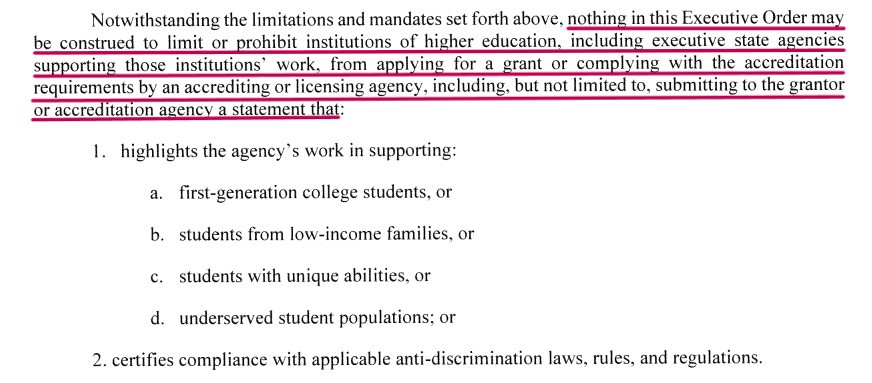
Thinking in that vein, note the underlined in red below:

Let’s stop here. This paragraph says that EO-31 will not apply to COLLEGES and UNIVERSITIES or any of the executive agencies SUPPORTING them – INCLUDING THE STATE DEPARTMENT OF EDUCATION – if they apply for a GRANT or to comply with ACCREDITATION requirements. Unfortunately, GRANTS and ACCREDITATION are where so much of the DEI in higher education arises. If you don’t believe me, internet search “DEI in higher ed accreditation” and you will find article after article about how, the only way to really advance DEI principles in higher education is THROUGH ACCREDITATION. 

Here, in fact is an article from the Chronicle Of Higher Education titled, “The New Accountability: How Accreditors Are Measuring colleges’ diversity, equity and inclusion efforts“.

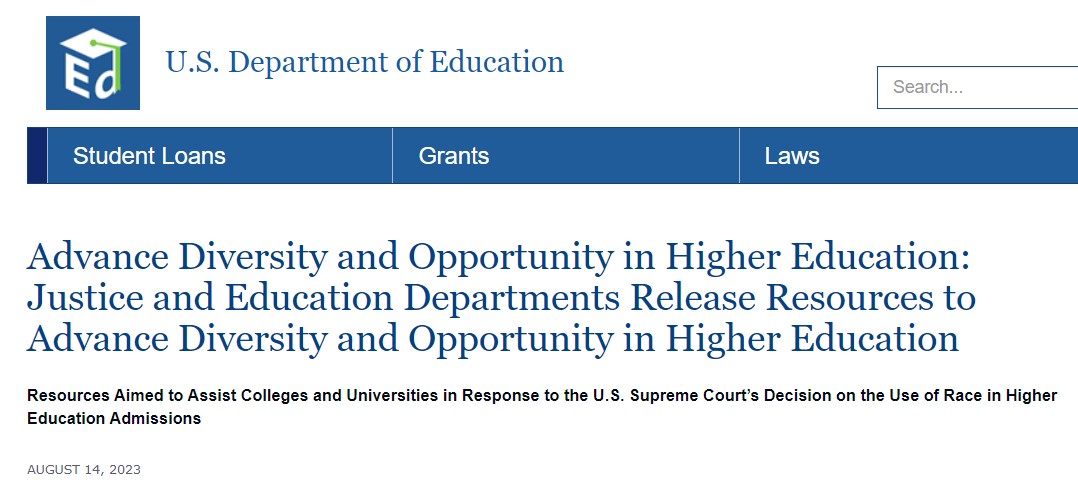
So what about grants? Well, we ALL know Higher Ed takes federal government grant money. Check this out:

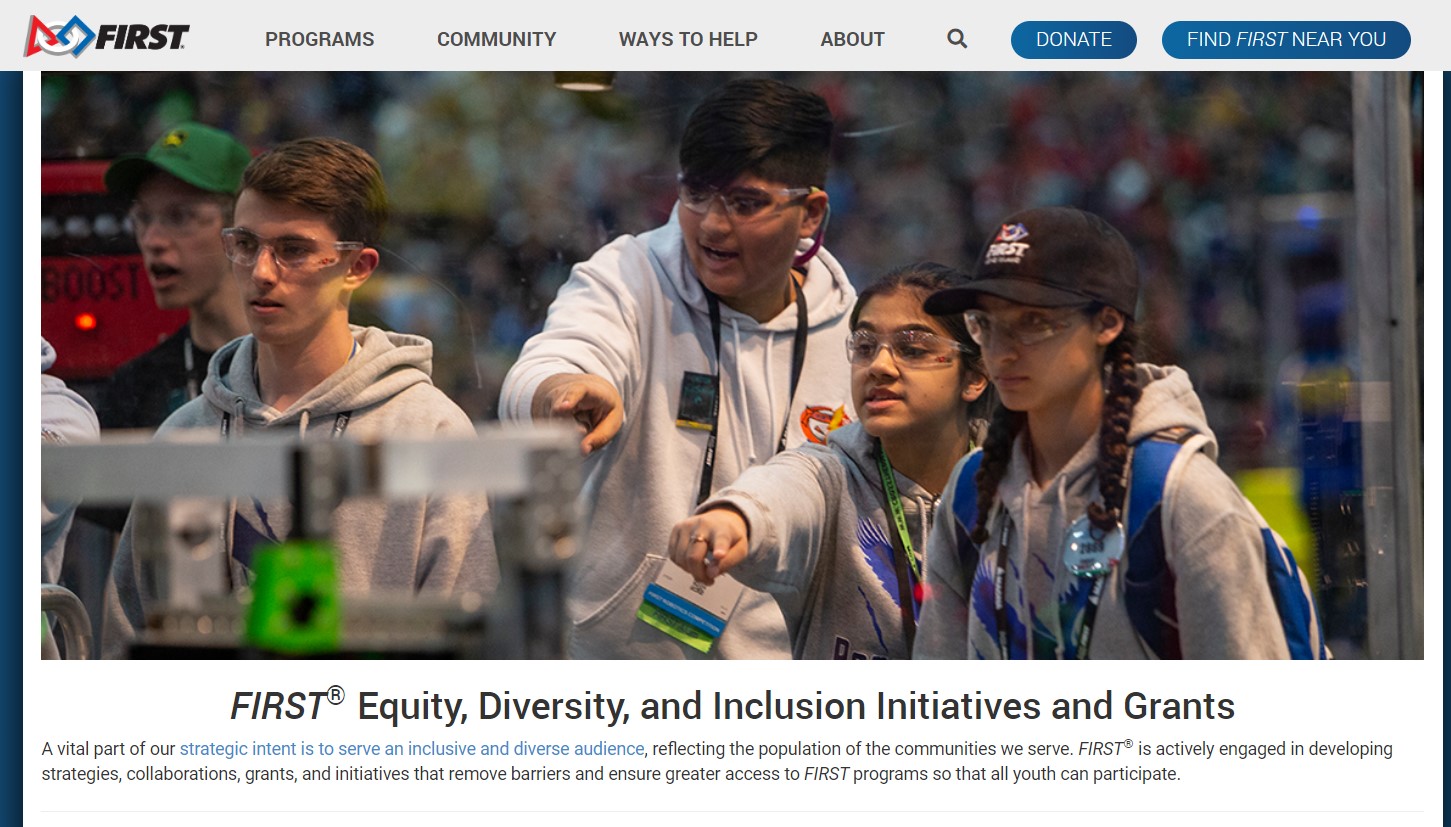
And that’s just FEDERAL grants. There are other grants from non-Federal sources in abundance, like this group. 

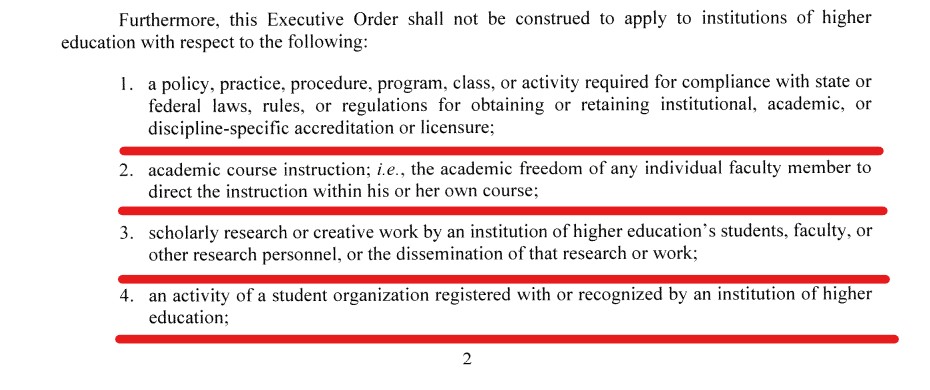
Now let’s look even FARTHER down in EO-31. It says:

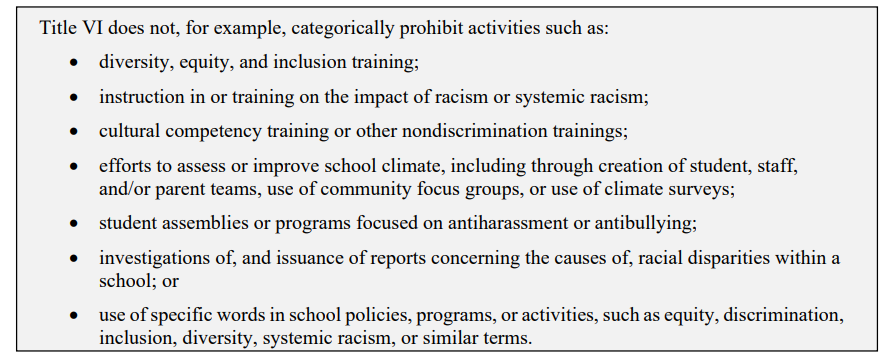
Alright. Let’s think about that. The order says the EO DOESN’T apply if a federal law supersedes. Here’s a Fact Sheet from the Feds that talks about how Title VI law CAN PROMOTE DEI. And not only that, President Biden also has his OWN EO mandating DEI in schools, so NO, EO-31 STILL DOESN’T STOP DEI in higher ed. 

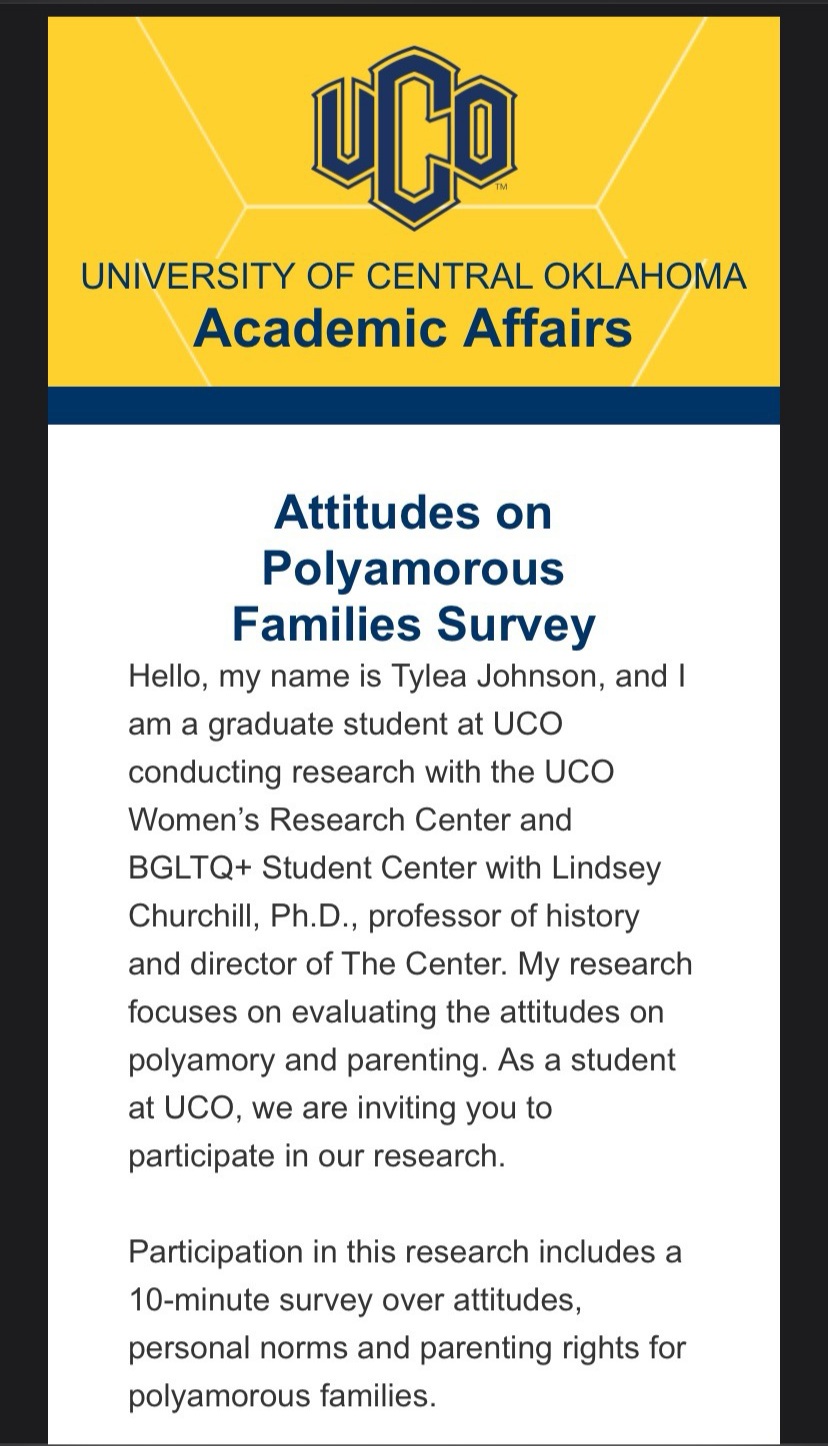
We could go on, but EO-31 won’t stop higher ed DEI scholarly research either and a friend just sent this to me. Not only will EO-31 not stop, creepy research, it won’t stop “a student organization registered with or recognized by an institution of higher education”. This research is in conjunction with the BGLTQ+ Student Center and we all now know that the alphabet sex brigade and DEI go together like furries and cat boxes.

RYAN WALTERS PROPOSED DEI RULE FOR K-12 SCHOOLS

Here is the set of rules proposed by Walters to be heard by the Board on Friday, February 16th. 

The rules for K-12 actually do more than those for higher ed, but they still do not stop DEI.

Walters’ rules FOLLOW THE GOVERNOR’S EO-31 EXACTLY (with the exception of the removal of #2 and #3 under letter (f) of the Governor’s EO that apply only to higher ed). In point of fact, they would have to, as the OSDE is an Executive Branch and it must follow the Governor’s EO-31. 

But herein lies a bit of a problem.

Accreditation of Oklahoma public schools are done by the OSDE using their accreditation standards. So, as long as those standards don’t allow DEI, that window is closed – unlike with higher ed and Oklahoma private schools which can be accredited by the OSDE, or a myriad of other accrediting agencies.

Unfortunately, however, we still have the issue with GRANTS.

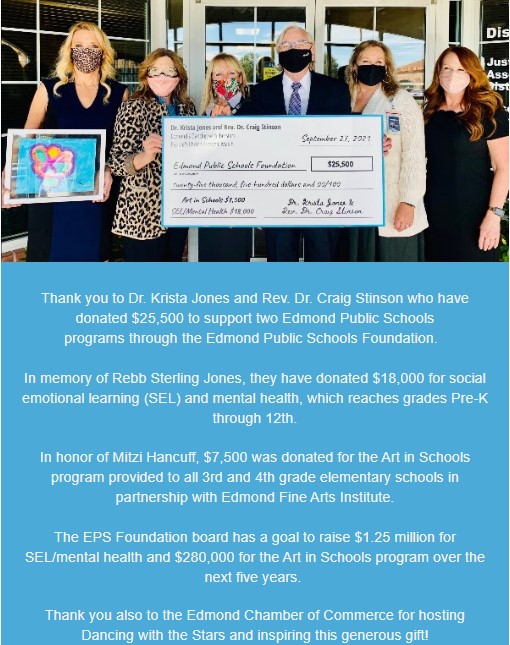
Here, Edmond Public Schools Foundation is thanking those donors who are helping to raise OVER ONE MILLION DOLLARS for SEL programs inside Edmond schools. Unfortunately, SEL is intricately tied to DEI in a million ways and any grant that comes into a school for SEL will ultimately bring in DEI as well. George Lucas’ educational non-profit Edutopia, has a whole page devoted to ways in which k-12 schools can obtain grants to push out SEL. 

Also unfortunately, we still have the problem with FEDERAL LAW being exempted as well as student organizations, with both of those issues similar in K-12 to my discussion on higher ed.

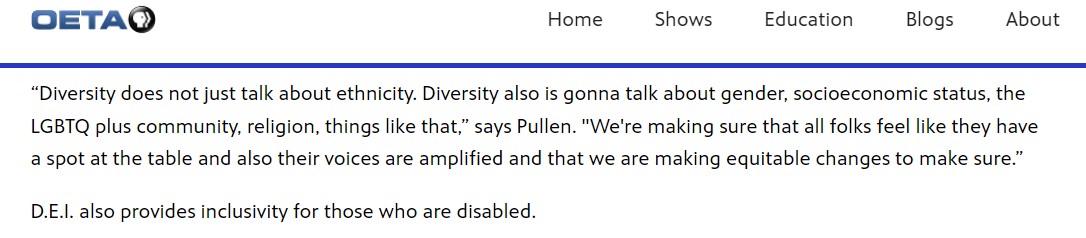
An article from OETA entitled, “D.E.I. In Oklahoma Schools“, quoted OCU’s DEI coordinator as saying:

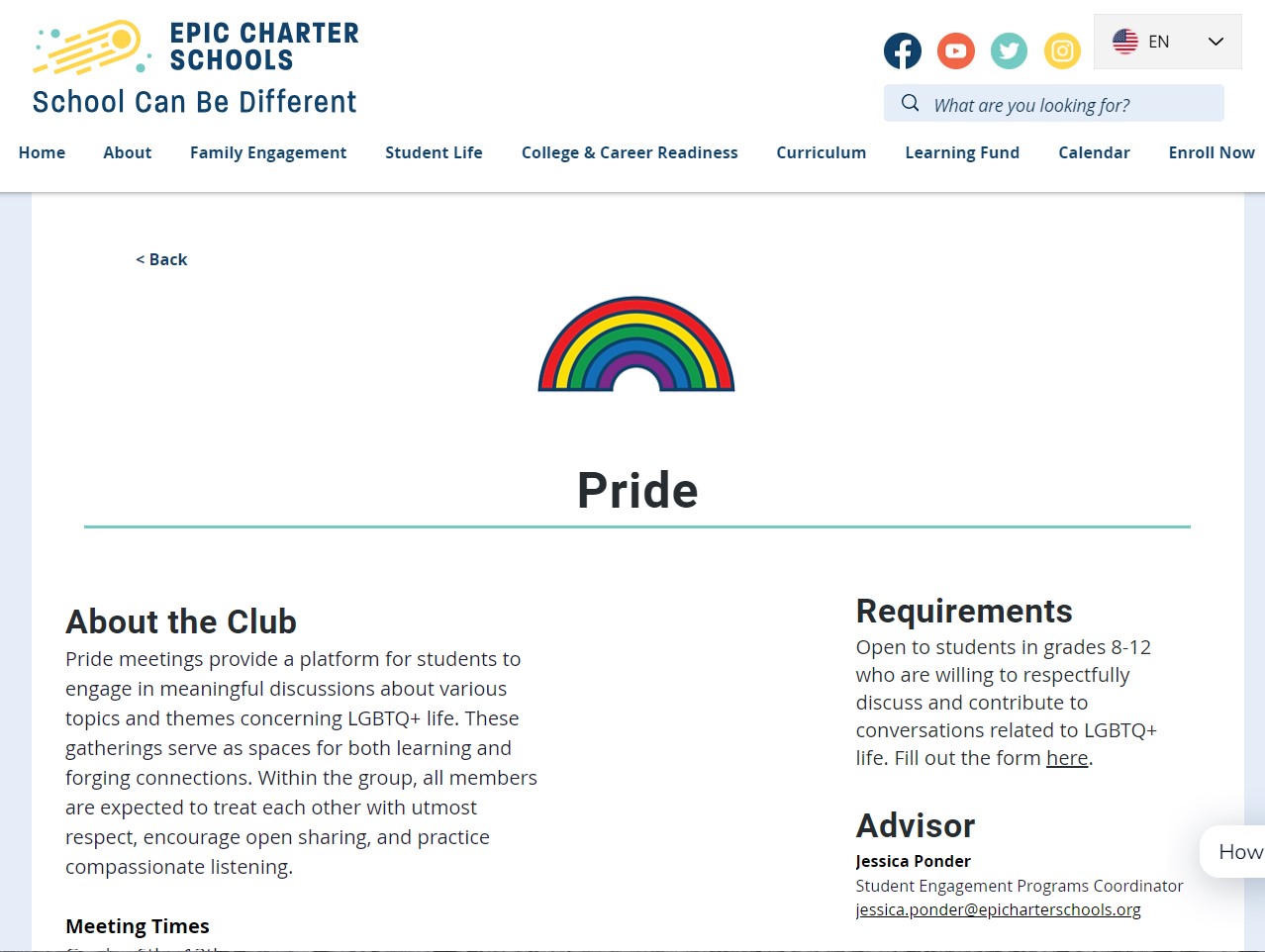
Yet LGBTQ clubs such as this one from EPIC Charter Schools, is exempted from the new DEI rule because it’s a student organization recognized by the school.

To close out, since data collection is ALSO exempted, DEI also can come in through THAT door. I’ve written numerous times about how horrible some of the surveys being given by Oklahoma public schools are today. Here’s an article about Success Highways and its link to DEI. Here’s another about the Oklahoma Prevention Needs Survey.

And worse, here’s an exchange I had with a teacher on social media that shows that it’s often teacher training and teacher mindset that bring DEI ideals into the classroom on a daily basis without even needing a private or federal grant, or anything else.

Additionally, Oklahoma uses school counselors from the American School Counselor Association an organization DEDICATED to bringing DEI into every school and with every child. So there’s that.

Consequently, since we still have DEI coming into schools through data, teachers and counselors, whether or not Walters’ new rule on DEI is passed by the Oklahoma State School Board members or not

the bottom line here is this: BOTH THE HIGHER ED EO and the K-12 RULES ARE BETTER THAN WHAT WE HAD BEFORE – WHICH WAS NOTHING – but it’s important to remember that NEITHER STOP DEI. Really, the surest way to keep your child from being influenced by DEI ideology is to:

  1. Educate your child/children at home – not even private schools are ‘sure things’ in terms of rational, classical, non-ideological education anymore
  2. Monitor your child’s social media and internet access closely and lock down problem apps and sites
  3. Talk to your children constantly about your moral values and ethics – your worldview
  4. Make sure you’re clear with your children about what you as a parent – or guardian – expect from them in terms of their behavior
  5. Prevent as much government entanglement as possible, including the use of tax credits or vouchers for private school as these have strings that can bring unwanted influences in through the regulation

A List – With Commentary – Of The Newest Rules Added To The Oklahoma State Department Of Education Website For Review

Jenni White

I have simply copied and pasted much of the information from the OSDE website’s Administrative Rules page into this document, so please pay attention to the PUBLIC HEARING DATES in BOLD. Also, if you’d like to provide any commentary on these rules to the state prior to the hearing, you may do so here: rules@sde.ok.gov, or through their address:

Office of Legal Services
State Department of Education
Hodge Education Building
2500 North Lincoln Boulevard
Oklahoma City, Oklahoma 73105-4599


A public hearing will be held at 2:00 p.m. on Thursday, February 15, 2024, in Room 1-20 (State Board Room) at the Oliver Hodge Building, 2500 North Lincoln Boulevard, in Oklahoma City for the following rules.

Subchapter 3.  Standards for Elementary, Middle Level, Secondary, and Career and
Technology Schools
Part 22. Standard XII: Academic Performance
210:35-3-210. Purpose. [NEW]
210:35-3-211. Applicability of the Standard. [NEW]
210:35-3-212. Metrics for Academic Deficiencies. [NEW]

Text of proposed rule
Rule Impact Statement

These appear to be reasonable rules to specifically address schools with low academic proficiencies. The only question here is, upon what tests will the school year district data assessment be predicated? Oklahoma’s state tests, NAEP, or something else. Without knowing from what assessment tool the data to be considered will be culled, how can the rule be enforced? That issue needs to be addressed.


Subchapter 3.  Standards for Elementary, Middle Level, Secondary, and Career and
Technology Schools
Part 9. Standard V: The School Staff
210:35-3-86. Qualifications; personnel records; health and safety. [AMENDED]

Text of proposed rule
Rule Impact Statement

This rule appears to be addressing the issue at Western Hills Elementary School exposed by ROPE Report Regular V1SUT.

These rules, under the NEW heading of Health and Safety, require all administrative assistants in a school building overseeing staff or an education program to have appropriate teaching certification for the job they hold.  Same for staff.  All certifications must be filed in the school of employment throughout the school year.

Additional PROPOSED rules say:

(g) Health and safety regarding certified employees. If a district maintains the active employment or contract of, or renews a contract of, a certified employee currently under investigation for certificate revocation, and that employee’s certificate is revoked at the conclusion of that investigation, the district shall be given a health and safety deficiency.

(h) Health and safety regarding non-certified employees. If a district maintains the active employment or contract, or renews a contract, of a non-certified employee currently under investigation by law enforcement for a felony; and that employee is convicted of a felony, pleads guilty to a felony, or pleads nolo contendere to a felony at the conclusion of that investigation; the district shall be given a health and safety deficiency.  

The problem to me here is the word CURRENT.  It appears to be a grandfather clause.  If there are staff or teachers with a felony record in the past, there is no provision for that.  This is an absolutely REQUIRED rule to protect the safety of children in public schools, but – in my mind – it should include ALL CURRENT employees regardless of whether they are ‘currently’ under investigation.  If a teacher or employee in a public school has a felony record, they should – more than likely – not be around children.

Also, what impact is a “health and safety deficiency” in a school’s accreditation?  If it is a slap on the wrist, why even create the rule?  This question speaks to the rule below.


Subchapter 3.  Standards for Elementary, Middle Level, Secondary, and Career and
Technology Schools
Part 21. Standard XI: Accreditation Status
210:35-3-201. Statement of the standard. [AMENDED]

Text of proposed rule
Rule Impact Statement

I’m unclear how specific are these rules.  Here’s an example of the 3rd accreditation standard:

3. Accredited With Deficiencies: A school site or district fails to meet one or more of the standards but the deficiency does not seriously detract from the quality of the school’s educational program.

Question: We learned above that a “Health and Safety” deficiency will be added if schools continue employment of certified or non-certified personnel under current investigation for a felony or found to have a current felony.  One could argue that employees under investigation of a felony do “not seriously detract from the quality of the school’s educational program”.  Consequently, this needs to be tighter language – or it should at least be made clear that the State School Board retains the right to use recorded deficiencies based on the evidence at hand for each school.  Even that doesn’t work, however, because that kind of language will be construed in whatever way an Administration decides to use it – for good or for evil.

Maybe we should keep the number of ‘deficiencies’ very small and very meaningful and then make the accreditation based on the number of deficiencies alone.


A public hearing will be held at 10:00 a.m. on Friday, February 16, 2024, in Room 1-20 (State Board Room) at the Oliver Hodge Building, 2500 North Lincoln Boulevard, in Oklahoma City for the following rules.

Subchapter 1.  General Provisions
210:25-1-2.  Equal Protection [NEW]

Text of proposed rule
Rule Impact Statement

This is the highly anticipated DEI rule that our Superintendent has been talking about.  I see no reason for this rule.  What the rule states in a-d is effectively wiped out by e-f.  Here’s what I mean:

(e) Nothing in this rule prohibits the Department or any recipient of funds from the Department from applying for a grant or complying with the accreditation requirements by an accrediting or licensing agency, including, but not limited to, submitting to the grantor or accreditation agency a statement that:

And then it goes on to specify services for poor and underserved populations.  Following this, the rule exempts situations:

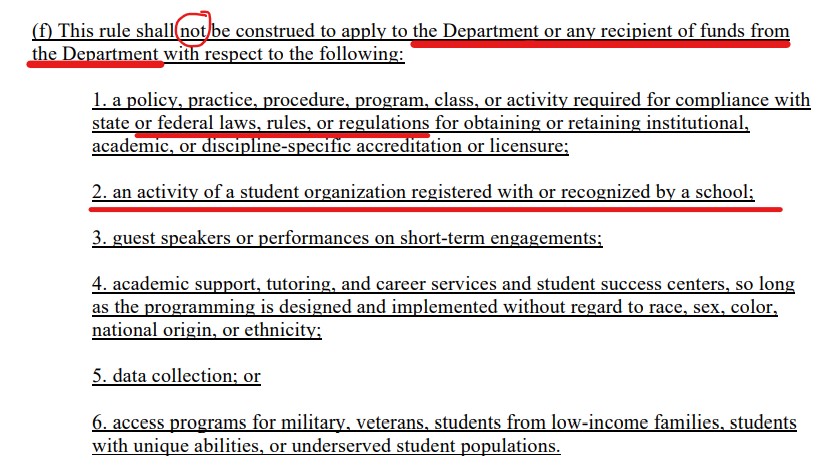
(f) This rule shall not be construed to apply to the Department or any recipient of funds from the Department with respect to the following:

Included under (f) is this specification:

  1. a policy, practice, procedure, program, class, or activity required for compliance with state or federal laws, rules, or regulations for obtaining or retaining institutional, academic, or discipline-specific accreditation or licensure;

Here’s an example of an accreditation organization for K-12 institutions including Catholic schools;

“Standard 1 Leaders cultivate and sustain a culture that demonstrates respect, fairness, equity, and inclusion, and is free from bias.”

So, if the OSDE is going to exempt accreditation organizations, you’re gonna get DEI.  There are other exemptions in this list.  I’m not going to list them all here, but I’ve pasted in the URL, please look at it yourself and let me know your thoughts, but if these rules DON’T APPLY to any of the items listed under (f) – THEY ARE COMPLETELY MEANINGLESS IN TERMS OF STOPPING DEI.


A public hearing will be held at 2:00 p.m. on Friday, February 16, 2024, in Room 1-20 (State Board Room) at the Oliver Hodge Building, 2500 North Lincoln Boulevard, in Oklahoma City for the following rules.

Subchapter 29. Standards of Performance and Conduct for Teachers
210:20-29-5.  Principle III [AMENDED]

Text of proposed rule
Rule Impact Statement

Here is the text of the rule:

(e) A teacher may be dismissed, refused employment, or not reemployed after a finding that such person has, either in the presence of a minor or in a manner available to a minor online, engaged in sexual acts, acts that appeal to the prurient interest in sex as found by the average person applying contemporary community standards, or acts that excessively promote sexuality in light of the educational value of the material and in light of the youngest age of any student with access to said material.

Again, this seems to be a perfectly reasonable rule that SHOULD stop predators from being around public school kids.  HOWEVER: here are some concerns:

  1. This is similar language to that used by many parents to try and remove sexually inappropriate library books from school libraries – this has only worked in isolated incidences.  Sexually inappropriate library books are still littering the shelves of libraries across the campuses of Oklahoma public k-12 schools.
  2. The left will argue until they turn blue in the face that whatever sexually disgusting nonsense they’ve brought into the classroom “has educational value”.
  3. In addition, they MAY be dismissed etc?  What does THAT mean?  That means that no one could be removed from the classroom.

This rule basically needs to say that ANY STAFF MEMBER OF A PUBLIC SCHOOL WILL be dismissed if – after a law enforcement investigation AND/OR a school inquiry of the individual – has found that they engaged in ANY sex act with a minor student – including inappropriate online communications.

So much of this stuff ends up being useless because the wording doesn’t say what it needs to say (not that mine is perfect either, just saying what’s written is NOT good)


A public hearing will be held at 10:00 a.m. on Tuesday, February 20, 2024, in Room 1-20 (State Board Room) at the Oliver Hodge Building, 2500 North Lincoln Boulevard, in Oklahoma City for the following rules.

Subchapter 3.  Departmental Precepts 
210:1-3-4. Annuities contracts. [REVOKED] 
Subchapter 5.  Due Process 
210:1-5-7. Teacher evaluation, dismissal, and nonreemployment. [REVOKED] 
Subchapter 9.  Interlocal Cooperative Agreements [REVOKED] 
210:1-9-1. Purpose. [REVOKED] 
210:1-9-2. Definitions. [REVOKED] 
210:1-9-3. Enabling provisions/restrictions. [REVOKED] 
210:1-9-4. Conditions applicable to interlocal cooperative agreements. [REVOKED] 

Text of proposed rule
Rule Impact Statement
 

Not sure why all these are being revoked, but nothing much to say about revoked law.  The more revoked laws we can get, the happier I’ll be!


Subchapter 1.  General Provisions
210:1-1-1. Purpose Declaration of Foundational Values [AMENDED]
210:1-1-7. Purpose [NEW]

Text of proposed rule
Rule Impact Statement

Oh my goodness.  So much of this is completely unnecessary.  While I agree with many of the sentiments, this is a Department of Public Education supported by the tax dollars of ALL Oklahomans.  This entire document should be scrapped excepting the BASICS contained in (a), (b) – I suppose, (e), (f), (i) and (j).  Because it’s been said in many of the other rules that the Department of Education of the State of Oklahoma follows that State and Federal Constitutions, there is no reason to take up space banging that ideal on the head.  It simply serves to put liberals into spasms and why should we use tax dollars for that?  We must educate kids properly as asserted in letter (e) and move on.  The more strife this department stirs up with the Left, the harder it becomes to get business done.


Subchapter 5.  Due Process
210:1-5-6.  Suspension and/or revocation of certificates [AMENDED]

Text of proposed rule
Rule Impact Statement

This rule inserts a single paragraph that states the number of days in which the OSDE must be notified if contesting the revocation of a teaching certificate.  Nothing here out of the ordinary.


Subchapter 1. General Provisions
210:10-1-6. Computer assisted pupil accounting [REVOKED] 
210:10-1-10. Accreditation rating [REVOKED] 

Text of proposed rule
Rule Impact Statement

It appears the accreditation rating was revoked in favor of the language submitted under 210:35-3-201. Statement of the standard.


Subchapter 1.  General Provisions
210:10-1-16.  Oklahoma Academic Scholar and other student recognitions [AMENDED]

Text of proposed rule
Rule Impact Statement

This is VERY HELPFUL.  It adds language including the CLT (Classic Learning Test) – a test that is being used by some universities now instead of the SAT and ACT (or at least in conjunction with).  My kids took the CLT as 8th graders and while there was still some iffy gunk on it about global warming for example (according to my kids), there was nothing at all as just downright confusing and indoctrinating as some of the ACT and/or SAT language.

But again, this goes back to my question about Metrics for Academic Standards at the beginning of this document.  What test will the state use to make those determinations?  We can’t have some kids tested with the state test, but then include ACT/SAT or CLT scores.  We need to pick a test and we have long advocated for an independent testing service like CLT or the Iowa Test of Basic Skills as the ACT is HORRID.


Subchapter 2.  Parental Rights
210:10-2-2. Definitions [AMENDED]
210:10-2-3. Requirements [AMENDED]
210:10-2-4. Noncompliance [AMENDED]

Text of proposed rule
Rule Impact Statement

This language has been added to the existing rule:

“Independent Contractor” means an individual, organization, or entity that is engaged by and/or contracted by a school district to provide services or instruction, whether directly or indirectly, to students or within a school district on a temporary or contractual basis and is not an employee of the school district.

Does this person have to be certified?  The school is responsible for them ultimately, but it makes me uncomfortable.  I’m not sure exactly what this might be.  If it’s a health coordinator, what information could they bring in the parent might not be aware of.  It’s a tricky business.  We have always wanted the public schools to have more ability to be flexible, but with all that has been going on in the last 10 years, one could argue that many are already way more flexible with education providers than we want them to.


Subchapter 13.  Student Assessment and School Accountability
210:10-13-2.  Oklahoma School Testing Program (OSTP) scope and general administration [AMENDED]
210:10-13-18. Oklahoma School Accountability System [AMENDED]

Text of proposed rule
Rule Impact Statement

I couldn’t really find anything that was problematic in either of these rules.  Basically it’s allowing for remediation for schools who do not score at least satisfactory on the state criterion-referenced tests (very specific test, thankfully).  The only problem is that the school only gets remediation if there’s funding.

The second rule gives schools a way to challenge their A-F score and makes it clear that F schools must get comprehensive support and show improvement – but then it doesn’t say here what will happen if they don’t.  It’s always the follow-up that kills the best rules/laws/plans…


Subchapter 17.  Federal Programs complaint procedures
210:10-17-1. Complaint Procedures [AMENDED]

Text of proposed rule
Rule Impact Statement

This is HUGE!  So huge in fact, that I wrote a whole blog just about that.  Please read it.


Subchapter 9. Professional Standards: Teacher Education and Certification 
Part 1. General Teaching Certificate Requirements
210:20-9-12. General education requirements of individuals who already hold baccalaureate
degrees [REVOKED]
210:20-9-14. Alternative plan for student teaching requirements [REVOKED]

Subchapter 11. Professional Standards: Accreditation Standards for Approved Teacher Education Programs
210:20-11-1. Evaluation process [REVOKED]
210:20-11-2. Specific Standards for Program Approval [REVOKED]
210:20-11-3. General education and professional education [REVOKED]
210:20-11-4. Specialization standards [REVOKED]
210:20-11-6. NCATE/State joint visits [REVOKED]

Subchapter 15: Residency Program
210:20-15-3. Residency committee [REVOKED]
210:20-15-4. Variations to the residency program regulations [REVOKED]

Subchapter 24. Science and Mathematics Advanced Recruiting Technique (SMART) Program
210:20-24-1. Purpose [REVOKED]
210:20-24-2. Science and Mathematics Advanced Recruiting Technique (SMART) Program [REVOKED]

Subchapter 26. Academic Achievement Award Program
210:20-26-1. Purpose [REVOKED]
210:20-26-2. Selection and payment criteria [REVOKED]
210:20-26-3. Qualified employees [REVOKED]

Text of proposed rule
Rule Impact Statement

Again, not sure why, but happy to revoke any laws, rules or regulations. LOL


Subchapter 23. School Board Members    
210:20-23-3. Requirements for new and incumbent school board member training [AMENDED]
210:20-23-4. Requirements for continuing education; certificates; costs [AMENDED]

Text of proposed rule
Rule Impact Statement

Interesting; the only thing changed about this rule is that the Oklahoma State School Boards Association (OSSBA) has been removed from the wording of the rule under training.  Unfortunately, I’m not sure how this will help anything because state law has not been changed.  We tried to get it changed, but we were not successful.  Several times in the rules I’ve read today it says that if the rule disagrees with state law, state law prevails, so I’m not sure how this will do anything.  If you’d like to see why I say that, please read this article.

SB1447 STOPS MANDATORY SCHOOL BOARD TRAINING and SB1445 REDUCES ALL SCHOOL BOARD TERMS TO TWO YEARS


Subchapter 5.  Budgeting and Business Management
Part 1. Implementation 
210:25-5-4.  Accounting [AMENDED]

Text of proposed rule
Rule Impact Statement

Apparently this removes the ability of a charter school to appeal any changes in the data they’ve sent the OSDE regarding their financial reporting and accounting.  They can show cause that changes are warranted before the data is locked, but the appeal process no longer would exist.


Subchapter 3. Standards for Elementary, Middle Level, Secondary, and Career and Technology Schools 
Part 5. Standard III: Administration and Organization
210:35-3-48. Local board responsibilities/staff relationships [AMENDED]

Text of proposed rule
Rule Impact Statement

Nothing really much to say about this.  These look to be changes required by reorganizing the text after removing this statement:

(3) The local board and its individual members shall refrain from involvement in or interference with the administrative functions of the school.

I’m surprised that was in the rules, but then I was also surprised that THIS was in the rules previously:

(B) Lack of harmony in the teaching staff, board, or community, when such conditions affect the quality and effectiveness of instruction and climate of the school, shall be considered sufficient cause for not accrediting a school. Political and special interest groups or individuals shall not interfere in the operation of the schools.


Subchapter 3.  Standards for Elementary, Middle Level, Secondary, and Career and Technology Schools
Part 17. Standard IX: Financial Support
210:35-3-167.  School District Transparency Act [NEW]

Text of proposed rule
Rule Impact Statement

This is a new section of rules that basically say that if a school’s website does not comply with accountability law they’ll get a deficiency on their accreditation if they don’t fix it within 30 days.


A public hearing will be held at 2:00 p.m. on Tuesday, February 20, 2024, in Room 1-20 (State Board Room) at the Oliver Hodge Building, 2500 North Lincoln Boulevard, in Oklahoma City for the following rules.

Subchapter 3. Standards for Elementary, Middle Level, Secondary, and Career and Technology Schools
Part 25. Standard XIV: Freedom of Religion [NEW]
210:35-3-251. Voluntary prayer [NEW]
210:35-3-252. Minute of silence in public schools [NEW]

Text of proposed rule
Rule Impact Statement

I’ll be honest.  I think this is nonsense.  I think it’s detracting from the REAL issues which are that our kids can’t read or do math proficiently, and while I love Jesus personally, I don’t think adding one minute of quiet time to their school day will affect a single thing about that.  Making  teachers teach properly and schools follow the law will do more for that than a single silent minute.

In fact, I don’t see anything different in this section of ‘new’ law than what has already been happening in public schools for many years.

The only thing different about this ‘new’ rule is that it provides for a complaints process if the school isn’t following the law and:

(c) The State Department of Education shall annually verify that districts have adopted policies that comply with this rule and shall recommend an accreditation deficiency to the State Board of Education for any school district that fails to comply.

Getting an accreditation deficiency for not enforcing a single silent minute is way over the top to me.  Now, if a school is not allowing a coach to say a prayer before a game, or teachers to keep Bibles on their desks – I think there’s a problem, as those are personal issues, not state issues – but those situations aren’t addressed in this rule, most probably because they’ve been adjudicated frequently at numerous levels of the judiciary.
Oklahoma Private Schools To Answer To The Feds? New OSDE Rules Appear To Say Just That.

Jenni White

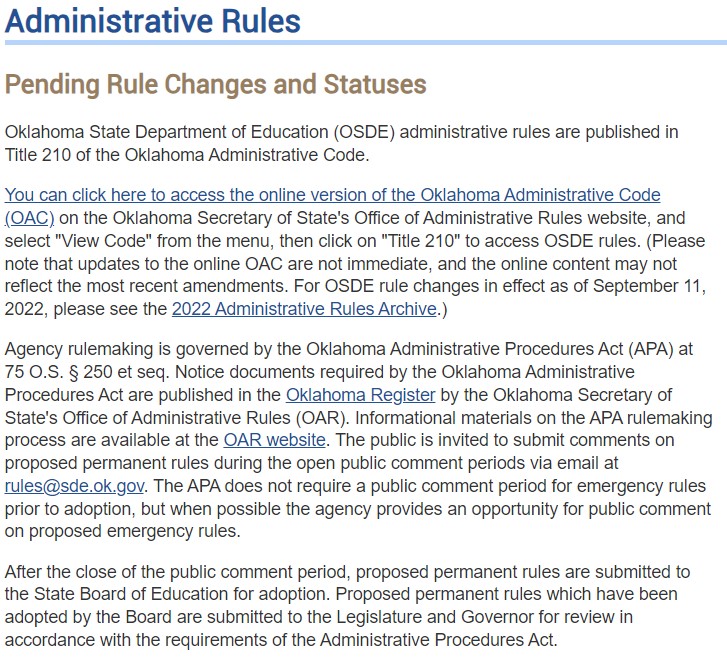
Today I’ve been going through the NUMEROUS new rules that have been uploaded to the Oklahoma State Department of Education website in the last week. 

Midway down the page I found this:

Subchapter 17.  Federal Programs complaint procedures
210:10-17-1. Complaint Procedures [AMENDED]

Text of proposed rule
Rule Impact Statement

This is HUGE. 

You can click on the link above to bring up the changes to the rule. Remember, that rules are like legislation. Sentences that have been stricken with a line through them are going away and new sentences being added to the rule are underlined.

Note that most of the rule changes here appear to be simple ones made to the procedure for filing a complaint based on the Federal Title (rule) structure.  Our OSDE accepts federal funds for things like Title 1 programming that allows children to be fed at school on the public tax dollar – and much more.  I’ve written much about federal education law and how it takes away local control from parents on many fronts, one only has to search our previous blog linked in the right sidebar. 

If a public school parent believes their child is not getting services required by federal funding – such as that required for disabled children – they can file a complaint with the state and with the federal government. This rule above was originally written to make provisions for how to file such complaints.

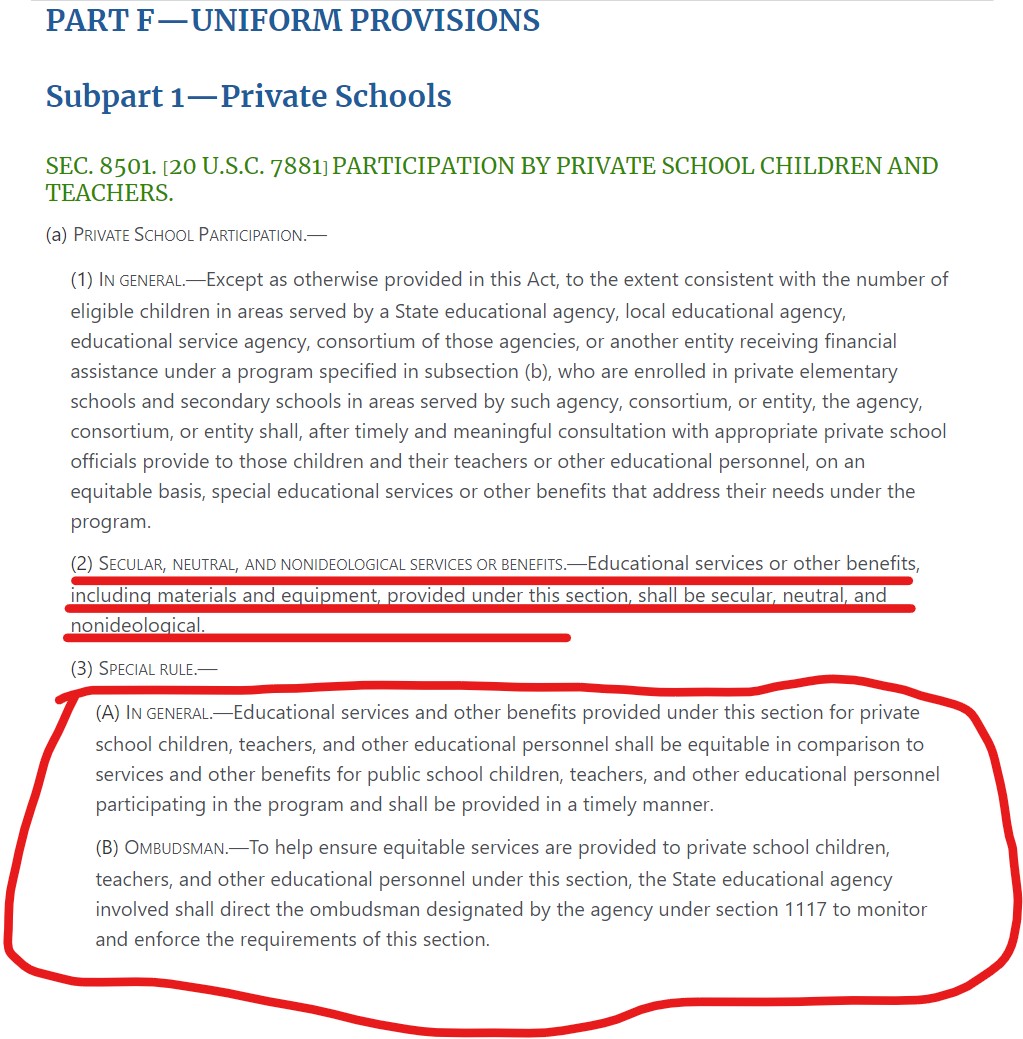
What is HUGE is this: Under (b) covered programs, all the existing categories are revoked and new ones placed.  NEVER was this listed under covered programs previously, making it an entirely new category – (12) Part F, section 7881 of Title VIII (Participation by Private School Children and Teachers). 

WHAT?  Haven’t we heard Superintendent Walters say numerous times that he wanted to get away from taking federal funds?  In fact, in November of last year, here he is saying that he wouldn’t take federal funds that run counter to “Oklahoma values”. 

So, is it an Oklahoma value for an Oklahoma PRIVATE SCHOOL TO ANSWER TO THE FEDS?

What’s going on?  According to this rule, the OSDE must plan to take and disperse federal funds to private schools.  Why would there be a specific rule added so that private school-associated families can complain about private schools not following federal dictates if that weren’t the case? 

Unfortunately, this could make sense considering the Oklahoma Parental Tax Credit, because state tax dollars are going to pay tuition at private schools.  It’s NOT taxpayers getting their money back (in the vast majority of cases) these are public dollars going to enroll Oklahoma (hopefully) kids in private schools. 

Consequently, if public money is going to the private school, the private school would then fall under Federal education Title jurisdiction like a public school – especially if they choose to ask the OSDE to provide them federal funds.

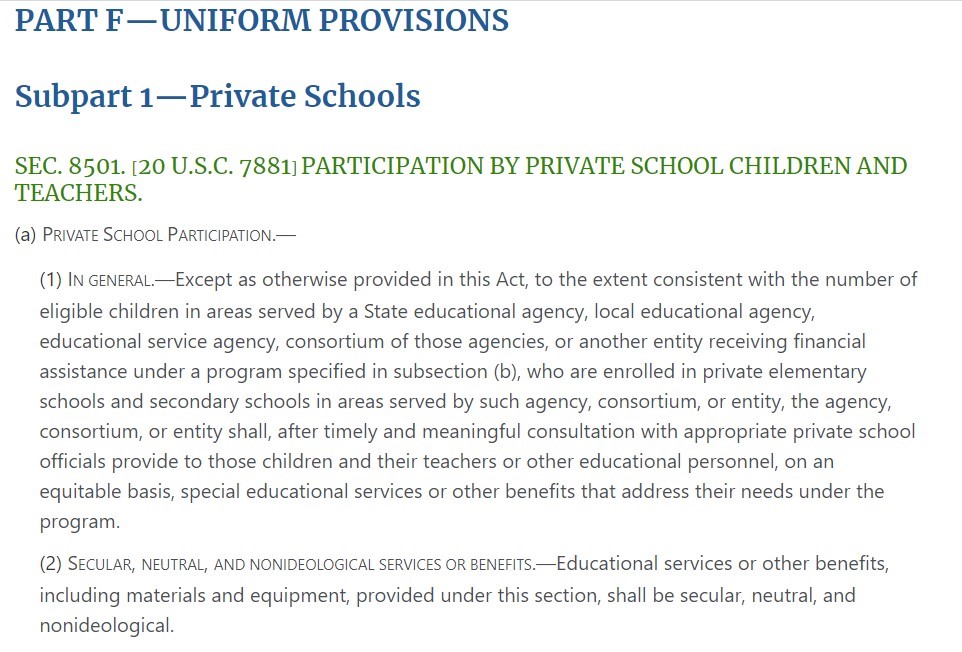
And what’s great about Private schools getting public funds?  Here’s a screenshot from the Federal Department of Education Title regulations page.

So, while Ryan Walters wants to change OSDE rules to make sure prayer is acceptable in public schools, he apparently also accepts the plan to provide private schools with federal dollars, making them secular, neutral and nonideological in the process. So what is the point of having private (religious) schools then? 

I hope we will hear from the OSDE and Secretary Walters on this issue and somehow I will be proven completely wrong.  Until then, however, I think Oklahomans can only see this as an assault on the independence of our Private schools being allowed by our state through our Oklahoma State Department of Education.

FYI: A public hearing will be held at 10:00 a.m. on Tuesday, February 20, 2024, in Room 1-20 (State Board Room) at the Oliver Hodge Building, 2500 North Lincoln Boulevard, in Oklahoma City for the following rules. Also, you can write rules@sde.ok.gov to let them know what you think of the rule.

Representative Jacob Rosecrants Files Bill To Force Accountability For Education Tax Credit Dollars

1.16.24 – Jenni White

File under ROPEtoldyaso. In fact, thanks to this, ROPE and homeschoolers across Oklahoma will take the prize for “prophets of the year” already for 2024.

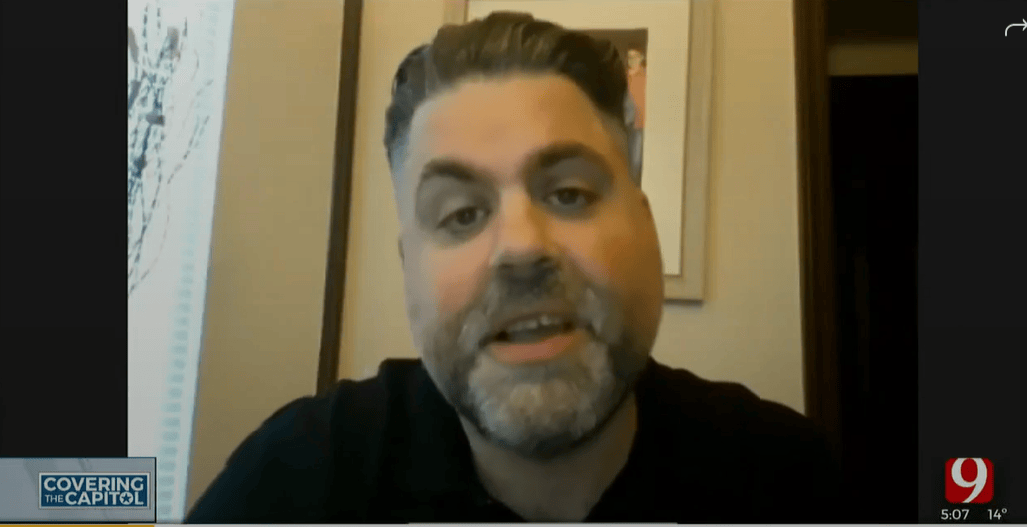
Yesterday, Oklahoma’s Channel 9, interviewed Representative Jacob Rosecrants who had the following to say about Oklahoma’s Parental Tax Credit for private school tuition.

Woah… Weird… Sounds exactly like what we’ve been saying could happen since nearly the beginning of the “Parental Choice” movement, right? 

Yes. All one has to do is search this site to find out how many articles have been devoted to attempting to educate people about this specific issue.

“But Jenni, Rosecrants is a DEMOCRAT! This will NEVER happen here!”

Well picture me as Santa Clause in this quote from the movie Elf:

I’ve watched the legislature for nearly 15 years now and I’ve seen Republicans do some super UNRepublican stuff – the biggest example here being jumping on the Common Core bandwagon, where a majority of Oklahoma Republicans wanted a national curricula for Oklahoma kids until we began going to them individually with facts that showed how harmful such a program would be (and now we know – for the states who used it – how harmful it was). 

In fact, one would have HOPED that Republicans – people whose platform indicates them to be bastions of smaller government and private enterprise over public control – would have spotted the whole tax credit/VOUCHER scheme from a mile off. Yet, how can we forget that there wasn’t a single Republican lawmaker who voted AGAINST the tax credit/VOUCHER – scheme last session. Not one. Here are the votes for the HOUSE. Here are the votes for the Senate so you can check me up on that.

So ask yourself…how did not a single Republican Senator or House member think it wouldn’t be problematic to give private schools public tax dollars? 

Frankly, that’s a great question, and if we can’t answer that question, how in the world could we trust our legislature not to simply double-down on the whole thing and then turn around and tell us it’s a good thing – which is what they did with the tax credit/VOUCHER scheme in the first place.

“This is a tax credit, not a voucher”, they said. 

“This is to help underserved/underrepresented kids”, they said.

Already, however – not even two months into the program – nearly every Republican talking point for the program has been debunked.

Not only is the program over budget 4 million dollars by using the globalist data collecting vendor MERITS INC. to administrate the program instead of the Oklahoma Tax Commission as stated in the bill, but there’s more.

In this video, I make the point that out of the 4 income categories proposed for the “tax credit”, only the upper two income categories are a true tax credit – and that’s only for one child – the lower 2 income categories are 100% VOUCHERS. So it’s just a boldfaced lie to have sold the program as a tax credit right there. Why were none of the Republicans crunching the numbers to find this out for themselves? This was easy info to find.

Oklahoma Parental Choice Tax Credit Act (OPCTCA)

Then we have the idea that it’s to help disadvantaged kids/families.

According to Carmen Forman at the Oklahoma Voice:

The Tax Commission has received more than 30,000 applications for the tax credits approved by the GOP-led Oklahoma Legislature last year. About 45% are from priority applicants and 55% are from families earning more than $150,000 annually, Haxton said.

So, there you go. If you have a household income of $150k and you can’t put your own kids in private schools, OTHER PEOPLE SHOULDN’T BE SENDING YOUR KIDS TO PRIVATE SCHOOL FOR YOU. That’s 100% socialism – especially when I just showed that you don’t even get ONE KID as a tax credit at that level. Our household is near that income level and we had one kid at Oklahoma Christian School for two years, scrimping and saving and homeschooling the others. Why should I pay for YOUR kid when you didn’t pay for mine?

Meanwhile, back in Arizona, School Choice Inc’s MODEL for school ‘choice’ legislation – including full universal vouchers like Oklahoma’s Governor signed into law just last year – Democrat Governor “Katie Hobbs unveils plan to rein in Arizona school voucher program“. Yup, regulation of private schools on even a WORSE level than Rep. Jacob Rosecrants has suggested, including the following:

  • A requirement that private schools provide the accommodations and services in a disabled student’s Individualized Learning Plan or Section 504 Plan.
  • Require manual approval of any ESA purchase over $500. That should ensure the taxpayer dollars that fund ESAs are spent on academic purposes, Hobbs said. She also called for an end to ESA awards for items such as ski passes and luxury car driving lessons, although it’s unclear how those “luxury” items would be defined. 
  • Give the state Auditor General authority to review and report on how ESA money is spent by private schools. This is a standard practice for Arizona’s public schools.

So, how in the world did a REAL threat that private schools be regulated for purposes of accountability and essentially turned into public schools over a tax credit bill rear its ugly head? How does this happen in Oklahoma? Aren’t we smarter than that? 

Whelp…NO. According to EdWeek, Oklahoma was 49th in education in 2021. So, maybe we aught to be putting more effort into MAKING public schools actually educate kids instead of growing government to the point that it becomes the blob that ate private schools.

Are Children In Oklahoma Going To Starve Because Governor Stitt Turned Down Federal Money To Feed Them?

Hint: the short answer is NO.

Earlier this week I scanned this opinion piece by Oklahoma Voice editor, Janelle Stecklein, Stitt shouldn’t have opted out of USDA program that feeds hungry youth. In fact, I admit I didn’t spend too much time reading it because I know the bottom line – children are starving and it’s government’s job to force dollars from the hands of its citizens to feed them. 

NOPE.

First of all, THIS IS A NEW PROGRAM. It is not the Title 1 government funding for nutrition programs that NO Oklahoma governor has ever refused – ever.

Secondly, the government has no money other than what it takes by force from its citizens. Government’s jobs are to be few and those don’t include feeding people. Churches and non-profits offer the opportunity for individuals to help the poor and hungry.

Thirdly, the government is trillions and trillions of dollars in debt. IT HAS NO MONEY PERIOD. The more it prints, the higher inflation rises and the less money our children are going to have to set up and run their own households and raise their own children. Americans are already living on borrowed money and when the bottom falls out, most ALL of us will suffer the consequences of hunger and scarcity.

But charity giving is down. Ok. Let’s get the government to quit usurping the jobs of the private sector and force that to return.

But kids are starving. Then how do we explain the explosion in childhood obesity rates?

But kids can’t learn when they’re hungry. That’s what Title 1 funds are for and the government feeds children breakfast and lunch 5 – and sometimes more – days a week in our tax dollars. Yet, I’ve even advocated turning that job over to non-profits and removing Oklahoma from the federal government teat. Do you know how often Oklahoma is forced to create rules and laws to get those funds? Rules and laws that separate citizens further from their government and trade individual liberty for group comfort?

Sadly, the author has one really good point – we’re shelling out millions of taxpayer dollars to make sure people get subsidies for sending their kids to private schools, but we won’t take more money from taxpayers to feed kids. Interesting. But then again, there aren’t tons of “nutrition choice” PACS out there giving money to every legislator on God’s green earth to subsidize private organizations through the state to provide every parent their choice of nutrition for their children either…

So, my solution is this; GOVERNMENT, STOP SUBSIDIZING PRIVATE FAMILIES AND BUSINESSES. Get out of the non-profit lane and let non-profits take it back. Frankly, it may be too late at this point, but if we don’t start doing it now, our highly subsidized economy will crash – and it will take us all out – not just the 4 kids falling through the cracks of the multiple government programs already set up to subsidize their care.

PS: Here’s an opinion piece in the Oklahoman by OU Professor David Demming that says nearly exactly the same thing!

White Christian Nationalism Is A Threat To Democracy?

This morning I read an article from the Daily Disappointment’s Carla Hinton – the supposed religion reporter – that was the worst I’ve read in some time. It was called, “White Christian nationalism is a danger to democracy, critics say. Oklahoma is no stranger to the ideology.”

You don’t have to pay a subscription fee to read this article, you simply have to sign up. I urge you to do so just to read this piece of absolute race-baiting tripe – not to ruin your day, but so you know what is being said about Christians in the media.

This is the worst form of irresponsible journalism. While Carla Hinton interviews Jackson Lahmeyer – who she clearly sees as an example of WHITE Christian nationalism (because everything is racist today) – she interviews not a single other conservative Christian on the “issue” for the article.

Instead, she interviewed no less than THREE separate individuals to pimp the narrative that Christians want to reclaim America for white European Christianity.

Hinton never addresses the issue as church via state, but simply white Christians versus other races and/or religions. Carla Hinton, please read your Bible, where you will find this TRUTH: Galatians 3:28 – “There is neither Jew nor Gentile, neither slave nor free, nor is there male and female, for you are all one in Christ Jesus.”

Here, however is the other side of the problem: we have a group of Christians feeding this liberal media narrative by trying to make the state push the Christian religion in public schools and government. There IS a separation of church and state and while it prevents the federal government from establishing a national religion, the Supreme Court has rightly (previously) also said that state tax dollars can’t be used to support religious schools or religious activities.

Why should we prevent this? Because once the government gets its fingers in anything by ‘giving’ tax dollars, the government then has the authorization to protect those tax dollars through whatever means it desires.

Christians SHOULD be involved in government. Christians should love their country and be patriotic. Government can benefit from elected leaders who predicate their decisions upon Christian ideals and love their country – hat tip racists and liberal America-haters, that includes LOVING ONE ANOTHER as Jesus loved us – but to desire to elect Christian leaders to then use the government as a means of protecting, or spreading Christianity is COMPLETELY WRONG.

Until this stops, the ridiculous liberal narrative of White Christian Nationalism will continue to stink up the media and fuel racism, hate and fear in those that desire division and chaos.

If you’re interested in more discussion on this topic, please join Linda Murphy, Michael Grande and myself Friday, January 19th for the ROPE Report podcast, live at 9am.

Observations From An Alternate Oklahoma County Election Board Member Regarding Oklahoma County Election Procedure

Jenni White

May 2023, the Chairman of Oklahoma County Republican Party (Ken Warner) had the opportunity to appoint a Republican member (Cheryl Williams) and alternate member (me) to the Oklahoma County Election Board.  Since that time, both Cheryl and I have relayed questions to both Warner and Election Board officials regarding OK CO Election Board procedure.

Since September 6th, when Cheryl and I attended a mandatory Election Board meeting, I’ve had various questions that – both Cheryl and I – have asked election officials and legislators without getting answers to solve the issues as I’d hoped. 

December 11th, 2023, Governor Stitt signed an Executive Order (2023-29) creating the Task Force on Campaign Finance and Election Threats which is authorized until March 31st, 2024. While I am grateful and hopeful for government oversight into these matters, I also believe that the public should be aware of my observations (and suggestions) for the Oklahoma County Election Board as well as those I’ve previously published regarding Dark Money (campaign finance). What follows is a description of several issues I’ve witnessed over the course of my time participating as an Oklahoma County Election Board alternate.

Friday, December 15th, 2023, Cheryl Williams (Vice-Chairman) of the 3-person Oklahoma County Election Board (comprised of a Republican, a Democrat – Chairman, David Glover – and the Secretary of the Oklahoma County Election Board, Doug Sanderson) voted against certification of the December 12th election which would choose a general election candidate to replace Ryan Martinez, the House Representative for district 39, and a sales tax to build a sports arena in downtown Oklahoma City.

At issue is the prescription of Oklahoma Administrative Code (OAC) and Oklahoma law, versus OK CO Election Board procedure as outlined in these observations.

According to State Law (26-14-125) absentee ballots must be counted on the day of election (OAC 230:30-19-3).

26-14-125 C. 1. Says that, “Upon written approval by the Secretary of the State Election Board, the county election board may begin the process of counting absentee ballots as described in this section on a date earlier than the day of the election.”

Absentee ballot counting began Monday, December 11th. Neither Glover nor Williams were presented with evidence of authorization for early counting at that time.  After Williams directed an email to OK State Election Board Secretary Paul Ziriax after the meeting questioning this issue, a letter from Ziriax to OK CO Election Board Secretary, Doug Sanderson, dated December 12th, was provided to Williams and Glover Friday, December 15th.

This letter indicated that Ziriax had received a letter dated 10-25-23 from Sanderson requesting an earlier counting date for the December 12th election, but that letter had contained a typographical error resulting in lack of approval for absentee ballot counting on the 11th. 

Ziriax’ letter to Sanderson contained an amended authorization for the 11th, as “the best resolution for ensuring a proper count of absentee ballots received in Oklahoma County and so that the transfer cases containing those ballots are not disturbed.”

According to OAC 230:30-19-4, Procedure for counting absentee ballots on election day, 230:30-19-4 (5), “The Secretary shall assign an employee of the County Election Board to each voting device or high-speed scanner to be used to count the absentee ballots.  The County Election Board Chairman and Vice Chairman shall be present and shall observe the counting process.”

Neither Glover nor Cheryl were able to observe any of the counting process in person.  Both members were confined to a public room the entire time absentee ballots were being handled and counted and were required to watch the entire procedure on a closed-circuit television also made available for any members of the public attending the meeting.

The only member of the 3-person OK CO Election Board present in the room to observe all absentee ballot processing and counting procedure was Secretary Sanderson.  Unfortunately, many times Sanderson was out of range of the CCTV handling absentee ballots, making direct observation by Glover, Williams and the public impossible. In fact, neither Williams or Glover were able to see the absentee ballot ‘box’ (a large rollaway garbage can with 3 locks on it – 1 kept by Glover, 1 kept by Cheryl and 1 kept by Sanderson) being opened, nor the ballots being counted.

Glover and Williams were allowed to examine absentee affidavit ballot envelopes (12.11.23).  These were brought into them by OK CO Election Board staff and split between Glover and Williams. Both checked the affidavits for the ballots in each of their piles, but there was no cross-check performed.

OAC 230:30-11-3 says, “If the County Election Board meets prior to election day to open outer envelopes as outlined in 230:30-11-2 [revoked](?), it is permissible for the Board members also to open and remove affidavit envelopes that are determined to be executed properly.  Upon removing the affidavits, the Board members shall place the ballot envelopes in a ballot box of the type described in 230:30-7-8(b) and shall lock the box…. Additionally, the Board members shall affix a long, white State Election Board seal across the opening on the top of the box so that the opening is entirely obstructed.  The County Election Board members each shall sign and date the seal.  Each member of the County Election Board shall retain the key to only one of the locks on the ballot box.  The Secretary shall store the ballot box in a secure place until it is time to count absentee ballots on election day.”

According to OAC 230:-19-4 (10), the employee operating the voting (counting) device is to put the [absentee] ballots in a transfer case and that case is to be sealed with a State Election Board seal [tape] to be signed by the person who operated the voting device and all County Election Board members. 

These seals [tapes] were brought into the room with Glover and Williams for their signature, however, neither member saw either the box, or the contents of the box – just the seal [tape].  

Election Monday (12.11.23), I emailed a formal complaint to the State Election Board, explaining the procedure I had witnessed that Monday and what I had observed during the Jones school bond election held the previous November 14th.  I also asked Secretary Ziriax to direct a member of the Oklahoma State Election Board to observe the next two meetings of the OK CO Election Board due to the concerns detailed in my complaint.  Unfortunately, no State Board Member was present for either the 12.12 or 12.15 OK CO Election Board meetings as requested.

According to OAC 230:35-3-84, “The Chairman and Vice Chairman of the County Election Board, the Secretary or employees of the Board may be involved in reception of voting devices, election supplies, and ballot transfer cases from Inspectors.”

OAC 230:35-3-91 (a) says, “On election night, the County Election Board shall canvas the precinct and absentee results for all elections including elections for which the county is an affected county.”

During the Jones election, neither Glover nor Williams were able to leave the “public” room to witness – or receive – any of the incoming precinct materials.  Neither were they allowed to witness, or review (canvas) any of the election materials during or after processing by Oklahoma County Election Board staff.

Tuesday morning (10:10am), December 12th, Cheryl Williams had car trouble so I sat on the Board as the member. Glover and I were asked to “accept and process” 32 absentee ballots.  Both Glover and I were able to check the affidavits on the outer envelopes, but the ballots were removed from us to the counting room after that.

I requested that we be allowed to witness the counting of the absentee ballots as described by OAC 230:30-11-3 and was denied by Sanderson and Deputy Secretary Tuesday Sanders.  I refused to sign the seal [tape] for the box with the absentee ballots when it was presented to me for my signature because I wasn’t allowed to observe the counting of the ballots or see the ballots being placed in the box.  At one point, I even asked the Sheriff’s Deputy in the room to ask Secretary Sanderson to follow the law and was told, “I’m only an observer”.  Consequently, I abstained from the vote to “accept and process thirty-two (32) absentee ballots”.  It makes no sense that I should sign something saying I’ve seen something when I absolutely had not.

Secretary Sanderson takes the minutes of the meeting.  Unfortunately, none of my concerns were noted in the minutes of the December 12th meeting, nor was there an auditory recording of the meeting made by the OK CO Election Board.

Tuesday evening (6:47pm), the Election Board assembled to canvas the ballots for that day’s elections. I stayed on the Board again that evening for Cheryl. At 7:36pm the meeting was recessed, and Deputy Sanders took Glover and I on a tour of the building to witness election night procedure. Sanders answered numerous questions I had and was extremely pleasant. The tour was very helpful in understanding the process. The meeting was then called back to order at 8:06pm.

At this time, Glover and I were allowed to observe the election machine tapes from each precinct involved in each election – something I had asked to do after the Jones elections where neither Glover nor Cheryl were given any evidence of the election other than the absentee affidavits.  David and I spot-checked tapes for accuracy – which was 100% – and I checked the tapes against the precinct list provided by Deputy Sanders.

I found that 10 precincts had 2 tapes (not all of which were spot-checked for accuracy) so I alerted Deputy Sanders who said that she would have to wait until all tapes had been numerically assembled at the end of the night to investigate this issue.  I also had no record of a tape for 1 precinct in the Edmond HD39 election.  (Friday, December 15th, Sanders informed me that she could not find two tapes for any precinct and that another tape included in the results for which there was no precinct, was indeed a ‘training’ tape that had been mistakenly included by the precinct officials.  This information was also not included in the meeting minutes of the 12th.)

Cheryl was in her seat on the OK CO Election Board Friday night, December 15th when the results from the December 12th elections were to be certified.  Because of the concerns enumerated above, Williams voted “no” to certify results and refused to sign any paperwork regarding election certification.

At this point in time Cheryl and I are asking for the following concerns to be addressed by state lawmakers and the OK CO Election Board:

  1. Oklahoma Administrative Code and Oklahoma Law both refer to the “Oklahoma County Election Board” often as both the office and the 3-member board.  This is very confusing and needs to be made more specific in both law and code. Those hired by the Oklahoma County Election Board to help administrate an election have different duties than those appointed to the 3-person Oklahoma County Election Board and these duties should be specifically identified in both law and code.
  2. The 3-member Election Board needs to become a 5 or 7-member board for several reasons:
    • If two Board members are together in the room, it constitutes a meeting according to the Oklahoma Open Meeting Act (25:304.2). This fact has been used to dampen transparency in several meetings I’ve attended as Secretary Sanderson has refused to answer public questions either during the meeting or after the meeting has been adjourned citing this particular issue.
    • It takes only two Board members to certify an election and one is the Secretary of the OK CO Election Board.  If one party has questions or concerns, those are negated by the Secretary and the other party’s appointee.  This can also dampen transparency and lead to concerns of partisanship in elections.  Adding voters of other parties, such as Independent voters, by random drawing of interested voters could stimulate transparency by putting more eyes on the process.
  3. The Secretary of the OK CO Election Board is a voting member of the Board but should be relegated to a position of information for the Board and not a voting member for the reason listed in 2b.
  4. There should be a meeting Secretary assigned to meetings of the Board and the meetings should be recorded via audio.
    • Secretary Sanderson conducts the meeting, writes the minutes of the meeting and performs his duties as Secretary during elections.
    • Minutes of the meetings are often incomplete as mentioned above.  Transparency hinges not only on proper procedure, but accurate and effective communication with the public.
  5. The OK CO Election Board must follow the law as it is written in Title 25 of the Oklahoma Statutes and Title 230 of the Oklahoma Administrative Code.  Neither Cheryl nor I believe that the OK CO Election Board is following the OAC regarding Absentee voting.

I know that Cheryl and I are both willing to work with the OK CO Election Board in whatever way necessary to perform our Board duties, but are united together in the requirement that the OK CO Election Board be transparent in their actions and follow all pertinent State Law and Oklahoma Administrative Code in the performance of their required duties.

Blog at WordPress.com.

Up ↑